

Fairy Knoll at a Glance:
- Built 1901. A two-storey Federation Filigree villa designed by Ipswich architect George Brockwell Gill.
- Hancock family. Built for timber merchant Thomas Hancock Jr, his wife Louisa Hancock and their ten children.
- Mothercraft home. Later used as the Jefferis Turner Centre, a Queensland Government mothercraft home, from 1952 to 1986.
- Heritage listed. Listed on the Queensland Heritage Register in 1992 as Place ID 600600.
📊 By the Numbers

- Address. 2A Robertson Road, Eastern Heights, Ipswich.
- Listing. Queensland Heritage Register Place ID 600600 listed 21 October 1992.
- Built. Completed in 1901 for about £2,000.
- Lot. About 5,313 m² / 1.31 acres, the original estate was about 4 acres.
- Architect. George Brockwell Gill.
- Builder. Worley & Whitehead.
- Style. Federation Filigree.
- Layout. Seven bedrooms, two bathrooms, sewing room, kitchen, dining room, scullery, drawing room, office and service rooms.
- Water. Two built-in roof cisterns supplied rainwater; the stated capacity was 4,000 imperial gallons.
- Later use. The Jefferis Turner Centre operated here from 1952 to 1986.
- Sale 2010. Last sold for $1.2 million on 22 October 2010.
Fairy Knoll is currently Ipswich’s #2 ranked character home, based on nearly 1,000 votes from locals like you and me.
You know the house?
It sits at the top of the hill on Robertson Road in Eastern Heights.
You’ve probably seen it and thought it was part of Ipswich Hospice.
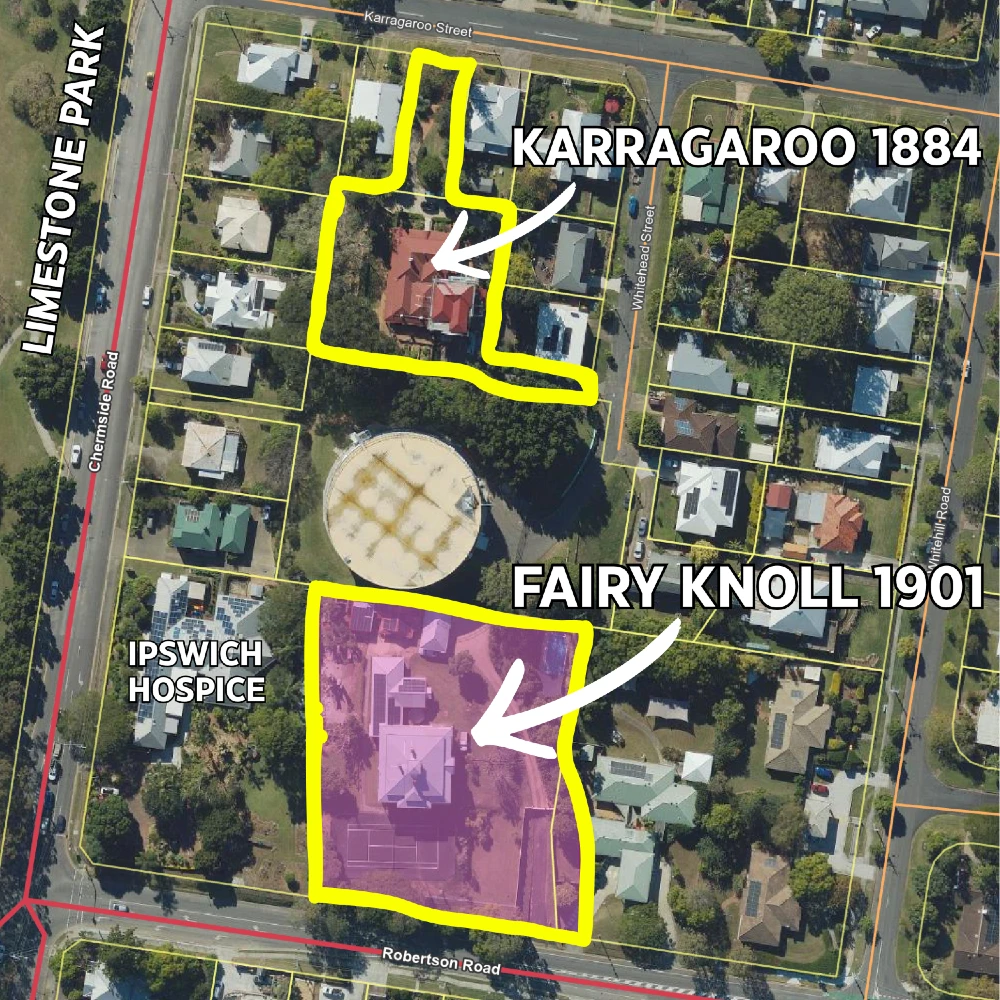
The purple/pink shows the Queensland Heritage Register protection around Fairy Knoll’s lot overlay. Karragaroo is older but not on the Register.
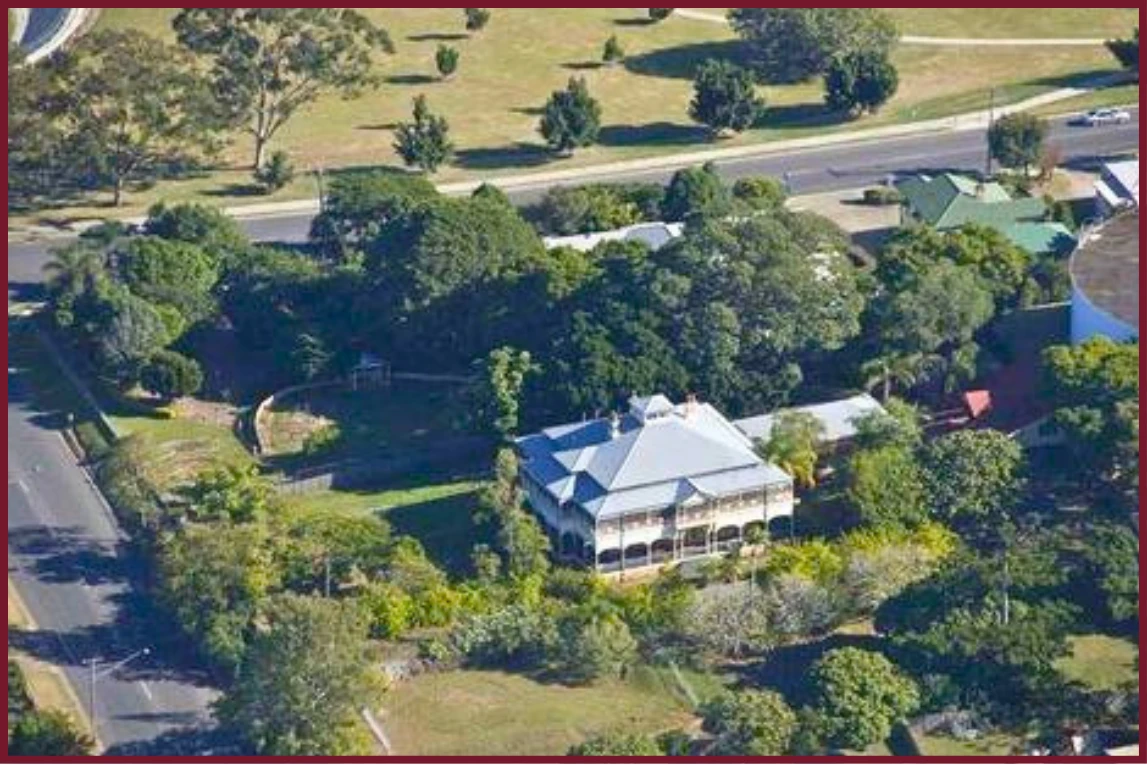
It is a large two-storey brick villa with its main recognisable feature being a stairway lantern/WWII watch tower.
Completed in 1901, it was designed by Ipswich architect George Brockwell Gill and built by Worley & Whitehead for the Hancock family.
Thomas Hancock Jr died before the house was finished. His widow, Louisa Hancock, moved in with their 10 children in 1901 and lived there until her death in 1947.
The house later became the Jefferis Turner Centre, a Queensland Government mothercraft home for mothers and babies. It was later used for respite care before returning to private ownership.
Today Fairy Knoll is a restored private residence (owned by a local surgeon and his wife) and a Queensland Heritage Register place.
You can have a look on Google Street view:
📜 Origins & History
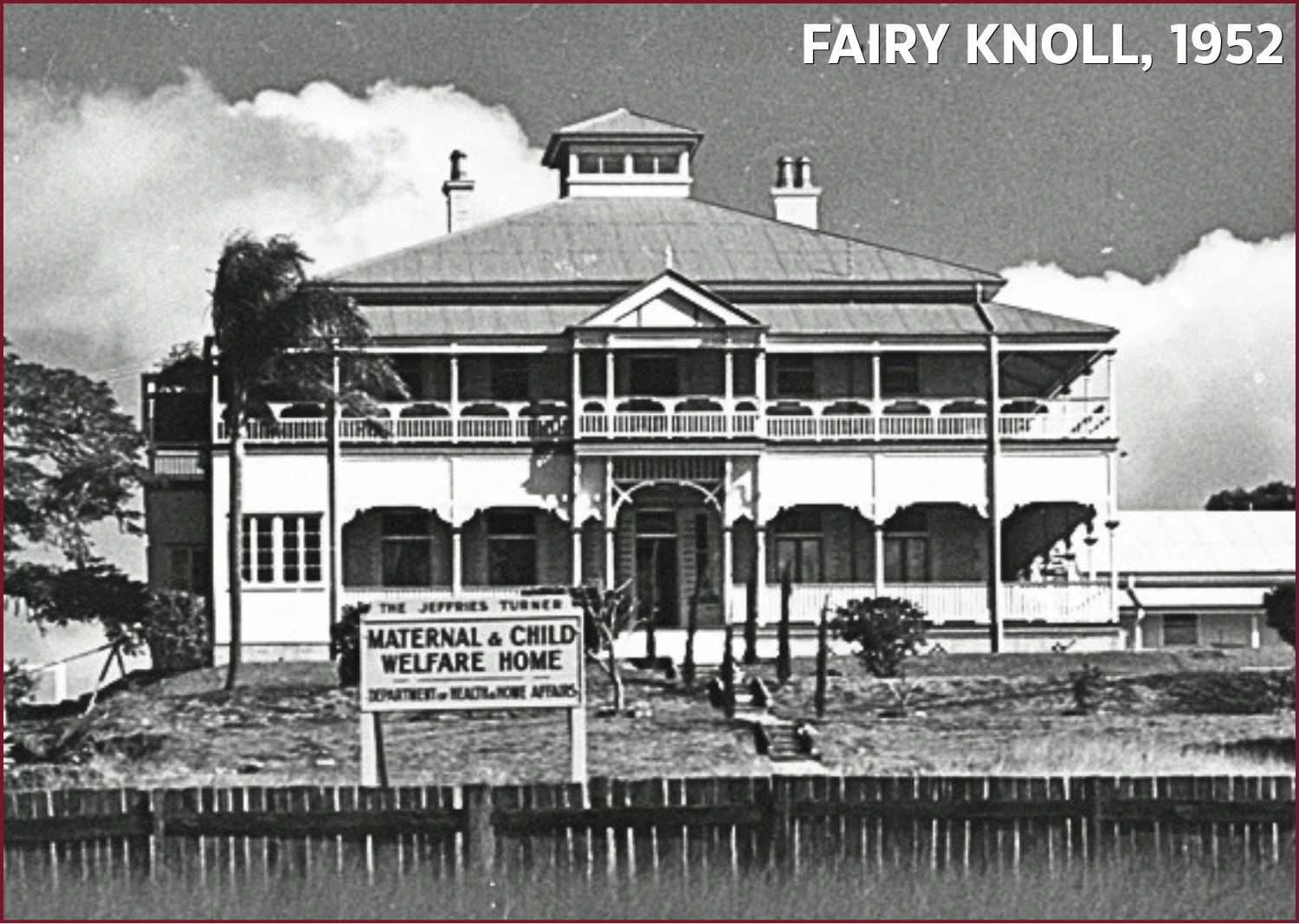
Fairy Knoll in 1952 when it was the Jefferis Turner Centre for Maternal and Child Welfare. (Source: Picture Ipswich Reference ID qips-2009-11-08-0004p.jpg)
Highlight
Fairy Knoll began as a Hancock family property on the Eastern Heights ridge. A smaller timber house came first, followed by the larger brick villa completed for Louisa Hancock and her children in 1901.
- Site. The house sits on the Eastern Heights ridge running along the east edge of Limestone Park, near Robertson, Chermside and Whitehill roads.
- Nearby house. Karragaroo, on the other side of the water reservoir, was already standing nearby before Fairy Knoll was completed. It was built in 1883/84 for Ambrose Foote of the Cribb & Foote family.

Home of Arthur Whitehead on Karragaroo St, Eastern Heights, 1920s (Whitehead Studios via Picture Ipswich) with Fairy Knoll clearly visible in the background.
- Timber family. Thomas Hancock Jr was part of the Hancock timber business, one of Ipswich’s important early timber firms.
- First house. A simple timber home was built on the land before the brick villa.
- Name. The name Fairy Knoll is linked to a nearby estate called Faerieknowe.
- Family. By the late 1890s, Thomas and Louisa Hancock had a large family and planned a bigger house.
- Transfer. Thomas Hancock Jr transferred the title to Louisa Hancock in 1896.
- Design. George Brockwell Gill prepared the design in the late 1890s.
- Building. Worley & Whitehead built the house, which was completed in 1901 for about £2,000.
How much is £2,000 in 1901 worth in 2026?
£2,000 in 1901 ≈ $280,000 in 2026 consumer-price terms.
- Move-in. Louisa Hancock and her children moved into the house in 1901.
🏗️ Architecture & Design

Highlight
George Brockwell Gill designed Fairy Knoll as a large two-storey brick villa with wide verandahs, patterned brickwork, a central stair and a roof lantern.
- Form. Fairy Knoll is a two-storey Federation Filigree villa.
- Verandahs. Wide timber verandahs wrap around the house and shade both levels.
- Brickwork. Light quoins and darker brick arches give the walls their patterned look.
- Lantern. A roof lantern lights the central stairwell and later served as a wartime lookout. This is what many locals refer to as the watch tower.

- Rooms. The house was built with seven bedrooms, two bathrooms, formal rooms and service areas.
- Hall. A ten-foot-wide entrance hall leads to the central stair.
- Stair. The main staircase was made with walnut.
- Water. Two built-in brick cisterns under the roof supplied rainwater by gravity.
- Timberwork. Screens, columns, friezes, brackets and railings give the verandahs much of their detail.
- Grounds. The original grounds included gardens, a circular drive, service buildings and a tennis court site.

Fairy Knoll, 2 Robertson Road, Eastern Heights, Ipswich, 1972 (Source: Picture Ipswich Reference ID qips-2009-09-14-0068p.jpg)
George Brockwell Gill in Ipswich
 George Brockwell Gill was one of Ipswich’s most important architects. He settled in Ipswich in 1886, worked for architect Samuel Shenton, and took over Shenton’s practice in 1889.
- Fairy Knoll connection. Fairy Knoll sits inside Gill’s bigger Ipswich body of work: a ridge-top Federation villa by the same architect behind many of the city’s best-known houses, schools, churches, hotels and civic buildings.
- Gill houses and residences. Local houses and residences linked to Gill include Brynhyfryd, Woodlands of Marburg, Dorrington, St Paul’s Rectory, Fairy Knoll, Dumfries, Bowerbank, Arrochar, Ipswich Club House / Tydfil, Bowerlea, and houses on Roderick Street.
- Partial or possible links. Gill was also linked to later work at Booval House, where he designed an 1896 rear extension and new iron roof. Rockton is a softer claim: its c.1900 tower and verandah works were possibly designed by Gill.
- Other Ipswich work. Beyond houses, Gill’s local work includes Ipswich Girls’ Grammar School, Ipswich Technical College, the Old Flour Mill, Hotel Metropole, City View Hotel, Ipswich Club House, RSL Memorial Hall, the Congregational Sunday School and part of the Ipswich Hospital buildings.
⏳ Through the Years
Highlight
Fairy Knoll has been a family home, a mothercraft centre, a respite-care centre and a private residence again.
- Residence. The Hancock family lived here from 1901 to 1947.
- Louisa. Louisa Hancock lived at Fairy Knoll until her death in 1947.
- Lookout. During World War II, the light well was used as a spotter’s tower because of its wide view over Ipswich.
- Subdivision. After World War II, parts of the surrounding Hancock land were subdivided and given to local churches and the Scouts.

The original Fairy Knoll estate shown. It was ~4 acres and took the entire corner block of Whitehill, Robertson and Chermside Roads.
- Government use. The Queensland Government took over the house in 1952 for maternal and child welfare work.
- Opening. The Jefferis Turner Centre officially opened on 3 August 1952.
- Mothercraft. The centre provided care for mothers and babies and training for infant-health staff.
- Capacity. At opening, it could accommodate about four or five mothers and about ten babies.
- Respite care. From 1986, the building was used for short-term respite care for children with intellectual disability.
- Private home. By 2011, Fairy Knoll was again in use as a family home.
🥰 Reader Memories
Locals love Fairy Knoll.
And many of you have fond memories.
When we first shared Fairy Knoll on Facebook in March of 2025 we received a bunch of comments.
Here are some local memories of Fairy Knoll:
I worked there in 1972 when it was a maternal and child welfare home looking after new mums and their babies. It's a beautiful old heritage-listed home. I have lots of memories of the time I worked there.
My mum did her mothercraft nursing there back in the 50s. New mothers could stay there so they could establish breastfeeding.
When my son and first born was 5 weeks old in 1986, we stayed here for a week while the amazing staff helped get my son into a sleep routine and helped us with breastfeeding. This place was a life saver.
Downstairs there was an add-on that had bedrooms, a large lounge room and an office. The Fairy Knoll section had an industrial kitchen, lounge room, bathroom, three bedrooms on the ground floor and the entry section had the most beautiful wooden staircase.
It was a lookout from the atrium in World War II. It had beautiful formal gardens, including a round rose garden and vegetable gardens.
🛠️ Renovations & Restorations
Highlight
The biggest changes came after the 1952 government purchase, when the house was adapted for health use. In 1988, enclosed verandah areas were opened up again.
- 1952 changes. Verandahs on the southern and western sides were enclosed for clinic use.
- Extension. A northern extension and new outbuildings were added during the Jefferis Turner Centre period.
- Interior. Internal rooms were changed to suit the mothercraft home.
- Water tank. The roof water-tank system was removed during the government conversion.
- 1988 works. The Department of Public Works reopened enclosed verandah areas to improve the look of the building.
- Residential use. After returning to private ownership, the house was adapted back for family-home use.
- Heritage fabric. Later private work focused on keeping the main historic features while making the house liveable again.
🌟 Why it Matters / Heritage Importance
Highlight
Fairy Knoll matters because it brings together three Ipswich stories: the Hancock timber family, George Brockwell Gill’s architecture and Queensland’s mothercraft program.
- Listing. Fairy Knoll was added to the Queensland Heritage Register on 21 October 1992.
- History. It records Ipswich’s growth and prosperity around the turn of the 20th century.
- Architecture. It is a strong example of a large Federation-era residence built for a wealthy Ipswich family.
- Architect. The house is closely linked to George Brockwell Gill, one of Ipswich’s best-known architects.
- Hancock family. It is linked to the Hancock timber family, who were important in Ipswich’s early industry.
- Health history. As the Jefferis Turner Centre, it became the fifth mothercraft home established by the Queensland Government.
- Landmark. Its size and hilltop position make it one of Eastern Heights’ best-known houses.
- Craft. The verandahs, timber detailing, brickwork, stained glass and roof lantern give the house strong visual appeal.
Sources
- Fairy Knoll – Queensland Heritage Register. Queensland Government.
- Ipswich Houses: Fairy Knoll. Ipswich Libraries.
- Fairy Knoll. Wikipedia, based on Queensland Heritage Register material.
- Fairy Knoll image and history. Picture Ipswich.
- Fairy Knoll, 2 Robertson Road, Eastern Heights. Picture Ipswich.
- George Brockwell Gill (1857-1954) – Architect. Picture Ipswich.
- 2A Robertson Road, Eastern Heights sale history. PropertyValue.