
Note: Thank you to Laura Whitmore (née Vincent)—granddaughter of Clara and Frank Vincent and lifelong Almondsbury visitor. She edited this report and contributed everything shown in the green boxes like this. For a deeper dive, you can watch her detailed 2021 talk on Almondsbury.

Almondsbury at a Glance:
- Classic. Victorian Rustic-Gothic cottage in sandstone and red brick.
- Landmark. Sits just below Gooloowan on Denmark Hill; twin gables and lace verandah catch every passer-by on Park/MacAlister St.
- Cherished. Privately owned until 1962. After nearly 80 years in the Williams–Vincent family.
- Unlisted yet acclaimed. Marked by an ICC heritage plaque—still awaiting formal protection.
 By the Numbers

- Address: 36 Park St, Ipswich
- Plan: ≈10 rooms, ~8 m hall, wrap verandah
- Fabric (est.): ~400 sandstone blocks (~80 t) + ~12 000 bricks
- Features: Ceilings 12 ft · 3 fireplaces (1 marble) · Twin gables 7 m
- Land: 1,324 m² (3 × 1880s lots)
- Heritage: ICC marker, Character-Place code (unlisted)
- Rarity: <5 pre-1890 stone homes left in Ipswich
- Value: $171 k (1988) → est. $1.11 m (2025)
- Neighbours: ~200 m to Gooloowan; flanked by To-Me-Ree #7 and Villa #15
One block down Macalister Rd. from Gooloowan sits Almondsbury, Ipswich’s stone-and-brick rebel.
George Williams raised the house in 1883, quarrying Denmark Hill sandstone and stamping a hidden ‘W’ into its Gothic gables.
George built two more bricks houses for his kids: To-Me-Ree at 7 Macalister crowns the ridge, and a matching brick villa at 15 anchors the lower slope.
Almondsbury rests between them at 36, still private, still solid.
Two generations of the Williams family held it until 1962, yet its wide verandah, marble fireplace and crisp tuck-pointed stone still earn their keep every day.
No listing, no tours—just 140 years of craft staring back at Gooloowan.
Part of a Series—Also Check Out These Ipswich Icons:
Origins & History
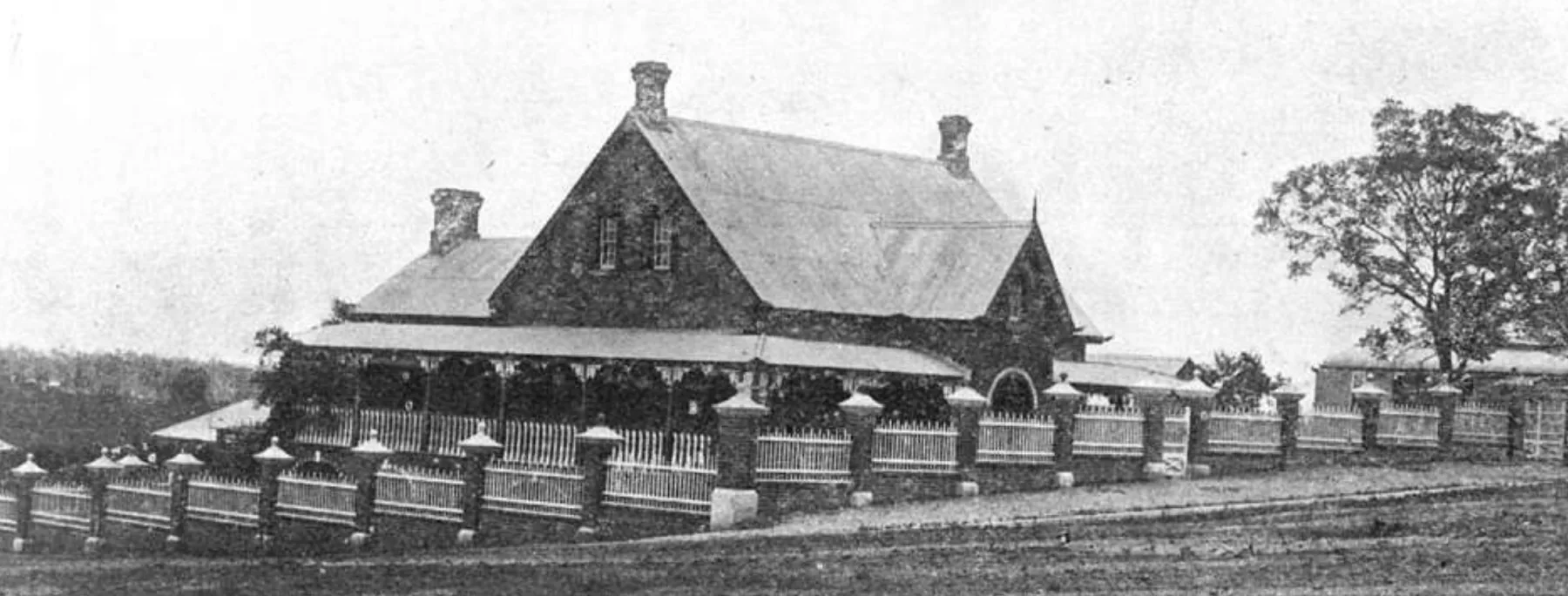
Almondsbury (c.1916-1919). Source: Matthew Fox, History of Queensland, v. 1, p. 480
Highlight: Built c. 1883, Almondsbury wove English roots, local sandstone and a tradesman’s dash for social stature beside Gooloowan.
- Lot grab. c. 1882 (est.) George Williams bought three adjoining Denmark Hill lots, giving his dream house elbow-room and scope for future family builds.
- Hands-on build. With no architect, he and his crew cut and laid each sandstone block to show a working man’s craft could rival any mansion.
- Gloucestershire name. He christened the cottage “Almondsbury” after his UK village, tying Old-World identity to new Ipswich stone.
From Laura Whitmore (nee Vincent):
Almondsbury is in the county of Gloucestershire. Gloucester is the large county town about 45 kms from Almondsbury.
- Hidden ‘W’. A tiny carved ‘W’ in the bargeboards became a family initiation game: spot Grandad’s signature.
From Laura Whitmore:
Family labour. George’s three eldest sons helped their father to cart the stone and build the home, literally helping raise their walls.
Mary Ellen was always known as Nell or Nellie and was the 4th daughter born in 1881 so would not have been old enough to help.
A third daughter born in 1879 was the only one of George and Georgina’s 13 children to die in childhood at the age of just over 1 month.
George Williams was helped by his three older sons – Frank (b. 1872), Alfred (b. 1873) and Harry (b. 1874).
- Prestige site. Planting the house one block below Gooloowan put a tradesman among Ipswich’s elite and turned heads.
- First wedding 1895. Clara Williams wed Frank Vincent at St Paul’s Church in Ipswich. They moved into “Almondsbury” during the 1920s starting almost 40 years of Vincent Vincent custodianship.
From Laura Whitmore:
Clara and Frank were my grandparents. They married in Sept 1895 but the ceremony was not held at “Almondsbury” but at St Paul’s Anglican Church in Ipswich (Trove newspaper article link).
My grandparents didn’t live in “Almondsbury” until the 1920’s. I remember my dad pointing out the house he and his family lived in until they moved to “Almondsbury”. It was called “Leamington” and was further down the road in Park St close to Warwick Road.
- Alderman host. During his 1896-1900 council term, George held informal committee teas around Almondsbury’s dining table.
- Stone economy. Quarrying metres away saved haulage and left a rear pit later shaded with ferns.
Architecture & Design
Highlight. Gothic gables, bold stone-and-brick colour play and cedar interiors make Almondsbury Ipswich’s standout 1880s show-piece.
- Rustic Gothic. Twin steep gables and a brick-arched porch give a romantic cottage silhouette.
- Polychrome walls. Rough sandstone meets crisp red-brick at the corner blocks, arches and chimneys in daring 1880s colour contrast.
- Lace verandah. Cast-iron balustrade and timber fretwork wrap the breezy north-east sides.
- Cedar joinery. 12-foot high board-and-batten ceilings, skirtings and an eight-panel front door glow in Queensland red cedar.
- Marble hearth. A Carrara mantel anchors the parlour; two bedrooms keep original cast-iron surrounds.
- Ripple glass. Wavy 1880s panes shimmer in afternoon light through sash windows.
- Vent-ridge roof. High iron vents deliver early subtropical airflow long before regulations.
- Corner outlook. Slight rotation captures Bremer breezes and frames Gooloowan across the trees.
- Tuck-point finish. Pencil-thin mortar joints flaunt masonry precision and still shed water.
- Cool cellar. A rare sandstone pantry below floor level keeps preserves chilled year-round.
Through the Years
Highlight. Almondsbury stayed a lived-in Williams/Vincent family home until a 1962 change of hands.
From Laura Whitmore
The house was left to Herbert Williams, one of the younger sons of George and Georgina Williams and was kept in the family until his death in November 1961.
It was sold in 1962.
Herbert had lived in “Almondsbury” since his birth in 1889.
At his death it was left to another member of the Williams family who then sold it out of the family. The family who bought it were no relation.
- 1910–12 Williams row. George built daughter Nellie’s To-Me-Ree (7 Macalister) and son Walter’s villa (15 Macalister), book-ending Almondsbury.
From Laura Whitmore
Walter Williams was the 6th son and 11th child. He was married to Natalie Bugler and they always lived at 15 Macalister Street after their marriage in 1912.
- Patriarch passes 1926. George dies; Clara and Frank Vincent have moved in, Sunday roasts unchanged.
From Laura Whitmore
1932-1936 Clara and Frank’s youngest child, George Vincent, sets up his dental surgery in his grandfather’s old study downstairs.
- Sleep-out 1950s. One verandah bay gained fibrolite walls, giving the house an extended sitting room.
- Clara dies 1954. Remains the family hub.
- Sale 1962. The house is sold out of the Williams family after the death of Herbert Williams in Novemeber.
From Laura Whitmore
The house was originally sold in 1962 to the Hardie family, in the 70’s to Mr and Mrs Waldie, then to the Thomas family in the 1980’s followed by the present owner’s parents also during the 1980’s.
The present owner’s parents bequeathed the house to the current owner after they both died.
- Early-1990s restump. Concrete pads replace hardwood stumps; north-east corner lifted 70 mm.
- Early-1990s roof. Rusty iron swapped for heritage-profile galvanised sheets; finials reset.
- Library spotlight 2021. Ipswich Libraries’ Chasing Our Past talk rekindles public fascination with the cottage.
Renovations & Restorations
Highlight. Restump, roof, kitchen wing and stone repointing are the only big moves in 140 years.
- Sleep-out 1950s. Timber infill closes one verandah bay; iron lace hidden but intact behind panels.
- Services mid-1960s. Complete rewiring and new copper plumbing threaded through skirtings to spare walls.
- Restump early-1990s. All 90 stumps swapped for concrete, securing floors for another century.
- Roof early-1990s. New galvanised sheets match the 1880s profile; ridge vents retained.
- Garden revival 2005-10. Terraced beds and 1902 rose varieties reinstated from historic photo.
- Colour audit 2012. Scraping uncovered the original cream-and-oxblood palette; facade repainted to match.
- Stone rescue 2015. 60% state-funded lime repointing plus patch repairs halt salt decay.
- Window tune-up 2017. Sash cords, brass pulleys and matching ripple glass restored with period stock.
- Stewardship ongoing. Owners log every repair (mentioned in Picture Ipswich interview) in a conservation diary for future custodians.
Why It Matters — Heritage Importance
Highlight. Ipswich’s last stone Gothic cottage shows George Williams’ craft and still awaits formal protection.
- Material rarity. One of fewer than five pre-1900 stone houses in Ipswich—and the only Gothic-cottage example.
- Builder’s badge. Live advertisement for Williams, later foreman on the famous Brynhyfryd mansion.
- Streetscape anchor. Frames Denmark Hill’s skyline with Gooloowan and To-Me-Ree.
- Century-plus home. Held by one family from 1883-1962, mirroring Ipswich’s social story.
- Craft touches. Hidden ‘W’, crisp tuck-pointing and cedar joinery shout 19th-century pride.
- Often taught. Local teachers and heritage walks use Almondsbury to explain Victorian design in a subtropical climate.
- Community marker. ICC plaque by the gate tells passers-by why this modest cottage rivals nearby mansions.
- Grant success. 2015 stonework proves private owners can tap public funds for conservation.
- Dream tour. National Trust lists Almondsbury as a “dream future” Great Houses of Ipswich host if owners ever open the door.
- Protection gap. Still unlisted, Almondsbury underscores the need to refresh local heritage registers before gems slip through cracks.
Want more Ipswich icons to your inbox?
Sources
- Almondsbury House – Chasing Our Past (video). Transcription. Ipswich Libraries.