

Claremont at a Glance:
- Classic. 1857 Georgian-style sandstone home—one of QLD’s oldest.
- Premier ties. Once home to QLD Premier George Henry Thorn.
- Lovingly restored. Brought back by Michael Read & Sharon Jones (2000s-today).
- Heritage-listed. Protected and part of the Great Houses of Ipswich tours.
Perched on Limestone Hill with sweeping views of the Bremer, Claremont isn’t just a beautiful sandstone home—it’s where a Queensland Premier once lived. Built in 1857 on former convict ground, this rare Georgian gem has seen everything from chain gangs to political power and elegant restoration.
Now a private family home (yes, with working fireplaces), Claremont occasionally opens its doors for the Great Houses of Ipswich tours.
Here’s why it’s one of the most important historic homes in town:
📜 History and Origins: How It All Started
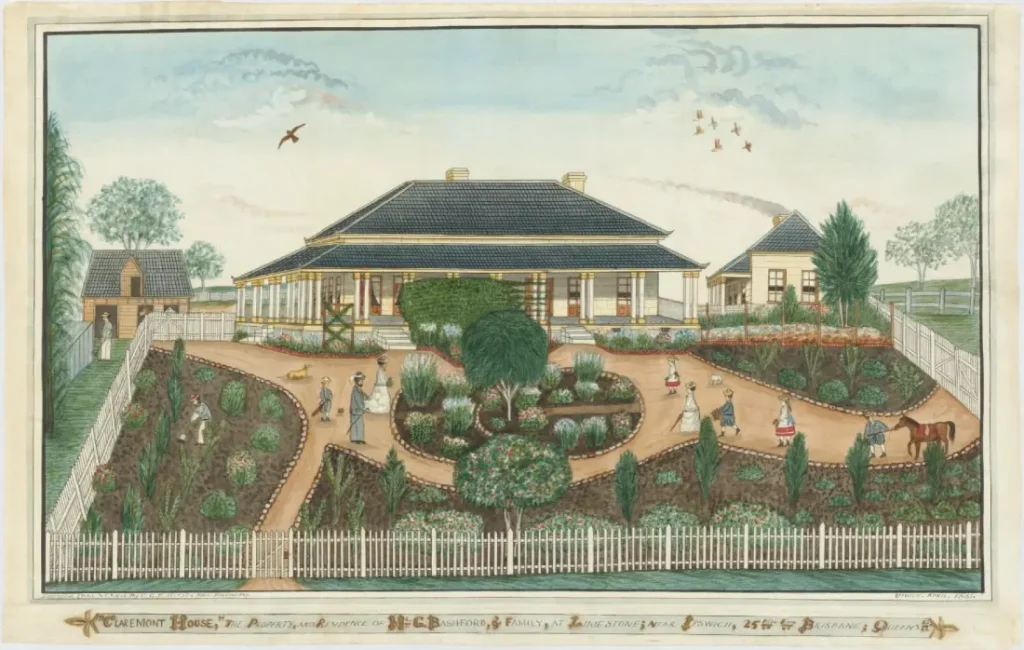
Source: C.G.S. Hirst / 1881 April / Pen, ink and watercolour drawing of Claremont House, near Ipswich.
History Highlights:
- Built in 1857 by merchant and politician John Panton on an old convict work site.
- Bought by George Thorn in 1862—later inherited by his son, George Henry Thorn, who lived at Claremont while serving as Queensland Premier (1876–77)
- Shows how Ipswich grew from a prison outpost to a busy trade and political town.
- Back in 1827, convicts were digging up lime at Limestone Station for Brisbane buildings—Claremont sits right where that happened.
- By 1842, the prison days were over, and the land was opened up for regular people to buy and settle.
- John Panton arrived in Ipswich in 1851—a merchant with cash and connections—and grabbed this spot for his dream home.
- He hired architect William Claydon Wakefield to build Claremont, finishing it in 1857 with local sandstone.
- Panton hit hard times after betting big on cotton during the American Civil War, so he sold the house in 1862.
- George Thorn, who once managed convicts and later became a key town figure, bought it that year.
- Thorn’s son, George Henry, lived there as Queensland’s Premier from 1876 to 1877, making it a busy social spot.
- The Thorn family held onto it until 1906, when George Henry passed away, and it changed hands.
- In 1874, a railway took part of the land, shrinking the property but leaving the house untouched.
- Panton named it “Claremont”—maybe a personal touch or just a name that sounded classy.
🧱 Architecture & Design: What Makes It Awesome
Design Highlights:
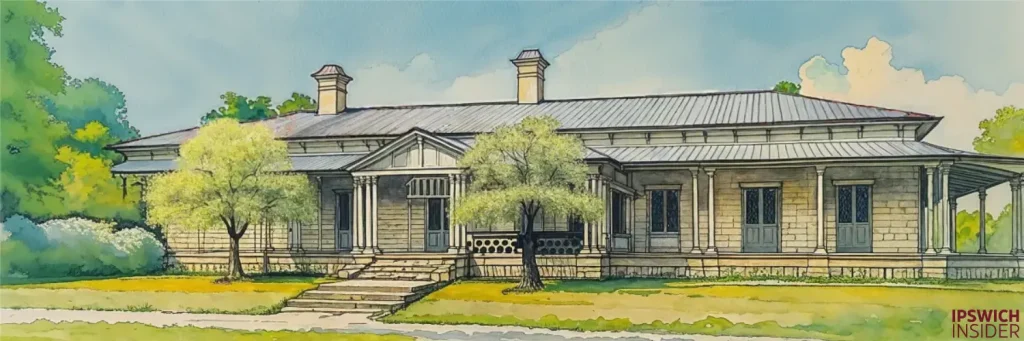
- A rare Georgian-style stone house with a U-shape, wide verandahs, and nine chimneys.
- Still has original features like wood details, marble fireplaces, and a brick cellar.
- Built in a unique way that makes it special for Queensland homes.
- Claremont’s got a classic Georgian look—neat, balanced, and different from most Queensland houses.
- It’s one level with a U-shape, big verandahs for relaxing, and nine chimneys popping up on the roof.
- Made from sandstone dug up nearby—possibly Woogaroo or Helidon—it’s got a warm, golden shine.
- Inside, you’ll find old woodwork, marble fireplaces, and fancy designs on the walls from the 1850s.
- The slate roof got swapped for corrugated iron long ago, but some original parts still hang on.
- There’s a brick cellar underneath—great for storage or a spooky hideout—reached by a stone staircase.
- Glass doors open to the verandah, letting in light and river breezes through all 15 rooms.
- The yard’s full of old plants like bamboo, hibiscus, and bright flowers, framing it like a picture.
- High ceilings with metal patterns and pine floors add a touch of old-time charm.
- It’s like other grand homes in Brisbane, but Claremont came first and has its own vibe.
🏚️ Later Use and Heritage Listing: Rough Years and a Comeback
Hard Times Highlights:
- Split up and turned into flats in the 1900s, it got rundown over time.
- Saved by the National Trust starting in 1975 and added to the heritage list in 1992.
- A great example of people coming together to rescue an old house.
- After the Thorns, George Rennie Wilson bought it in 1906 and cut off some land in 1919, leaving a smaller lot.
- In 1939, Jessie Violet Preddy took over and split it into three flats for renters.
- By the 1940s, it was falling apart—some sections got torn down, and it looked worn out.
- From 1964 to 1975, it was used as a hostel by the Queensland Sub-Normal Children’s Welfare Association, with fireplaces blocked and a bathroom added over the cellar.
- The school later moved near Brothers Football Club, and kept the Claremont name—still in use today.
- The National Trust stepped in during 1975, buying it with a grant and starting to fix it up.
- Architect Bruce Buchanan worked on it in 1980, bringing back verandahs and fireplaces—winning an award in 1986.
- In 1992, it joined the Queensland Heritage Register, making it officially too special to lose.
- It’s part of Great Houses of Ipswich tours, letting people step inside (Have you been inside? I did—I love it!) and see its history.
- An old convict lime kiln might still be buried out back—a cool secret from the past.
- It was featured in The Ipswich House art exhibit, with Bruce Buchanan’s paintings showing off its style.
🛠️ Modern Ownership and Renovations: Bringing It Back to Life
Modern Highlights:
- Bought in the early 2000s by Michael Read and Sharon Jones, who restored it beautifully.
- Mixes old charm with modern perks like solar power and air conditioning.
- Opens sometimes for heritage events like Great Houses of Ipswich.
- The National Trust sold it in the early 2000s to Michael Read and Sharon Jones when money got tight.
- Michael and Sharon put in tons of work, earning a Queensland Heritage Award in 2006 for their efforts.
- They removed a 1960s bathroom to reopen the cellar, keeping its old-time feel alive.
- Modern upgrades like air conditioning and solar panels were added, but it still looks like the past inside.
- The kitchen and bathrooms got updated with fittings that match the house’s vintage style.
- The yard was spruced up with a classic garden—think old trees and colorful flowers around the stone walls.
- As of 2025, it’s their family home, but they let people visit during Great Houses of Ipswich (check the National Trust site!).
- They work with Ipswich’s heritage team to make sure every change keeps it true to its roots.
- The fireplaces still work, and fresh heritage-approved paint makes it glow—warm colors that fit perfectly.
- Bought for around $653,000 in 2003, it’s likely worth well over $1.5 million now—a steal for such a gem.
🏛️ Heritage Significance: Why It’s Worth Caring About
Heritage Highlights:
- Tells the story of Ipswich growing from a convict spot to a place for leaders and culture.
- One of Queensland’s few old Georgian stone houses, with history and beauty to spare.
- Linked to big names like John Panton and Premier George Thorn Jr.
- Claremont shows how Ipswich went from a tough convict start to a thriving town with leaders and trade.
- It’s a rare find—one of the last Georgian stone houses in Queensland, full of old charm.
- Famous folks like John Panton and George Thorn (and his Premier son) made it a key part of history.
- There could be convict-era relics like a lime kiln hidden in the ground—pretty neat to imagine.
- Its sandstone look, neat shape, and river view make it a local favorite to admire.
- Heritage events and art exhibits keep it alive, with people rooting for it to stick around.
- The National Trust’s rescue in the 1970s sparked a trend of saving old Queensland homes.
- It’s a real-life example of how to fix up a classic house and live in it without ruining it.
- Bruce Buchanan’s artwork in The Ipswich House ties its past to today’s creativity.
- From hosting Premier meetings to surviving hard times, Claremont’s a tough one that’s earned its spot.
🔢 Where does Claremont rank on your list of the Best Ipswich Heritage Houses?
If you’re into old homes, cool designs, or fixer-upper tales, Claremont’s got you covered. Catch it at the next Great Houses of Ipswich event—grab a ticket and step inside.
You’ll walk away loving it! I know I did.