

Elamang at a Glance:
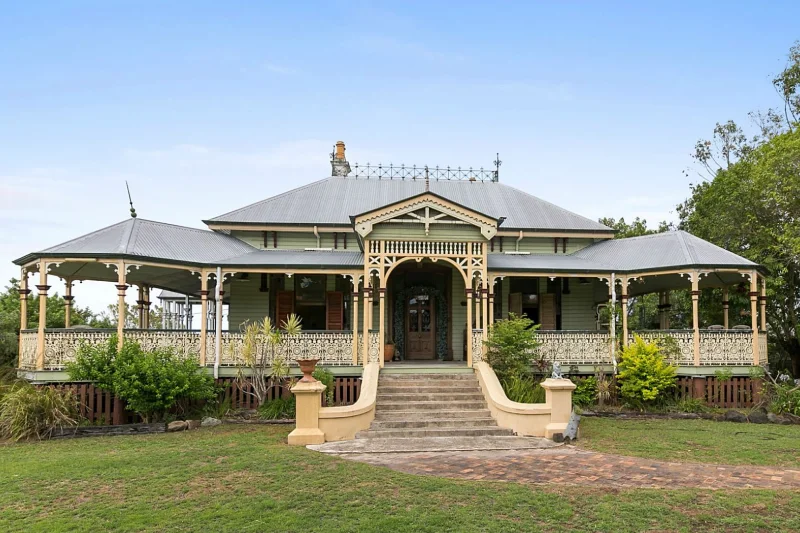
- Hidden gem. 1895 late-Victorian Queenslander designed by G. B. Gill.
- Historic acreage. Originally a 22-acre estate spanning Brisbane Street to the rail line; now a 2,500 m² garden lot.
- Still lived in. Carefully restored, re-stumped in 2021, and privately owned since 2018.
- Character-listed. Protected as an Ipswich Character Place.
🔢 Elamang by the Numbers
- Location: 6 Watson Street, East Ipswich
- Year Built: 1895
- Architect: George Brockwell Gill
- Heritage Listing: Ipswich Character Place (local register)
- Original Estate Size: 22 acres (Brisbane St to the rail line)
- Current Lot Size: ~2 500 m² (≈0.6 acre)
- Rooms: 17 rooms off a 16 m central hallway
- Ceiling Height: 13 ft (4 m) hoop-pine boards
- Fireplaces: 4 Italian-marble surrounds
- 2021 Re-stump: 36 new steel screw-piers, workshop, bath and utility room built underneath.
- Market Value (2025): AU $1.35 – 1.5 million
Elamang sits at the end of a plain driveway off Watson Street, tucked behind newer houses and trees. You’d hardly know it was there if its towering roofline didn’t rise above the skyline.
In 1895, Richard Watson—an Ipswich alderman who would later become mayor—built the timber villa as a wedding gift for Sarah Ann Fox.
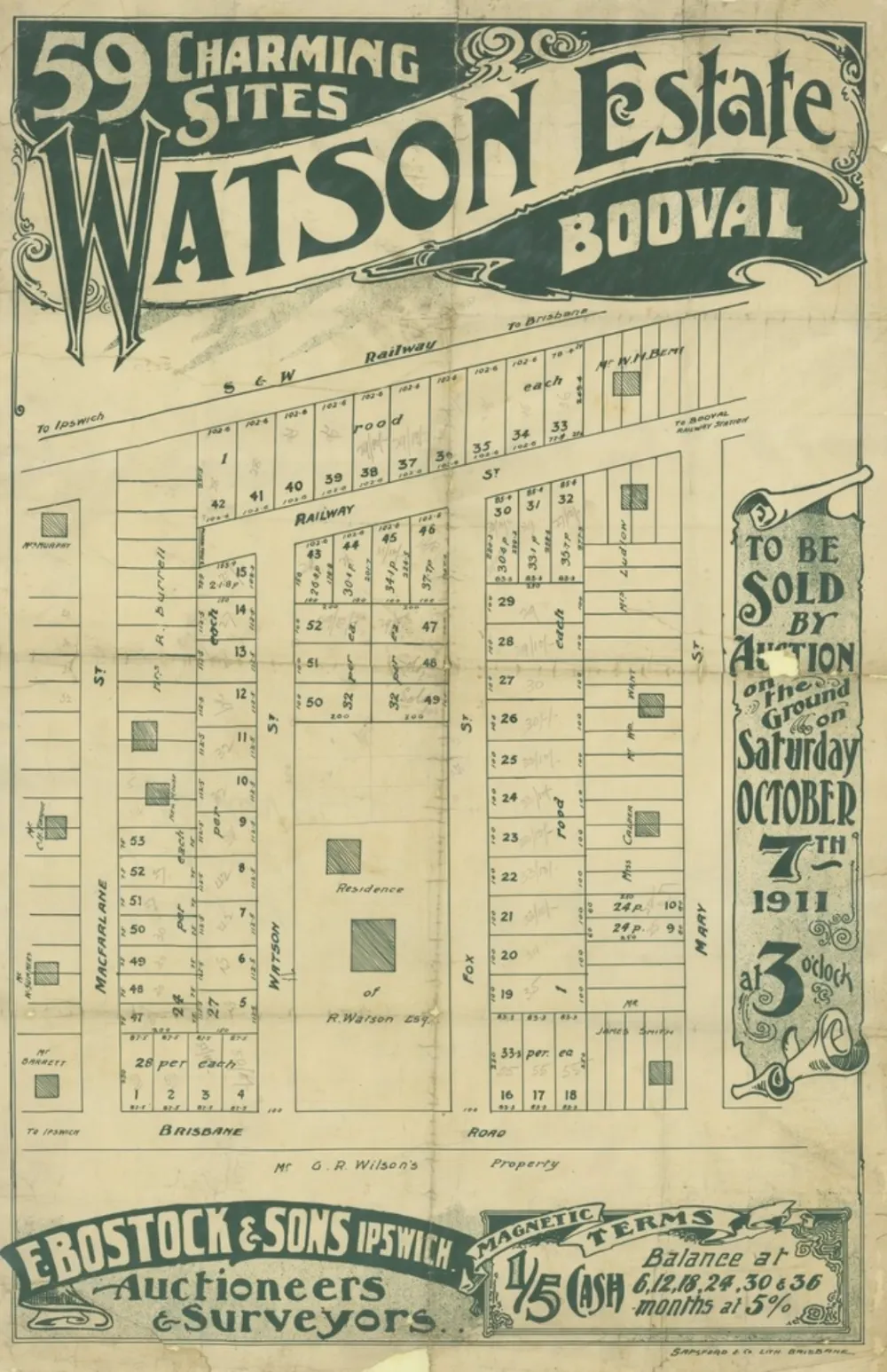
Their 22-acre estate ran from Brisbane Street north to the rail line, and Watson stamped both surnames on the map with Watson and Fox Streets—still there today.
Architect George Brockwell Gill wrapped the house in wide lace verandahs and octagonal bays, giving it scale, shade, and breeze.
Subdivision, flat-era tweaks, and careful restorations followed, yet most of Gill’s cedar and pine remains.
Elamang still stands while the suburb changes around it—an uncommon survivor of Ipswich’s 1890s boom.
Part of a Series—Also Check Out These Ipswich Icons:
Origins & History
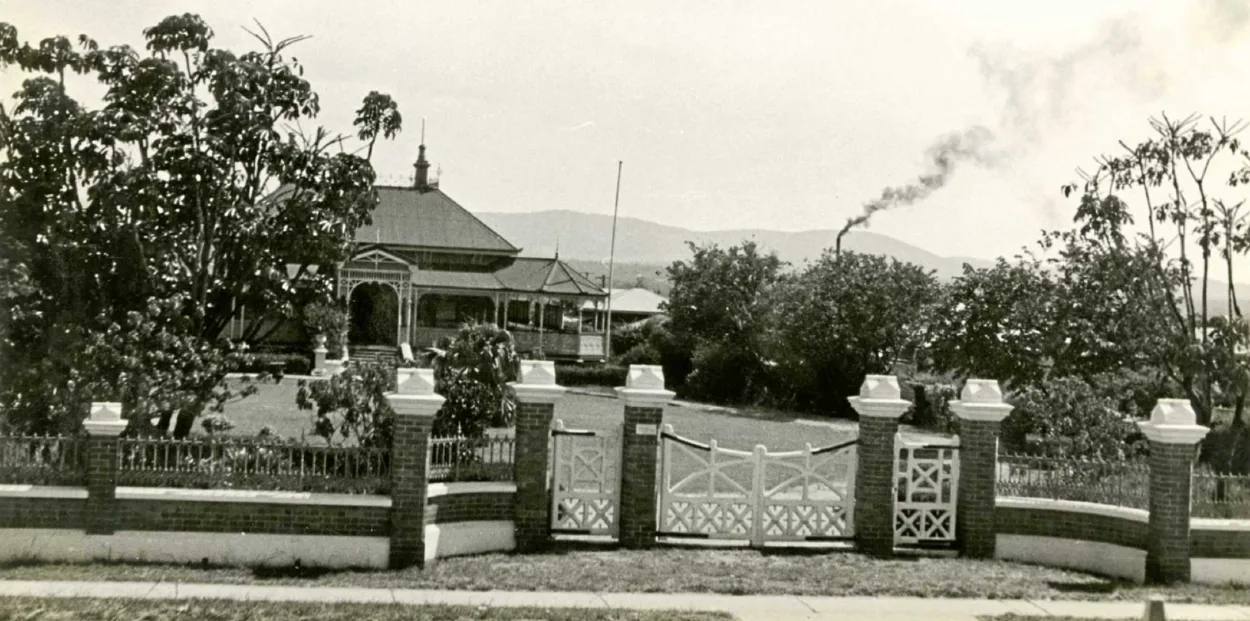
Elamang (c. 1930s) — Looking North from Brisbane St. (Source: Ipswich Heritage Club)
Historic Highlight:
- Love-gift. Built in 1895 by alderman Richard Watson as a wedding present for widow Sarah Ann Fox, setting the tone for a life-long family estate.
- Street-names. Watson christened the bounding lanes “Watson” and “Fox”, forever stamping the couple’s surnames on the suburb’s map.
- Gill signature. Commissioned architect G. B. Gill—already famous for Ipswich Girls’ Grammar—to design a timber villa that could rival local brick mansions.
- Social-hub. Through the 1900s the house hosted garden fairs, musical afternoons and council teas, boosting its early civic standing.
- Downsizing. A 1911 subdivision cut the paddocks from 22 acres to a deep garden lot while preserving the cedar-lined carriage drive.
- Cribb era. Local merchant George Cribb bought the slimmed-down holding in 1924, keeping the villa in private gentry hands.
Architecture
Highlight:
- Grand-Queenslander. High-set late-Victorian form with continuous lace verandahs and twin octagonal bay pavilions.
- Axe-hall. A 16 m central hall (3 m wide) feeds 17 rooms, maximising ventilation and procession.
- Vertical-scale. 13-foot hoop-pine ceilings capped by ornate plaster roses create ballroom-like volumes.
- Material-lux. Cedar sashes, four Italian-marble fireplaces and Brisbane-cast iron lace proclaim prosperity.
- Service-wing. Rear skillion once held kitchen, laundry and maid’s room, marking 1890s social zoning.
- Landscape-frame. Current 2 500 m² allotment still hints at the original gentleman-farmer setting.
Timeline
Highlight:
- 1895 Completion. House finished; local press hails it as “a mansion in timber.”
- 1902–03 Mayoralty. Watson serves as Ipswich mayor, lifting the property’s civic cachet.
- 1911 Subdivision. Estate carved up; original driveway retained as private avenue.
- 1924 Sale. Cribb family purchase for £2,600 (AU $260,000 in 2025), starting nearly three decades of stewardship.
- 1950 Flats. Queensland Times converts villa into four staff apartments.
- 1984 Restoration. Ben & Valma Petersen strip partitions and reopen verandahs.
- 2018 Resale. Current owners acquire for $895k.
- 2021 Re-stump. Council-approved build-in adds workshop, bath and mud-room under.
- 2025 Present. Family dwelling.
Restorations
- Rescue-phase. 1984 works reversed 1950s fibro, reinstating cedar walls, lacework and roof profile.
- Hallway-reveal. Partition removal exposed full cedar panelling and kauri-pine floorboards.
- Fireplace-revive. Four marble surrounds cleaned; two adapted for gas while keeping iron grates.
- Colour-study. Paint scrapes guided a heritage olive-and-biscuit palette applied with low-VOC acrylics.
- Landscape-renew. Petersens re-imagined the old carriage loop as a crushed-granite garden walk.
- Structural re-stump. 2021 re-stump used 36 steel screw-piers and concealed LVL beams, adding 120 m² of utility space.
- Compliance-tick. QBCC issued a defect-free certificate in December 2021.
- Future-proof. Owners follow a five-year maintenance cycle for gutters, paint and pest checks.
Current Status
Highlight:
- Private-icon. Largest surviving 1890s timber villa in East Ipswich; one of six from that decade.
- Title-holders. T. & S. C. on title since 2018 private sale.
- Heritage-tag. Listed as an “Ipswich Character Place” with demolition and design controls.
- Valuation-band. 2025 appraisal: AU $1.35–1.5 million, boosted by compliant under-build.
- Insurance-load. 15 % premium via RACQ heritage policy; covers like-for-like reinstatement.
- Community-symbol. A living case study of how timber Queenslanders can adapt without losing character.
Want more Ipswich icons to your inbox?
Sources
- Elamang. Picture Ipswich.
- The Making of Elamang. Queenslander Homes.
- Watson Estate. State Library Queensland.
- Sold – $895,000. Domain.