

Glendalough at a Glance
- Queenslander Villa. High-set timber home, built circa 1900 and lavishly enlarged by merchant T.E. Bulcock in 1911.
- Octagonal Room. Rare eight‑window summer sleeping pavilion designed to catch cooling breezes on hot nights.
- Heritage Icon. State‑listed since 1992, still boasts intact pressed‑metal ceilings, leadlights and wrap‑around verandahs.
🔢 By The Numbers
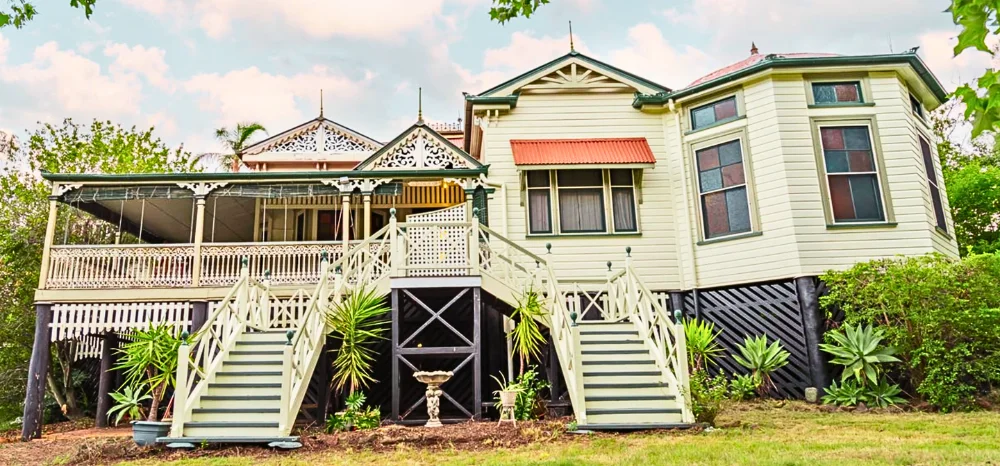
- Address: 96 John St, Rosewood
- Heritage (listed 21 Oct 1992): ID 600735
- Built: circa 1900 first stage
- Rooms: Originally 5 rooms. 1910 transformation brought it to 12 principal rooms.
- Land: about 1.25 acres (≈ 5,400 m²)
- Price: $535,000 at 2018 auction
- Owner timeline:
- 1923 Harry Grant
- 1958 Wally Edwards
- 1969 Arnold and Joyce Rieke
- 1992 Ronald Casey and Catherine Archbold
- Mortgage: £800 raised in 1911
- Palms: 90-year-old trees still standing
Glendalough is a grand Federation-era Queenslander at 96 John Street, Rosewood.
The timber villa began life around 1900 and was lavishly enlarged in 1911 by ambitious storekeeper T.E. Bulcock.
Its most talked-about feature is an eight-window octagonal sleeping room that draws breezes on every side and turns heads from the street.
The house still flaunts its pressed-metal ceilings, leadlights and verandahs, earning a place on the Queensland Heritage Register in 1992.
In 2018 it changed hands for $535,000, proving Rosewood’s landmark is as desirable today as it was a century ago.
Take a look at Google Maps street view to see what it looks like present day.
📜 Origins & History

Take a look inside Glendalough (c.2018 RealEstate.com.au Listing)
Highlight
Glendalough began as a modest six‑room cottage around 1900 and was transformed in 1911 into an eight‑room showpiece by merchant T.E. Bulcock. The house’s early story mirrors Rosewood’s dairy‑boom prosperity and fast population growth in the 1910s.
- Construction. The house started circa 1900 as a six‑room timber cottage on high stumps.
- Merchant. In 1908 local storekeeper T.E. Bulcock opened the once thriving Trade Palace general store in Rosewood.
- Marriage. Bulcock wed Edith Mary Bourke in June 1910, soon seeking a substantial family home.
- Purchase. He bought the 1¼‑acre John Street property in December 1910 and named it Glendalough.
- Expansion. A major 1911 upgrade enlarged the dwelling to eight principal rooms, adding a billiard wing and octagonal pavilion.
- Context. Rosewood’s dairy boom saw the town’s population quadruple by 1911 (to 1,418 people) .
- Praise. By 1919 newspapers described the villa as having “lofty and spacious rooms” and a unique summer bedroom.
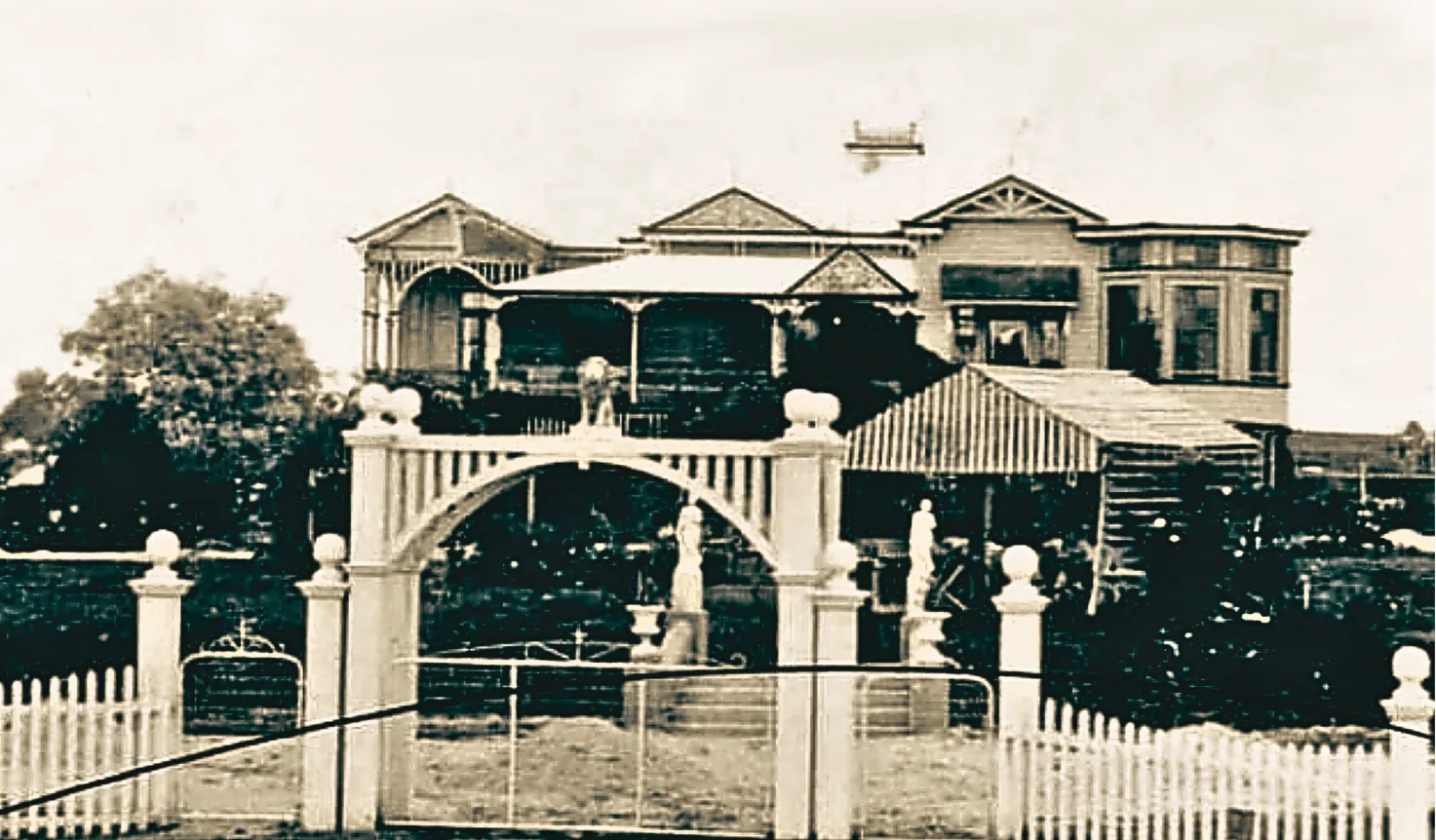
Glendalough c.1919 – Source: RosewoodHistory.au
- Society. Throughout the 1910s the Bulcock family hosted community gatherings, making the home a local social hub.
🏗️ Architecture & Design

Highlight
Glendalough is a grand, high‑set Queenslander villa with wrap‑around verandahs, a complex roof crowned by an octagonal turret, and richly detailed timber and ironwork throughout.
- Style. A classic Queenslander set high on timber stumps with broad verandahs on every side.
- Roof. A central pyramidal roof intersects gables and an octagonal turret over the north bedroom.
- Cladding. Exterior walls use chamferboards and vertical joint boards beneath wide verandahs.
- Staircase. A double‑wing front stair creates an impressive formal entry.
- Pavilion. The octagonal “summer sleeping room” has windows on all eight sides for cross‑breezes.
- Wing. A southern extension houses a large billiard room designed for entertaining.
- Plan. A broad central hallway links four bedrooms, living and dining rooms, giving a total of eight rooms.
- Ceilings. Pressed‑metal patterns and cedar joinery add rich interior detail.
- Glass. Leadlight panes in soft greens and yellows brighten the octagonal bedroom.
⏳ Through the Years
Highlight
From a 1923 change of hands to 21st‑century restorations, Glendalough has remained a private residence while gaining formal heritage protection and community admiration.
- Transfer. In 1923 butcher Henry M. A. Grant bought the house and renamed it Alvie.
- Residence. The Grant family lived there for about 35 years until the late 1950s.
- Reception. A 1937 family wedding reception was held in the garden.
- Continuity. During the 1960s‑1980s the property stayed a single‑family home and avoided subdivision.
- Listing. On 21 October 1992 it entered the Queensland Heritage Register (Place ID 600735).
- Awards. Late‑1990s owners carried out an award‑winning restoration program.
- Auction. The house sold at auction in March 2018 for A$535,000.
- Today. As of 2025 Glendalough remains a decently well‑cared‑for private residence.
🛠️ Renovations & Restorations
Highlight
Major works span the 1911 enlargement, mid‑century conveniences, and meticulous 1990s conservation that preserved original fabric while adding modern comfort.
- 1911. Extensions added a southern billiard wing, northern pavilion, full verandahs and a grand stair.
- Bathroom. Mid‑20th‑century owners enclosed a verandah bay to create an indoor bathroom.
- Laundry. Under‑house areas were enclosed for a laundry and second toilet.
- Arch. The central hallway opening was widened mid‑century for better flow.
- Fretwork. Late‑20th‑century screens were added as sympathetic detail.
- Roof. 1990s works replaced or refinished corrugated iron sheeting and repainted the home.
- Ceilings. Pressed‑metal panels were repaired and repainted.
- Glass. Damaged leadlight panes were matched with vintage replacements.
- Wiring. Original light fittings were rewired to modern standards.
- Kitchen. A period‑style kitchen hides contemporary appliances.
- Bathrooms. Updated plumbing provides comfortable amenities without altering heritage fabric.
- Cellar. An insulated under‑house room now serves as a wine cellar.
- Maintenance. Regular painting and termite checks keep the structure sound.
🌟 Why it Matters / Heritage Importance
Highlight
Glendalough is protected for its rarity, intact architecture and landmark presence; it illustrates early‑1900s rural prosperity and remains a source of community pride.
- Protection. State listing on the Queensland Heritage Register (1992) shields the house and grounds.
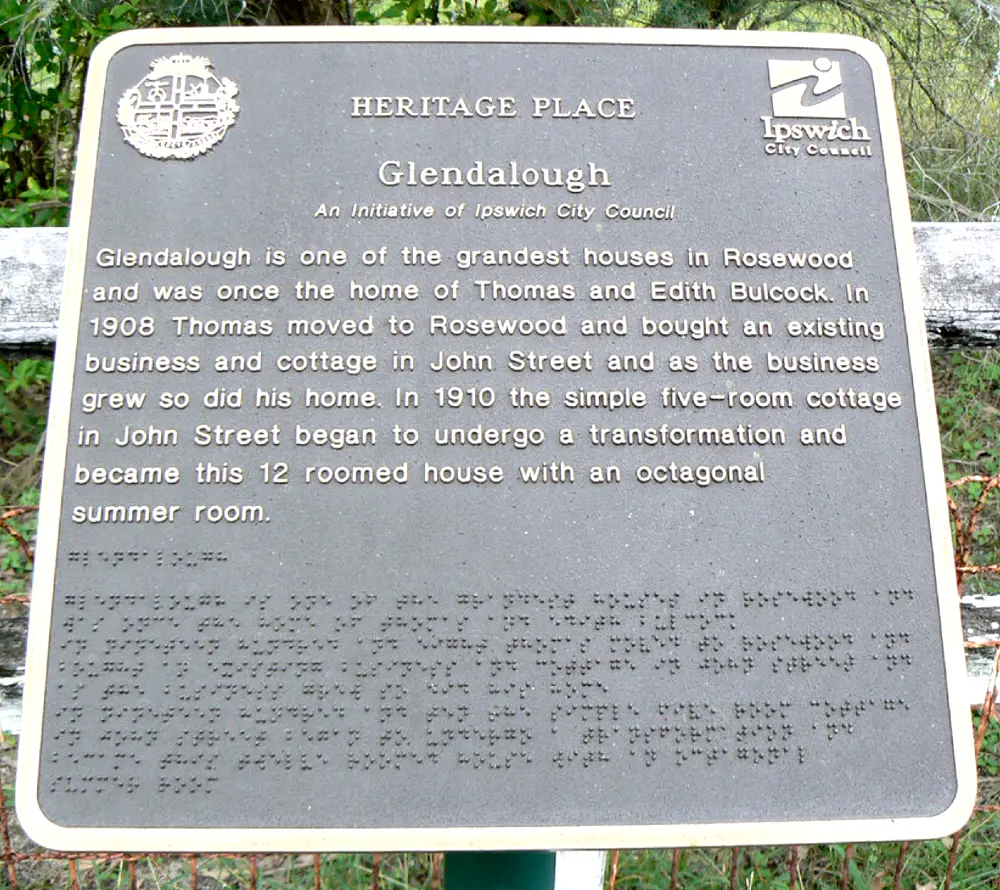
Heritage plaque in front on Glendalough on Lanefield Rd.
- Recognition. National Trust and local overlay listings reinforce its heritage value.
- Example. The villa demonstrates early‑20th‑century prosperity in rural Queensland.
- Integrity. Original pressed‑metal ceilings, leadlight windows and fretwork remain intact.
- Landmark. Its elevated corner setting and ornate form give strong streetscape impact.
- Community. Locals regard the property as a long‑standing landmark and social touchstone.
- Rarity. Few timber villas of this scale with an octagonal sleeping room survive in the Ipswich region.
- Guidance. A conservation management plan and heritage grants help fund future upkeep.
- Setting. Keeping the large garden whole guards against loss of heritage context.
Sources
- Glendalough, Rosewood. Wikipedia.org.
- Queensland Places – Rosewood – “Glendalough”. Slq.qld.gov.au.
- Rosewood Then & Now. Ipswich.qld.gov.au.
- Glendalough, Lanefield Road, and John Street, Roswood, Ipswich, 2024. Picture Ipswich.
- Historic Buildings. RosewoodHistory.au.