
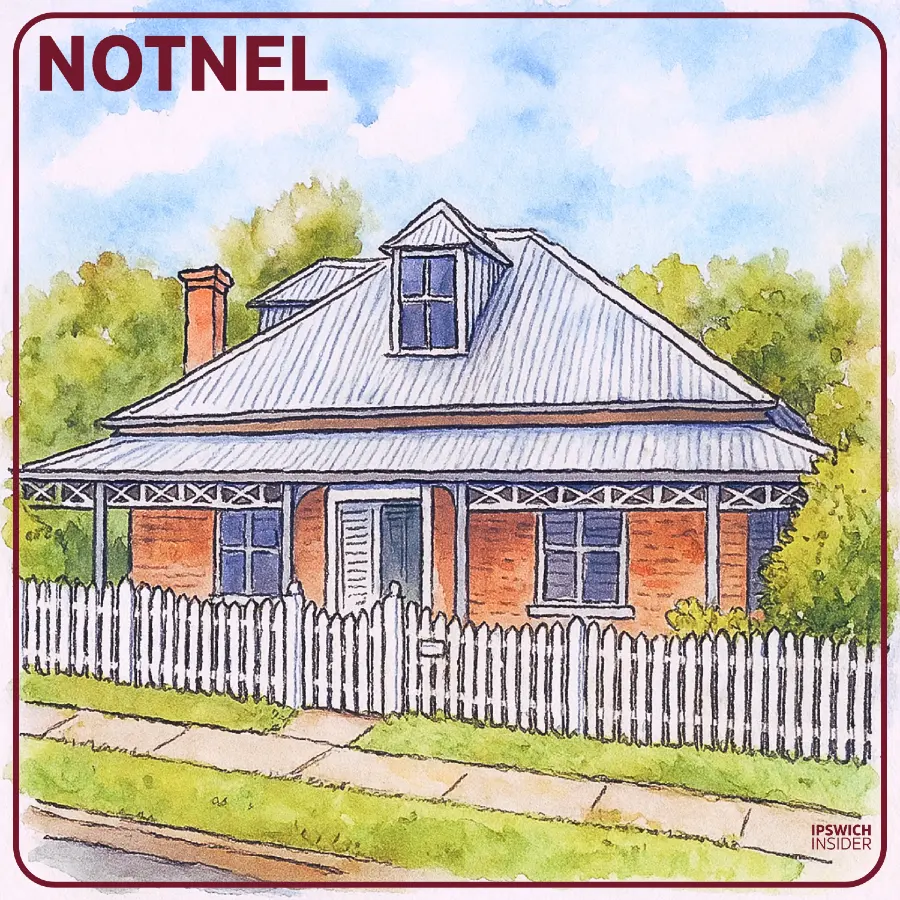
Notnel at a Glance:
- Frontier roots. Built 1861–63 on an 1855 land grant, Notnel bridges Ipswich’s jump from convict outpost to bustling city.
- Brick rarity. Thick 13-inch walls, a rare attic-plus-loft combo and a name that flips “Lenton” backward make it unique.
- Heritage survival. 80% of its 1860s structure endures thanks to 56 years of Hawley care and a 1990s rescue—earning QHR Place 600571.
🔢 By The Numbers
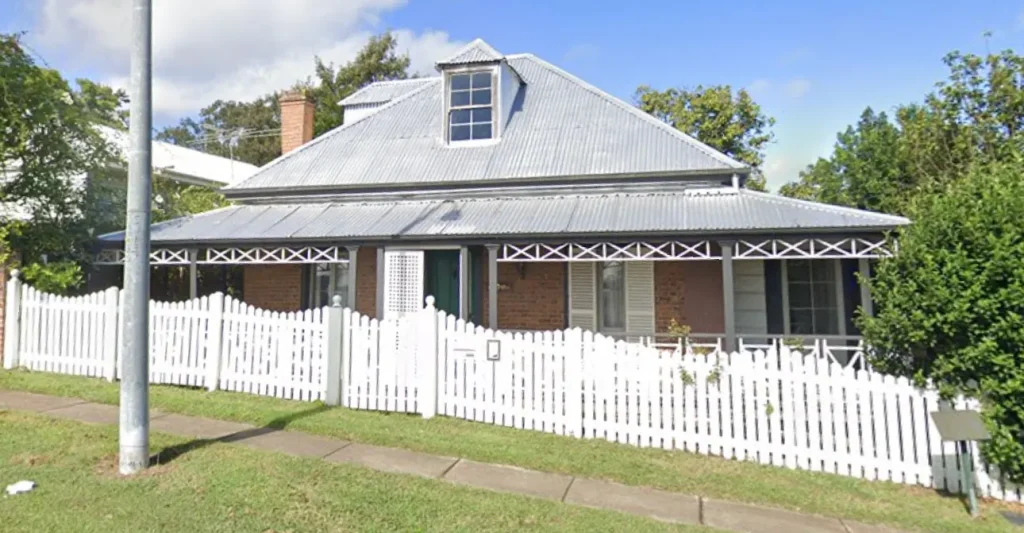
- Address: 6 Burnett St, West Ipswich
- Heritage: QLD Register (1992) Place 600571
- Built: 1861 – 1863
- Age: 162 years (in 2025)
- Land: 2,203 m² block
- Walls: 13-inch solid brick
- Rooms: 10 main rooms
- Attics: 1 attic + 1 loft
- Original: 80 % of 1860s structure intact
- Price (sold for): $900,000 (2024), $650,000 (2021), $550,000 (2019), $475,000 (2016), $80,000 (1990)
- Tenure: Hawley family owners for 56 years (1934 – 1990)
NOTNEL, one of Ipswich’s oldest surviving homes, sold for $900,000 in 2024.
That price crowns a steady climb: $80,000 in 1990, $475,000 in 2016, $550,000 in 2019 and $650,000 in 2021.
Each sale shines a brighter spotlight on this rare brick survivor on Burnett Street—behind the Federal Hotel bottle-shop.
Notnel was almost lost.
In 1990 new owners drained damp walls, stripped out rot and rewired the house. Their rescue helped the house earn a place on the Queensland Heritage Register in 1992.
For the 56 years before that, the Hawley family kept the cottage much as they found it. George Hawley even named it by spelling his old Nottingham street, Lenton, backwards.
Roll back further and you reach the start. Builder David McLaughlin raised the house in 1861–63 on land first bought in 1855. Thick 13-inch bricks, a steep roof and a tiny attic have carried it through every change since.
Ready to pry up another brick? Let’s dig deeper.
Explore more Iconic Ipswich homes:
📜 Origins & History
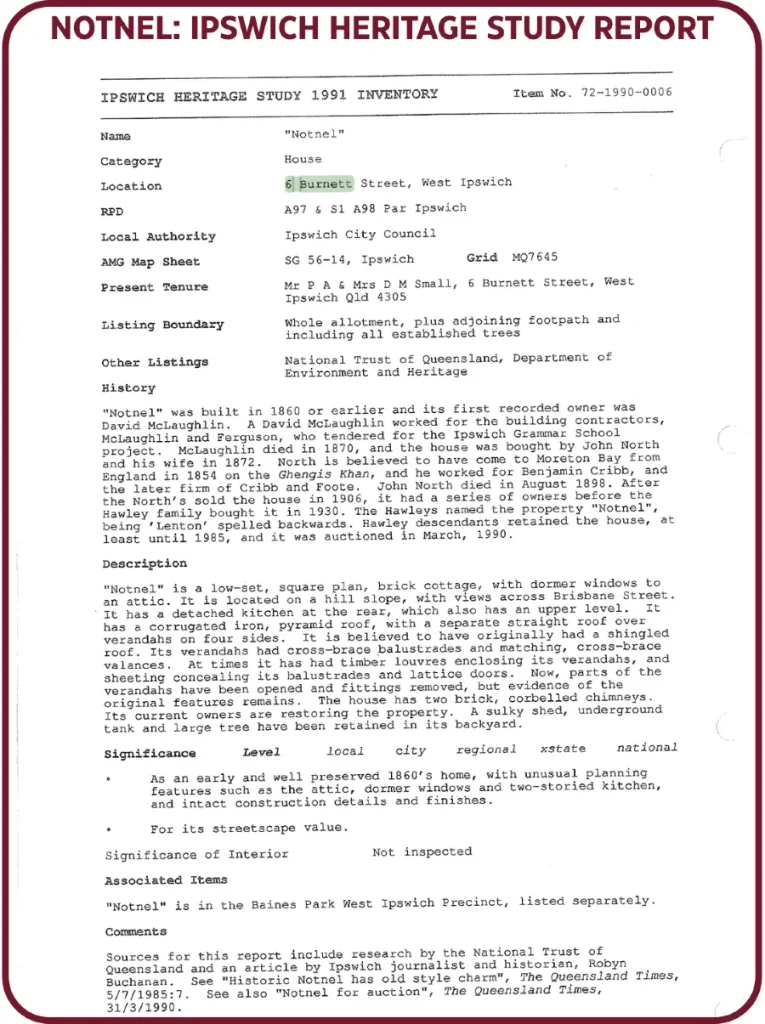
Highlight
Notnel rose in the early 1860s on land first bought in 1855. Its brick build, rapid rental listings and quick resale chart Ipswich’s jump from frontier outpost to confident municipality.
- Purchase. Patrick O’Sullivan bought the Burnett Street block in 1855 for £31, becoming the site’s first recorded owner.
- Builder. Contractor David McLaughlin erected the five-room brick cottage circa 1861-63.
- Context. Ipswich became a municipality in 1860 and eyed capital status while river trade boomed.
- Economy. Building a substantial home during the early-1860s recession showed rare confidence.
- Letting. November 1861 ads offered the house to rent with garden, yard and detached kitchen.
- Upgrade. April 1862 notice added a servant’s bedroom, hinting at early alterations.
- Workshop. 1863 valuation rolls list a cottage and brick workshop on the lot.
- Marketing. A 1870 sale ad praised “refreshing sea breezes,” a colourful selling point for inland Ipswich.
- Tenant. Alfred Dann occupied the home around 1870, showing its use as a long-term rental.
- Transfer. McLaughlin sold the property in June 1872 to draper John North.
🏗️ Architecture & Design

Highlight
Notnel is a low-set red-brick cottage with a rare attic, steep hipped roof and wide verandahs. Its plain Georgian lines differ sharply from Ipswich’s later timber Queenslanders.
- Structure. The house is single-storey, low-set, and built in Flemish-bond brick.
- Roof. A steep hipped roof once shingled, now corrugated iron, holds a dormered attic.
- Chimneys. Two tall brick stacks vent the parlour and kitchen fireplaces.
- Verandah. Wrap-around decks on three sides use plain timber posts and cross-braced rails.
- Plan. Four main rooms open off a central hall with a steep stair to the attic.
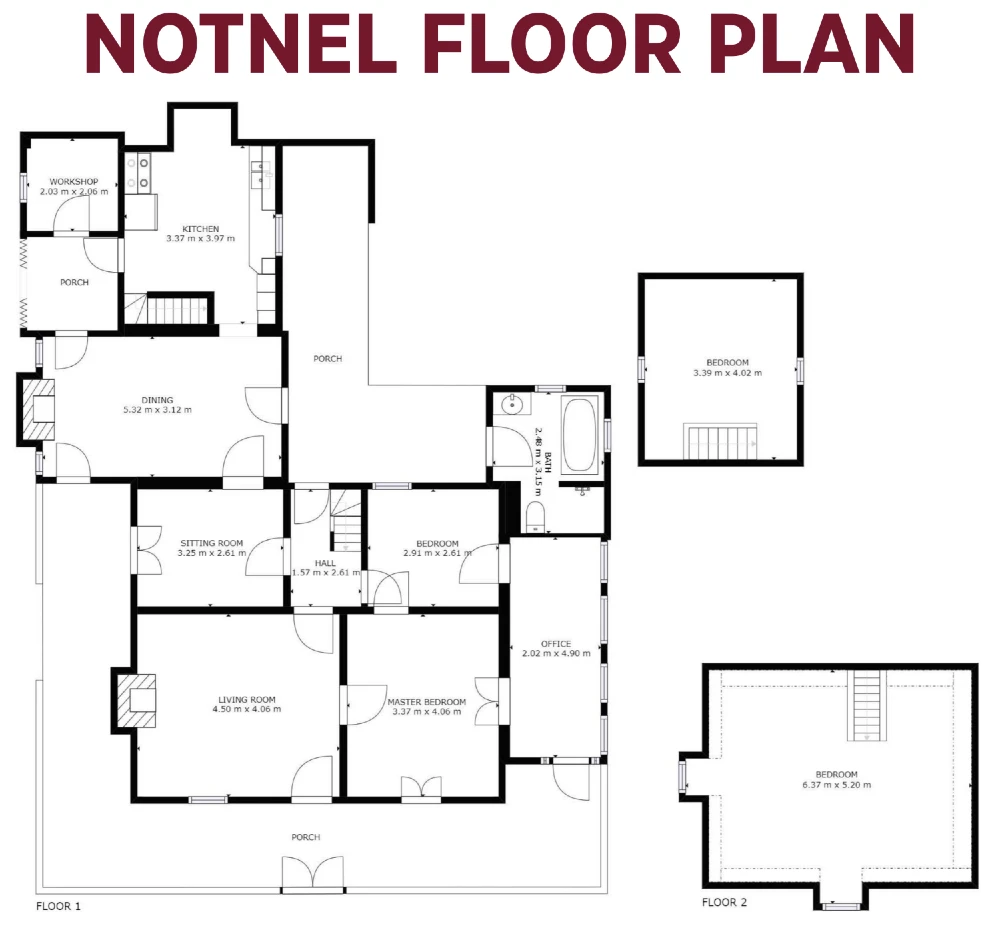
- Kitchen. A detached brick wing later joined to the house forms dining and cooking spaces.
- Laundry. A rear lean-to houses the original outdoor washroom.
- Joinery. Interiors keep 13-inch walls, wide pine floors and cedar trim.
- Fireplaces. The parlour mantle and cast-iron stove show mid-19th-century hearth design.
- Outbuildings. A brick-lined well, sulky shed and poultry shed survive on site.
- Contrast. Later 1880-1910 Ipswich homes grew larger, timber-framed and highly ornate, unlike Notnel’s simplicity.
⏳ Through the Years
Highlight
Ownership moved from builders to merchants to long-term custodians. Restorations in the 1990s safeguarded its fabric, and a string of sales from 2016-2024 shows rising demand for well-kept heritage homes.
- 1855. O’Sullivan’s land purchase predates Queensland’s 1859 separation.
- 1861-63. McLaughlin completed and briefly rented the cottage.
- 1872. John North bought the property as a family home.
- 1876. North acquired the next lot and enlarged the gardens.
- 1898. North died; widow Laura kept the house.
- 1907. Dentist George Rylatt became new owner.
- c.1912. Businessman Carl Runge acquired and later subdivided spare land.
- 1934. Farmer George Hawley bought the cottage and coined the name Notnel.
- 1934-90. Hawley family held the home for 56 years with few changes.
- 1990. Small family purchased and launched full restoration.
- 1991. Major works fixed damp, rewired and revived open verandahs.
- 1992. Added to Queensland Heritage Register as Place 600571.
- 2016. National Trust opened the house for public tours; sold for about $475 k.
- 2019. Sold again to a heritage-minded family for roughly $550 k.
- 2021. Market uplift saw a resale at around $650 k.
- 2024. Achieved a record $900 k sale, underscoring its rising value.
🛠️ Renovations & Restorations
Highlight
Few changes occurred before 1990, leaving rich original fabric. Expert works since then cured damp, rewired, rebuilt verandahs and revived lost sheds with heritage care.
- Dining. Late-19th-century infill linked the kitchen wing, forming an internal meal room.
- Roofing. Mid-20th-century sheets replaced failing timber shingles.
- Boarding. 1940s-50s verandahs were partly closed for safety.
- Damp. 1990-91 works rebuilt lower bricks and added drainage paths.
- Decks. 1991 restoration reopened verandahs and copied original railings.
- Services. Full electrical wiring, hot water and a shower were installed in 1991.
- Joinery. Cedar doors, floors and a parlour mantel were painstakingly repaired.
- Loft. A small mezzanine bedroom was added above the kitchen.
- Walls. Dining-room end walls were rebuilt in brick for strength.
- Poultry. 2011 saw the long timber hen-house carefully re-made.
- Sulky. 2012 work rebuilt and shortened the old carriage shed.
- Verandah. 2013 repairs fixed weather-damaged corners.
- Garden. New brick courtyard walls and a herb plot were laid out in 2013.
🌟 Why it Matters / Heritage Importance
Highlight
As one of Queensland’s earliest brick cottages, Notnel keeps over 80 % of its 1860s fabric and anchors a historic streetscape. Listing in 1992 secures its future as a lesson in Ipswich’s rise.
- Register. State-listed on 21 Oct 1992 as Place 600571.
- Local. Included in Ipswich Council heritage overlays.
- Rarity. One of few surviving brick cottages with an attic in Queensland.
- Integrity. Retains more than 80 % original external fabric.
- Example. Shows mid-19th-century domestic design and materials.
- Streetscape. Forms a visual anchor near Ipswich Grammar School.
- Custodians. Hawleys lived here 56 years, boosting its social value.
- Engagement. 2016 open day drew crowds and community pride.
- Guidance. Conservation policy urges only minimal change and moisture control.
- Status. The house remains a sound, privately-loved home.
Sources
- 2016 Heritage Awards Entry Board – Notnel. PictureIpswich.com.au.
- Notnel. Wikipedia.org.
- ‘Notnel’ — A house with history. Ipswich Libraries.
- The National Trusts’ Great Houses of Ipswich 2016. Ipswich Libraries.
- Notnel. PictureIpswich.com.au.