
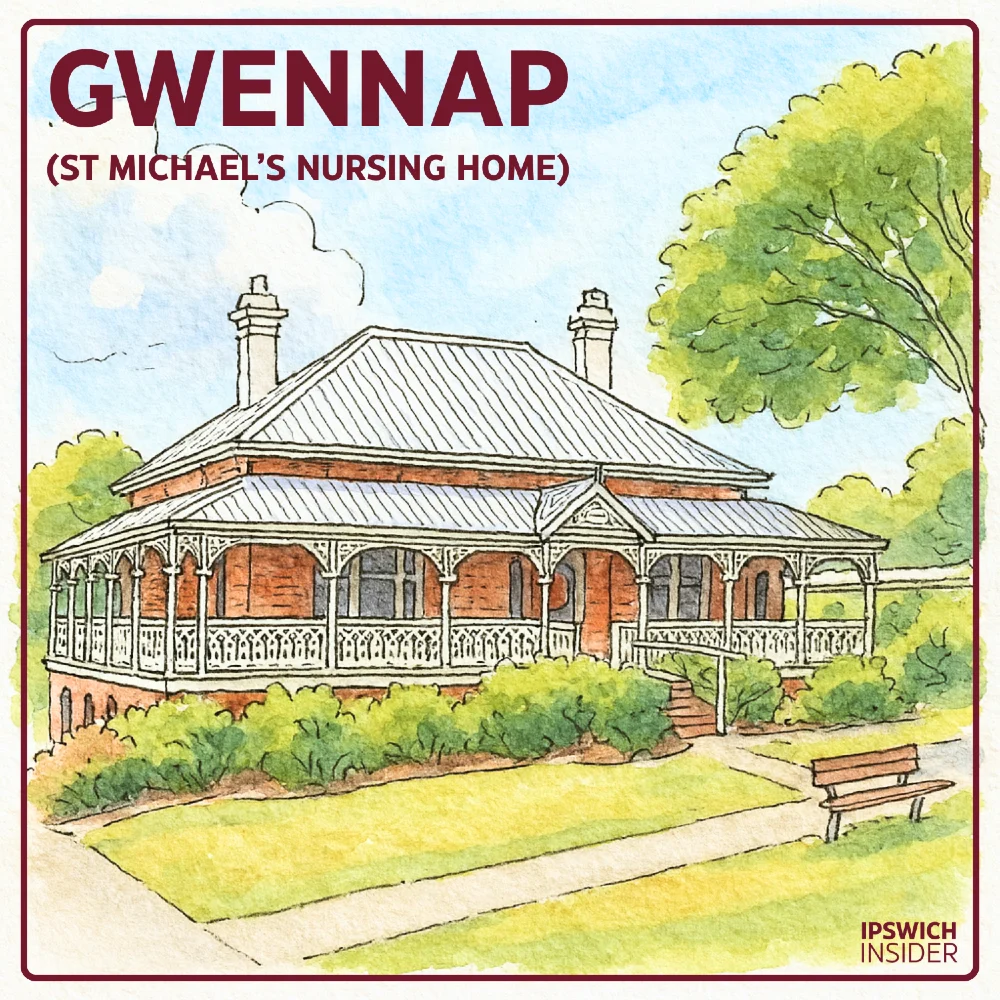
Gwennap at a Glance
- House type. A ~1874 late-Victorian two-storey brick homestead with wrap-around verandahs.
- Hill site. The brick house is cut into the Limestone Hill ridge on Chermside Road above Queens Park. From the street it looks like one storey and from the back/side it clearly shows two storeys.
- Today. The original brick house is still the main street-front entrance and reception for Lilliput Caring at 68 Chermside Road. Newer brick and concrete wings and units sit behind it.
🔢 By The Numbers

- Address.: 68 Chermside Road, Newtown, Ipswich
- Heritage listing (21 Oct 1992).: Place ID# 600573
- Built.: ~1874 late-victorian two-storey brick homestead
- Storeys.: 2 full levels
- Rooms.: 4 main rooms off the upper hall
- Extras.: 2 smaller rooms formed from the enclosed southern verandah
- Land.: 4,906 m² block on the Limestone Hill ridge
- Listing.: 5-bedroom house classification in property records
- Conversion.: ~1950 change from family home to nursing home
- Church.: 1970 purchase by the Presbyterian Church’s Department for Social Mission
- Sale.: December 2014 sale recorded at $1.925 million
- Land valuation: $1.8 million in 2025 for just the land (no buildings or improvements)
Why would a timber merchant build his family home from brick?
To show off? To stand out? Who knows.
But Gwennap certainly did both. Built ~1874 by Ipswich timber boss Josias Hancock, this late-Victorian two-storey brick homestead sits neatly carved into Limestone Hill, overlooking Queens Park.
In 1950, Gwennap left private hands and became St Michaels Nursing Home. Over the years, new buildings sprang up around the original brick house, turning it into a larger care complex.
Yet Gwennap remains remarkably untouched. It still serves as the reception and main entrance for Lilliput Caring since the 2010s.
From Chermside Road, it looks like a simple one-storey cottage, but the hillside reveals its true two-storey scale as you move down Chermside Rd.
Today it’s easy to overlook, hidden behind shrubs and set back off the busy Chermside Rd. But Gwennap is there. Quietly standing—a rare Ipswich landmark built by timber money, still watching over Queens Park.
Have a look. Have you ever noticed this great Ipswich house when passing by?
Discover more Ipswich gold
📜 Origins & History
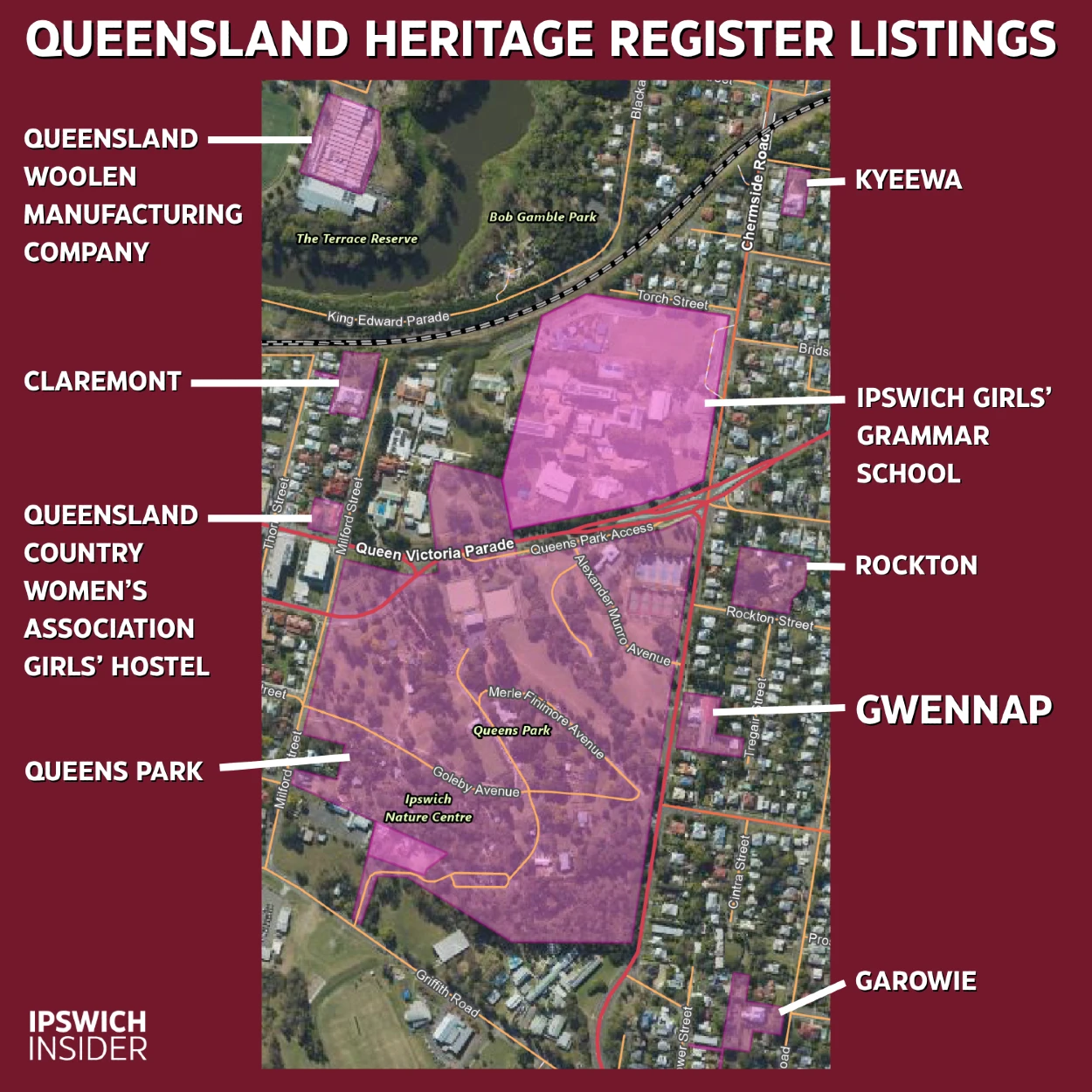
Satellite view showing all the Queensland Heritage Listings near Gwennap.
Highlight
Gwennap is a brick house built ~1874 on Chermside Road in Newtown. It sits opposite Queen’s Park and came out of Ipswich’s timber boom.
- Builder. Timber merchant Josias Hancock had Gwennap built ~1874 on Chermside Road in Newtown.
- Name. He named the house Gwennap after the area in Cornwall, England, where he was born.
- Family year. The house dates to ~1874, the same year Hancock married Emily Trevaskes, so it was built as their new family home.
- Timber roots. Josias’s father Thomas Hancock ran pit sawing at Pine Mountain and later operated timber mills at Rosewood and in Ipswich.
- Money source. The Hancock family’s timber work in the district helped pay for a solid brick house rather than a simple timber cottage.
- Ipswich boom. In 1874 Ipswich was a busy industrial town with coal mines, foundries and timber yards, and that strong economy made a big house like Gwennap possible.
- Show home. Many business families were putting up large homes on the ridges, and Gwennap was one of these status houses, along with Rockton, Garowie and Kyeewa.
- Newtown feel. When Gwennap went up the Newtown ridge still felt semi rural and a fair walk from the town centre.
- Neighbours. At that time only a few big homes sat nearby, including the Bullmores’ Rockton and a Shillito family house.
- Estate lot. The house stood on land from John Rankin’s Newtown Estate, which had been cut into house blocks in 1865 but kept generous lots with gardens.
- Park outlook. Queen’s Park was laid out in the 1850s, so by 1874 the house already looked over a well used town park rather than bare paddocks.
🏗️ Architecture & Design
Highlight
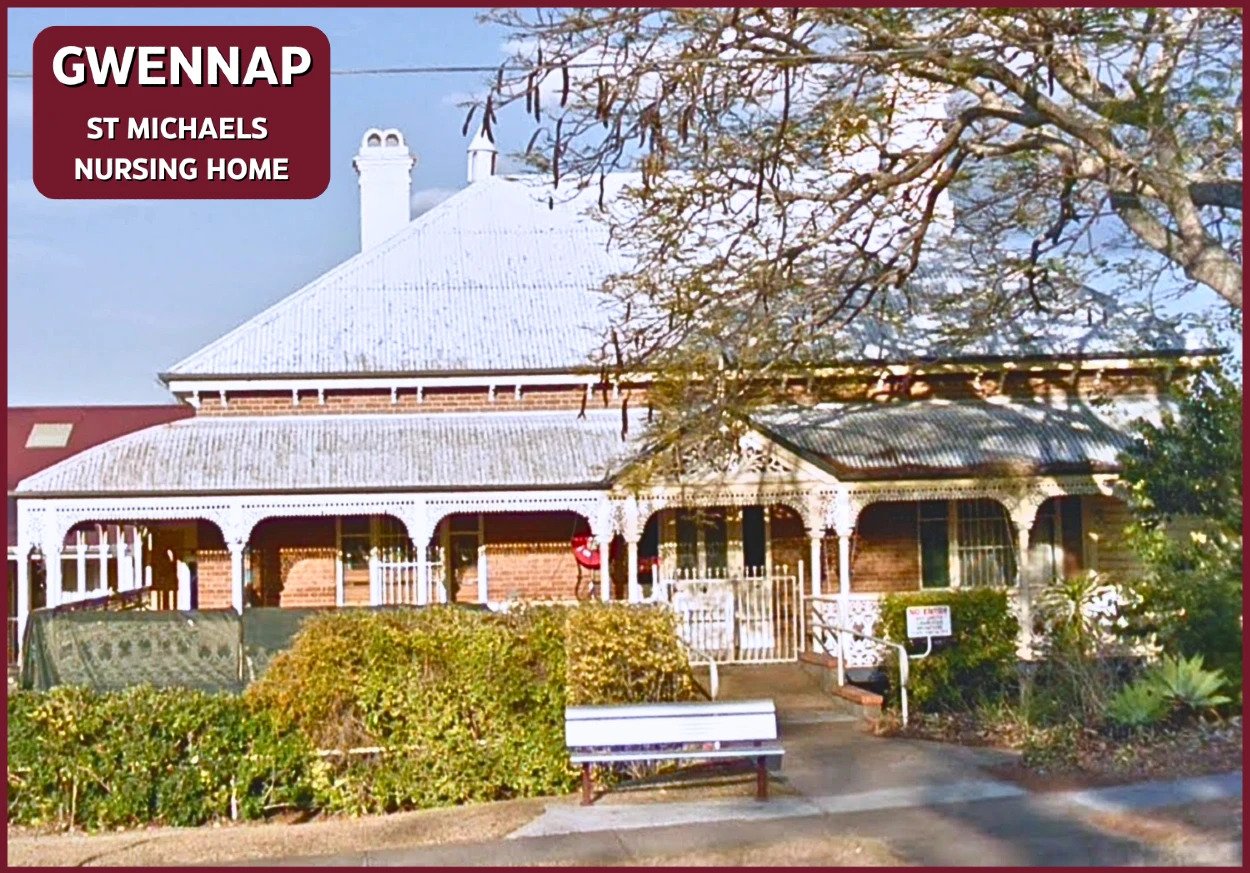
Gwennap is a two storey brick house with a steep iron roof and verandahs all the way around. It is cut into the hill so you see one level from Chermside Road and two levels from the back.
- Type. Gwennap is a brick house built ~1874 in a formal style with wide verandahs for shade.
- Brick. It uses solid brick walls, not timber boards, which sets it apart from many later Queenslanders.
- Height. It is a true two storey home, which was unusual in Ipswich at the time.
- Shape. The main body is roughly square, with rooms grouped around the middle.
- Roof. A steep pyramid roof of corrugated iron sits over the square core.
- Cut in. The site was heavily excavated, so the house sits down into the hillside.
- Verandahs. Verandahs wrap around the house on both levels, giving shade and outdoor sitting space.
- Enclosed parts. The rear and southern verandahs have been enclosed with walls and windows to create more internal rooms.
- Front entry. A timber fretwork pediment and paired posts mark the main front door on the upper verandah.
- Iron lace. The upper verandah still carries cast iron balustrades and a decorative iron fringe.
- Roof bits. Several brick chimneys, two metal roof vents and paired timber brackets under the eaves break up the roofline.
- Hall. Inside, a large entrance hall runs from the front door through to the back of the original house.
- Foyer. A short timber screen near the front door forms a small foyer but does not reach the ceiling.
- Ceiling. Above the hall is a high vaulted ceiling in dark timber boards running the full length of the space.
- Hall use. The hall is big enough that it likely doubled as a place for gatherings as well as a passage.
- Mantel. An ornate timber mantelpiece with a mirror now sits on the left wall inside the foyer after being moved from a main room.
- Main rooms. The upper floor has four main rooms opening off the central hall.
- Sitting room. To the right of the entrance is a sitting room with large timber window frames to the verandah and a fireplace on the inner wall.
- North side. Two large rooms on the northern side have doors from the hall and out to the verandah.
- Corner room. Another room fills the south east corner at the back of the upper floor.
- Extra rooms. The enclosed southern verandah now holds two small rooms off the main space.
- Downstairs. The lower level under the main house provides more rooms and service areas.
- Old timber. Most of the original timber windows and doors remain in place.
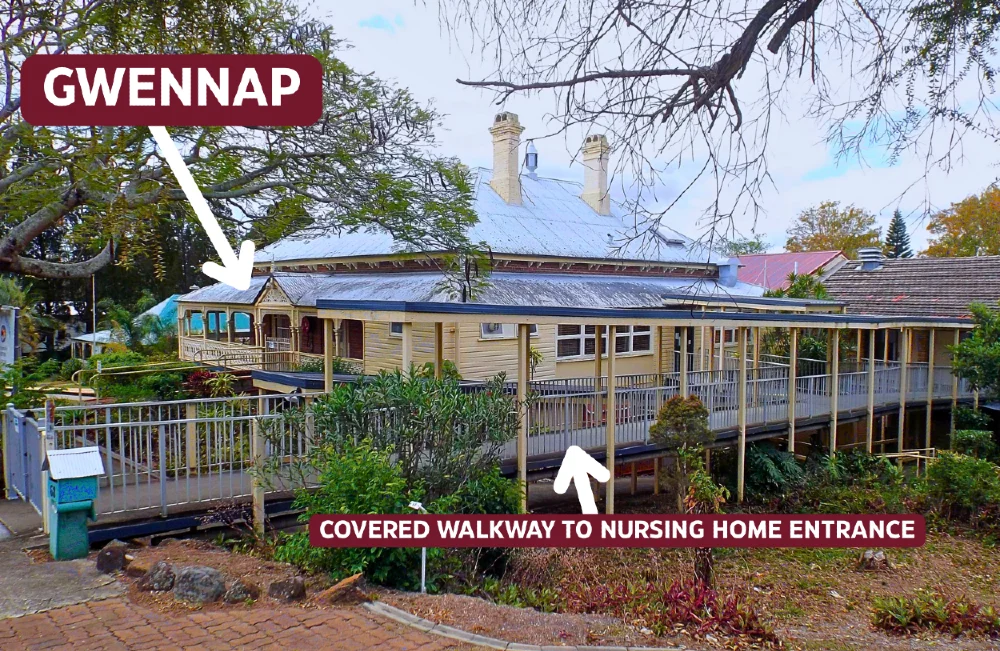
- Rear wings. Later nursing home wings in brick and concrete run out at right angles from the back of the house.
- Setback units. Extra units on the north and south sides of the block sit well back from the street, so the old house still leads the view.
⏳ Through the Years
Highlight
Gwennap began as a timber man’s home, then became the Tatham family’s place, and from ~1950 has worked as St Michael’s nursing home and care complex. The wider site is still in care use and last sold in 2014. It is currently operating as Lilliput Caring.
- Move to Brisbane. In the ~1890s Josias Hancock moved from Ipswich to Brisbane to grow his timber business.
- Timber firm. His firm traded as Josias Hancock Timber Merchant, then Hancock and Sons and later Hancock and Gore.
- Leaving. When Josias left town the Hancock family’s time at Gwennap came to an end.
- New owner. Bookseller William Tatham later bought Gwennap and shifted there from his earlier home “The Palms” on Denmark Hill.
- Tatham story. Tatham came from Yorkshire, worked at Cribb and Foote and then opened his own bookshop on what is now the Woolworths site in the CBD.
- Family years. Under the Tathams, Gwennap stayed a family home through the early 1900s.
- Daly purchase. ~1950 Mr M Daly bought the property.
- Nursing use. After that sale the house was turned into a nursing home.
- Name change. With the new use the house took on the name St Michael’s (sometimes St Michaels).
- Church era. In July 1970 the nursing home was bought by the Presbyterian Church’s Department for Social Mission.
- Architects. New nursing home wings were designed by Fulton, Gilmour, Trotter and Moss.
- Complex name. Government listings refer to the wider site as St Michael’s Aged Persons Complex at 68 Chermside Road.
- Care use. Recent business records show Lilliput Caring, a disability and care service, based at 68 Chermside Road.
- Block size. Property data records the block at 4,906 m² in area.
- Profile. Real estate profiles treat the main holding as a five bedroom house for listing purposes, even though it runs as a complex.
- Sale price. In December 2014, 68 Chermside Road sold for about $1.925 million.
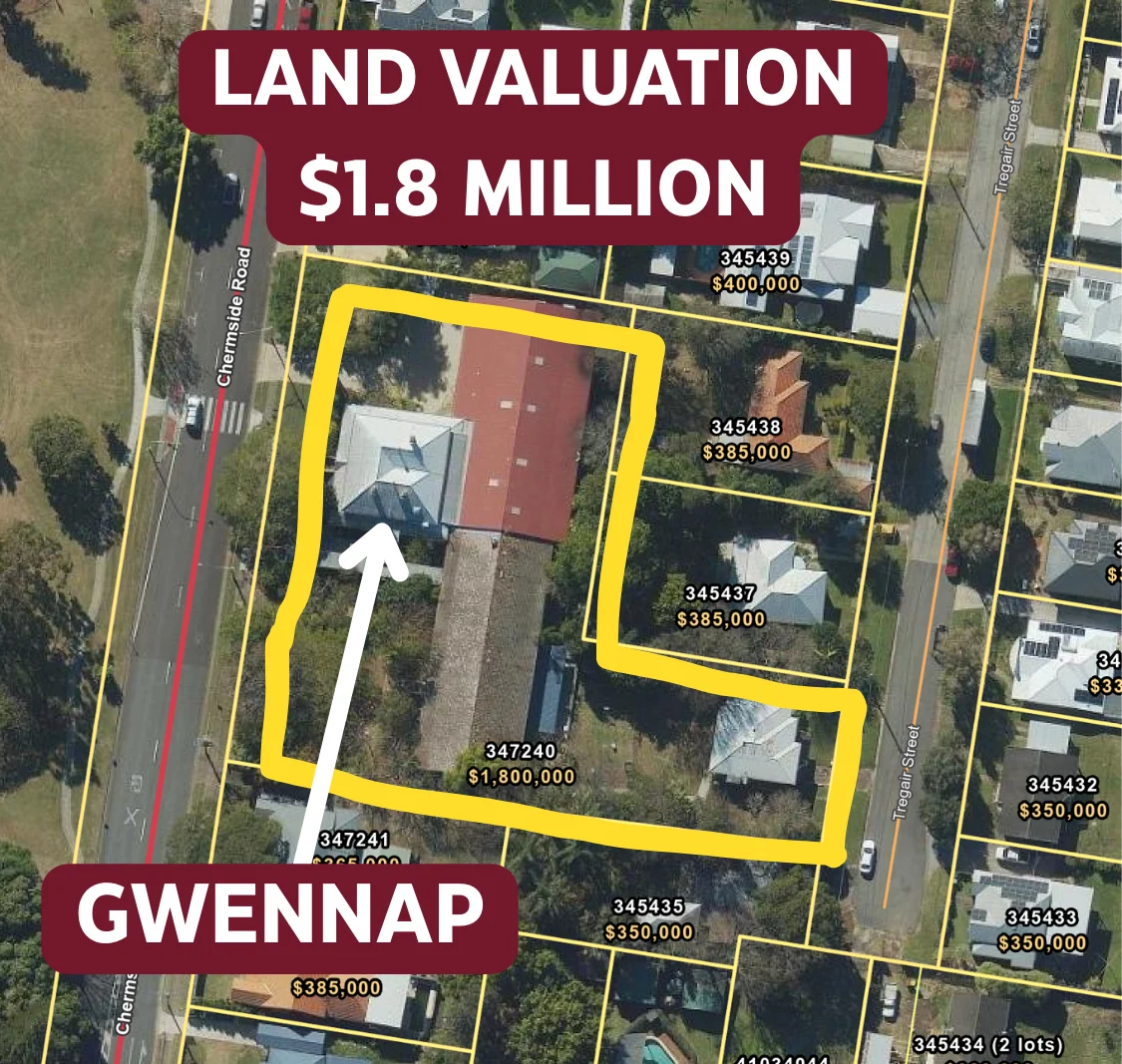
The current unimproved land valuation in 2025 is $1.8 million.
- Off market. Property sites now show the address as off market but still list its land size, past sale and care use.
🛠️ Renovations & Restorations
Highlight
The big changes came when Gwennap became St Michael’s. New wings went on the back and some verandahs were closed in, but the core brick house and most of the old timber work are still there.
- Conversion. ~1950 Gwennap was converted from a family home into a nursing home.
- Name. At the time of conversion the house took the new St Michael’s name.
- Rear build. New nursing home wings were added off the rear of the old house to create more rooms.
- Design team. The firm Fulton, Gilmour, Trotter and Moss drew up the plans for these wings.
- Construction. The added wings use brick and concrete and run at right angles to the original house.
- Extra units. Extra units on the north and south sides of the site were added but kept back from the street so the old house still fronts Chermside Road.
- Verandah infill. The rear and southern verandahs were enclosed, turning open deck areas into indoor rooms.
- New rooms. Two smaller rooms were formed on the enclosed southern verandah upstairs.
- Mantel move. An ornate timber mantelpiece with a mirror was moved from one of the main rooms to the foyer wall near the entrance.
- Core layout. Heritage reports say the basic structure of the house has stayed much the same despite later fit outs.
- Old joinery. Most of the original timber windows and doors are still in place in the main house.
🌟 Why it Matters / Heritage Importance
Highlight
Gwennap is on the Queensland Heritage Register and anchors a key stretch of Chermside Road. It links Ipswich’s timber story, Newtown’s growth and many years of nursing and disability care on the hill.
- Listing. The place is on the Queensland Heritage Register as St Michael’s Nursing Home, also recorded as Gwennap.
- Date. It was added to the state heritage register on 21 October 1992.
- House type. The listing describes it as a stand alone house built ~1874.
- History value. It shows how Ipswich business families built big homes during the town’s growth in the late 1800s.
- Design value. It is valued as an early two storey brick house set into a deeply cut site with wide verandahs.
- Street role. The house is one of several important Chermside Road buildings opposite Queen’s Park and near Ipswich Girls’ Grammar that give the ridge its character.
- People link. It has clear ties to the Hancock family of timber merchants who first built it.
- Tatham link. It is also linked to the Tatham family, who moved from The Palms to Gwennap in the early 1900s.
- Care story. Its long use as a nursing and care place gives it social value for locals who know it in that role.
- Surviving house. The heritage entry notes that the core fabric of the old house, including layout and many fittings, is still largely intact.
Sources
- St Michaels Nursing Home. Wikipedia.org.
- St Michael’s Nursing Home wing. PictureIpswich.com.au