

Penrhyn at a Glance
- Architecture. A rare slate-roofed brick cottage with a concave verandah roof built c. 1879.
- Farrelly’s row. Built by John Farrelly as one of four adjoining brick houses at 109 (Colthup’s House), 107, 105 and 103 (Penrhyn) Limestone Street.
- Legacy. Best known as Penrhyn, a long standing Denmark Hill landmark now protected on the Queensland Heritage Register.
🔢 By The Numbers
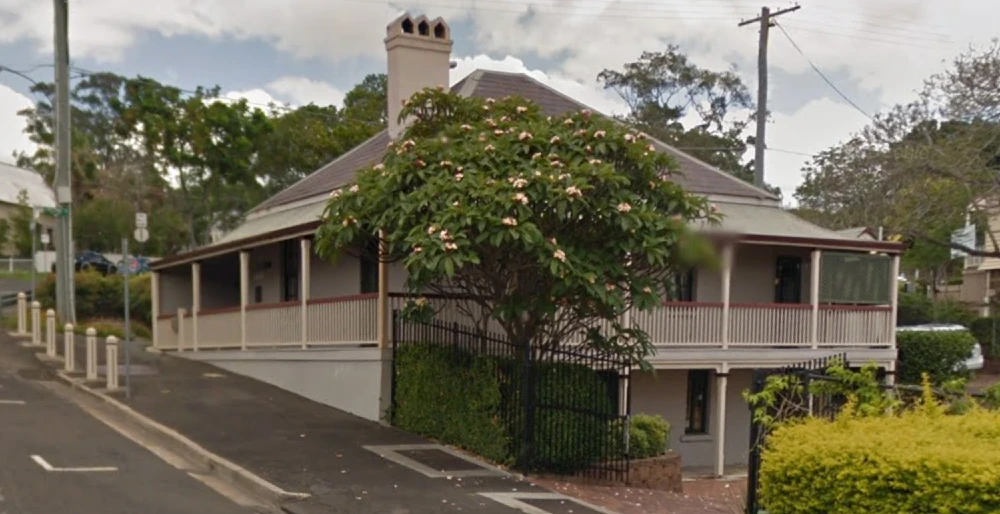
- Address.: 103 Limestone Street, Ipswich.
- Heritage Listing (21 Oct 1992).: Place ID #600585
- Built.: c. 1879
- Land.: 484 m² block on the slope of Denmark Hill
- Storeys.: 2 levels, with a street floor and a lower ground floor
- Rooms.: 4 main rooms on the street level
- Fireplaces.: 3 fireplaces across the two levels
- Row.: 1 of 4 adjoining brick houses at 109, 107, 105 and 103 Limestone Street
- Sales.: Sold in 1973 for $15,000, in 1991 for $85,000, in 2005 for $360,000 and in 2012 for $475,000
Penrhyn is a brick-and-slate cottage that looks like it slipped in from another century.
Its rare, deep concave verandah roof curves all the way around, and the whole place feels more like an old sketch come to life than a standard Ipswich house.
John Farrelly built it as part of a row of 4 brick homes on the bottom side of Denmark Hill, reusing bricks from earlier buildings to give it that timeworn look.
Today you can still see the clever way it hugs the slope, with a lower level tucked under the street front.
One of the quirkiest details is out front: over the years the road was raised so much that the verandah now sits below the footpath.
From the street you look down onto this little brick hideaway, a rare survivor that can still turn heads on Limestone Street.
See for yourself. Have a walk around Penrhyn:
📜 Origins & History
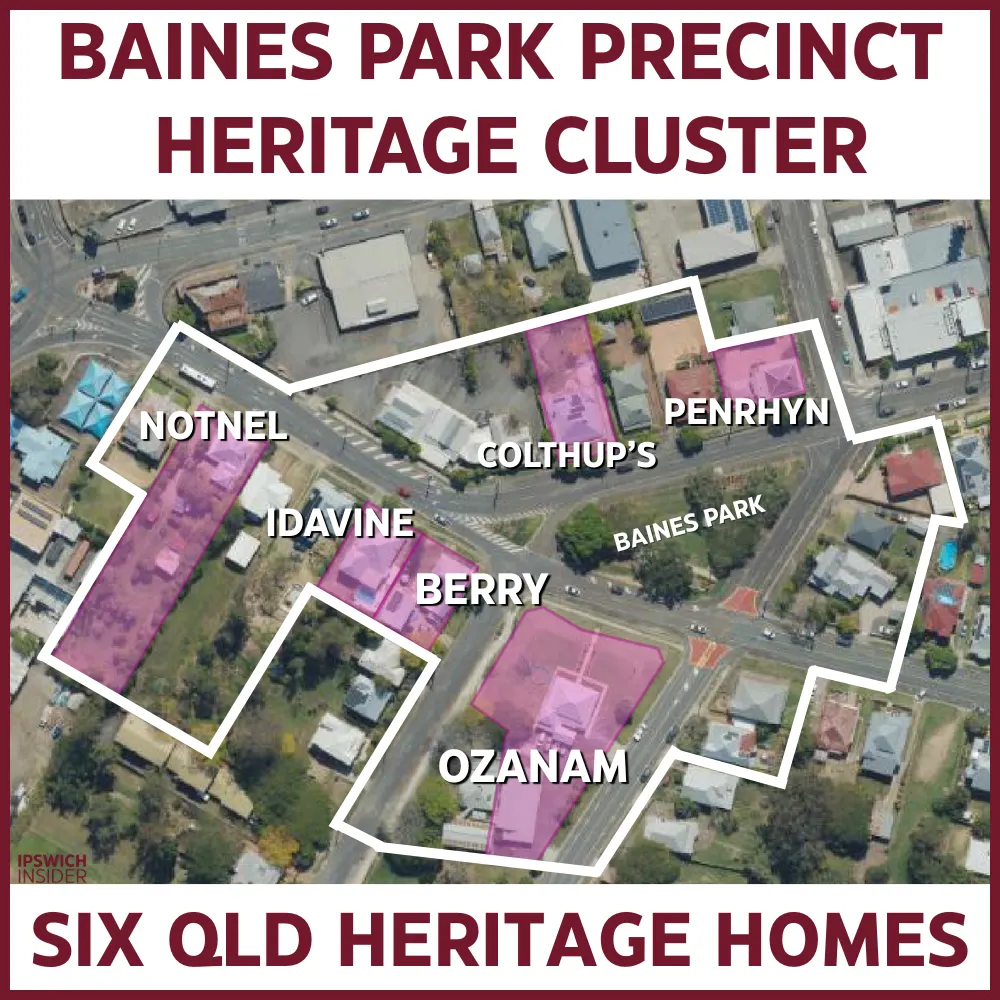
Highlight
A late Victorian brick cottage at the base of Denmark Hill began as a builder’s investment and soon became a family home. Its first years set the tone for a long, steady life in central Ipswich.
- Place. The house stands at 103 Limestone Street on the slope of Denmark Hill.

Notice the 4m elevation gain from the entrance side of Penrhyn on Waghorn St to Limestone Street.
- Date. The home was built circa 1879.
- Builder. It was built by John Farrelly, who worked in Ipswich as a builder and later an architect.
- Land. In 1875 Farrelly bought four adjacent lots on Limestone Street.
- Tenancy. Number 103 was first rented before the owners moved in.
- Residence. John and Susan Farrelly lived at No. 103 from about 1884.
- Roadworks. In 1881 Farrelly lodged a complaint about the street being filled up outside the property.
🏗️ Architecture & Design

Penrhyn c.1977 (Source: Picture Ipswich)
Highlight
A compact brick cottage with a slate cap and deep verandahs is tailored to a steep site. Inside are simple rooms, pressed metal ceilings and sash windows that show solid local workmanship.
- Form. A compact brick cottage with a hipped slate roof and encircling verandahs.
- Verandah. A concave corrugated‑iron verandah roof wraps all four sides.
- Finish. Walls are rendered and ruled to resemble stone courses.

Penrhyn Jul 1997 (Source: Flickr via Queensland State Archives ID Series 20380)
- Plan. The street level has four main rooms opening to verandahs.
- Slope. The site drops to a lower ground level at the rear with two service rooms.
- Bath. An early cement bath survives in the undercroft.
- Ceilings. The main rooms have pressed metal ceilings, three with a gentle vault.
- Windows. Most are 6‑over‑6 sash windows with recessed exterior panels.
- Fireplaces. There are two fireplaces upstairs and one downstairs.
- Structure. Foundations mix brick piers and stone, with one wall carried on a timber log.
- Materials. Some building fabric was reused from earlier structures.
- Site. The lot area is 484 m².
- Comparative. Unlike most local houses of the era, this dwelling is masonry rather than timber.
⏳ Through the Years
Highlight
The house moved from its founding family to new owners and then through long spells of rental before modern sales. A clear line of dates marks each phase.
- 1904. John Farrelly died at the house on 20 August 1904.
- 1908. Susan Farrelly died and the properties were auctioned later that year.
- 1909. The property was purchased by the Watson family, who lived there for more than three decades.
- 1941. Robert P. Watson’s funeral was held from the Limestone Street home.
- Mid-century. The house spent years as a rental.
- 1973. The property sold for $15,000.
- 1991. The property sold for $85,000.
- Early 1990s. Conservation work converted the house into a professional office.
- 2005. The property sold for $360,000.
- 2012. The property sold for $475,000.
- Recent. 103 Limestone Street is the head office address for Children First Early Learning Centre.
🛠️ Renovations & Restorations
Highlight
Most change involved verandahs and services. A 1990s project removed intrusive add‑ons and added a small rear wing to house modern amenities.
- Front. The verandah along Limestone Street sits below the footpath and is enclosed.
- Mid‑century. Owners progressively enclosed verandah sections to gain extra rooms.
- Roof. The house has kept its slate roof.
- 1990s. A careful restoration reopened many verandah sections.
- Extension. A small western wing was added for kitchen and bathroom functions.
- Adaptation. The building was fitted for professional office use.
- Services. Electrical and other services were upgraded with minimal change to original fabric.
- Integrity. Most original elements remain and later changes are largely reversible.
🌟 Why it Matters / Heritage Importance
Highlight
The house is protected at state level for uncommon fabric and for its local story. It helps define the Denmark Hill streetscape as part of a small brick group.
- Listing. The place is on the Queensland Heritage Register as entry 600585.
- Date. The listing took effect on 21 October 1992.
- Rarity. It is an uncommon brick and slate cottage with a concave verandah roof.
- Group. It forms part of a coherent set of four brick houses on Limestone Street.
- Streetscape. The house contributes to the historic Denmark Hill and Baines Park precinct.
- Association. It has a special link to John Farrelly as his project and one‑time home.
- Marker. A Council heritage plaque was installed in 2006.
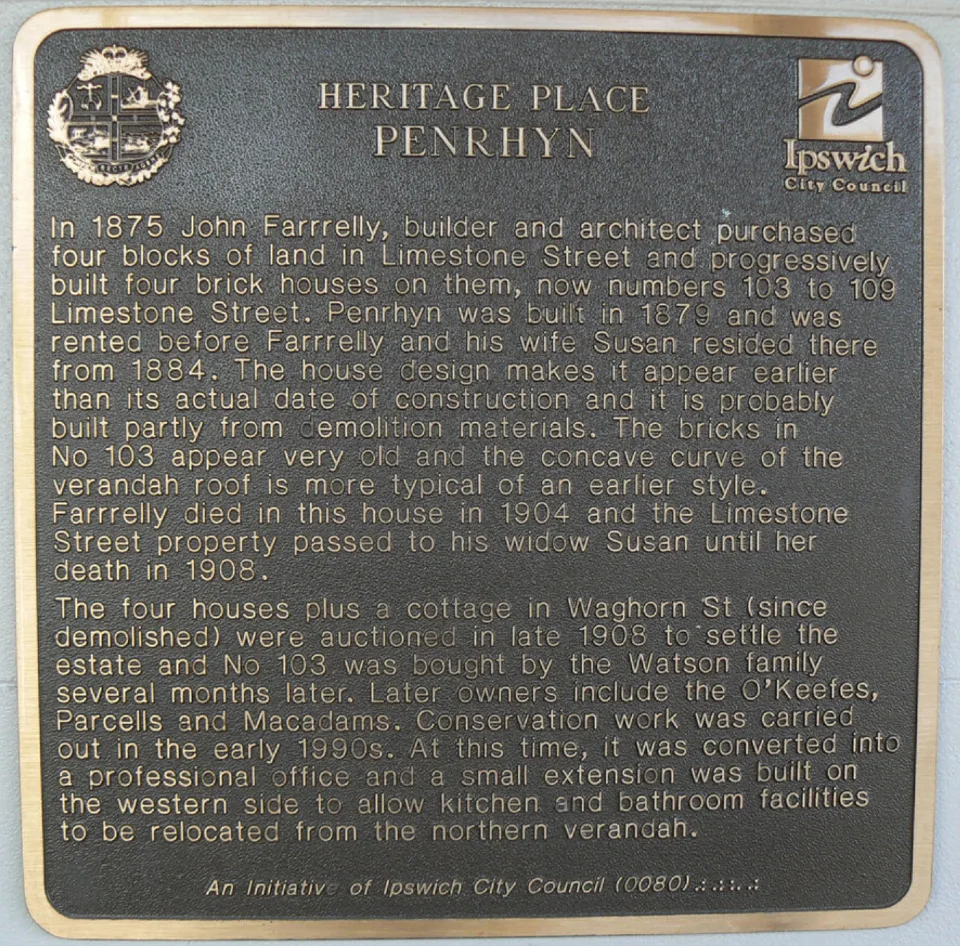
Penrhyn Historical Marker (Source: Picture Ipswich)
- Condition. The building is in stable condition.
Sources
- West Ipswich – Ipswich Heritage Study 1992 Volume 4. PictureIpswich.com.au.
- Penrhyn, Ipswich. Wikipedia.org.