

Beau‑Guest (formerly Orangefield) at a Glance
- Mid‑Victorian brick. Built c.1870 by William Hancock for himself. Sold to orchardist J. A. Jackes in 1875.
- Orchard homestead. The orchard spanned south down the hill toward Cemetery Rd and grew custard apples, persimmons, mangoes, oranges, figs, and plums.
- Changed & subdivided. The orchard was cut into 65 lots in 1914. The house later gained rendered walls and a columned porch. Home building in Orangefield Estate lagged—few houses by 1946, most added after the war.
🔢 By The Numbers
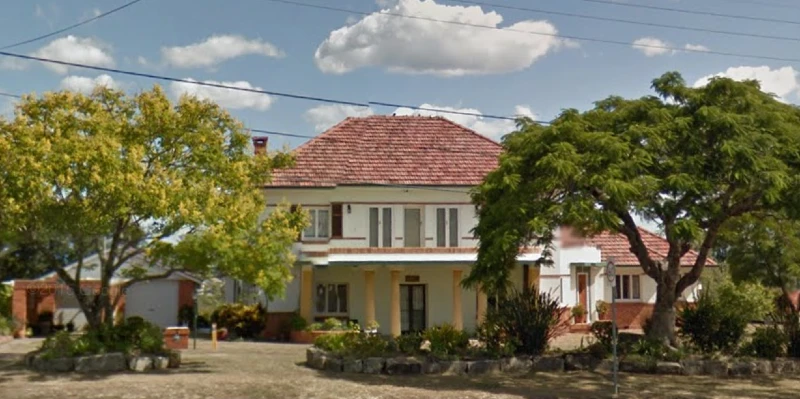
- Address: 59 Salisbury Road, Eastern Heights, Ipswich
- Built: c. 1870
- Sold: 16 Aug 1875
- Storeys: 2 (noted by 1882)
- Orchard: about 20 acres
- Auction plant: 14 working bullocks (1886)
- Subdivision: 65 allotments (1914)
- Orangefield Estate Aerials: 1946 mostly empty → 1955 built out
- Lot: 1,056 m² (current site)
- Changes noted: 1991 photo shows render and columned porch
📌 House Name Over Time
Orangefield (c.1870–late 20th C) → Beau‑Guest (in public use by 2010; owners sometimes style it “Beauguest”). We use Beau‑Guest for present‑day references and Orangefield for the historical narrative and the 1914 Orangefield Estate subdivision.
You know the house at the top of Salisbury Road, looking over Limestone Park?
That’s Beau‑Guest — historically known as Orangefield.
Built around 1870 as a two‑storey brick homestead, it sat at the top of a 20‑acre orchard stretching down the hill toward Cemetery Road—custard apples, mangoes, oranges, figs, and more.
The orchard was subdivided into residential blocks in 1914, known as the Orangefield Estate, but it stayed mostly empty paddocks until houses filled it after World War II.
Today, Beau‑Guest has an Art Deco‑style facelift—smooth render, neat horizontal lines, columns out front. But beneath it all is that same solid, mid‑Victorian brick homestead that’s watched Eastern Heights slowly transform into suburbia.
Take a walk around:
📜 Origins & History
📌 Highlight
A brick homestead (then known as Orangefield, today Beau‑Guest) was built on Salisbury Road in the early 1870s for a prominent Ipswich builder. Within a few years it passed to the Jackes family, whose thriving orchard gave Orangefield its name and local fame by the 1880s.
- Built. The home was constructed around 1869–1870 for builder William Hancock.
- Sold. Hancock sold the property to James Alexander Jackes on 16 August 1875.
- Name. The property became known locally as Orangefield during the Jackes family’s ownership.
- Location. At the time, it was situated on Ipswich’s quiet, semi‑rural eastern edge.
- Orchard fame. By 1882, the Orangefield orchard was praised publicly for its impressive growth and careful cultivation methods.
- Techniques. Jackes grafted trees onto hardy orange rootstock and used raised mounds for drainage.
- Crops. The orchard produced oranges, mandarins, lemons, grapes, pears, and apples.
- Market. Orangefield fruit was sold widely across Queensland.
- Correction. Claims that the house was built specifically for J.A. Jackes in the 1860s are incorrect.
🏗️ Architecture & Design
📌 Highlight
The house now known as Beau‑Guest (historically “Orangefield”) is a historic brick homestead documented as two storeys by the early 1880s. The home was built as a practical residence and farm property, including multiple service buildings suited for orchard work.
- Two levels. By 1882, it was noted as a two‑storey home positioned on the hill.
- Construction. Historic records describe it as a substantial brick house.
- Service area. Early records list a separate kitchen, stables, outbuildings, and stockyards.
- Neighbourhood. In 1908, a home named Chasely was built nearby at 51 Salisbury Road, reflecting the area’s evolving style.
⏳ Through the Years
📌 Highlight
After decades as a successful orchard under the Jackes family, Orangefield changed hands in 1907. A large subdivision in 1914 created the surrounding neighbourhood, while the original house remained a private residence.
- Auction. In 1886, Orangefield Orchard was put up for sale, including its brick home and farm gear.
- Farm assets. The sale listed a team of 14 working bullocks.
- Storm damage. A severe hailstorm in 1892 caused major damage to the orchard.
- New owners. In 1907, J.A. Jackes sold Orangefield to Joseph Foote and moved into town.
- Passing. Jessie Jackes sadly died soon after relocating in October 1907.
- Residents. The Foote family was living at Orangefield by late 1907.
- Greenham family. Between 1907 and 1908, the property transferred to the Greenhams.
- Subdivision. In 1914, the Orangefield Estate’s original 20 acres were subdivided into 65 residential allotments.

Orangefield Estate auction, 31 Oct 1914 – 65 garden allotments around the Orangefield homestead, marketed as the “Garden of Ipswich”. Fruit noted in the ad: custard apples, persimmons, mangoes, oranges, figs, plums.
- Views. Promotional material in 1914 emphasised attractive views to nearby Queens Park and the golf course.
- Event. The land auction took place onsite at Orangefield, run by E. Bostock & Sons.
- Special terms. The original homestead was sold with unique financing, while land blocks were available on easy payments.
- Results. At auction on 31 October 1914, twenty blocks sold initially, with the remaining blocks offered later.
- Street names. New roads included Orangefield Street, Jackes Street, and Orchard Street.
- Local growth. In 1922, another estate off Whitehill Road was promoted nearby.
- Bus service. In the late 1940s the Beaumont family operated the Ipswich Bus Service from the top of Salisbury Road near Jackes Street, with their residence, office and bus sheds nearby.
- Post‑war build‑out. Aerial photos show the estate mostly empty in 1946 and filled with houses by 1955—most building happened after World War II.
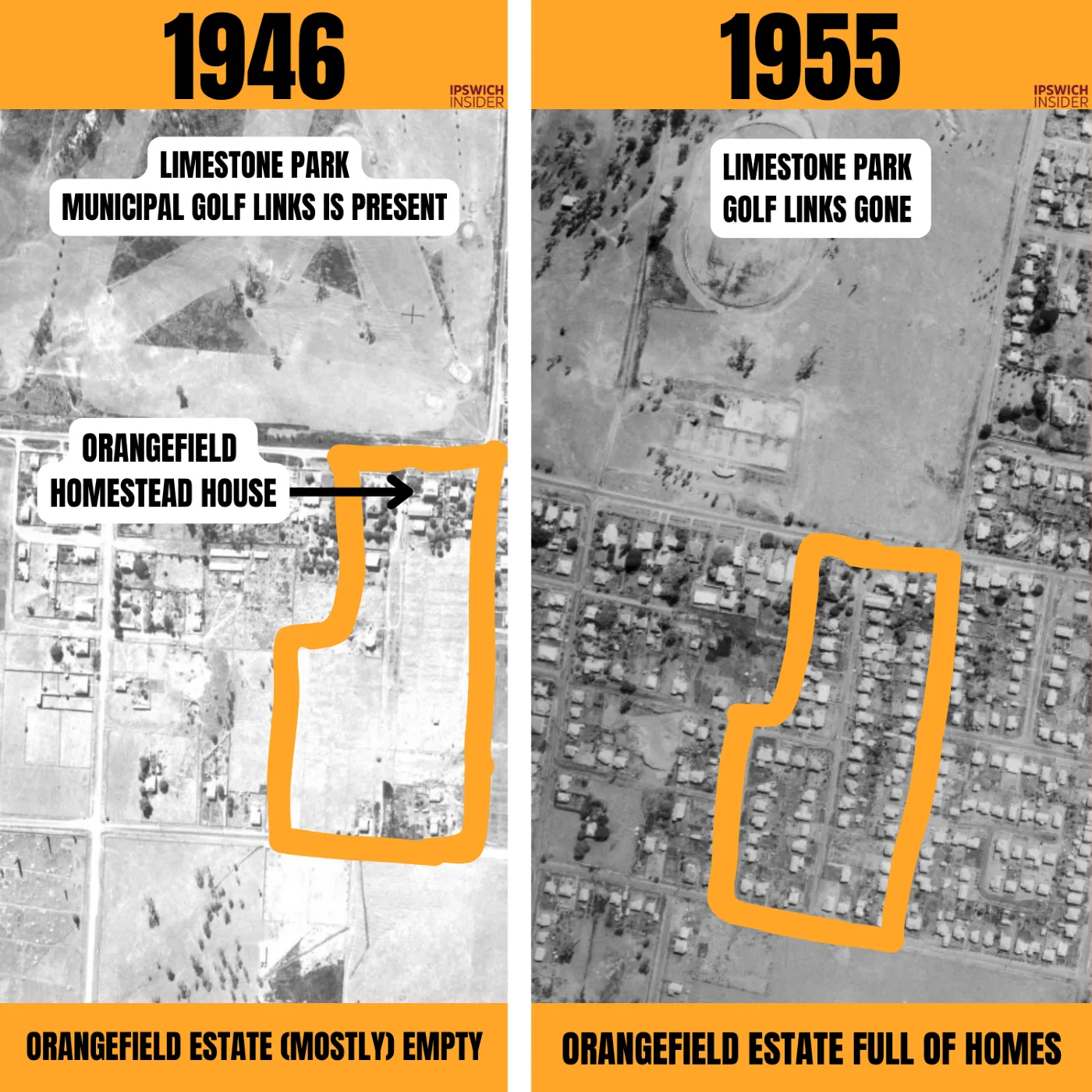
From paddocks to suburb: the Orangefield Estate is mostly empty in 1946 and built out by 1955. The long gap reflects slow take‑up after the 1914 subdivision (WWI, interwar slump, Depression), with a post‑war housing surge.
- Current size. Today, the property sits on about 1,056 m².
- Status. As of 2025, the house remains a private residence.
🛠️ Renovations & Restorations
📌 Highlight
Two main changes visible by 1991—rendered walls and a columned porch—are clearly documented at the house (today Beau‑Guest, then Orangefield). A related architectural plan from 1922 survives for works at the property.
- Rendered walls. The home’s brickwork was covered with render at some time before 1991.
- Front porch. A distinctive columned porch was added, documented by 1991.
- Photos. A clear 1991 photograph shows these two changes in place.
- Plans. An architectural archive contains a 1922 drawing labelled “Residence Orangefield” prepared for L. Greenham.
- Dates unclear. Exact years these renovations occurred are not clearly stated in available sources.
🌟 Why it Matters / Heritage Importance
📌 Highlight
Beau‑Guest / Orangefield uniquely ties together early Ipswich building, orchard industry, and suburban growth. Its local significance is recognised even without formal state heritage registration.
- Local heritage. It is listed on Ipswich’s local heritage register.
- State register. It does not appear on Queensland’s state heritage register.
- Community story. Ipswich library published a blog highlighting the Greenham–Orangefield connection.
- Local pride. The original estate marketing dubbed the area the “Garden of Ipswich.”
Sources
-
- Orangefield, 59 Salisbury Road, Eastern Heights, Ipswich (1991). Picture Ipswich (notes render & porch; built for William Hancock c.1870).
- Salisbury Rd houses, Eastern Heights (1991). Picture Ipswich (Orangefield at No. 59; render and columned porch noted).
- Ipswich Bus Service. Picture Ipswich (Beaumont family; residence/office/sheds at top of Salisbury Rd near Jackes St).
- 2010 Design, Heritage, Environment & Student Awards. Picture Ipswich (lists “Beau‑Guest, 59 Salisbury Road, Eastern Heights”).
- “Orangefield Estate — The Garden of Ipswich” (3 Oct 1914). Queensland Times (auction notice; terms for homestead).
- “ORANGEFIELD ORCHARD … Commodious BRICK DWELLING … A TEAM of Fourteen WORKING BULLOCKS” (28 Aug 1886). Queensland Times.
- UQFL115 — Haenke Collection (UQ), item B.159: “L. Greenham Esq, Residence Orangefield — plan, elevations, section, 1 Dec 1922”. University of Queensland Library.
- 59 Salisbury Rd, Eastern Heights QLD 4305. RealEstate.com.au (lot size ~1,056 m²).
- Toni Risson, Whatever It Takes: The Beaumont Transport Story. State Library of Queensland catalogue.