

Liberty Hall at a Glance
- Origins. Colonial Georgian house built in the late 1850s for Chief Constable Edward Quinn.
- Hostel. QCWA purchased in 1942; operating as the Mary Tregear Hostel by 1947.
- Cellar. Built over a rare full brick cellar that runs beneath the main house.
- Next. Approved in 2022 for adaptive reuse as a medical centre with childcare/café (DA 2703/2022/MCU). Approval includes demolition of post-1946 additions; the 1850s core remains protected by heritage listing.
🔢 By The Numbers
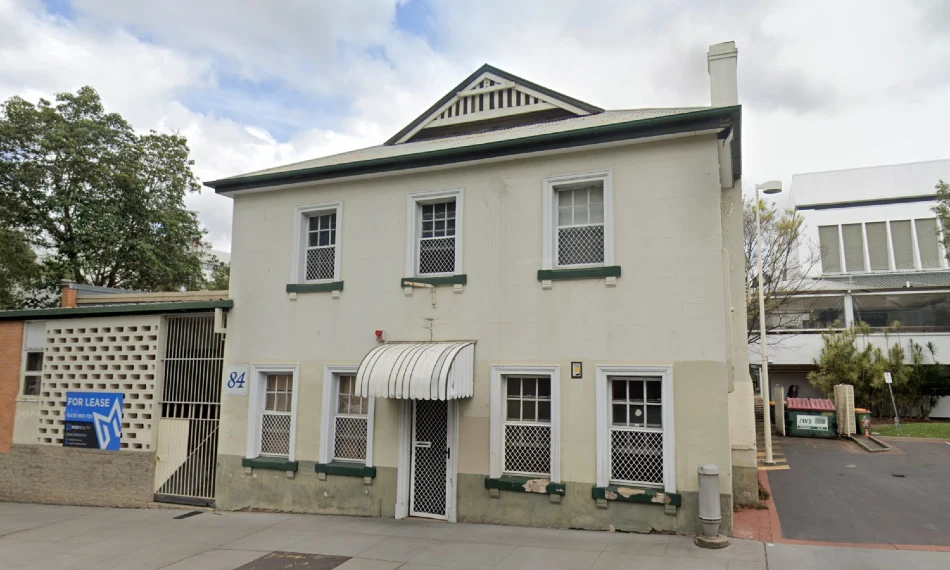
- Address: 84 Limestone Street, Ipswich
- Heritage Listing (1992): Place ID 600583
- Built: Around 1857–1860
- Bedrooms: 7 bedrooms
- Boards: 300 mm (12 in) wide tongue-and-groove partitions
- Rear wing: 1958–1960 rear wing added
- Hall: 1964 brick hall built
- Tenure: 75 years of QCWA ownership
- Mortgage: Cleared in 5 months after purchase
- Sale: Sold in 2017 for about $400,000
At first glance, Liberty Hall is a simple brick box.
Look closer, and you’ll find a rare colonial Georgian home in a city dominated by timber Queenslanders—with a balanced facade, small-pane sash windows, and a full brick cellar tucked beneath.
Long before fridges, this cool underground space stored everything from butter and cheese to preserves, salted meats, and beer.
The name “Liberty Hall” stuck naturally.
Local blacksmith Hugh Campbell opened the doors wide, welcoming friends and neighbours—turning the house into a symbol of easy hospitality.
The Queensland Country Women’s Association (QCWA) purchased the house in 1942, and by 1947 it was operating as the Mary Tregear Hostel providing safe accommodation for country women starting work in the city. In 1949, a plaque was unveiled formalising the name and honouring the Ipswich branch’s first president.
One address, many roles—and a story that still speaks clearly to the city’s heart.
📜 Origins & History
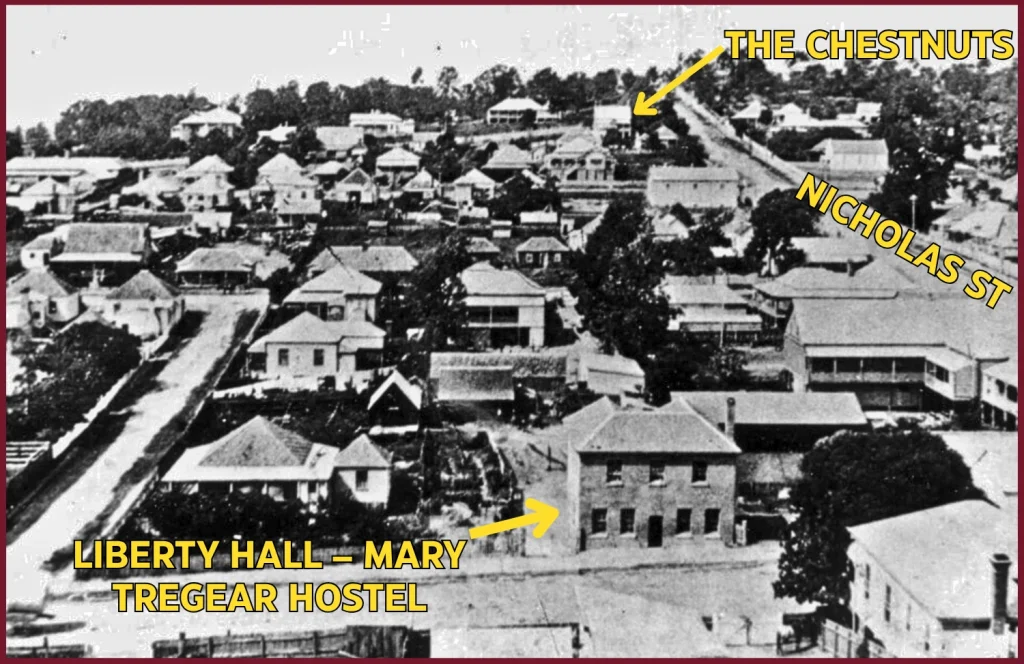
Photo taken from Ipswich Post Office clock tower looking south c. 1903 (Source of image: Picture Ipswich)
Highlight
This mid-1800s house began as a family home in Ipswich’s town centre and soon became part of the young city’s civic life. Its story starts in the era when Ipswich was shifting from frontier outpost to organised municipality.
- Construction. The house was built in the late 1850s and was already standing by 1860.
- Owner. The original owner was Edward Quinn, who served as the town’s Chief Constable.
- Use. It began as the Quinn family home through the 1860s.
- Setting. The address sits in central Ipswich on Limestone Street.
- Context. Ipswich became a municipality in 1860 as coal mining and the river port economy grew.
- Status. It was one of the city’s earliest substantial homes.
🏗️ Architecture & Design
Highlight
A plain, symmetrical brick house with a central hall, small bedrooms upstairs and an uncommon cellar. The design favours sturdy materials and simple lines over showy decoration.
- Style. The design follows a Colonial Georgian approach with symmetry and minimal ornament.
- Fabric. External walls are brick with ruled render to mimic stone blocks.
- Form. The front is symmetrical with a central door and aligned windows.
- Roof. The roof is corrugated iron, and the overall roofline has changed slightly over time.
- Windows. Windows are small-pane sash types with simple plaster frames, and there is a single chimney.
- Plan. A central hallway runs from the front door to a stair, with rooms on each side.
- Rooms. Upstairs holds five bedrooms, while downstairs had two bedrooms plus sitting and dining rooms.
- Joinery. Inside features include a simple cedar stair and a painted cedar mantel.
- Partitions. Upper-floor partitions use 300 mm vertical tongue-and-groove boards with ledged doors; upstairs ceilings are also board-lined.
- Cellar. A full brick cellar extends under the main house, unusual for Ipswich’s climate.
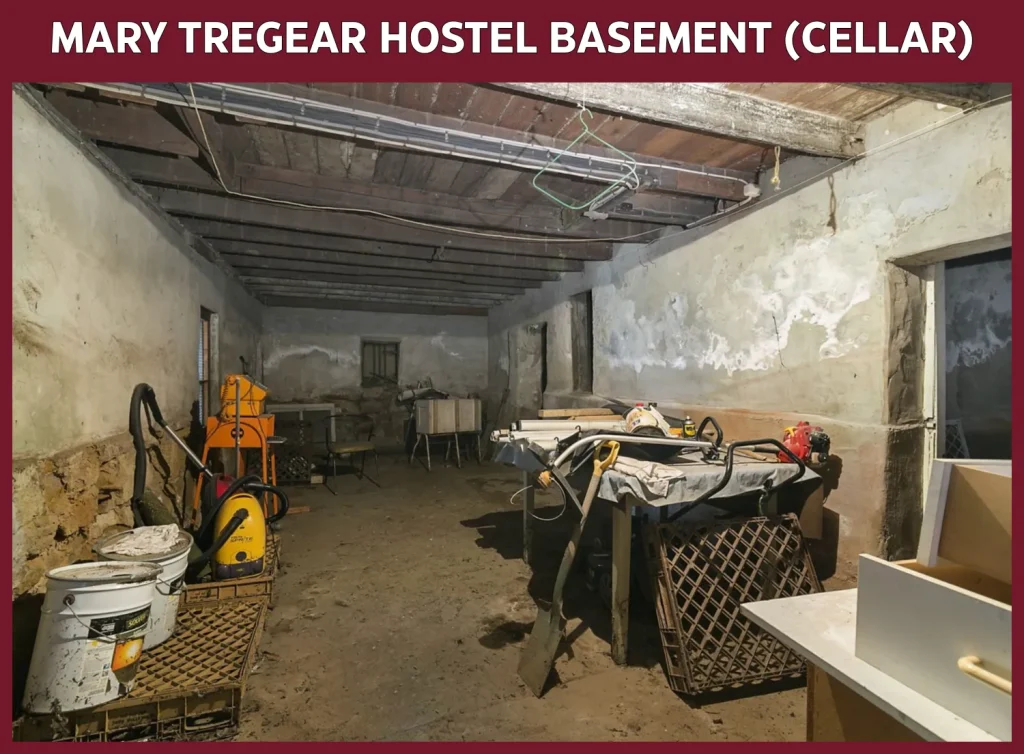
- Photo. The 1850s cellar under the main house — earth floor, lime-washed masonry, and a small ventilation slit.
- Contrast. Unlike verandahed Queenslanders, this house has no front verandah and keeps a boxy plan.
- Peers. It aligns more with early in-town homes like Claremont and Notnel than with ornate mansions such as Gooloowan.
⏳ Through the Years
Highlight
Ownership moved from a police official to a pioneer family and then to the QCWA, which ran a long-serving women’s hostel. In recent years it changed hands again with intent for careful reuse.
- Sale. In 1877 the property was sold to James Sloan.
- Title. After James’s death around 1887, title passed to Helena Sloan.
- Tenancy. In the late 1880s–1890s Hugh Campbell lived here as a tenant, and locals called the house “Liberty Hall.”
- Purchase. On 1 July 1910 Hugh Campbell’s sons purchased the property, keeping it in the family.
- Succession. The Campbell smithy closed in 1916; Hugh died in 1917; by 1919 William Campbell was sole owner.
- QCWA purchase. 1942 — QCWA bought the house; hostel use established under QCWA.
- Mary Tregear Hostel. 1947 — operating publicly as a women’s hostel; 1949 plaque unveiled naming it in honour of the Ipswich branch’s first president.
- Service. From the 1950s to the 1980s it housed young working women and offered emergency accommodation.
- Offered for sale. Aug–Oct 2017 — auction and sale listings.
- Sold. 23 Sep 2021 — $440,000 (private sale).
- Sold. 1 Jul 2024 — $650,000 (private sale).
- Today. In the 2020s the hall continued to host QCWA events by arrangement, while the house awaited restoration under adaptive-reuse plans.
2022 Development Approval & Current Status

Approved 14 Sep 2022 (DA 2703/2022/MCU) for mixed medical/community use beside and behind the heritage house. The 1850s core is retained; the 1960 rear wing and 1964 hall may be removed. The new building steps up to four storeys with a basement.
- Applicant: Gibson Property Pty Ltd (c/- LandPartners) — not QCWA.
- Currency: 6 years from decision (live through 2028 unless extended/acted on).
- Parking: Minimum 10 on-site spaces (Condition 13).
- Streetscape: tree/planter seat and bike racks on Limestone St; Operational Works required (Condition 20).
- Heritage oversight: SARA concurrence for a Queensland heritage place; artist impressions included in approved plans.
- Full Development Application
🛠️ Renovations & Restorations
Highlight
Upgrades focused on making the place work as a hostel: bathrooms, a rear service wing and a side hall. Even with these changes, the 1850s core and layout remain largely intact.
- Amenities. Mid-20th-century updates added indoor bathrooms, including an upstairs powder room.
- Extension. Around 1958–1960 a rear wing added a kitchen, dining room, laundry and more bathrooms.
- Materials. The rear addition sits lower on stumps with fibro shadow-line cladding and casement windows.
- Hall. In 1964 a timber army hut was replaced by a brick QCWA hall along the eastern boundary.
- Subdivision. Also in 1964 the site was subdivided and a coal research laboratory was built on the severed portion.
- Ceilings. Ground-floor ceilings were refitted with fibro sheets and cover strips, while upstairs kept timber board ceilings.
- Roofline. The overall roofline changed slightly over time, yet the symmetrical form remained.
- Services. Electrical and plumbing services were progressively upgraded during hostel years, with later air-conditioning and switchboard improvements.
- Entrance. A small metal canopy was added over the front door in a later period.
- Integrity. The main two-storey brick core, layout, stair, windows and partitions remain substantially original.
🌟 Why it Matters / Heritage Importance
Highlight
This rare early Ipswich home later became a lifeline for women and girls. Its simple Georgian face still adds character to Limestone Street, and its story links law, trade and community care.
- Listing. It was added to the Queensland Heritage Register on 21 October 1992 (Place ID 600583).
- Rarity. It is a rare Georgian town dwelling in Queensland with a two-storey masonry form and cellar.
- Streetscape. The house contributes aesthetically to Limestone Street through its simple, balanced facade.
- Associations. It has strong ties to Edward Quinn, the Campbell family, the QCWA and Mary Tregear.
- Social role. For decades it provided supervised and emergency accommodation for women and country girls.
- Themes. It illustrates early settlement, community services and women’s welfare in Ipswich’s history.
- Condition. In the 2020s the place stands intact and awaits conservation and sensitive reuse.
Sources
- Liberty Hall | Mary Tregear Hostel. PictureIpswich.com.au.
- Liberty Hall, Ipswich. Wikipedia.org.
- 150-year-old mystery hidden under Ipswich’s CBD. IpswichFirst.com.au.
- 84 Limestone Street – sold history. realestate.com.au.