
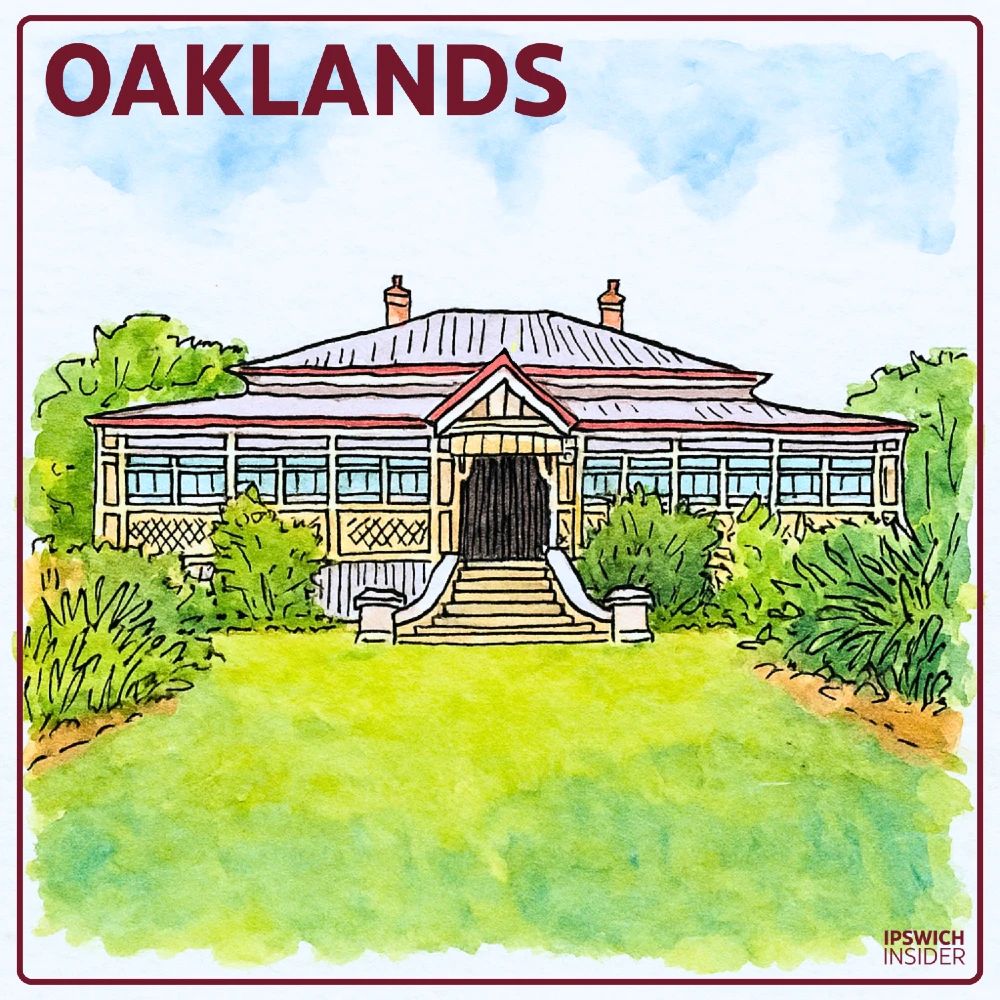
Oaklands at a Glance
- Architecture. Timber Queenslander villa built 1895–1897 for John and Elizabeth Wright on 1.42 ha.
- Purpose. Built beside Perseverance Colliery and Tivoli School to house the Wrights near their coal operations.
- Today. Private residence today, owner occupied since 2015 sale, protected in Queensland Heritage Register group listing since 2004.
- Legacy. Morgan family held Oaklands for almost a century, from 1926 until its sale in 2015.
🔢 By The Numbers

- Address.: 100 Mount Crosby Road, Tivoli
- Heritage Listed (30 Jan 2004): Place ID #601898
- Built.: 1895–1897, standing by January 1898
- Land.: 1.42 hectares across 2 lots (about 3.5 acres)
- Group.: 1 of 3 heritage listed Wright Family Houses
- Ownership.: Morgan family stewardship for 89 years
- Sale.: Sold by auction 25 July 2015 for about $650,000
- Verandah.: Partly enclosed with coloured sash windows by 1919
- Extension.: Large rear addition in the 1970s created a dining room
- Wedding.: Isabella Wright married here on 10 July 1909
Oaklands is the showpiece in a rare 3 house listing called the Wright Family Houses. 3 neighbours treated as one heritage overlay.
It is a Federation Queenslander with a balanced front and a tall finial. The verandahs were enclosed with coloured glass that still catches the light.
Built for the Wright colliery family during Tivoli’s coal boom, the trio survives side by side. Oaklands leads. The other two echo it. That street scale is why the listing protects the group, not just one house.
Take a walk around Mt Crosby Rd.
Your starting point is Oaklands (c.1898). Go right and you’ll arrive at Wrightson (c.1903). Go left and you’ll arrive at 98 Mt Crosby Rd (c.1903). All part of the Wright Family Houses group heritage listing.
📜 Origins & History
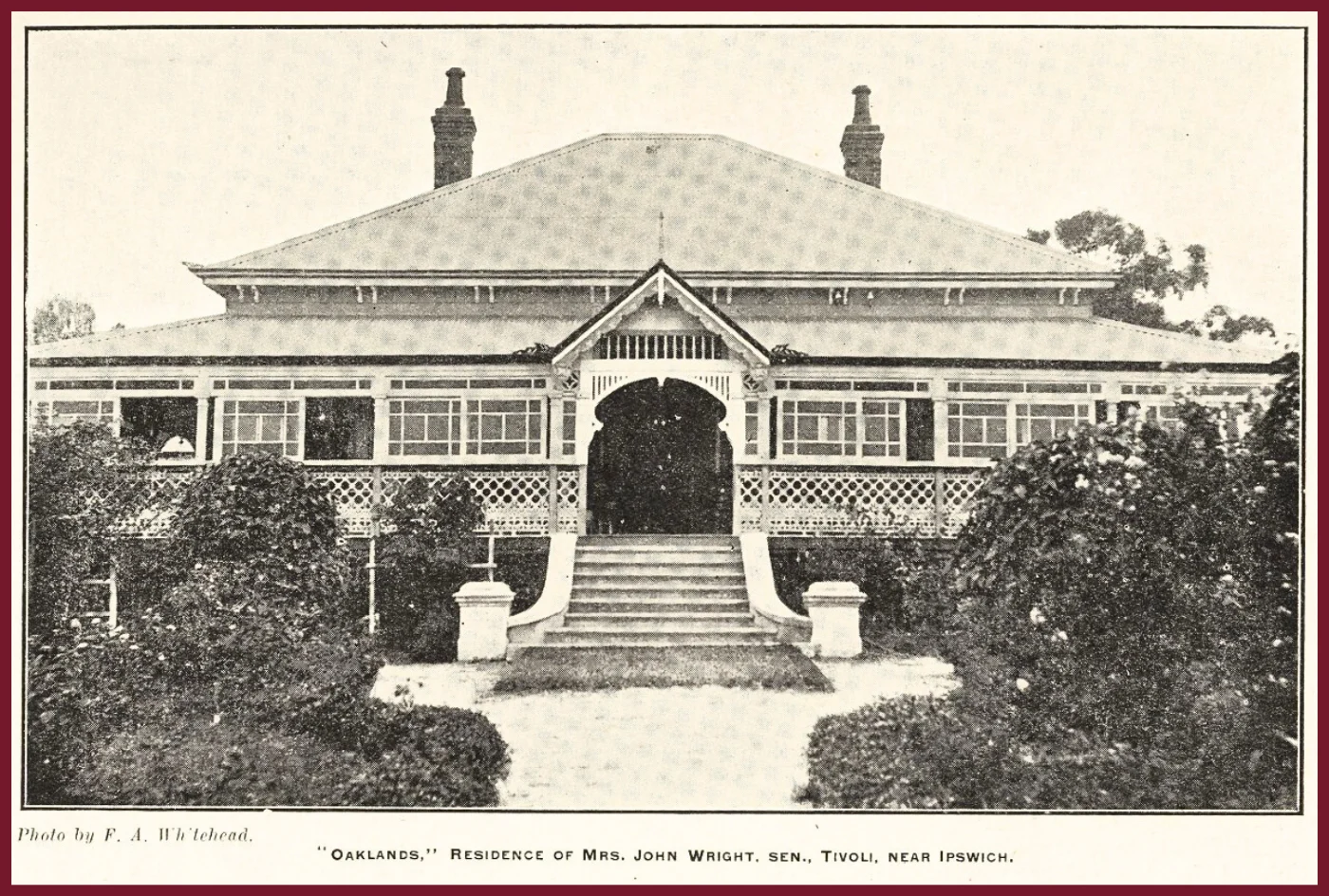
Oaklands in Tivoli, the Wright family’s main home on Mt Crosby Road, pictured about 1919. The elevated Queenslander shows its enclosed verandahs and central stair, the showpiece of the three Wright houses. (Source: F. A. Whitehead. “Oaklands, Tivoli, near Ipswich,” c.1919. John Oxley Library, State Library of Queensland. Public domain)
Highlight
This story begins with a coal family who chose to live above their work and beside each other. Oaklands at 100 Mount Crosby Road anchored the trio, with two companion houses completing a tight family precinct at Tivoli.
- Main home. Oaklands was built as the principal residence of John and Elizabeth Wright on a rise above the Perseverance mine.
- Setting. The house sits on a high block beside Tivoli State School in a community shaped by coal.
- Group. Two companion houses stood either side of Oaklands, forming a close family enclave along Mount Crosby Road.
- Use. Oaklands functioned as the family’s main home and regular gathering place in the early years.
- Naming. Together the three properties are known as the Wright Family Houses.

- Character. The home signalled prosperity while remaining a timber Queenslander rather than a show mansion.
98 Mt Crosby Road

- Purpose. Built as a family house for Andrew Wright beside his parents.
- Ownership. Held in Elizabeth Wright’s name at first, then transferred to Andrew in his own right.
- Verandah. Part of the south side verandah survives with original cast iron lace.
- Form. High‑set timber on stumps with areas of single‑skin VJ boards where a verandah once sheltered walls.
- Outbuilding. A small detached, hip‑roofed office or service room remains beside the house.
- Land. The property comprised about 1.73 hectares when it left the extended family in the early 1990s.
Wrightson @ 106 Mount Crosby Road

- Name. The house is historically called Wrightson, though some modern references use Wrightlands.
- Purpose. Built for John Wright Jr next door to his parents at Oaklands.
- Siting. Set well back from the road with a long driveway and mature gardens.
- Verandah. The front verandah presents a graceful bullnose profile.
- Fretwork. Decorative timber brackets and gable detailing show a sunray motif.
- Cladding. Exterior walls are finished in wide timber chamferboards.
Wright family / J. Wright & Co. / J. Wright & Sons

Patriarch. John Wright (1837–1915) arrived from County Kilkenny in 1867 and rose from miner to mine proprietor at Tivoli.
Enterprise. In 1873 he opened the Perseverance Colliery, then expanded to the Eclipse Colliery and fields at Purga, Walloon, Burrum and Oakey under J. Wright & Sons.
Reach. By the early 1900s the firm was Queensland’s largest producer of coke, supplying Mount Crosby Waterworks, the Queensland Woollen Manufacturing Company, Toowoomba’s electric light station and Queensland Government Railways.
- Tragedy. Sons Richard died in 1890 and George and Thomas in the 1893 Eclipse flood.
- Succession. Andrew Wright and John Wright Jr managed operations into the new century.
- Recognition. In 1910 the family was praised as pioneers of Ipswich’s coal industry.
🏗️ Architecture & Design

Highlight
These are substantial late‑19th‑century Queenslanders built for comfort in a warm climate. Plans are simple and airy, with broad verandahs, high ceilings and fine joinery set in generous garden lots.
- Type. All three are high‑set timber houses with near‑square plans and wide verandahs.
- Roofs. Main roofs are pyramid forms sheeted in corrugated iron with prominent brick stacks.
- Oaklands ironwork. Oaklands retains cast‑iron verandah balustrades and columns with ornate capitals.
- Hall plan. A central hallway leads to formal front rooms with bedrooms opening off the passage.
- Bay windows. Oaklands’ two front bedrooms project with bay windows to catch light and air.
- Joinery. French doors, sash windows and fanlights reflect quality craft.
- Ceilings. Room heights reach about 11–12 feet for cooler interiors.
- Grounds. Large lots with mature trees give the trio a strong garden presence.

- Topography. The blocks fall towards Sandy Creek at the rear.
- Façade. Oaklands faces the street with a central gable trimmed by ornate bargeboards and a tall finial.
⏳ Through the Years
Highlight
From first land purchase in the 1860s to state heritage listing and recent sales, the timeline tracks how the houses rose with the coal boom and then settled into long lives as landmark homes.
- 1864. Josiah B. Sloman bought the 43‑acre parcel that later held the three house sites.
- 1873. John Wright leased part of that land and opened the Perseverance mine.

- 1890. Son Richard Wright died in a workplace accident at Eclipse.
- 1893. Flooding at the Eclipse Colliery claimed George and Thomas Wright in a major disaster.

Eclipse Collier Disaster (1893, Ipswich) memorial photo.
- 1894. Elizabeth Ann Wright bought the Tivoli lots that became 98 and 106.
- 1895–1897. Oaklands was planned and built during these years.
- January 1898. The Queenslander described Oaklands as “one of the nattiest villas in North Ipswich,” confirming the house stood by that date source
- 1899. Title for 100 Mount Crosby Road was registered in Elizabeth Wright’s name.
- c.1900–1903. The companion houses were finished and by 1903 three substantial homes were shown in the valuation register.
- 1903. Council records confirmed all three houses were owned by Elizabeth A. Wright.
- 10 Jul 1909. Isabella Wright married Percy A. Barbat in the drawing room at Oaklands.
- 1911. Title for 106 Mount Crosby Road passed to John Wright Jr.
- 8 Oct 1915. John Wright Sr died at Oaklands.
- 1920. Elizabeth Ann Wright died and the main house stood unoccupied for a time.
- 1922. Oaklands was transferred to Elizabeth Ann “Bessie” Barbet.
- 1924. 106 Mount Crosby Road was sold outside the family to Robert H. Hunter.
- 1926. Oaklands was sold to Benjamin Morgan, a trusted family associate.
- 1931. Title to 98 Mount Crosby Road passed to Catherine Wright.
- 1953. 98 Mount Crosby Road left Wright family ownership.
- 1969. A photograph showed Oaklands weathered yet intact among mature trees.
- 1970s. A substantial rear extension created a large dining room at Oaklands.
- 1980s. Wrightson received upgrades including pool and interior refurbishment.
- 1991. 98 Mount Crosby Road sold for about $36,000.
- 30 Jan 2004. The three properties were entered as a group in the Queensland Heritage Register.
- 2004. Wrightson gained a development approval for a childcare use and subdivision that later lapsed.
- 25 Jul 2015. Oaklands sold for about $650,000 after nearly a century with one family.
- 2023. Wrightson sold for around $1.035 million after sympathetic modernisation. It is also currently for sale (as of 11 Nov 2025 for a price guide of $1.35-1.45m) source
- 2025. The trio remains protected and lived in as a recognised heritage precinct.
🛠️ Renovations & Restorations
Highlight
The houses have been adapted over time without losing their core character. Verandahs changed, services were updated and gardens cared for, yet the look and feel of the trio has stayed consistent.
- Oaklands verandah. By 1919 the front verandah was partly enclosed with coloured sash windows.

- Oaklands addition. In the 1970s a large rear extension created a generous dining space.

- Oaklands fabric. Original marble fireplaces, VJ walls and other early elements remain alongside later kitchens and bathrooms.
- Oaklands garden. Early garden edging and mature fig trees still shape the setting.
- 98 verandah. The front verandah was removed mid‑century, while a side section with iron lace survives.
- 98 outbuilding. A small detached, hip‑roofed structure continues to stand beside the house.
- 106 stumps. Wrightson’s original timber stumps were replaced with concrete and the under‑house enclosed with battens.
- 106 outdoor. A rear covered patio and an in‑ground pool were added out of street view.
- 106 interior. The kitchen and bathrooms were modernised in the late 1990s and early 2000s.
- 106 shed. A large garage and carport were built in the 2000s with minimal impact from the street.
- 106 detailing. Damaged verandah fretwork was replaced like‑for‑like to match original patterns.
🌟 Why it Matters / Heritage Importance
Highlight
The Wright family houses tell Ipswich’s coal story in timber and garden form. They show how industry, family life and place intertwined here at Tivoli.
- History. The trio illustrates the rise of Ipswich’s coal economy and how success shaped domestic life.
- Type. They demonstrate the key traits of substantial late‑1800s Queenslander homes in a semi‑rural setting.
- Aesthetic. Together they create a strong heritage streetscape with repeating roof forms and gardens.
- Social. Locals connect the houses with Tivoli’s mining past and the neighbouring school.
- Rarity. Three adjacent homes built for one extended family are unusual in regional Queensland.
- Association. The place is directly linked to mine proprietor John Wright and his family story.
- Continuity. Their survival gives Ipswich a tangible link to a formative era of work and community.
Sources
- Wright Family Houses. Wikipedia.org.
- Historical Marker, Wright family houses. Picture Ipswich.
- 106 Mount Crosby Road, Tivoli, QLD 4305. RealEstate.com.au.
- 100 Mount Crosby Road. RealEstate.com.au.
- Oaklands. Picture Ipswich.