

Ozanam House at a Glance
- Origins. Built c.1886 for architect R. D. Graham as his family home on Roderick Street.
- Heritage. On the Queensland Heritage Register since 21 October 1992.
- Vinnies. Owned and used by the St Vincent de Paul Society since 1960.
- Name. Named in honour of Frederic Ozanam, founder of the St Vincent de Paul Society.
🔢 By The Numbers
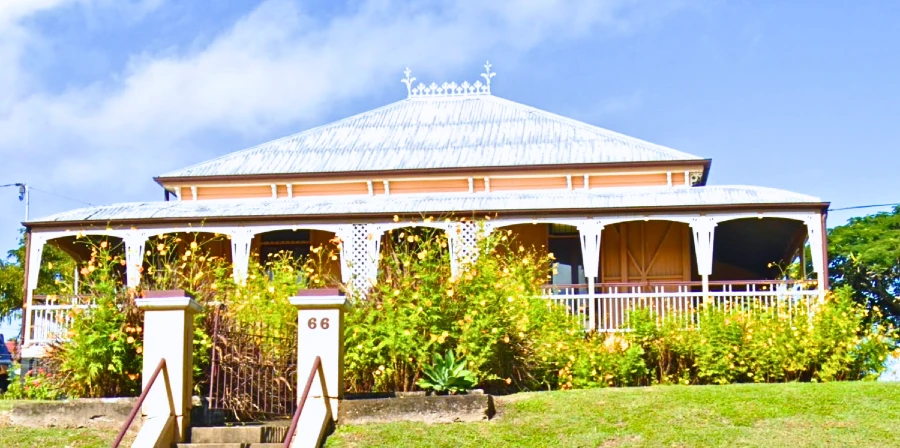
- Address: 66 Roderick Street, Ipswich QLD 4305
- Built: 1886
- QLD Heritage-listed: 1992 ID#600598
- Landmark years: Private home (1886–1960), Vinnies hub (1960–today)
- Verandahs: Wrap-around, all 4 sides
- Rooms: 4 main rooms plus kitchen wing
- Ceiling height: High ceilings throughout (Victorian style)
- Site expansions: Rear land (1961), adjoining Crown land added (1966)
- Subdivision: Original land subdivided in 1950
- Hostel built: 1982, operated until 1994
- Society ownership: St Vincent de Paul for over 60 years
- Architect mortgages: £2,500 (1886) ≈ A$852,000 today
- Verandah renovation: £350 (c.1905) ≈ A$112,000 today
Ozanam House isn’t your everyday Queenslander. Sure, it’s got the classic timber build and wrap-around verandahs, but there’s more to this Ipswich gem than looks alone.
Built as a family home back when Ipswich was booming, this place took a big turn in 1960.
It became the local Vinnies hub. Where countless locals have volunteered, cooked meals, and sorted Christmas hampers.
Even its name has heart: “Ozanam” honours Frederic Ozanam, the French bloke who kicked off the St Vincent de Paul Society.
So, behind those fancy French doors and Victorian trims, there’s a real Ipswich story—one of community spirit, resilience, and heaps of helping hands.
Ozanam House has charm, but it’s the history inside that’s worth sticking around for.
Let’s go back to the start to see who built it and why.
Take a walk around Ozanam house in Google Street View.
📜 Origins & History
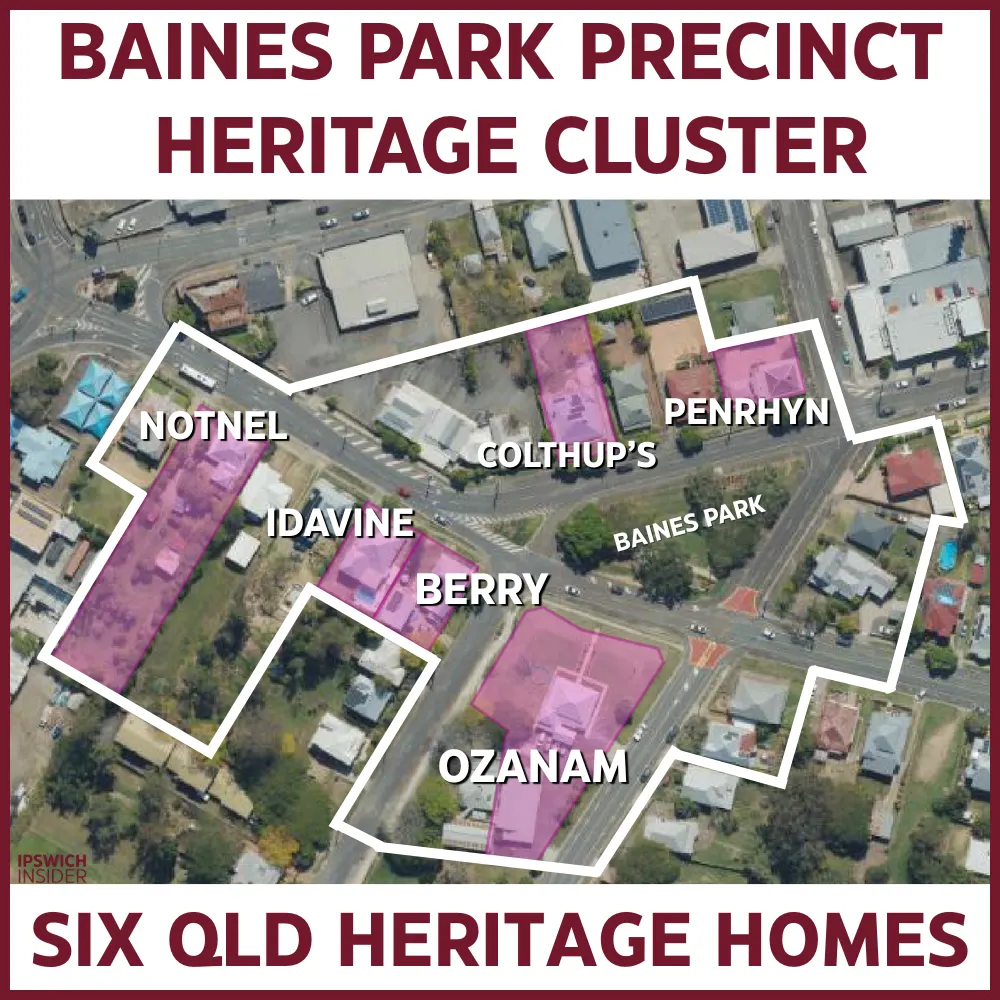
Ozanam is part of the Baines Park Precinct of heritage homes.
📌 Highlight
Built in the late 1880s for architect R. D. Graham, the house began as a private family home on an elevated Roderick Street site. Its early story tracks Ipswich’s 1880s boom, a 1890s downturn, and steady handovers into the 20th century.
- Build. The house was built around 1886 for architect and engineer R. D. Graham.
- Designer. The design is attributed to R. D. Graham & Son, with Graham likely planning the house himself.
- Land. The allotments were first alienated by James Stirling (1879), then sold to William Berry (1884), and to R. D. Graham (1885).
- Finance. Mortgages totaling about £2,500 in June 1886 indicate construction was underway.
- Use. Graham used the house as his private residence in the late 1880s.
- Exit. Graham left Ipswich in 1889 and was declared insolvent in 1896.
- Sale. The property passed to Samuel Piper in 1892.
- Context. In the 1880s Ipswich was in an industrial boom; professionals built on the high ground near Denmark Hill close to the city centre.
- Neighbourhood. Roderick Street is an elevated address within walking distance of the commercial “Top of Town.”
- Ownership. John Canty, a blacksmith, purchased the property in 1906 and the family held it for decades.
- Postwar. After John Canty died in 1946, his daughter Ethel May Senior inherited the property.
- Subdivision. In 1950, Ethel Senior subdivided the land and sold the house lot to Thomas Keith Johnson.
🏗️ Architecture & Design

📌 Highlight
This is a single-storey timber Queenslander with a hipped iron roof, full wrap-around verandahs, and fine late-Victorian detailing. A central hall plan, French doors, and a rear kitchen wing define the layout.
- Type. A one-level timber Queenslander with verandahs on all four sides.
- Roof. A hipped roof in corrugated iron with cast-iron ridge cresting and paired eave brackets.
- Structure. Timber frame on timber stumps with chamferboard external walls.
- Verandahs. Verandah roofs are gently curved with a scalloped timber valance, tapered brackets, and timber balustrades; lattice flanks the front stairs.
- Plan. A central hallway with two rooms on the east and one large combined room on the west with a timber divider.
- Services. A rear kitchen wing extends off the southwest, with a lean-to laundry and a toilet on the rear verandah.
- Doors. French doors with arched panes open to the verandahs; the front has a panelled door with sidelights and a patterned-glass fanlight.
- Finishes. Interior walls are vertical-joint timber boards; ceilings are later hardboard sheets with cover strips.
- Enclosure. The southeast verandah corner is enclosed as an extra room.
- Setting. The block is elevated and slopes north to Roderick Street with a central front stair.
- Comparison. It is more ornate than many timber peers and less massive than nearby brick villas such as Keiraville (1886).
⏳ Through the Years
📌 Highlight
The site moved from Crown alienation to private residence, then long family occupancy, post-war subdivision, and from 1960 a sustained charitable role as Ozanam House. Heritage listing followed in 1992.
- 1879. Land first alienated from the Crown to James Stirling.
- 1884. Property sold to William Berry.
- 1885. Site purchased by R. D. Graham.
- c.1886. House built as Graham’s family home.
- 1887–1888. Graham listed as residing in Ipswich.
- 1889. Graham left Ipswich.
- 1892. Title transferred to Samuel Piper.
- c.1905. Piper mortgaged about £350, likely to fund works.
- 1906. John Canty purchased the property.
- 1941. Susan Canty (of Roderick Street) died, per probate notices.
- 1946. John Canty died; the property passed to Ethel May Senior.
- 1950. Ethel Senior subdivided the land and sold the house lot to Thomas Keith Johnson.
- 1960. The St Vincent de Paul Society purchased 66 Roderick Street.
- 1961. The Society acquired the rear portion of the original block.
- 1966. The Society bought adjoining Crown land fronting Omar Street.
- 1960s. The property was named Ozanam House and used for meetings, training, and food-parcel preparation; a timber shed was added at the rear.
- c.1982. A men’s hostel was built at the rear of the site.
- 21 Oct 1992. The house entered the Queensland Heritage Register.
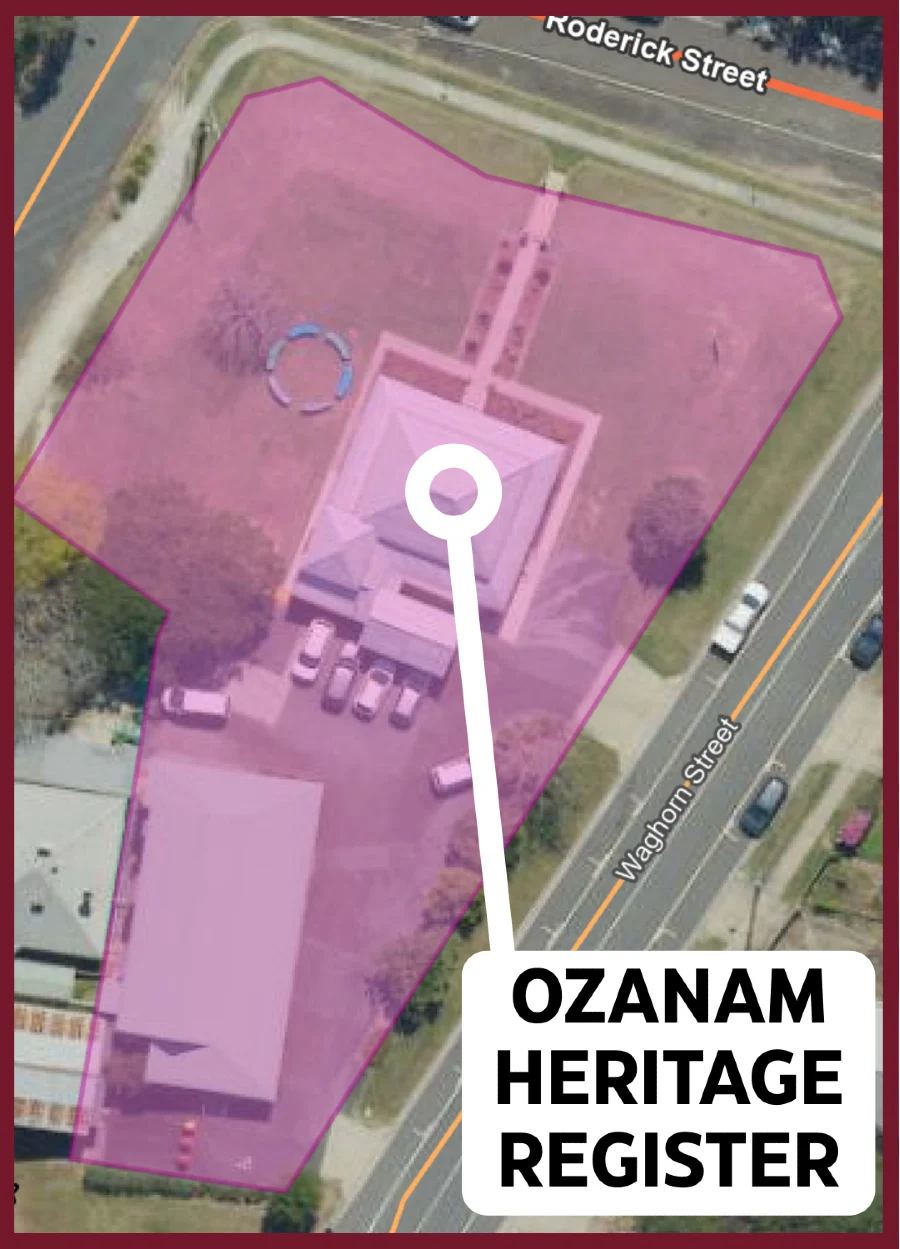
The heritage protected lot at 66 Roderick St where Ozanam house sits.
- June 1994. The men’s hostel closed and the rear building was reused as a welfare office.
- 2010s–2020s. The site continued as a base for community support and family services.
🛠️ Renovations & Restorations
📌 Highlight
Visible changes include early-1900s verandah upgrades, mid-century service rooms and ceiling linings, a 1950s garage wing, a relocated donation shed, and a separate hostel building. The 1886 plan and joinery largely survive.
- Verandah. Front verandah details appear later than the 1886 fabric and likely date to an early-1900s upgrade.
- Enclosure. The southeast verandah corner was enclosed to form an extra room.
- Ceilings. Original ceilings were replaced with hardboard sheets and cover strips.
- Sanitary. A toilet was added on the rear verandah.
- Kitchen. The rear kitchen wing connects via a leaded-glass door and has a lean-to laundry.
- Garage. A garage wing was added sometime between about 1946 and 1958.
- Donation shed. A timber shed was moved onto the back of the site in the early 1960s.
- Hostel. A separate rear hostel was built around 1982 and later reused as a welfare office.
- Integrity. The original plan and joinery remain largely intact; later changes are additive and mostly reversible.
🌟 Why it Matters / Heritage Importance
📌 Highlight
The house is a highly decorative 1880s timber residence that contributes to the Roderick Street townscape and shows the principal traits of its type. It also holds a long association with the St Vincent de Paul Society in Ipswich.
- Listing. Entered on the Queensland Heritage Register on 21 October 1992 (Place ID 600598).
- Aesthetics. Recognised as a highly decorative late-19th-century timber residence that contributes to the streetscape.
- Type value. Demonstrates the principal characteristics of Queensland timber houses of the period.
- Association. Has a long link with the St Vincent de Paul Society in Ipswich since 1960.
- Community role. Continues as a base for community support services.
- Conservation. Later buildings sit apart, helping protect the original fabric of the 1886 house.
Sources
- Ozanam House. PictureIpswich.com.au.
- Ozanam House, Ipswich. Wikipedia.org.
- Ozanam House. Apps.des.qld.gov.au.