
Also check out:
- Case #1: 19 Ipswich Curiosities →
- Case #2: 16 Ipswich Peculiarities →

19 Ipswich Intrigues at a Glance
- Not random: Many of these odd sights have a real job or backstory. A bomber sells a motel. A 1902 rail bridge still works. Berrys Weir helps feed Swanbank. A single pole powers Limestone Park sports precinct.
- Old vs new: This report keeps landing on the edge between old Ipswich and fast-growing Ipswich. A huge Raceview factory waits for a future. Woogaroo Forest faces housing pressure. Springfield Lakes’ lakes were built from scratch.
- Things people notice: The rest are the local intrigues people aren’t sure about. Did people really rollerskate on the Brassall water tank roof? What’s that round tower at Ipswich Grammar? Why is Kmart checkout in the middle of the store?
🔢 By The Numbers

- 19 intrigues make up this Ipswich Files report
- 1902 is the year the Sadliers Crossing rail bridge was completed
- 1986 is when the Canberra bomber was reportedly sold to the Willowbank Caravan Park
- 5,000m² is the approximate floor area under roof at the old Raceview factory site
- 19 megalitres is the storage capacity of the Brassall reservoir locals used to rollerskate on
- 1964 is the date on engineering drawings for Berry’s Lagoon Pump Station and Diversion Weir
- 450+ hectares is the reported size of Woogaroo Forest in 2025
- 250 metres is the short ridgeline stretch beside Tallegalla Cemetery that feels sky-high
- 500kVA is the transformer size feeding part of the Limestone Park sports precinct
- $550,000+ was/is the asking guide for the fire-damaged house at 7 Coolabah Drive
Everyone loved the first two Ipswich Files reports. If you missed them check them out here:
So we’re back today with another case. Case #3. This batch is called: 19 Ipswich Intrigues.
From a bomber beside the highway and a heritage protected rail bridge you can actually walk across, to a hidden weir feeding Swanbank, a round dorm tower, a backwards-feeling Kmart and a ruined house in the middle of a new estate…
This is the stuff you don’t even know you want to know until you know it.
Let’s get stuck right into it. Here’s the latest Ipswich Files report: 19 Ipswich Intrigues.
More Ipswich Gold
Jump to:
- Bomber by the Highway
- 1902 Rail Bridge
- Raceview Factory
- Springfield Lakes’ Lakes
- Rollerskating Water Tank
- Berrys Weir
- Old BP at Loamside
- Grammar Round Dorm
- Woogaroo Forest
- Tallegalla Ridgeline Road
- Limestone Pyramid
- Limestone Park Power
- Brisbane View Swings
- Queens Park Bats
- Springfield Tunnel
- Hoop Pine Incinerator
- Whiterock Sales Office
- Ipswich Kmart Layout
- Coolabah Drive House
1. Why Is There a Bomber Beside the Highway?
Details
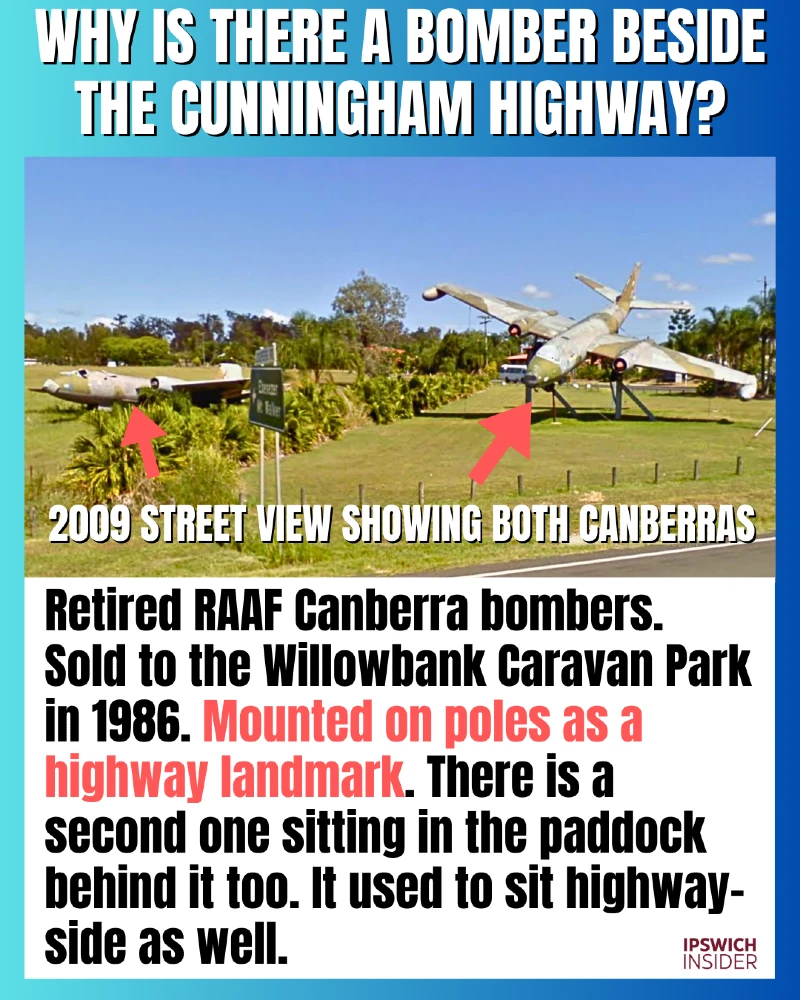
That plane at Willowbank is not just random roadside weirdness. Best read, it’s a retired RAAF Canberra bomber. It was bought by the Willowbank Caravan Park and mounted beside the Cunningham Highway as a giant gate guard and motel landmark. A second Canberra airframe sits further back in the paddock.
- Main plane: The aircraft on poles beside the highway is identified in aviation records as Canberra A84-238.
- Why there: Aviation photo notes say it was sold to the Willowbank Caravan Park in June 1986, which suggests it was installed as a highway-side landmark for the motel.
- RAAF past: Aviation records say this aircraft served with 2 Squadron in Vietnam-era operations before retirement. So yes, that’s a genuine warplane on sticks beside a caravan park.
- Second plane: There’s actually another Canberra, A84-248, sitting in the paddock behind the display aircraft. Two bombers for one motel.
- First impression: You’re doing 100 on the Cunningham and suddenly there’s a whole plane mounted beside a motel. Half war memorial, half giant roadside ad.
2. You Can Just Walk Across This 1902 Rail Bridge

Details
Sadliers Crossing has one of Ipswich’s best hidden bits of working history. Slightly off the road and easy to miss. A heritage-listed rail bridge from 1902 that still carries trains across the Bremer. Locals can also walk across it on the attached pedestrian footbridge.
- Walk across it: The biggest surprise is that this is not just something to look at from a distance. You can actually walk across it.
- Still active: A live rail bridge, not a preserved relic or dead piece of infrastructure.
- 1902 survivor: The current bridge dates from 1900 to 1902. It replaced the earlier crossing after the 1893 floods.
- Heritage-listed: On the Queensland Heritage Register. They’re not tearing this one down.
- Easy to miss: The pedestrian access sits slightly off the road. Unless you already know it’s there, it feels more like a local secret than a tourist stop.
3. The Giant Factory in the Middle of Raceview
Details
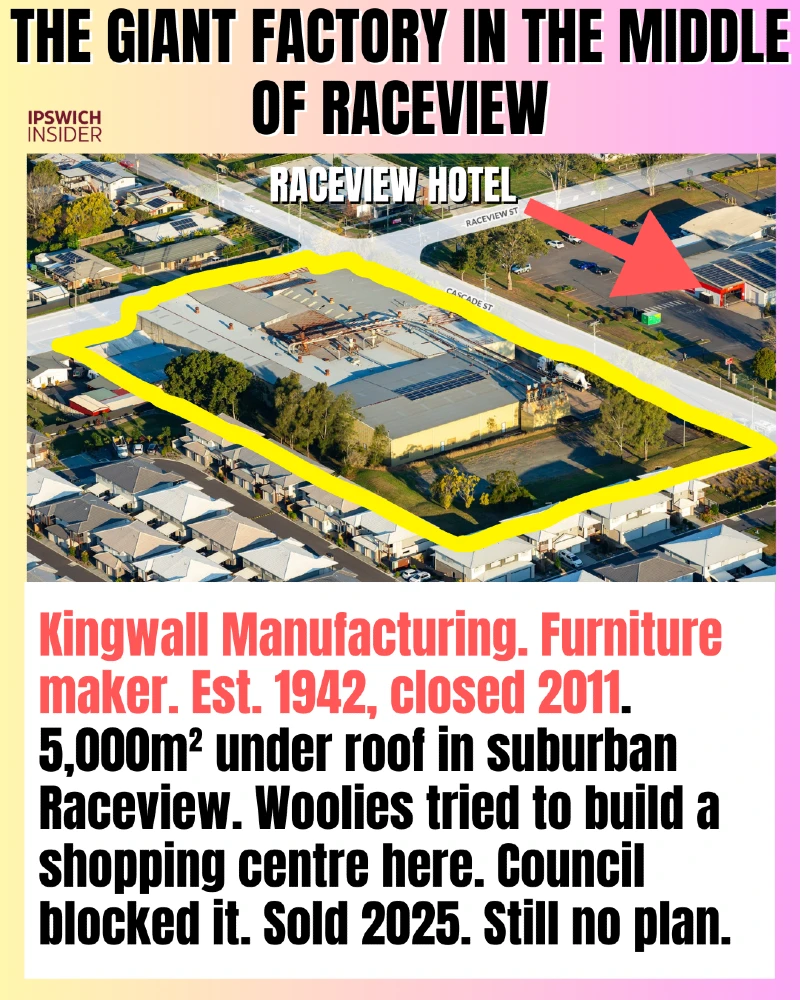
For years, plenty of locals have driven past this huge old factory at Raceview and wondered what on earth it’s still doing there. This was the longtime home of Kingwall Manufacturing, a furniture maker with deep Ipswich roots. Later it became the site of the proposed Woolworths shopping centre that never happened. It sold in April 2025. Its next chapter is still unclear.
- Kingwall factory: The site at 91–93 Raceview Street was home to Kingwall Manufacturing. Picture Ipswich records the furniture business as established around 1942 and closed in 2011.
- Big suburban oddity: The property is about 5,000m² under roof on 1.21 hectares. Right in the middle of suburban Raceview.
- The Woolies rumour was real: In 2019, Woolworths’ property arm Fabcot pushed a plan for a shopping centre here. It included a 3,200m² Woolworths supermarket, a 150m² BWS, a kiosk and specialty shops.
- Why it never happened: The Planning and Environment Court knocked it back in April 2022. Too far from an existing centre, too much impact on the shops already there.
- Sold, but not solved: The site sold on 10 April 2025 with vacant possession. The sales pitch played both sides: redevelop it under the draft 2024 Ipswich City Plan, or just keep using the sheds as-is under existing lawful-use rights.
- Stuck between eras: Too big and industrial for the suburb around it. Too visible to ignore. Still waiting for a future that actually sticks.
4. How Springfield Lakes Got Its Name

Details
Springfield Lakes sounds like a suburb that grew up around natural water. It didn’t. Every lake in it was engineered from scratch. Earthworks, dam walls and a concrete weir turned creek valleys into the water features people now assume were always there.
- Built, not natural: Springfield Lakes has three main lakes. None of them are natural. All created as part of the suburb’s development.
- Spring Lake: The first lake was constructed in the late 1990s near Spring Lake Metro and the IGA.
- Regatta Lake: Created around 2006 by building a large rock-and-earth dam wall across a creek valley.
- Discovery Lake: Formed around 2010 when a concrete weir was built across Opossum Creek. The weir drowned the valley behind it.
- Creek link: Discovery Lake is fed by Opossum Creek and water coming down from Regatta Lake. Part of why the whole layout can feel confusing when you first try to read it on a map.
- Fools everyone: The lakes and landscaping are convincing enough that many people assume they were always there and the suburb simply grew around them.
5. The Water Tank You Could Rollerskate On
Details
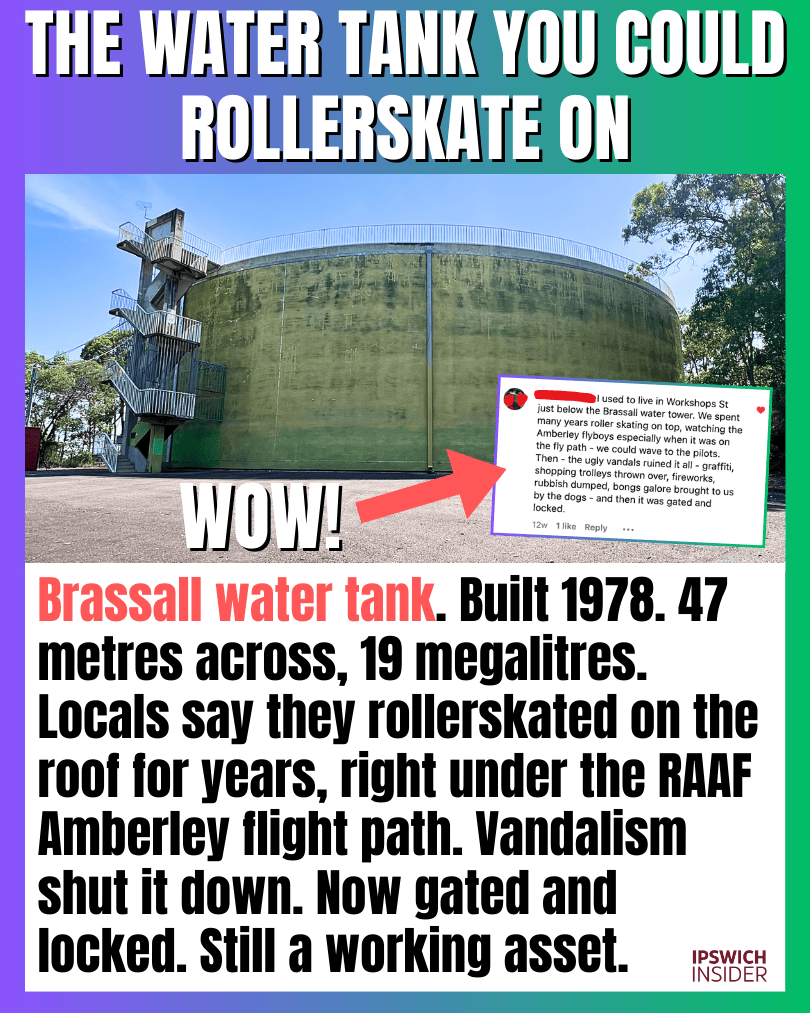
Brassall’s quarry-side reservoir near Workshops Street has been sitting above the suburb since 1978. About 47 metres across and 12 metres high. Holds 19 megalitres. Built to store water and keep pressure stable as Brassall and the north side expanded. It still shows up in long-range upgrade plans, which means it remains a backbone asset nearly 50 years after it was commissioned.
But the real story is what locals used to do with it. People who grew up nearby say they spent years rollerskating on the roof. They also watched the planes come in and out of RAAF Amberley because the tank sat right under the flight path.
- 1978 build: Late-1970s suburban-growth tank. Built to keep pressure stable as the north side expanded. Not the kind of thing anyone was meant to play on.
- Local memory: Several locals have said they used to go up onto the roof and rollerskate there, sometimes for years. Close enough to RAAF Amberley’s flight path to wave to the pilots. Just kids on rollerskates on top of 19 megalitres of drinking water.
- Big old tank: About 47 metres across, 12 metres high and 19 megalitres, confirmed in an Ipswich yearbook.
- Then it ended: Vandalism killed it. Graffiti, shopping trolleys thrown over the side, fireworks, rubbish and worse. Because that’s what happens to anything good that isn’t locked down. The site was eventually gated and fenced off.
- Still a backbone asset: Not an abandoned relic. Still part of the working water network and still showing up in long-range upgrade plans nearly 50 years on.
6. The Hidden Weir That Feeds Swanbank

Details
Berrys Weir is one of Ipswich’s stranger hidden infrastructure sites. From one side it feels like a secret stretch of river. From the other, the gates, pumping works and industrial signage make it clear this is not a quiet backwater. A Bremer River weir tied to Swanbank’s cooling-water system. Later modified with a fishway to reconnect the river for native fish.
- 1960s build: Engineering drawings for the Berry’s Lagoon Pump Station and Diversion Weir are dated 14 December 1964.
- Why it exists: The weir was built to impound water for power generation. CleanCo now says Berries Lagoon Weir allows water to be taken from the Bremer River into Swanbank Cooling Water Dam. That supports operations at the Swanbank gas-fired station.
- Not just a weir: Tied to a real pump station and diversion setup. That’s why it feels half river, half utility yard.
- Why not Bundamba Creek? Even though Bundamba Creek is much closer to Swanbank, the system was built around a managed Bremer River supply via Berrys Weir. Modern operations also use recycled water. Bundamba Creek may look closer on the map, but it’s a more degraded waterway with worse water quality.
- Fishway fix: The weir became a major barrier to fish movement. So a rock-ramp fishway more than 80 metres long was completed in 2016. Later described as about 90 metres long in Ipswich reporting.
- Two worlds: One of those places where Ipswich’s river, industry and hidden edges all collide. Feels secret, but doing a very practical job.
7. The Old BP at Loamside
Details
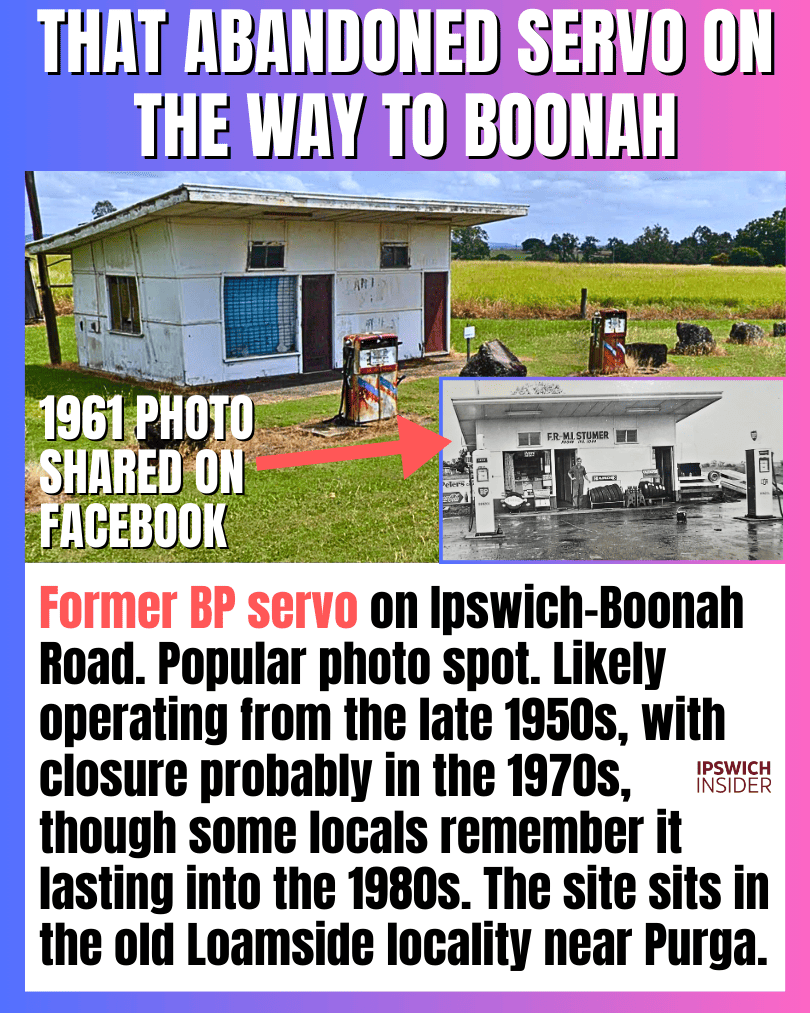
This abandoned little servo on Ipswich-Boonah Road is not just a rumoured old service station. These 1961 family photos show it operating as a BP-branded servo, with F.R. & M.I. Stumer painted on the building. That ties the site directly to the old Loamside locality near present-day Purga.
- 1961 proof: These family photos show the servo operating in 1961. A firm point in time rather than just local recollections.
- BP branding: The pumps, shield logos and forecourt setup clearly show it was a BP service station.
- Stumer family: The building signage reads F.R. & M.I. Stumer. Gives the old servo a real family name and identity.
- Loamside link: The site sits in what locals once knew as Loamside, a historic railway locality in the wider Purga area.
- Then and now: What looks today like a ruined roadside relic was once a proper working local business on a much more important through-route.
8. What Is That Round Building Across the Oval at Ipswich Grammar?

Details
Driving north on Burnett Street, one of Ipswich Grammar’s strangest buildings suddenly appears across the First Oval. A big round dormitory block that looks nothing like the school’s older heritage architecture. There’s a near-identical partner elsewhere on the campus too. The two five-storey dormitory towers were built as part of the school’s early-1970s boarding expansion.
- Not one, but two: The building most people notice from Burnett Street is only half the story. Ipswich Grammar has two near-identical round dormitory towers.
- What they are: The Edith Fox Dormitory Tower and J E Hancock Dormitory Tower. Built for boarding accommodation.
- 1972 clue: Ipswich Grammar has shared a photo of the Edith Fox Dormitory Tower under construction in 1972. That helps pin the pair to the school’s early-1970s expansion.
- Five storeys: “Tower” is fair. The heritage listing describes them as two five-storey dormitory towers.
- Spread apart: Built well apart on the campus. So the Burnett Street one feels like a strange standalone when you first spot it across the oval.
- First reaction: Such a strong local curiosity because your first thought is not “that must be student housing.” Your first thought is just: what is that?
9. The Forest Springfield Keeps Pushing Into

Details
Woogaroo Forest is where Greater Springfield’s growth story starts to feel uncomfortable. On paper, this bushland edge has sat inside the area’s long-term urban expansion plans for decades. In reality, it still feels like a proper forest. That’s why the idea of clearing it for housing lands so heavily with so many locals.
- Long planned: Springfield’s structure planning goes back to 2002. The approved Springview Village 2 and 3 Precinct Plan shows this push into the western bushland edge is not a brand-new idea.
- Still a real forest: The Save Woogaroo Forest campaign describes it as important habitat for koalas and other wildlife. ABC reporting says Woogaroo Forest spans more than 450 hectares. It also says most of it is mapped by the Queensland Government as prime koala habitat.
- What is proposed: Save Woogaroo Forest says 120+ hectares in Springview Village 2 and 3 are proposed for development, with more than 1,800 homes, a small town centre and a sports field. ABC reported the broader housing plan as over 1,800 homes, plus a commercial centre, childcare and a local sports park.
- Not fully settled: The federal environment assessment for this development, EPBC 2019/8575, was still open for public comment as of February 2026. Stockland’s own Springview page also says the Village 2 and 3 proposal is still being assessed. So it’s not a done deal.
- The real tension: Whether a forest that still functions as habitat and still feels like bushland should be treated as the next stage of suburbia because an old planning framework said so.
10. The Road That Suddenly Feels Sky-High
Details
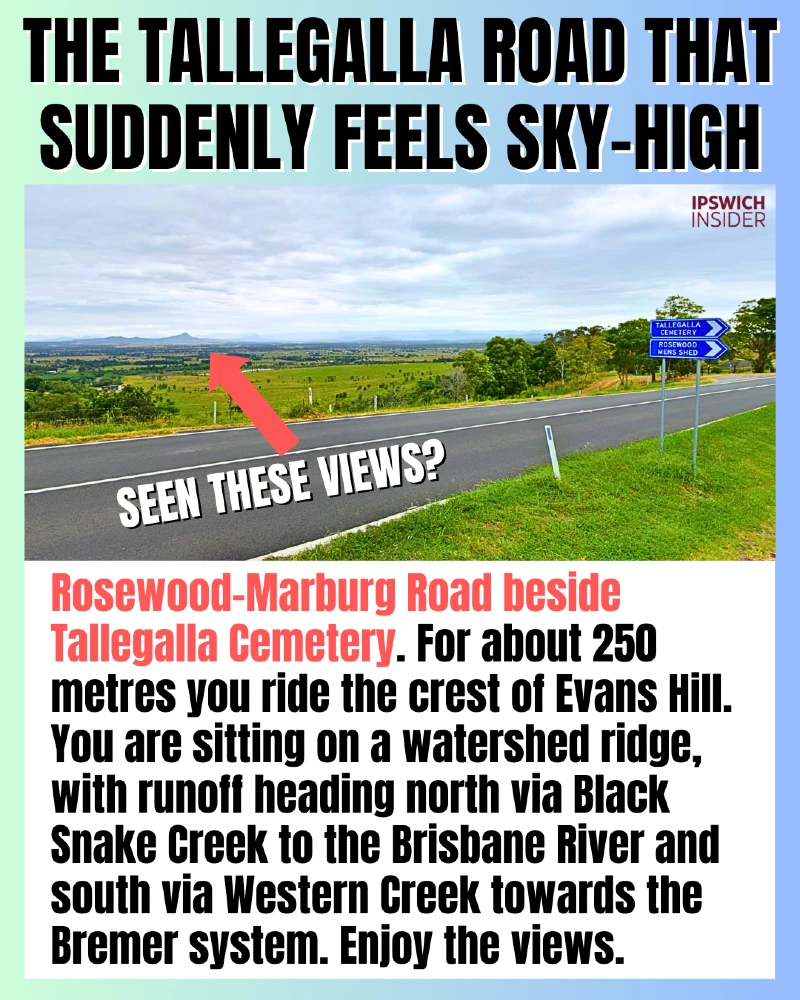
That short stretch of Rosewood-Marburg Road by Tallegalla Cemetery delivers one of Ipswich’s great surprise views. For roughly 250 metres, you’re riding the crest of Evans Hill. Land falls away on both sides. The road sits close to the divide between water heading north to Black Snake Creek and south to Western Creek and the Bremer.
- 250-metre shock: For only about 250 metres, you suddenly hit the top of the world.
- Why it happens: The road follows the high ground of the Evans Hill ridgeline. The practical line through the landscape.
- Two catchments: Water on the north side heads toward Black Snake Creek and the Brisbane River. Water on the south side heads toward Western Creek and the Bremer.
- Evans Hill: The name “Evans’ Hill” was already in public use by 1928. It appears tied to the Evans family of Pinegrove, Tallegalla.
- More than a view: Not just a road with a nice outlook. A working road running along a watershed ridge. For that brief stretch you can feel it.
11. Ipswich’s Limestone Pyramid

Details
At the front door of Ipswich sits one of the city’s strangest little landmarks. A stepped limestone pyramid (technically a ziggurat) that looks older and more ancient than it really is. Known as Cunninghams Knoll, the structure sits on a natural limestone ridge that has been there long before anyone built anything on it. Allan Cunningham camped on this hill in 1828. Over a hundred years later, Depression-era workers shaped it into the terraced monument you see today.
- Natural ridge: The knoll is the northwestern end of one of two limestone spine ridges running through this part of Ipswich. Not built from nothing. The hill was already there.
- Cunningham’s camp: Allan Cunningham stayed in Ipswich for five days in 1828. He took compass bearings of the distant mountains from here, then went on to discover what is now Cunningham’s Gap.
- Depression-era build: The terraced rock gardens were constructed in the 1930s to generate work for locals during high unemployment and to honour Cunningham and others.
- Convict link: A plaque at the site records that in 1827, Captain Patrick Logan sent an overseer and five convicts to quarry limestone here. That limestone was sent by boat to Brisbane for use in construction.
- Front door: Works because it feels like a ceremonial entrance to the city, even if most people barely slow down for it.
12. The Pole That Powers a Little Sports City
Details
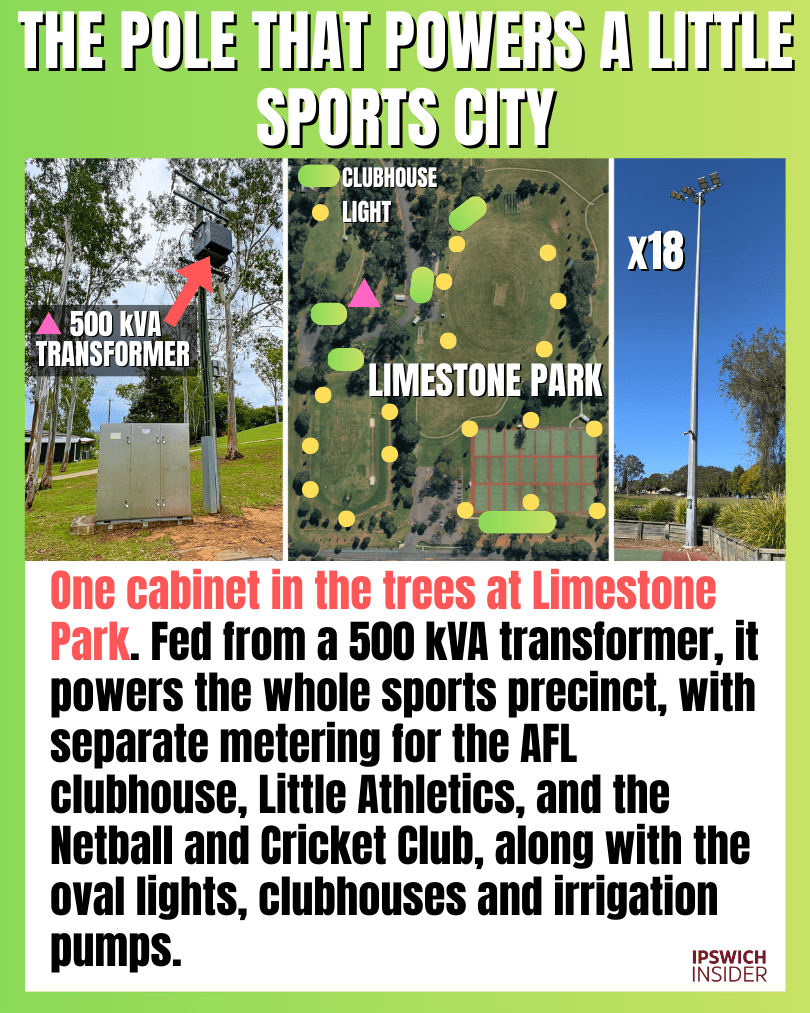
There’s a cabinet in the trees at Limestone Park that most people would walk straight past. Labelled “Limestone Park MSB” and “fed from 500kVA transformer above“. It also shows separate metering for the AFL clubhouse, Little Athletics & AFL field, and the Netball and Cricket Club. One pole. One locked box. And it’s feeding power to an entire sporting precinct.
- Small city feel: Not just power for one building. This helps tie together ovals, courts, lights and club spaces that locals think of as one big sporting precinct.
- One key link: The cabinet is labelled “Limestone Park MSB” and “fed from 500kVA transformer above“. A main feed point for this part of the park.
- Who it serves: The labels point to the AFL clubhouse, Little Athletics & AFL field, and the Netball and Cricket Club.
- 695 amps: A 500kVA transformer works out to roughly 695 amps on the low-voltage side at full load. That’s a lot of juice for a suburban park.
- Why it’s so big: With 7 tall light poles just at the main oval, plus club buildings and nearby sporting facilities, this is the sort of setup that turns a dark park into a fully lit night precinct.
- Walk-past infrastructure: Most people wouldn’t think twice about it. But if this box stops working, the lights go out on game night across the whole precinct.
13. The Swings With the Brisbane View

Details
Ben Nevis Park sits high above Springfield Rise. That’s the whole magic of it. The swings are great, but the real surprise is the view. While you’re there, you’re looking out over the bushland and all the way towards Brisbane.
- High-set park: This park sits on a ridgeline above the bushland. That’s what gives it such a big outlook.
- Big swing frame: The standout feature is the long custom swing setup, with a mix of swing types across one oversized frame.
- Brisbane view: Nearby Springfield Rise lots were marketed for views towards Brisbane City. That’s the sort of high ground this park sits on.
- Ben Nevis: The park is named after Scotland’s tallest peak, which suits the elevated feel of the place.
14. Why Don’t They Just Get Rid of the Bats?

Details
Probably the most common question about Nerima Gardens. The short answer is: they can’t just “get rid of them.” Flying-foxes and their roosts are protected under Queensland law. They’re also highly mobile and iconic Ipswich wildlife. Councils say dispersal is often ineffective because the bats either return or move into even less suitable places. Nerima Gardens has had this roost since 2013. Council is still managing access around it rather than simply removing it.
- Protected species: Ipswich City Council says all three local flying-fox species and their habitat are protected under the Queensland Nature Conservation Act 1992.
- Why not move them: Council says dispersal is rarely successful. The bats often return, or shift into even less desirable places such as nearby urban areas and backyards.
- Why Nerima: Flying-foxes want trees near water where the temperature and shelter suit them. As natural habitat disappears, urban bushland patches like Nerima are what’s left.
- Long-running colony: Local Ipswich News reports the Nerima Gardens roost has been there since 2013, with black and grey-headed flying-foxes present year-round and little reds arriving seasonally.
- Real impact: Not just theoretical. Ipswich City Council says sections of Nerima Gardens remain closed, with the main Burley Griffin Drive gates still shut because of the active colony.
- Why council tolerates them: Flying-foxes are major pollinators and seed dispersers for native forests. Like them or not, they’re doing a job. That’s why the law protects them.
15. The Proposed Tunnel Into Springfield
Details
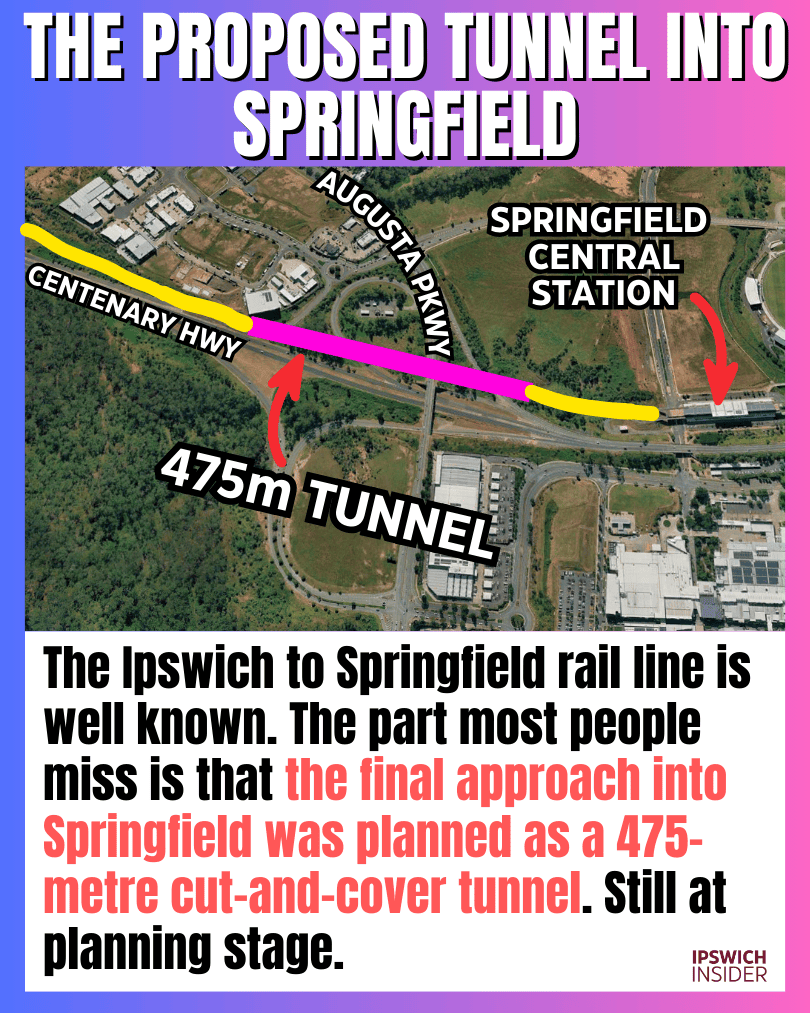
Many people know about the long-proposed Ipswich to Springfield rail line. Fewer realise the final connection on the Springfield end was planned to dip below ground in a short cut-and-cover tunnel. The old corridor study shows the line crossing the South West Transport Corridor in tunnel as it approaches the Springfield Town Centre end of the route. The whole project remains at planning stage.
- Final link: The interesting part is that last approach into Springfield, where the route was planned to go below ground before reaching the town centre end of the corridor.
- Tunnel design: About 0.475 km of cut-and-cover tunnel. Dig a trench, build the tunnel structure in it, then bury it again.
- Still proposed: None of this is under construction. The whole Ipswich to Springfield corridor is still at the planning stage.
- Future link: Keeps the door open for a rail connection between Ipswich and Springfield. If it ever gets built, this is how the line gets in.
- Hidden detail: The rail link itself is fairly well known, but the proposed tunnel at the Springfield end is the part many people have never noticed.
16. The Hoop Pine at the Incinerator

Details
There’s a 33-metre hoop pine right at the entrance to the Incinerator Theatre car park in Queens Park. Someone clearly decided it was worth keeping. They built a ring of bollards around the base and shaped the car park around it rather than removing it.
- Protected in place: The tree has its own fenced-off section at the car park entrance, with white bollards ringing the base. They built around it.
- Hoop pine: Based on its thick scaly trunk and layered branching, a hoop pine. The heritage record notes intentional plantings of hoop and bunya pines across Queens Park.
- 33 metres: At 33 metres one of the bigger trees in this part of the park.
- The building: The Incinerator Theatre was built in 1935 and opened in 1936 as a municipal incinerator. One of Ipswich’s strangest heritage buildings.
- The pairing: A Walter Burley Griffin incinerator with a 33-metre hoop pine protected by bollards right at its front door. An odd little scene.
17. The Sales Office That Looks Like a Lakeside Retreat

Details
At Whiterock, the Sales & Discovery Centre does not look like a sales office. Timber cladding. Long low roofline. Sitting right beside the water. More like a boutique retreat or a yoga studio. But that’s exactly what it is. An approved temporary sales office for a land development.
- Looks like something else: You’d guess community pavilion or luxury home before you’d guess real-estate sales office.
- Temporary on paper: Ipswich City Council records the site at 7000 Sandstone Boulevard as an approved Temporary Sales Office.
- Still very much in use: Whiterock’s current website still promotes the Sales & Discovery Centre as open 7 days, 10am to 5pm.
- Real hub is planned elsewhere: Whiterock’s long-term vision includes a proper Village Hub with a supermarket, cafes, shops, a primary school, kindy and sports fields. This sales office is just the placeholder.
- Worth keeping: The sort of building a community would actually want to keep. Even if its current job is selling land, it already looks like it was built for a second life.
18. Why Ipswich Kmart Feels Backwards
Details
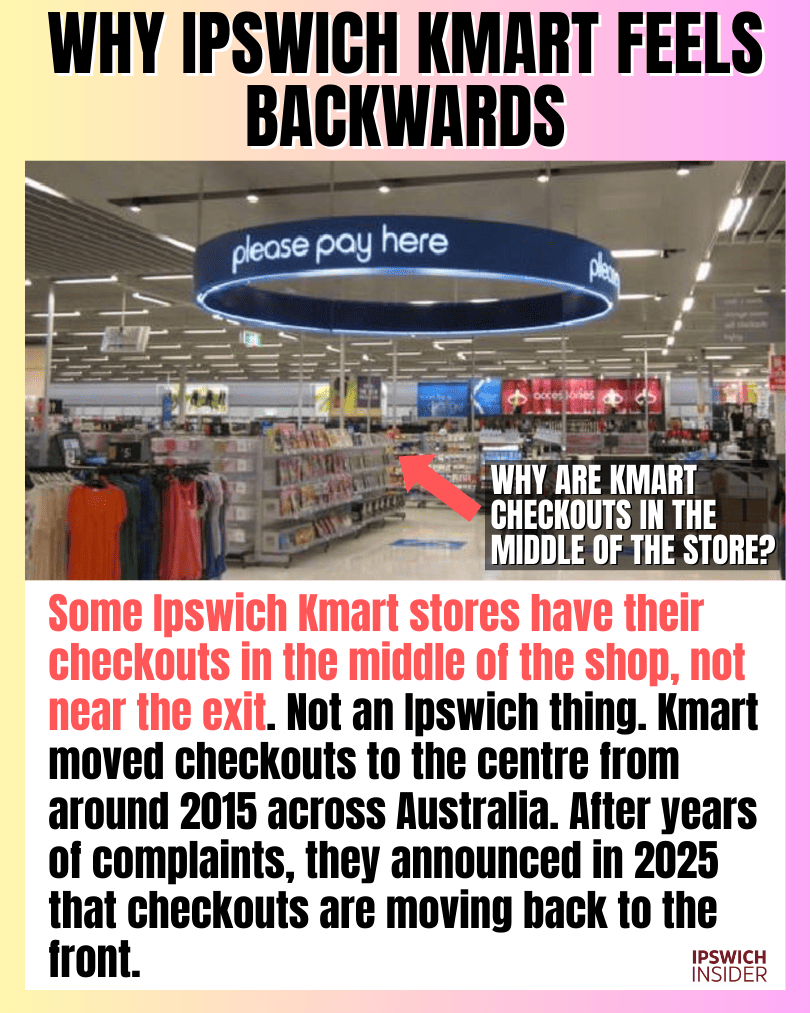
Some Ipswich Kmart stores feel backwards because the checkouts sit in the middle of the shop, not near the exit. You grab your stuff, pay halfway through, then keep walking past more stuff you’ve already paid to leave. It wasn’t an Ipswich-only idea. Part of a broader Kmart layout shift. Newer-format stores are now starting to move checkouts back toward the front.
- Not local: A wider Kmart format change, not some one-off Ipswich design choice. So it’s not just you.
- Original logic: Kmart wanted smoother flow and faster self-serve checkout. On paper it made sense. In practice, people just felt lost.
- Why it feels off: Your brain expects: shop, then pay, then leave. When you pay in the middle and there’s still more shop on the other side, something feels wrong. Like walking through a door that leads to another door.
- Latest shift: Kmart now appears to be moving checkouts back toward the front in newer-format stores, although not everywhere yet. So even Kmart seems to agree it was a weird call.
19. How Did This House End Up Like This?

Details
In the middle of a tidy modern estate at Redbank Plains sits a house that looks like it belongs in a disaster zone. 7 Coolabah Drive is not some old derelict relic from before the estate went in. A modern 4-bedroom, 2-bathroom house on 450m². Last sold in 2021. Now boarded up and being sold as a rebuild or knockdown after substantial fire and smoke damage. Every neighbour on the street has a neat lawn. Then there’s this.
- New estate shock: What makes it so striking is the contrast. Not an old shack on the fringe. A near-new suburban house in the middle of Eden’s Crossing, surrounded by homes that look exactly like it used to.
- Fire damage: The listing doesn’t sugarcoat it: substantial fire and smoke damage, needs major structural work or demolition.
- Why it looks so wild: The house has been boarded up and marked “DANGER DO NOT ENTER“. Reads more like a condemned ruin than a normal family home.
- Insurance twist: This doesn’t appear to be a simple “no insurance” story. Public reporting says the insurance claim had closed, but the interstate owner decided to sell instead of taking on the rebuild. The exact payout or coverage outcome is not public.
- What happens next: Hit the market on 25 February 2026 with a guide of offers over $550,000, pitched as a site to rebuild or start again.
Sources
- English Electric Canberra B.20 A84-238. JetPhotos.com
- Purga area Loamside Railway Station. IronBarkSprings.com.au
- Sadliers Crossing Railway Bridge. Apps.Des.Qld.Gov.au
- Ipswich Grammar School. Apps.Des.Qld.Gov.au
- Cunninghams Knoll. DiscoverIpswich.com.au
- Ben Nevis Park, Springfield Rise, QLD. LarkIndustries.com.au
- Kmart trials changes at store after customers slam ‘dumb’ checkout feature. au.news.yahoo.com