
Swanbank at a Glance
- Prime brownfields land. ~1,900ha, no residents, a rail spine, straddled by 2 highways, decades of energy infrastructure on the ground. Suntory picked Swanbank for a $400m mega-plant. The state government picked it for 138 Tesla batteries.
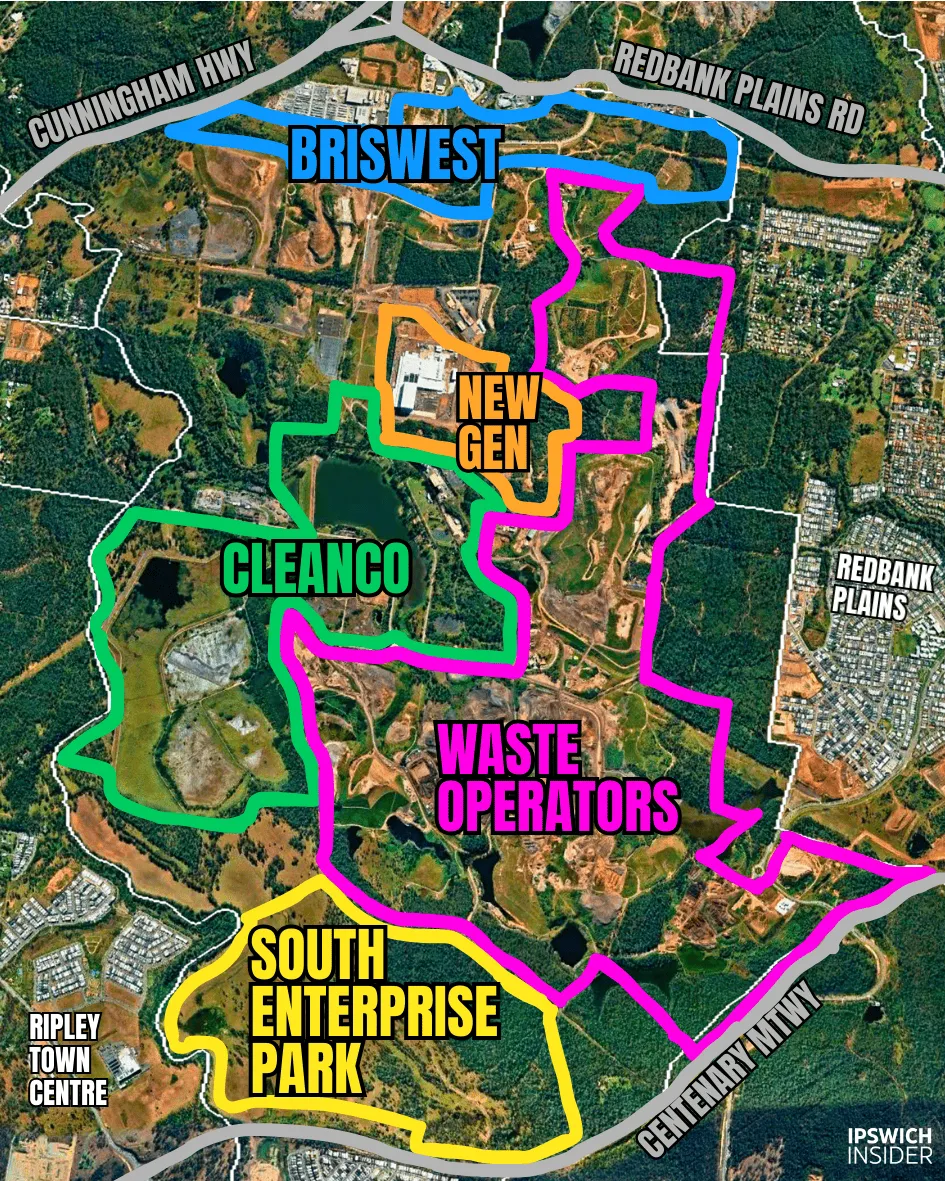
- 5 precincts. BrisWest and the existing northern industrial park. New-Gen anchored by Suntory. CleanCo running gas and a grid-scale battery. Waste and resource recovery across 100s of hectares. South Enterprise Park coming soon.
- Waste transformation. 500,000 tonnes a year still flows through. Remondis is building enclosed composting, NuGrow shifting to enclosed processing, demolition rubble getting crushed and reused, and landfill gas powering 4,800 homes.
By the Numbers

- 18.8 km² — Swanbank’s total footprint. Roughly the same size as RAAF Base Amberley
- ~0 residents — The 2021 Census recorded no people or a very low population
- ~140 years — Continuous industrial use, from coal mines in the 1880s to Tesla batteries in 2026
- $2 billion+ — Combined investment earmarked across the five precincts
- $400m — What Suntory spent building their mega-plant. The largest single FMCG investment in Australia in over a decade
- 180,000 cans per hour — What Suntory’s two canning lines pump out. Jim Beam, V Energy, Canadian Club, -196 and more
- 20 million cases a year — Suntory’s output at launch. Built to scale to 50 million
- 138 Tesla Megapacks — Sitting on the old Swanbank B coal site. 250 MW of storage. Enough to power 355,000 homes for two hours
- $330m — What the battery cost. Funded by the Qld Renewable Energy and Hydrogen Jobs Fund. Delivered under budget
- 385 MW — Swanbank E gas station, running since 2002. Broke the world record in 2011 with 254 straight days of continuous operation
- 130 ha — BrisWest industrial estate. Stage 2 alone is marketed at $900m+ end value
- 220 metres deep — How far down BrisWest’s developers had to fill old coal mine voids before a single lot could be sold
- 500,000 tonnes a year — What flows through Swanbank’s waste operations. Landfill, organics, construction and demolition
- 27,000 MWh — Renewable electricity generated each year just from capturing landfill gas. Enough to power 4,800 homes
- 14 km of solar panels — Laid end to end on the Suntory roof. The whole facility is carbon neutral from day one
When’s the last time you drove around Swanbank?
Any idea what’s been going on around there?
It’s pretty crazy.
Over $2 billion investment earmarked.
5 linked industrial precincts now operating or very near.
Also see: Redbank Motorway Estate and Citiswich
An absolute behemoth world-class beverage manufacturing facility.
A state of the art grid-size Tesla mega-battery.
Swanbank is reinventing itself again.
Let’s get the full story.
Swanbank is not one “site”. It’s 5 linked industrial precincts running north to south. Use the map above as your reference point for this whole report.
- BrisWest (north) — new industrial land supply on the Redbank Plains Road edge
- New‑Gen Business Park — serviced estate anchored by Suntory
- CleanCo Energy Precinct — gas, battery storage, and future energy projects
- Waste and Resource Recovery — landfill, organics, construction and demolition recovery
- South Enterprise Park (south) — planned expansion, early stage
Each wave seems to plug into what the last one built.
Swanbank by air. Check out the drone flyover I did last week:
More Ipswich Gold
Jump to:
What is Swanbank
Swanbank is a working industrial suburb built for the things a growing city needs space for. Energy, logistics, manufacturing, and waste infrastructure. Almost nobody lives here, but 100s to 1,000s of locals work in and around it.
This is the country of the Jagera, Yuggera and Ugarapul peoples. The name comes from early settler James Foote, who named it after his wife’s birthplace in Lanarkshire, Scotland.
Where is Swanbank
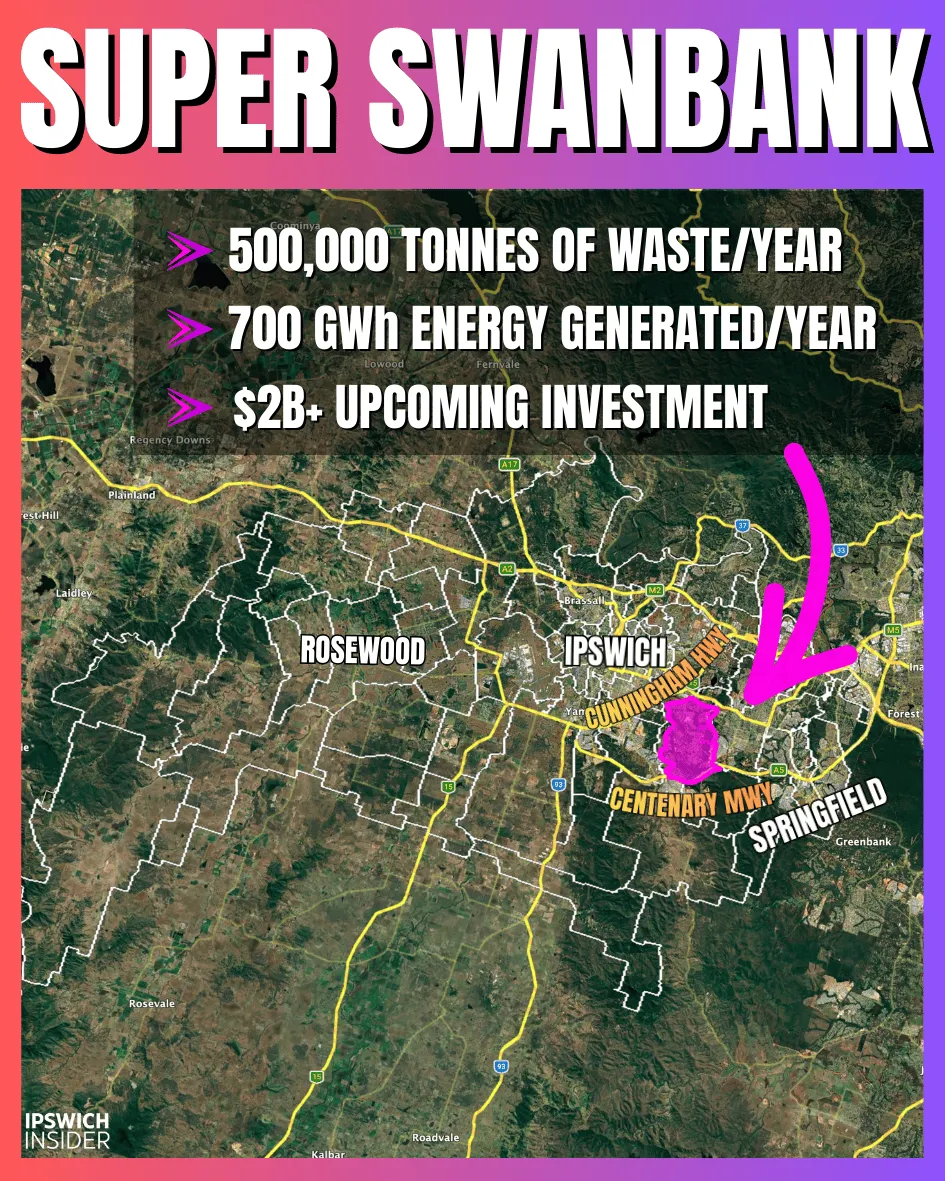
Swanbank sits on Ipswich’s eastern side, between major transport corridors and growth suburbs. Close enough that most locals have driven past it. Far enough that few people stop or drive-thru.
- Fast access: Cunningham Highway via Redbank Plains Rd and Swanbank Rd.
- Neighbour: RAAF Base Amberley sites a few km away down the Cunningham Hwy.
- Downwind reality: what happens here can affect nearby suburbs.
Swanbank vs Brisbane Airport

Source: Ipswich True Size tool
This comparison is here for one reason.
Swanbank is big and entirely industrial.
At 18.8 km², it’s roughly two-thirds the size of Brisbane Airport.
It’s about the same footprint as RAAF Base Amberley.
2x the size of Lake Wivenhoe. 14x the Ipswich Motorsport Precinct.
It’s not a single facility. It’s a multi-precinct industrial suburb with enough room for energy, manufacturing, logistics, and waste infrastructure side by side.
Key dates and turning points
Swanbank’s story starts underground. These are the turning points that built the precinct. From coal under the paddocks to power stations on the surface, to today’s reinvention around business parks and industrial operations.
The name and the coal
European settlers came for the coal. It was one of the main reasons Ipswich existed as a town.
- 1881 — Private tramway built from Bundamba to Blackleg Gully coal mine (about 2 km)
- 1886 — Extended to West Moreton Colliery at Swanbank
- 1895 — Extended again to New Swanbank Colliery
- 1897 — William McQueen opens Box Flat Mine
That rail corridor shaped everything that happened at Swanbank for the next 140 years.
1958: Before Swanbank was “visible”
Source: QImagery
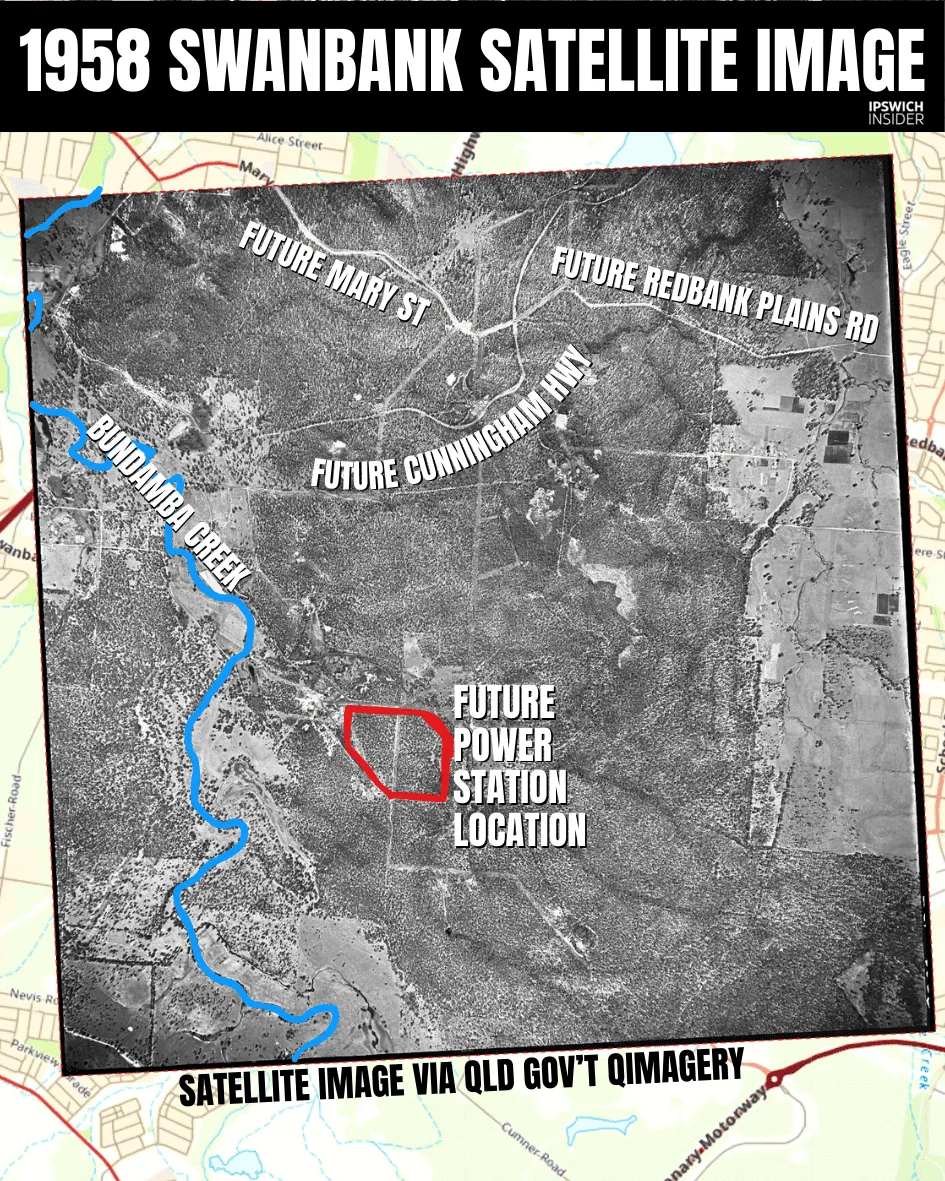
Fly over Swanbank in 1958 and you’d see nothing. Bush, paddocks, a few mine buildings. All the action was underground. Construction had just started and everything around it was still bushland.
Underground coal mines
Source: Ipswich Mine Mapper tool
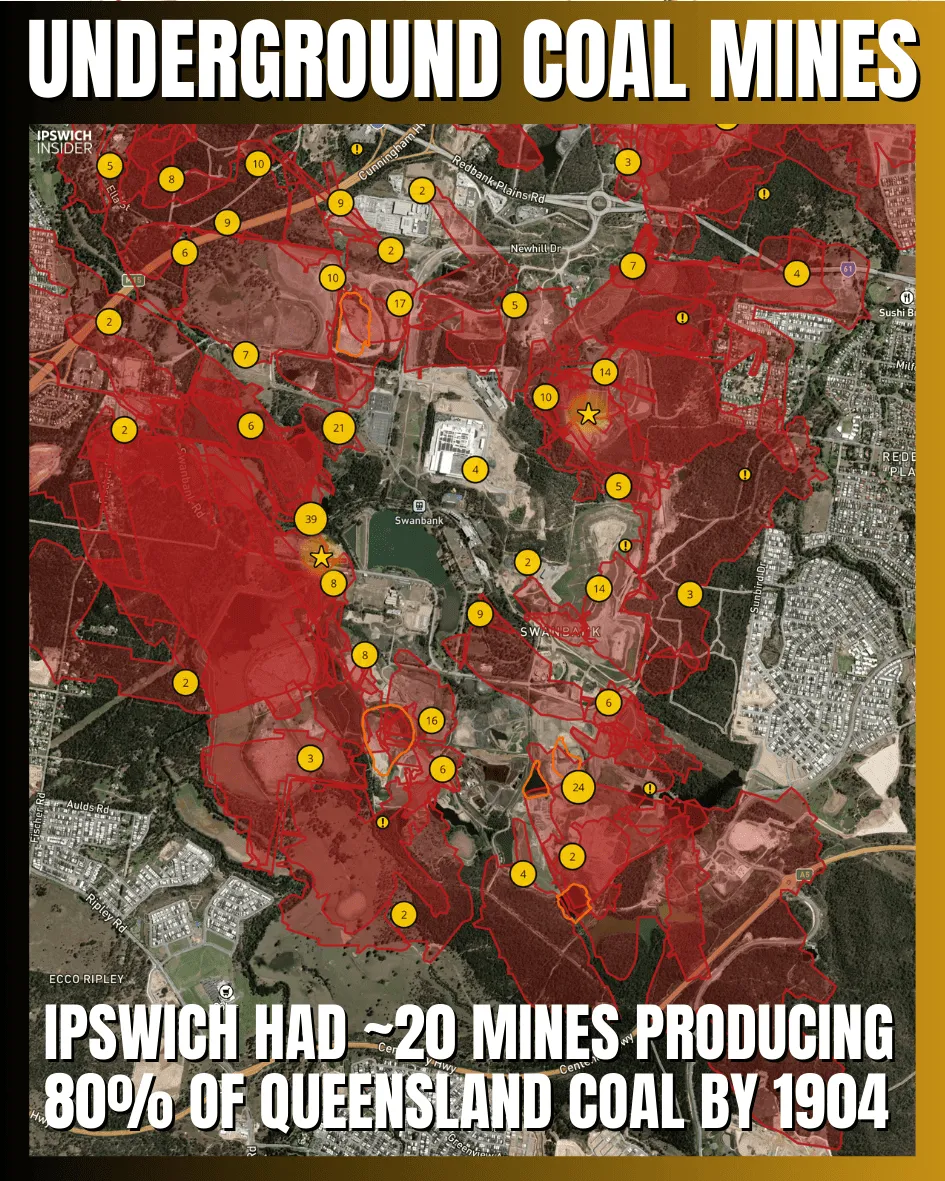
This is the part of Swanbank most people never think about. By 1904, the Ipswich coalfield was producing 80% of Queensland’s total coal output, with over 1,000 miners working across the region.
Old mine workings still sit beneath the surface and they still shape what can be built, where, and how much it costs to prepare the ground.
- Development constraint: legacy mine voids and stability work
- Why it matters: industrial estates here often need major ground preparation. BrisWest’s developers had to fill old mine voids at depths of up to 220 metres before a single lot could be sold
Box Flat Colliery

Source of Box Flat Colliery, 1963 image: Picture Ipswich
Box Flat sits at the centre of Swanbank’s coal era story. By 1912, William McQueen had 80 employees pulling 200 tonnes a day. Still using ponies to haul coal underground.
31 July 1972. 2:47am. An explosion ripped through Box Flat Mine. 17 men were killed. 9 mine employees and 8 rescue workers who went in to save them. An 18th man, Clarrie Wolski, died from his injuries 19 months later.
The mine was sealed.
A memorial stands on Swanbank Road. The Ipswich Historical Society holds a service there every year.
The mine closed in 1987.
Coal power stations: Swanbank A and B
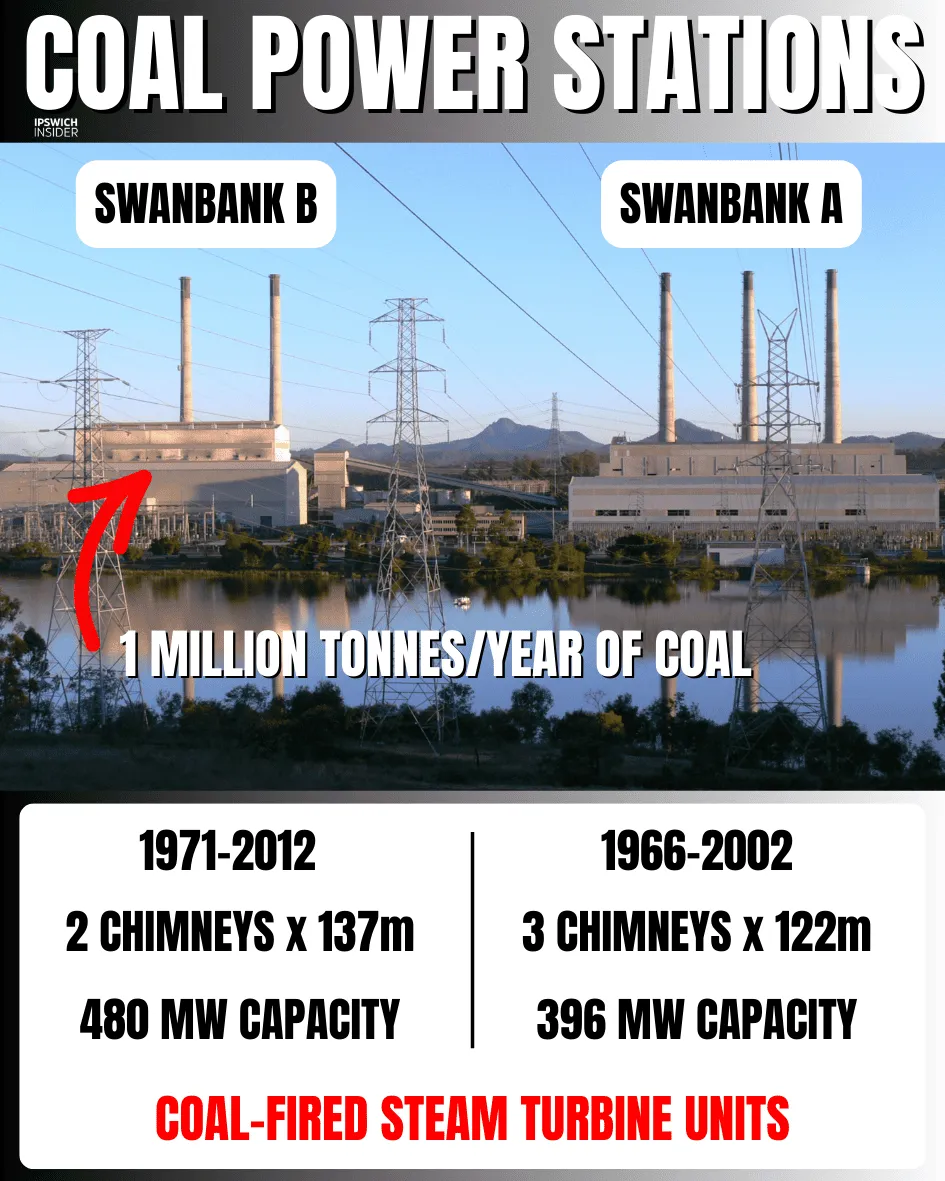
This is when Swanbank became impossible to miss. The power stations reshaped the landscape and locked in the big advantage Swanbank still has today — major grid infrastructure.
- Swanbank A: 396 MW, commissioned 1967. Six steam turbines. Three concrete smokestacks — 122 metres tall, 7,000 tonnes each.
- Swanbank B: 480 MW, commissioned 1971. Four units at 120 MW each. Two stacks at 137 metres.
- At peak: combined capacity exceeded 800 MW.
- Swanbank A decommissioned: It was shut on 30 June 2002. All three smokestacks demolished on the same day in 2006 — ten seconds between each collapse.
- Swanbank B: units progressively shut down between 2010 and 2012. Demolished between 2014-2015.
- Legacy: the coal units shut, but the 1.2 GW grid connection and 336 hectares of industrial land stayed.
Coal’s gone. But the grid connection stayed. That’s the whole play.
Swanbank rail siding

The rail corridor began as coal infrastructure. In 1975, it was extended about 5 km to deliver coal directly to the power station. It’s still part of the physical spine of the precinct and helps explain why industry clustered here in the first place.
Today, the Queensland Pioneer Steam Railway runs heritage train tours on a section of the old Bundamba–Swanbank coal line. The same rail corridor that started as an 1881 tramway to a coal mine now carries tourists in vintage carriages past a $400m drinks factory and 138 Tesla Megapacks.
BrisWest
BrisWest is Swanbank’s highway-facing expansion. Think logistics, warehousing, manufacturing, and big-lot industrial land on the Cunningham Highway/Redbank Plains Rd edge.
Where it sits
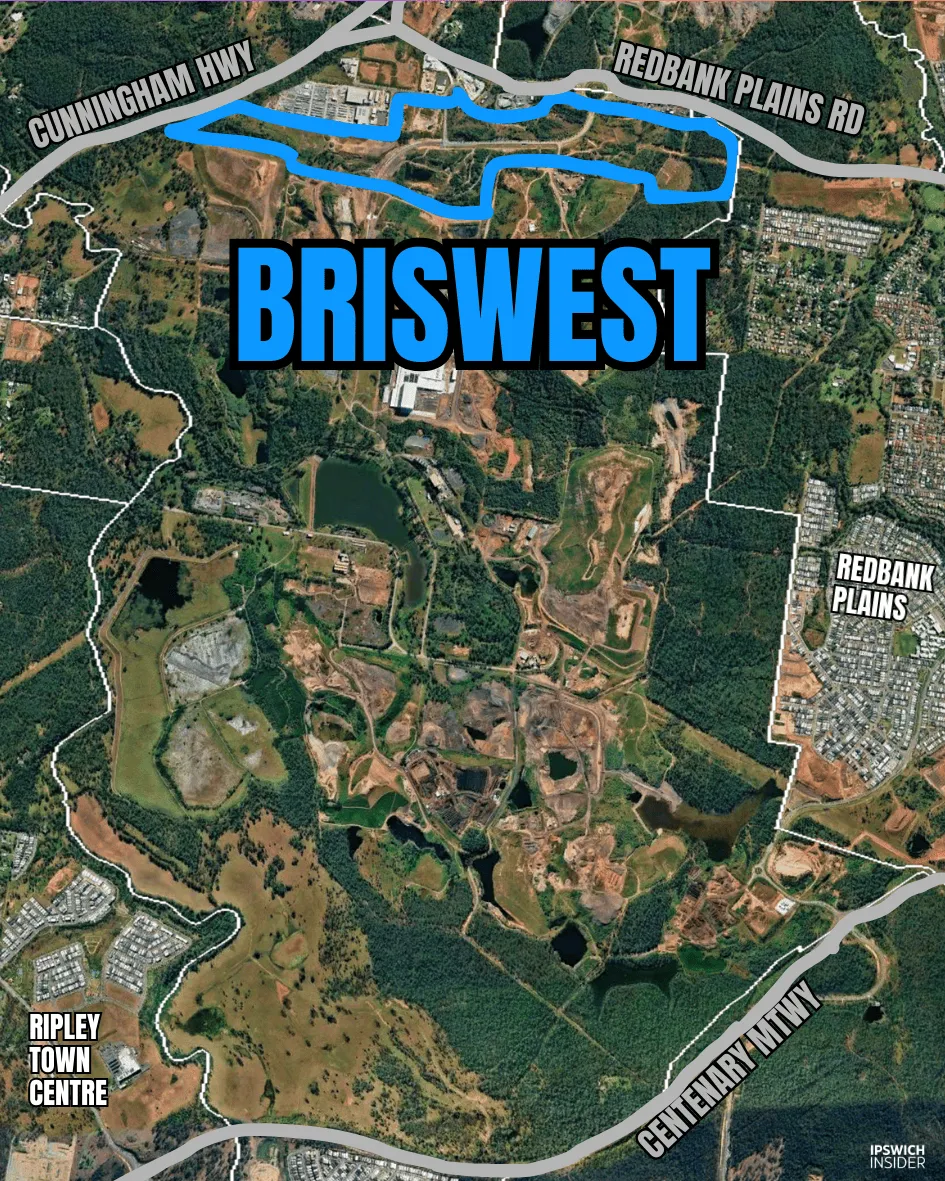
Developed by Vitale Property Group, BrisWest is built on top of old coal mine workings. Developers had to fill mine voids at depths of up to 220 metres before a single lot could be sold.
- Scale: 130 ha industrial estate
- Designed for trucks: A‑Double and B‑Double access
- Flood-free: everything engineered above Q500 flood level
- Six-leaf EnviroDevelopment certification — the highest rating available
- Built on legacy coal land: major ground works before lots can be delivered
Masterplan

This is the end-state view. BrisWest is being staged, with Stage 2 marketed as the biggest industrial land opportunity in Brisbane’s western corridor in two decades.
Stage 1
Launched at the end of 2024 with 24 lots, ranging from 2,800 m² to 6.4 hectares. Shadforths Civil is handling earthworks, with civil works completing around March/April 2026.
- Sales: 14 of 24 lots sold by September 2025 for a combined $31.9 million
- Most recent sale price: $575/m²
- Buyer mix: developers and owner-occupiers, strongest demand for blocks under 1 hectare
Stage 2
- Size: 60 ha across three precincts (25.9 ha, 19.7 ha and 14 ha)
- Potential: about 320,000 m² gross floor area of built product
- Marketed end value: $900m+ (developer marketing figure)
- EOI closed: October 2025. Delivery expected early 2027.
Designed for operators who need space and truck access, not neighbours.
New‑Gen Business Park
New‑Gen is the serviced industrial estate at the centre of Swanbank’s modern wave. This is where Swanbank starts to look like a conventional industrial park — just on a much bigger backbone.
Where it sits
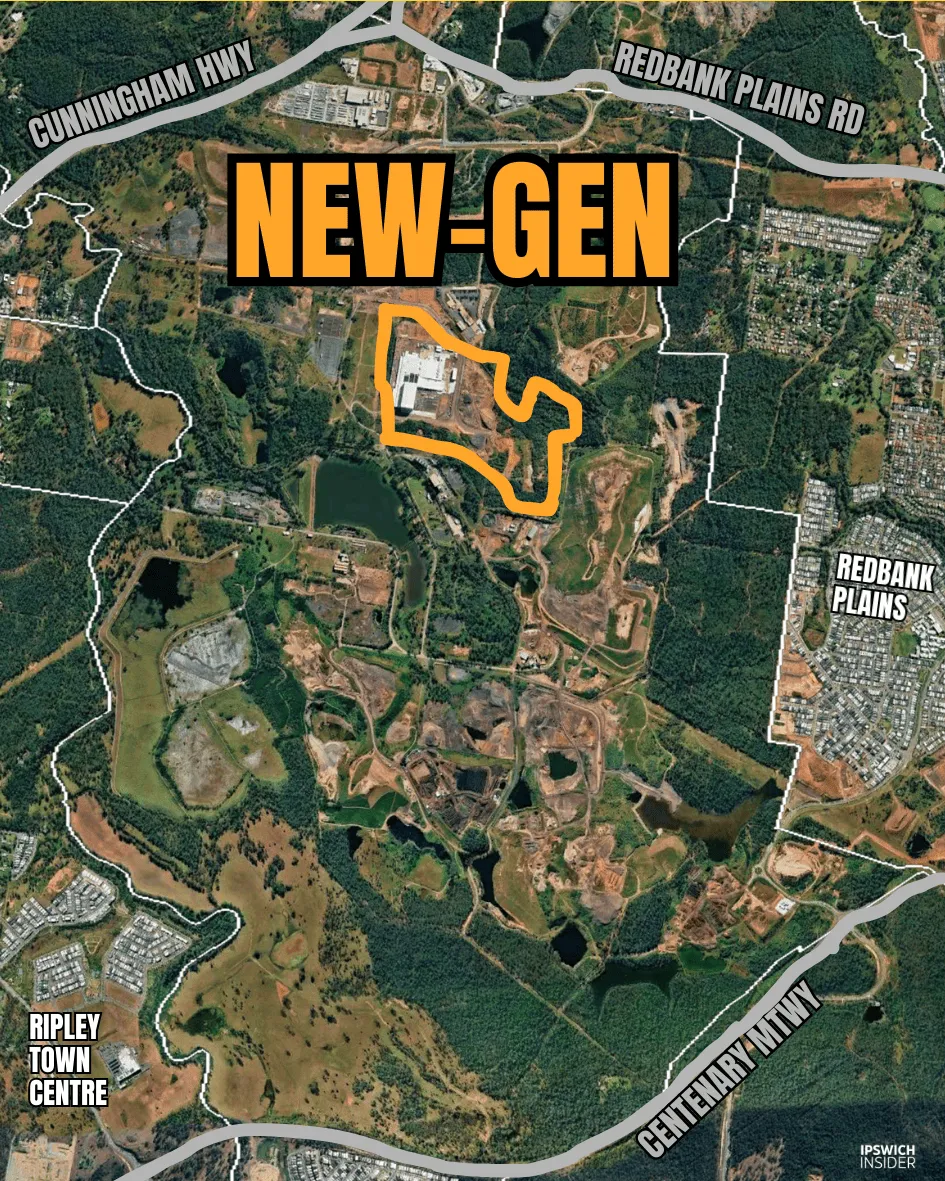
- Estate size: 65 ha of fully serviced industrial land — sewerage, electricity, water, natural gas, broadband
- Proximity: about 6 km to Ipswich CBD, 45 km to Brisbane CBD, 60 km to Port of Brisbane
- Flood-free: above Q500 flood level
- Access: B-Double and Super-B capable. 24/7 operations (subject to approvals)
Masterplan
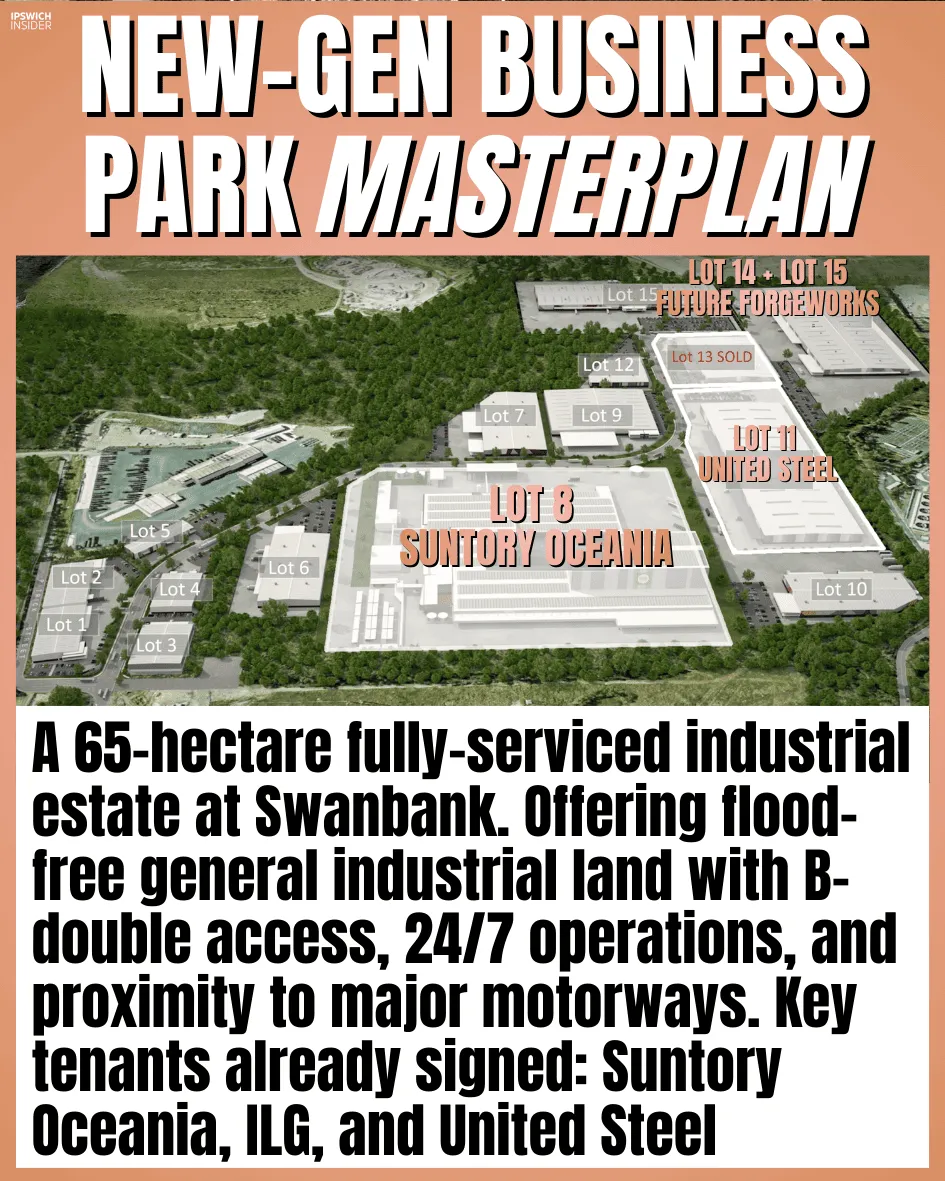
The masterplan shows why New‑Gen is attractive to large tenants. It’s built for 24/7 industrial operations, with big footprints and heavy vehicle access.
Layout today

Suntory gets all the headlines, but it’s not the only tenant. ILG (Independent Liquor Group) has built a purpose-built distribution hub next door. A 30,846 m² site with a warehouse the size of two Bunnings.
New-Gen’s marketing also lists United Steel as a pre-committed tenant.
The surrounding Swanbank precinct includes Boral, Humes, Remondis, Austral Bricks, BMI, and Tytec.
Suntory Oceania
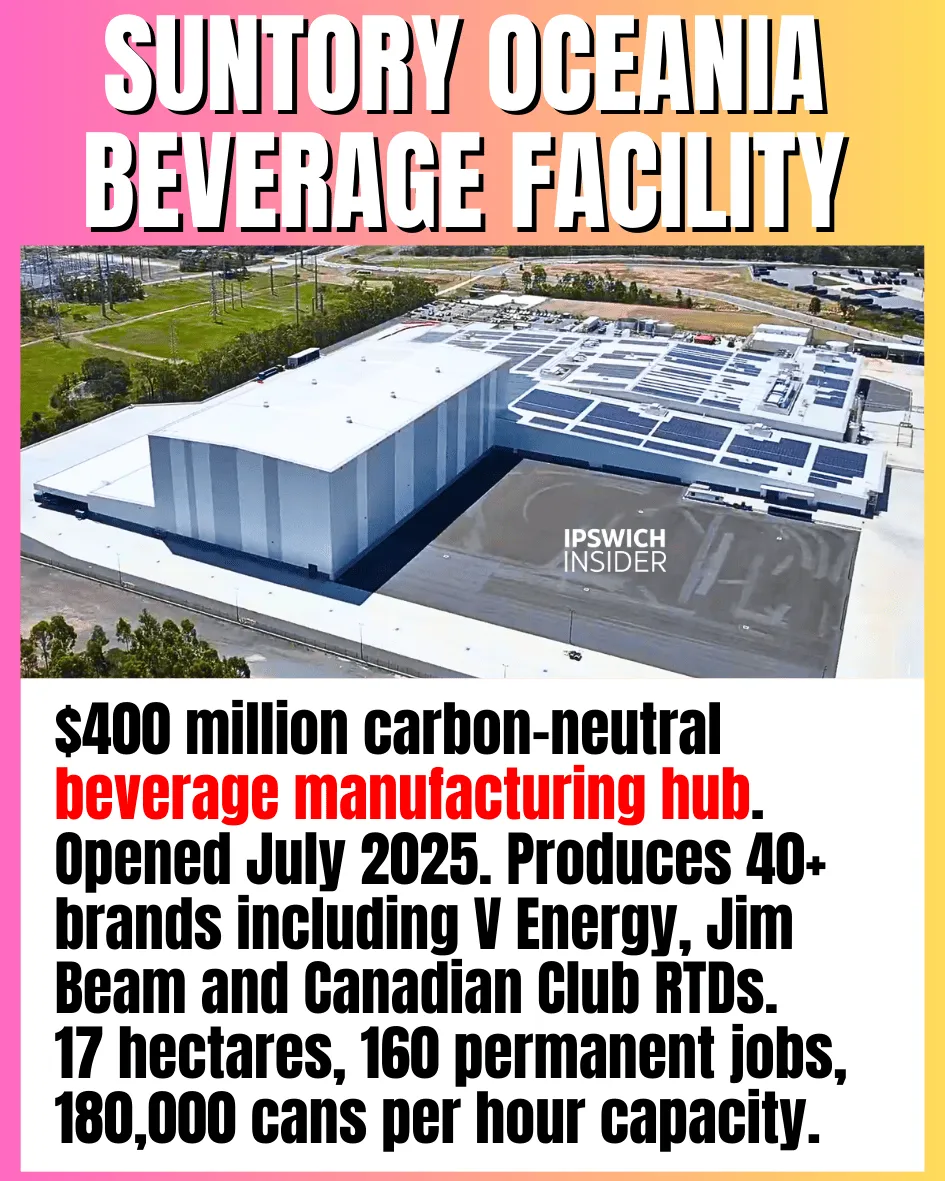
A Japanese beverage giant chose Swanbank over every other location in Australia. And offers from other countries for its new manufacturing HQ. Opened July 2025, Suntory Oceania is now a $3 billion multi-beverage company, the 4th largest in Oceania.
- Investment: $400m on a 17-hectare greenfield site
- Brands: 40+ — Jim Beam, V Energy, Canadian Club, Maker’s Mark, -196, BOSS Coffee and more
- Output: 20 million cases per year at launch, scalable to 50 million
- Speed: 180,000 cans per hour
- Jobs: 160 permanent roles, plus about 450 construction roles during the two-year build
- Green credentials: 7,500 rooftop solar panels (Ipswich’s largest single solar installation), biomass boiler, CleanCo solar power purchase agreement — carbon neutral
The building includes a 30-metre-tall automated storage retrieval system. Suntory’s supply chain chief described it as “like a cathedral.”
Future Forgeworks (proposed green steel)
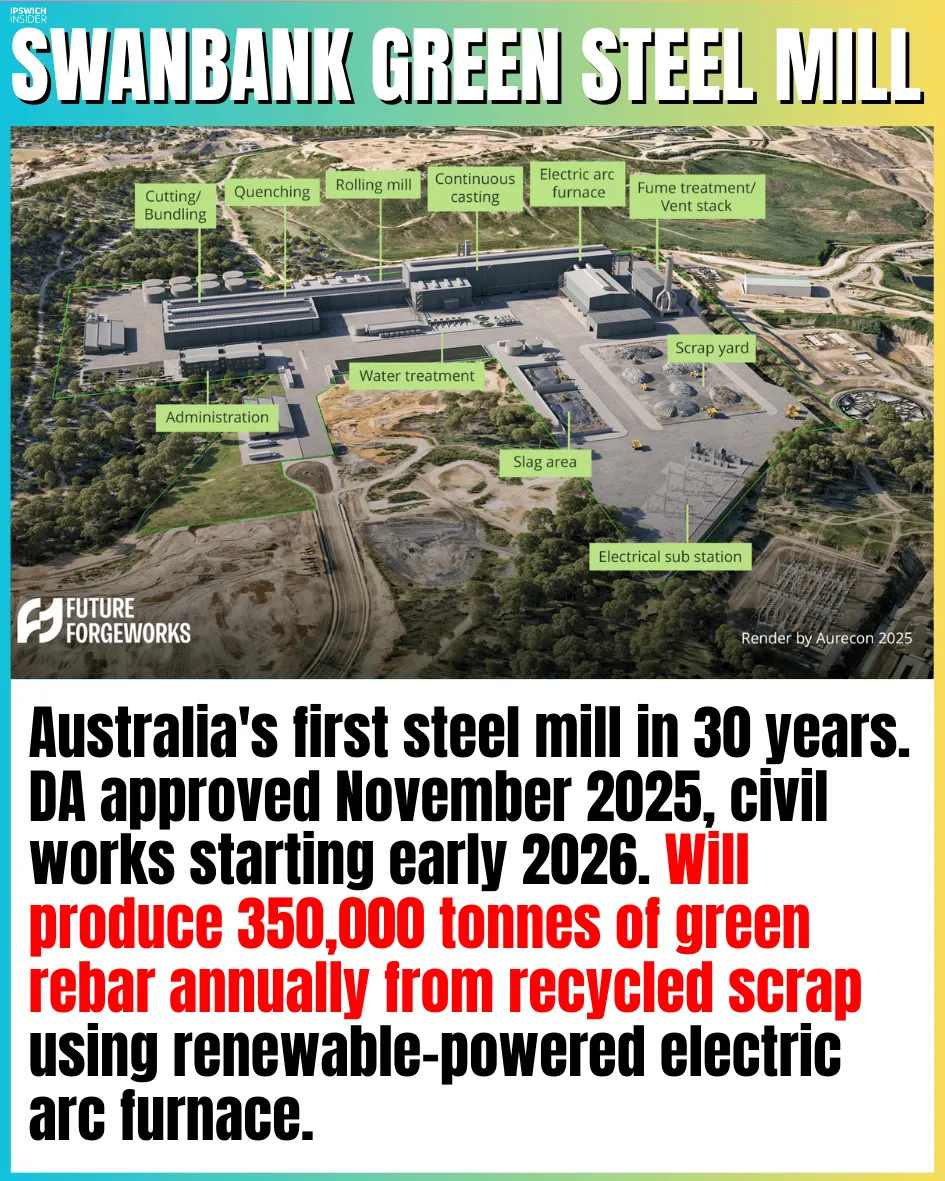
Future Forgeworks is planning Queensland’s first green steel mill in the Swanbank industrial precinct. Founded by managing director Rohan Richardson, who grew up in Ipswich.
The pitch is simple. SEQ scrap metal that currently gets exported overseas would instead be melted down locally and turned into the rebar going into concrete foundations for new homes across Ripley, Springfield and Redbank Plains.
- Technology: electric arc furnace (SMS group CMT350® continuous mill)
- Proposed output: 350,000 tonnes a year of rebar and reinforcing wire from scrap steel
- Emissions: about 90% fewer than current Australian steel production
- Status: DA approved by Ipswich City Council (November 2025). Equipment contract signed with SMS group.
- Funding: still in capital raising as of late 2025. Stated timeline is civil works early 2026, first steel within 24 months — but all contingent on securing funding.
This project is the watch-this-space signal that Swanbank’s next wave may include heavy manufacturing again, not just warehouses.
CleanCo Energy Precinct
This precinct is the energy heart of Swanbank. Coal is gone, but the grid connection stayed. That’s why the site could pivot to gas and grid-scale batteries without the massive cost of building new transmission from scratch.
Where it sits

- Land: 336 ha energy precinct
- Grid connection: 1.2 GW capacity
- Role: dispatchable generation and storage
- Pipeline: additional 250 MW fast-start gas generation under investigation, plus Australia’s largest grid-connected sodium-sulfur battery pilot (1.5 MW)
Energy hub plan

This plan ties together the key energy assets and the redevelopment logic. Reuse coal-era land and grid infrastructure for modern energy projects. Swanbank Lake (originally built to provide cooling water for the power station) is getting a parklands refresh as part of the precinct’s evolution.
Swanbank E (gas)
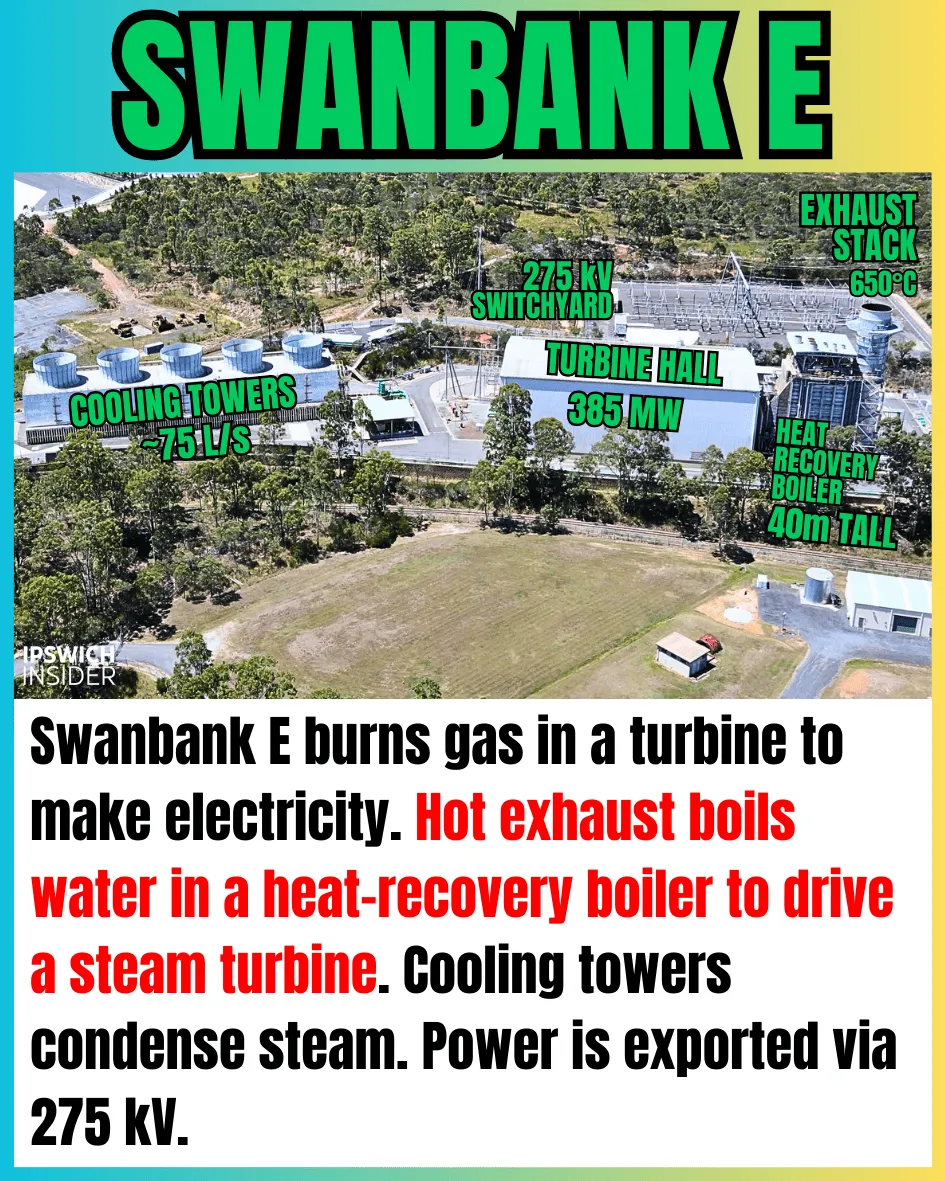
Swanbank E is the keeps-the-lights-on piece of the precinct. Gas generation still plays a role in peak demand and system reliability, especially during the energy transition.
- Capacity: 385 MW combined cycle gas
- Operating since: 2002
- World record: in 2011, Swanbank E ran for 254 straight days without stopping — a world record for continuous operation
Swanbank Battery (storage)
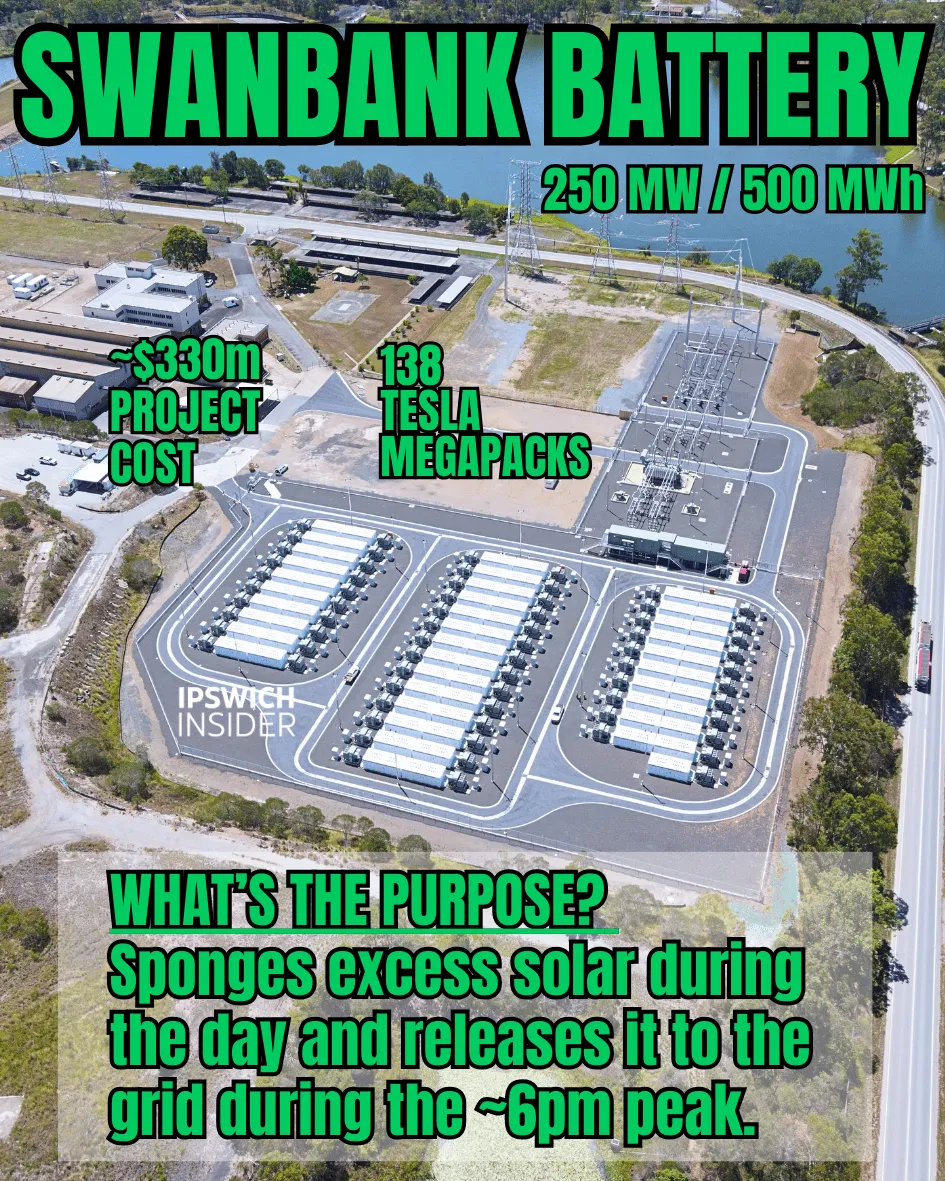
The battery is the cleanest symbol of Swanbank’s reinvention. Same industrial footprint: built right on the old Swanbank B coal site. Different job. Soak up energy, then release it when demand spikes.
- Size: 250 MW / 500 MWh (two-hour peak buffer)
- Build: 138 Tesla Megapack 2XL units
- Cost: $330m, funded through the Qld Renewable Energy and Hydrogen Jobs Fund. Delivered under budget.
- Local meaning: enough to power around 355,000 homes for two hours at full output, according to the Queensland Government (5 Feb 2026)
- Status: as of February 2026, operating at full capacity while final approvals continue
Powerlink high voltage (transmission backbone)

This is the reason Swanbank keeps getting picked for grid-scale projects. The transmission infrastructure is already in place, which massively lowers the barrier for new generation and storage. Building this kind of connection from scratch would cost $100s of millions.
Energex power network (distribution layer)

Think of this as the last-mile layer. Transmission moves bulk power. Energex distribution spreads it across suburbs and businesses.
Waste and Resource Recovery
This is essential city infrastructure. Every city needs somewhere to process its waste. Ipswich’s version is Swanbank.
Where it sits
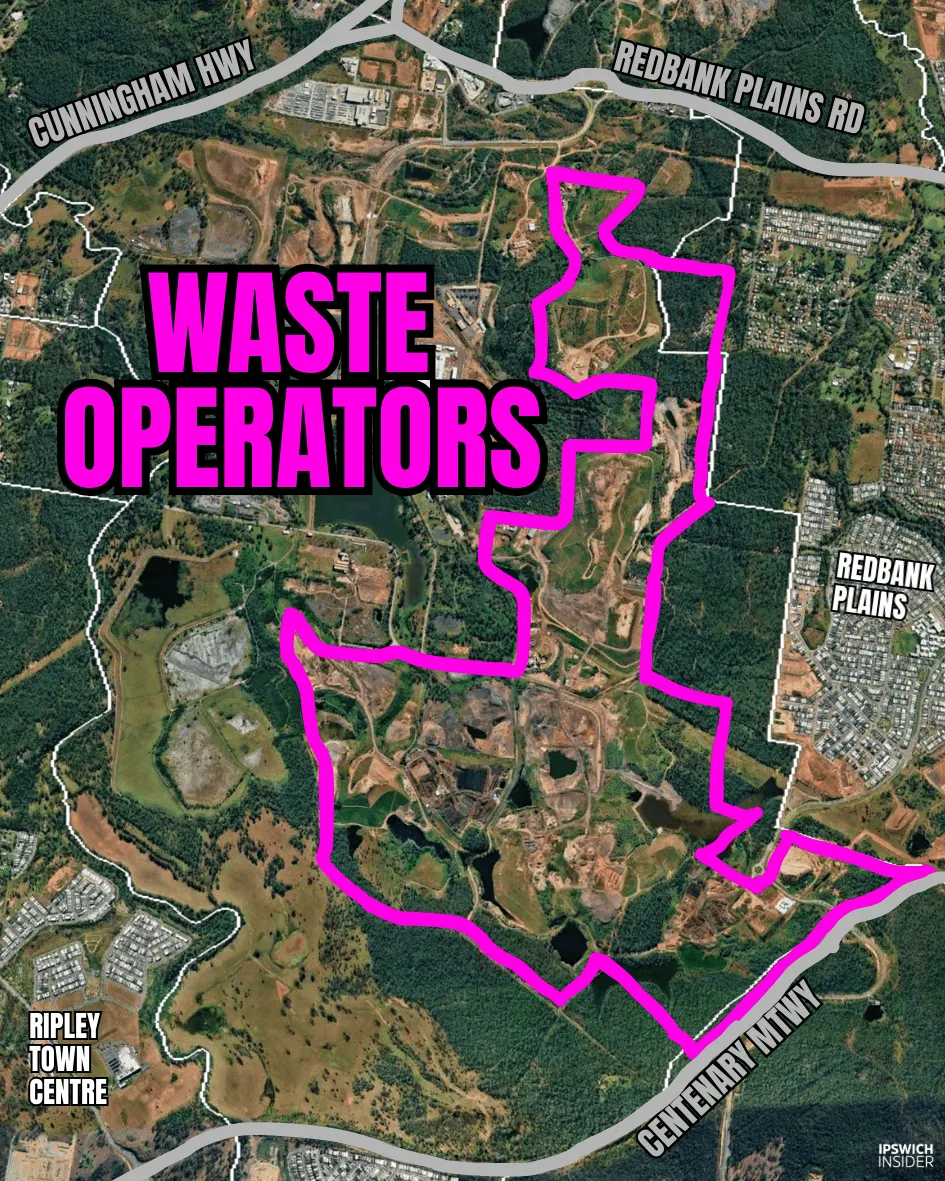
Swanbank has been a waste management hub since the late 1990s. The logic was straightforward: industrial-zoned land, no residents, good road access, and existing infrastructure from the coal era.
- Scale: well over 700,000 tonnes a year processed across the precinct including New Chum (multiple operators)
- Reality: it serves the whole region, not just Ipswich
- Regulated: the QLD Department of Environment, Science and Innovation maintains a public map of every licensed operator
Odour and oversight
Odour from organics processing has been an issue at times. Upgrades are pushing the precinct toward enclosed processing.
Waste operators map (Swanbank and New Chum)
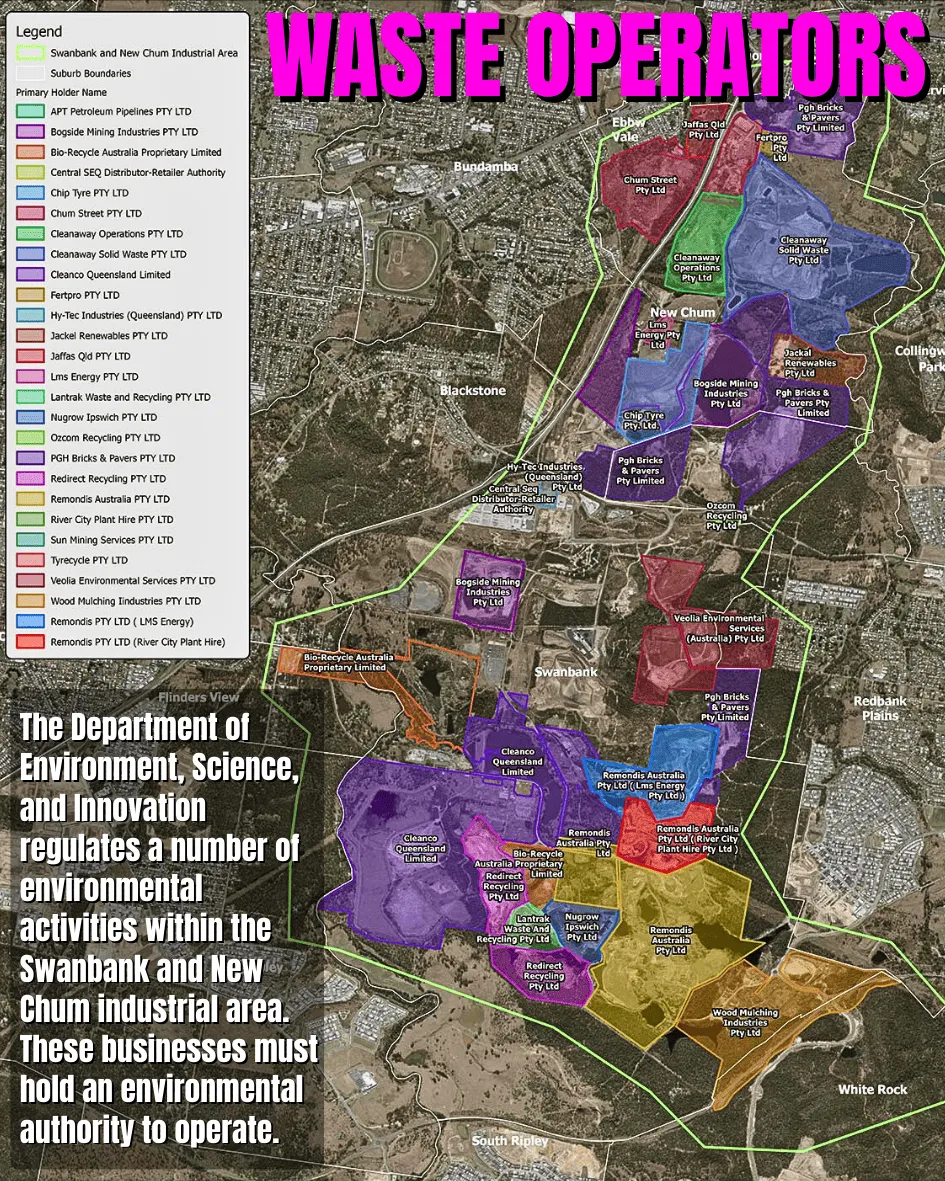
This is the who-is-where reference map. It shows the main licensed sites in the Swanbank and New Chum industrial area.
Source: Queensland Government: Location of waste operators
Swanbank landfill (Remondis)
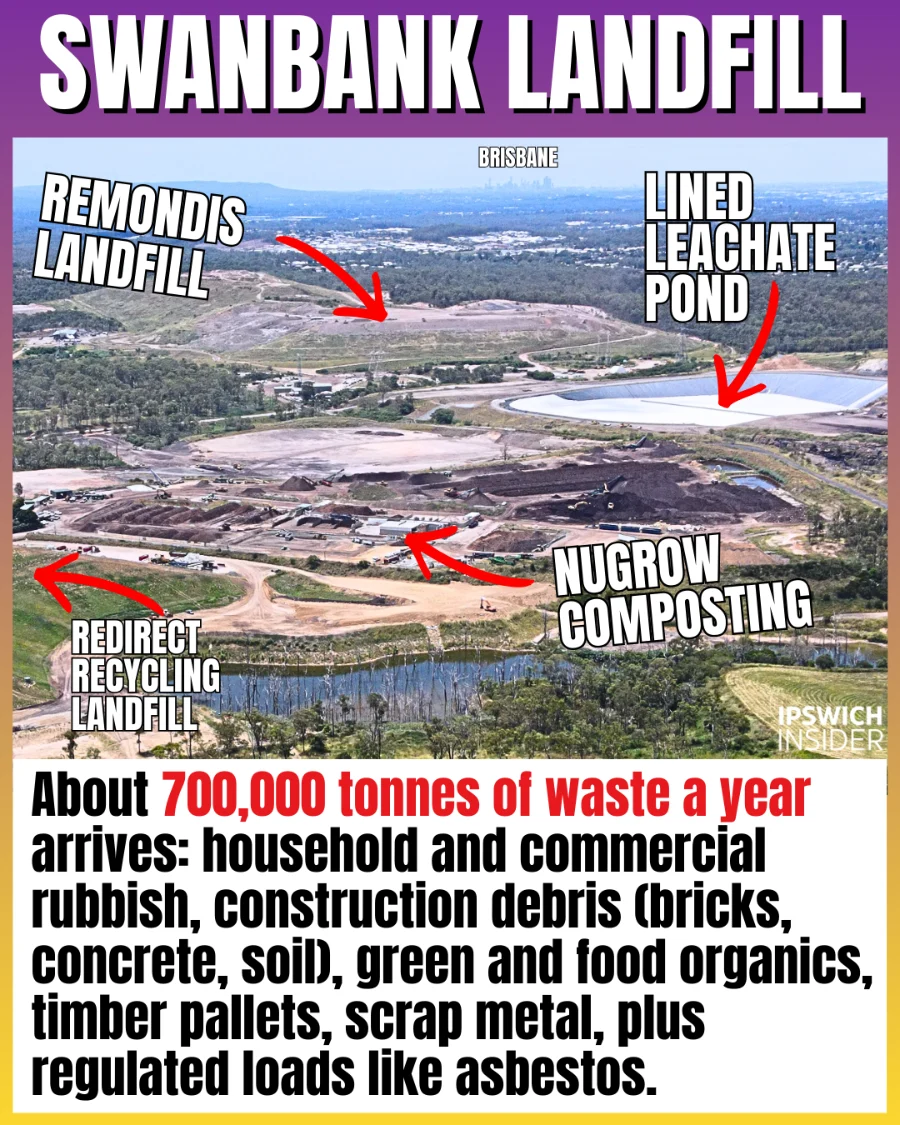
Remondis is the biggest operator in the precinct and one of the biggest in the country. A German-owned global waste management company running the Swanbank Renewable Energy & Waste Management Facility. Known locally as Swanbank Landfill.
- Land: 250 hectares. Established 1997.
- Throughput: about 500,000 tonnes of material a year. Commercial landfill (no public access), transfer station, contaminated soil disposal (including PFAS), construction and demolition waste, green waste, polystyrene, and secure product destruction.
- Beverage destruction: a facility on site has processed over 6 million litres of recalled beverages since July 2023, shredding containers and recovering the recyclable materials.
- Energy: ReOrganic Energy Swanbank (a joint venture between LMS Energy and Remondis) captures methane from the decomposing landfill and generates about 27,000 MWh of renewable electricity per year. Enough to power around 4,800 homes. The landfill literally powers itself.
- Direction: Council has approved Remondis to build an enclosed FOGO (food organics, garden organics) composting plant on part of the site. It will process 48,000 tonnes of organics per year, backed by $5 million in combined federal and state government grants. This is the transition the community and council have been pushing for – away from landfill, toward enclosed resource recovery.
- Learn more about Remondis Swanbank.
NuGrow
NuGrow is Queensland’s largest organic waste recycler and compost manufacturer. Their Swanbank facility receives green waste, food waste, biosolids and manures and recycles them into commercial-grade composts and soil products.
- Location: Box Hill, Swanbank Road. B-Double accessible.
- Operations: receives and processes organic waste through composting, then manufactures soil products.
- Direction: transitioning to enclosed composting in stages, with completion targeted by September 2028.
Wood Mulching Industries (WMI)
A family operation that’s been here since 1993. One of the original Swanbank waste-era tenants. Founded by John North, who learned wood grinding in America. The business is now run by his 3 sons Tyler, Chaye and Dustyn.
- Land: 70 hectares on Centenary Highway
- Throughput: over 200,000 tonnes of material per year. 20+ staff.
- What they do: green waste, timber and organic feedstock comes in. Mulches, composts, soil conditioners, erosion control products, washed sand and aggregates go out. Used in landscaping, horticulture, civil works and farm soil rejuvenation.
- Future: WMI has lodged a development application with Ipswich City Council to redevelop the site. Details pending.
Lantrak
A different kind of waste operator. Where Remondis and NuGrow deal in organic and general waste, Lantrak focuses on the construction industry.
- Location: 1 Memorial Drive, Swanbank. Open 6 days a week, all-weather access.
- What they do: licensed to accept construction and demolition materials, low-contaminated soils and clean fill. Uses heavy-duty processing to separate, crush and screen materials for reuse. Concrete from timber, brick from aggregate. Also runs material supply, tipper truck and plant hire from the site.
- Why it matters: with SEQ’s construction pipeline accelerating — new housing estates, road upgrades, Olympics infrastructure. The demolition and soil disposal work has to go somewhere. Over 50 years in the industry.
The bigger picture
Between these four operators alone, Swanbank processes well over 500,000 tonnes of material a year. It generates renewable electricity from decomposing rubbish. It turns food scraps into farm soil and demolition rubble into road base. It destroys millions of litres of recalled beverages and recovers the aluminium and glass.
However the direction is clear: away from open-air processing and landfill, toward enclosed facilities and circular economy models. Both council and the state government have made that explicit.
South Enterprise Park
South Enterprise Park is Swanbank’s next chapter. Right now it’s a plan and approvals pathway, not a built industrial estate. Farmland with a plan. One to watch, not one to visit.
Where it sits
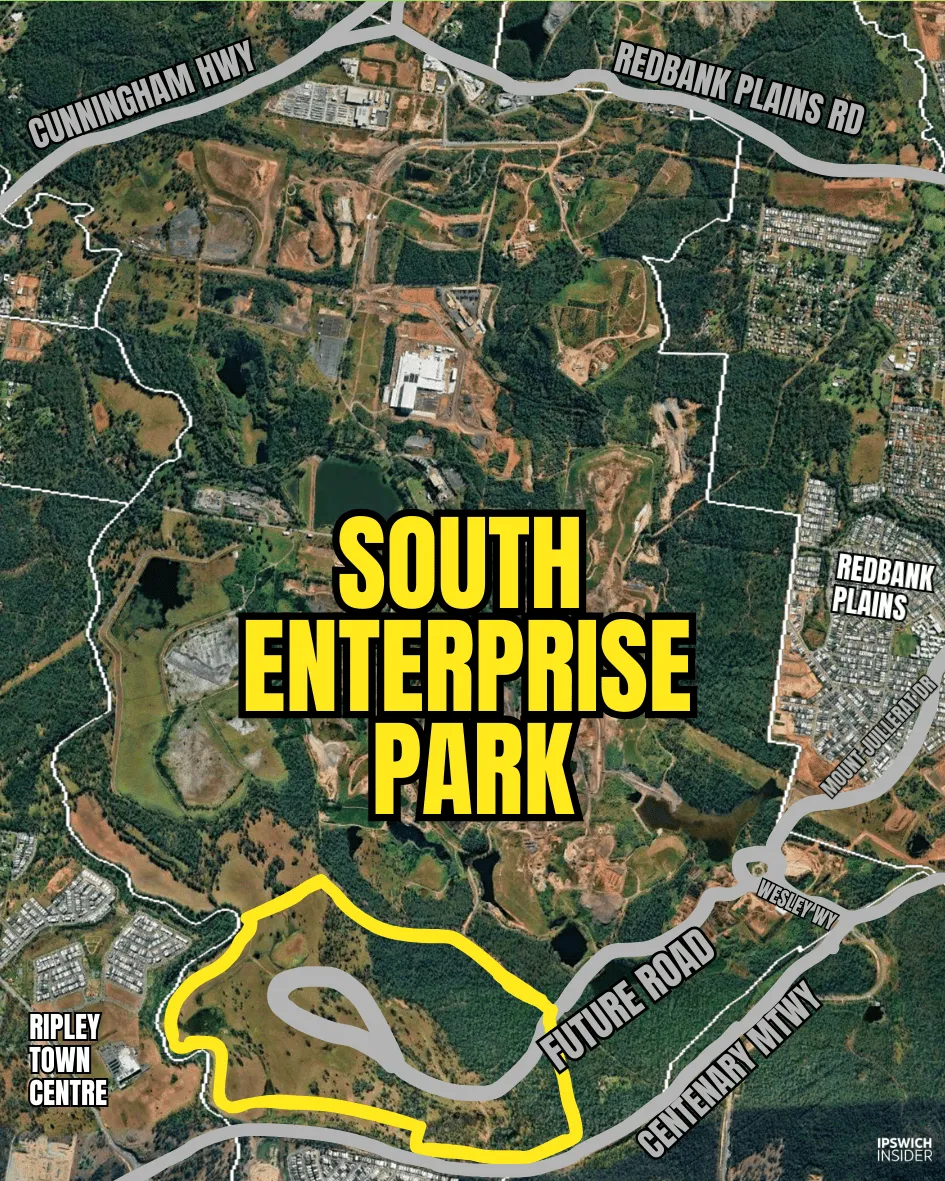
Swanbank South Enterprise Park (overview)
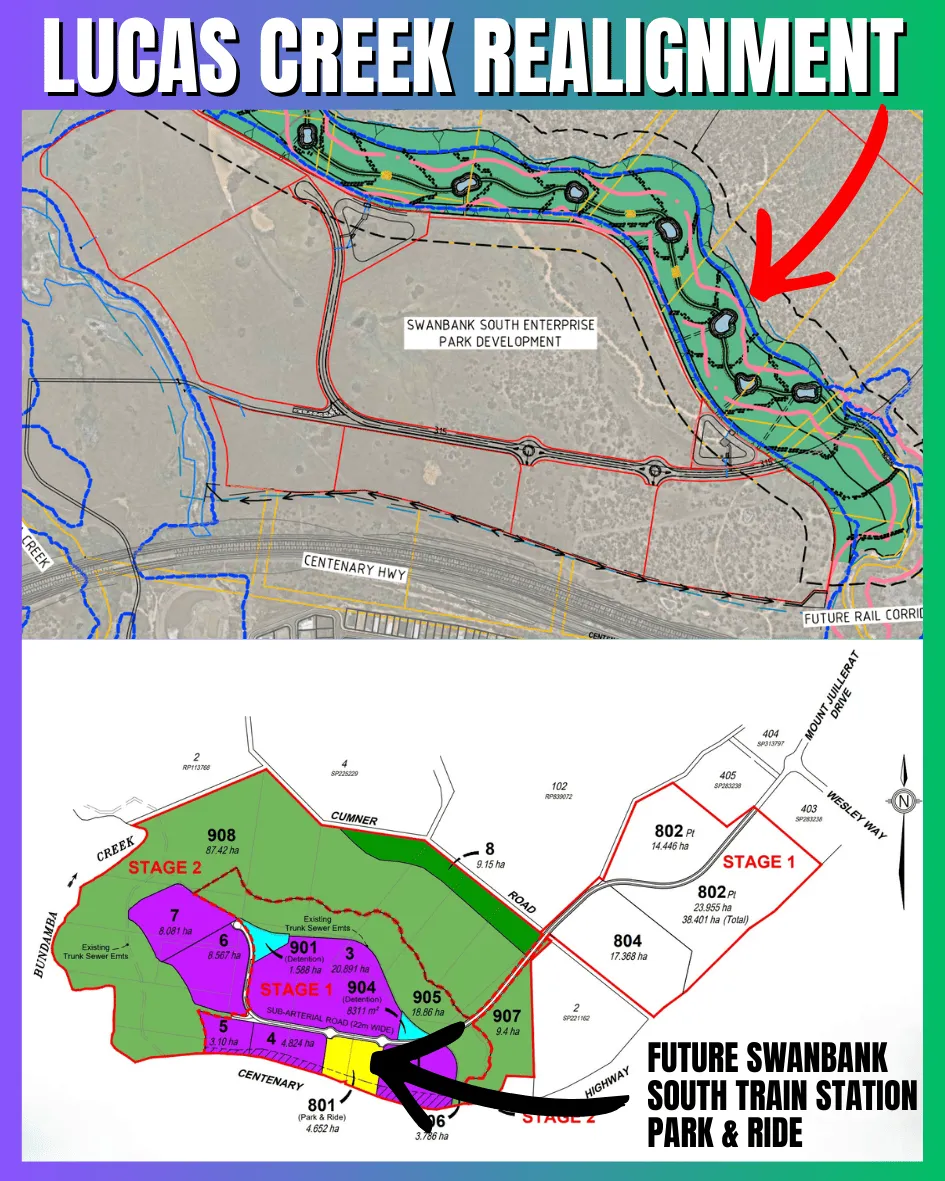
The pitch is simple. New master-planned industrial land at Swanbank’s southern edge with Centenary Highway access via a new road connection to Wesley Way in Redbank Plains.
Planning documents specifically reference new roads, drainage, a park, and a future park-and-ride.
Approvals have already been granted for Lucas Creek’s realignment along the north-eastern edge of the proposed Enterprise Park. Which tells you the ambition is precinct-scale, not a single warehouse.
- Early stage: planning and enabling works first
- What you’ll see first: roads, drainage, and creek realignment works before buildings
- Why it matters: industrial land supply is becoming a major constraint across SEQ
Swanbank South landholding details (what’s proposed)

When you see different numbers for “Swanbank South”, it’s usually because people are mixing up the broader landholding with the net developable industrial footprint.
- Landholding: about 191 ha plan area
- Industrial footprint: about 53 ha planned industrial development
- Enabling works: includes Lucas Creek realignment and drainage reserves
- Approvals: early approvals granted for subdivision, lot reconfiguration, new road and Lucas Creek realignment
- Everything else: still in planning
Show me the money
Swanbank generates jobs, construction spend, and rates revenue without needing the expensive community infrastructure that residential growth demands. No schools. No playgrounds. No libraries. No school zone crossings.
How council earns from industrial land
Ipswich uses differential general rates. Not a flat rate. Council has 60 separate rating categories, each with its own rate-in-the-dollar. Industrial and noxious industry categories pay significantly more per dollar of land value than residential.
The rate-in-the-dollar for industrial and noxious categories is typically 2–4 times higher than residential across QLD councils. So a $30 million industrial lot (like Suntory Oceania’s) doesn’t just pay more because it’s worth more. It also pays a higher rate per dollar of value on top.
The rating categories that matter for Swanbank:
- Categories 49a–49e — Light industry, split into five bands by land value. Suntory, ILG and most New-Gen/BrisWest tenants land here.
- Category 50 — Heavy industry. Power stations get their own secondary code within this category.
- Category 46 — Noxious industry involving waste recycling or processing. NuGrow and WMI likely fall here.
- Category 47b — Noxious industry involving landfill. This is Remondis.
- Category 25 — Vacant land requiring rehabilitation from coal mining.
Who pays for the infrastructure?
Mostly not council.
Under Queensland’s planning framework, developers pay infrastructure charges that fund trunk infrastructure — water, sewer, stormwater, transport, parks.
They also build and fund all the internal estate infrastructure themselves.
So when BrisWest or New-Gen build a new stage, the developer is paying for the internal roads and contributing to trunk infrastructure costs. Council isn’t footing that bill.
A sense of scale
- $730m+ combined investment from Suntory and the battery alone
- $678m — Ipswich council’s entire annual budget (2025) for comparison
- $30m — Valuer-general land valuation on Suntory’s single 17 ha lot
- 160 permanent jobs at Suntory alone
- ~450 construction and installation jobs during the Suntory build
Every one of those permanent workers likely lives somewhere in Ipswich or surrounds, spending locally.
CleanCo is publicly owned. Revenue from electricity generation and battery services flows back to the Queensland Government — not interstate or overseas shareholders.
What’s next
Swanbank has been reinventing itself for 140 years. It’s not stopping.
What’s happening now:
- BrisWest Stage 1 civil works completing early 2026. Stage 2 sold via EOI. See RealCommercial listing here.
- Suntory operational and scaling toward 50 million cases a year
- Battery at full capacity
- CleanCo investigating another 250 MW of generation
- Swanbank Lake parklands getting a refresh
What’s coming:
- Swanbank South working through approvals for 191 ha of new industrial land
- More tenants filling New-Gen and BrisWest
- Future Forgeworks green steel mill — DA approved, capital raising in progress, targeting first steel by 2027 (funding-dependent)
- Waste precinct modernising — shifting toward enclosed processing and resource recovery
Search any Development Application by location:
- Visit development.ipswich.qld.gov.au →
- Zoom and pan around the map to find the location you are interested in
- Click the blue dots to view more details about that location
- Once you click the DETAILS blue button in the popup look for Application Documents link in the next window.
- Once that Application Documents page loads look for DA Plans Approved or DA Plans Lodged. Those PDFs will show the renders and images of what’s going on at the location.
The trade-offs
Industrial precincts come with trade-offs. Here’s what comes with the territory.
- Odour: organic waste processing has drawn complaints at times. Upgrades toward enclosed processing are underway.
- Trucks and noise: more industrial activity means more heavy vehicle movements — waste trucks, delivery vehicles, B-doubles servicing logistics warehouses. As BrisWest and New-Gen fill up, traffic on Swanbank Road will increase. Some operations run 24/7.
- Legacy coal issues: old mine workings and contaminated land shape what can be built and how quickly. Remediation is part of CleanCo’s Clean Energy Hub redevelopment.
Swanbank does the heavy lifting so the rest of Ipswich doesn’t have to.
Sources
- NuGrow Facilities. Nugrow.com.au
- 189 Swanbank Coal Rd. RealCommercial.com.au
- New-Gen Business Park, Swanbank. NewGenBusinessPark.com.au
- BrisWest. BrisWest.com.au