
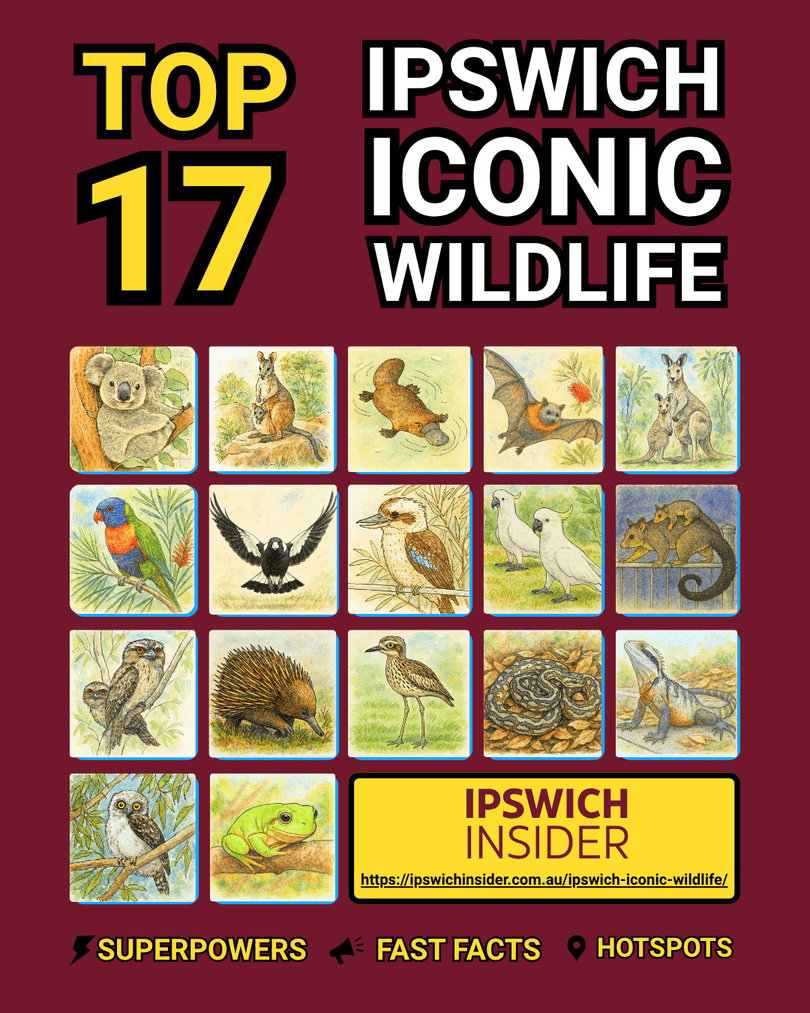
Iconic Wildlife in Ipswich at a Glance
- From 700 to 17. We shortlisted 70 species, scored 29 based on 7 things locals care about, and crowned the Top 17.
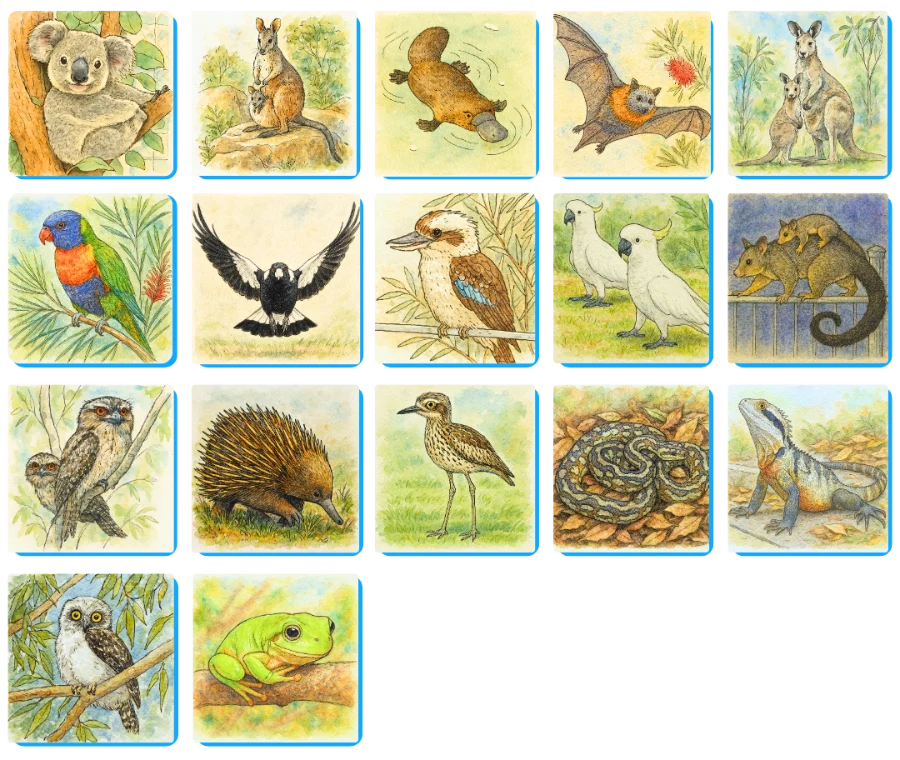
- Iconicity final ranking. Koala, Rock‑wallaby, Platypus, Flying‑fox, Eastern Grey Kangaroo, Rainbow Lorikeet, Australian Magpie, Laughing Kookaburra, Sulphur‑crested Cockatoo, Possum, Tawny Frogmouth, Echidna, Bush Stone‑curlew, Carpet Python, Eastern Water Dragon, Powerful Owl, Green Tree Frog.
- 17 graphics. Superpowers: toxic‑leaf expert to super‑hearing. Hotspots: Nerima Gardens to Purga to Woogaroo Creek. Crazy facts: echidna 10‑day egg to water dragon 30‑minute dives.
🔢 By The Numbers
- 695 – native animal species recorded in the Ipswich LGA
- 1,100 km² – land area of the City of Ipswich
- ~7,000 ha (~6%) – council conservation estates (Enviroplan)
- 341 – native bird species recorded locally
- 94 – reptile species in the LGA
- 35 – amphibian species logged for Ipswich
- 43 – rare or threatened animal species in Ipswich
- 500,000 – flying-foxes once roosted at Woodend
- 3+ – creek catchments with platypus focus: Sandy, Woogaroo/Opossum, Six Mile
- 10/day – peak summer snake relocations by Ipswich catchers; call a pro
- 80+ years – Sulphur-crested Cockatoo lifespan in captivity
- 1996 – year Enviroplan began protecting land
- 1 – faunal emblem: Brush-tailed Rock-wallaby (Flinders–Goolman hills)
- 2,200 ha – Flinders–Goolman Conservation Estate (largest in Ipswich)
- 1,262 – native plant species recorded in the LGA
- ~47% – of Queensland’s bird species occur in Ipswich
Here’s a field guide to the animals that feel most “Ipswich”.
To make it: we started by looking at 700 local wildlife species.
Then cut to a shortlist of 70.
Then actually scored 29.
The Top 17 emerged.
How did we score?
We scored each species on 7 things locals care about.
Each is weighted and scored 0-5.
7 metrics:
- How often you meet it (30% – Common).
- How much people love it (25% – Loved).
- How much the city backs it (15% – Civic).
- How iconic it is across Australia (10% – Mythic).
- How Ipswich-specific it feels (10% – Distinct).
- The job it does in nature (5% – Role).
- How reliably you can find it (5% -Reliable).
Jump to:
#1 Koala
Undisputed icon. Loved across Ipswich and backed by strong civic effort. Cultural mythic status plus mapped habitat make it the natural number one.
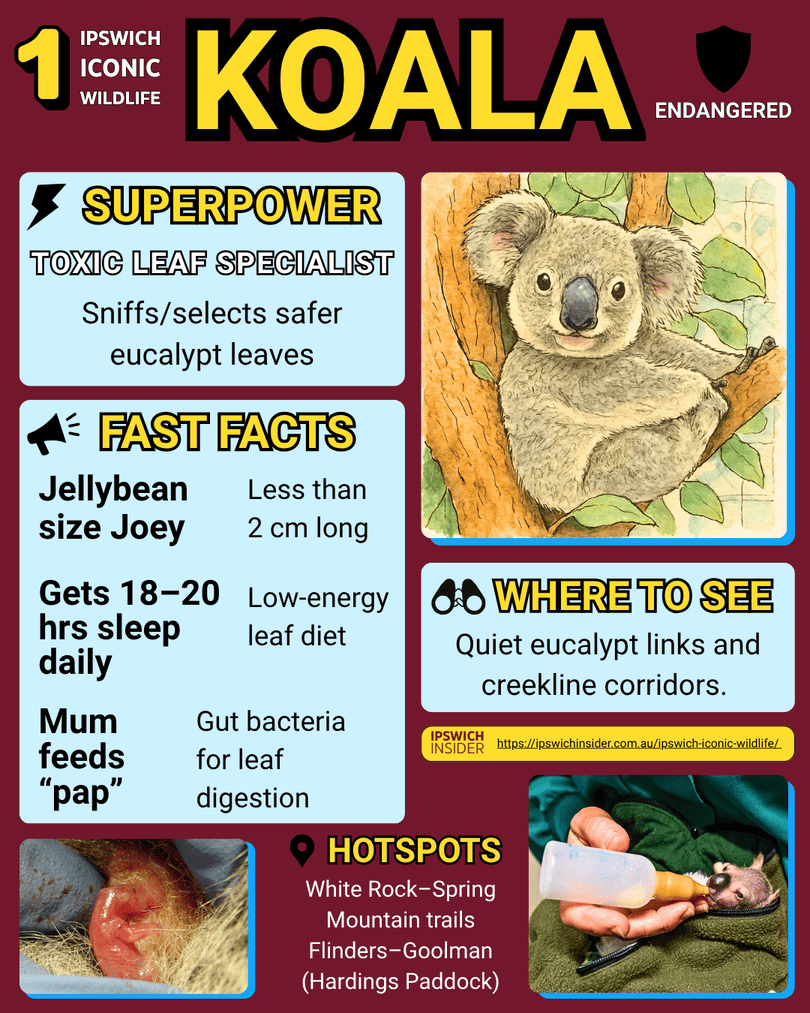
👥 Estimated number of individual koalas within Ipswich
- Population (est.): Hundreds. 200–1,000.
⚡ Superpower
- Toxic leaf specialist — sniffs and selects safer eucalypt leaves
📣 Fast Facts
- Sleeps 18–20 hours — low energy leaf diet
- Jellybean size joey — ~19 mm climbs to pouch
- Mum feeds pap — seeds joey gut for leaf digestion
ℹ️ More Info
- Status: Endangered EPBC and QLD
- Where to see them: Quiet eucalypt links and creekline corridors across Ipswich
- Exact Hotspots: White Rock–Spring Mountain Paperbark Flats and Six Mile Creek boardwalk and Flinders–Goolman Hardings Paddock sector
- Diet: Eucalypt leaves from a few species plus flowers and shoots
#2 Brush‑tailed Rock‑wallaby
Ipswich emblem. Distinct to Flinders–Goolman with real recovery work. Not widespread yet reliably seen on cliffs which keeps it high.
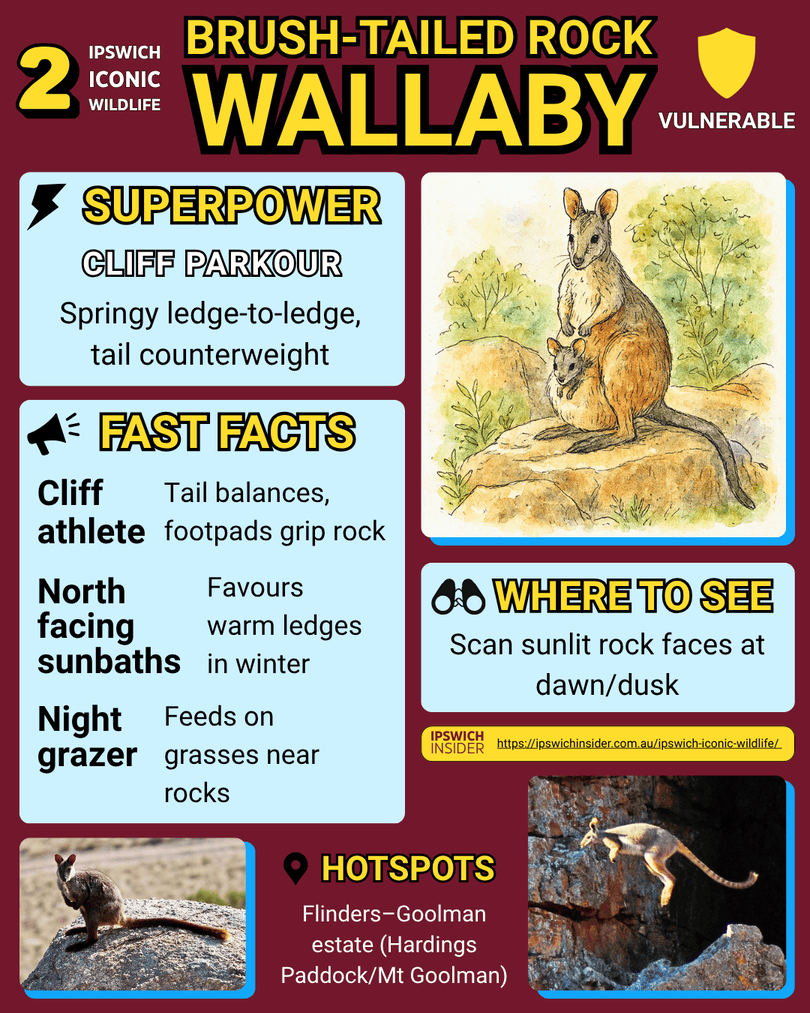
👥 Estimated number of individual brush‑tailed rock‑wallabies within Ipswich
- Population (est.): Dozens to low hundreds. 50–300.
⚡ Superpower
- Cliff parkour — springy ledge to ledge with tail counterweight
📣 Fast Facts
- Cliff athlete — footpads grip rock and tail balances
- North facing sunbaths — warm ledges in winter
- Night grazer — feeds on grasses near rocks
ℹ️ More Info
- Status: Vulnerable EPBC and QLD
- Where to see them: Flinders–Goolman rocky slopes at dawn and dusk
- Exact Hotspots: Hardings Paddock and Mt Goolman area
- Diet: Grasses and forbs with some browse
#3 Platypus
National marvel. Loved and mythic yet scarce in view. eDNA and creek projects give it civic weight and local distinctiveness.

👥 Estimated number of individual platypuses within Ipswich
- Population (est.): Dozens to low hundreds. 20–150.
⚡ Superpower
- Electroreception — hunts with eyes and ears shut and feels tiny signals
📣 Fast Facts
- Electric sense bill — detects prey in murky water
- Eggs hatch in ~10 days — monotreme marvel
- DNA in water proves locals — since 2016 across key creeks
ℹ️ More Info
- Status: IUCN Near Threatened and EPBC not listed and QLD Least Concern
- Where to see them: Quiet pools at dawn and dusk especially after rain
- Exact Hotspots: Shapcott Park canoe ramp and Cribb Park boat ramp and River Heart Parklands boardwalk check status and Woogaroo Creek Goodna
- Diet: Aquatic invertebrates plus yabbies and shrimp and worms
#4 Grey‑headed Flying‑fox
Night engine. Ecological heavy lifter for pollen and seed. Active roosts keep it common and reliable when the blossoms flow.
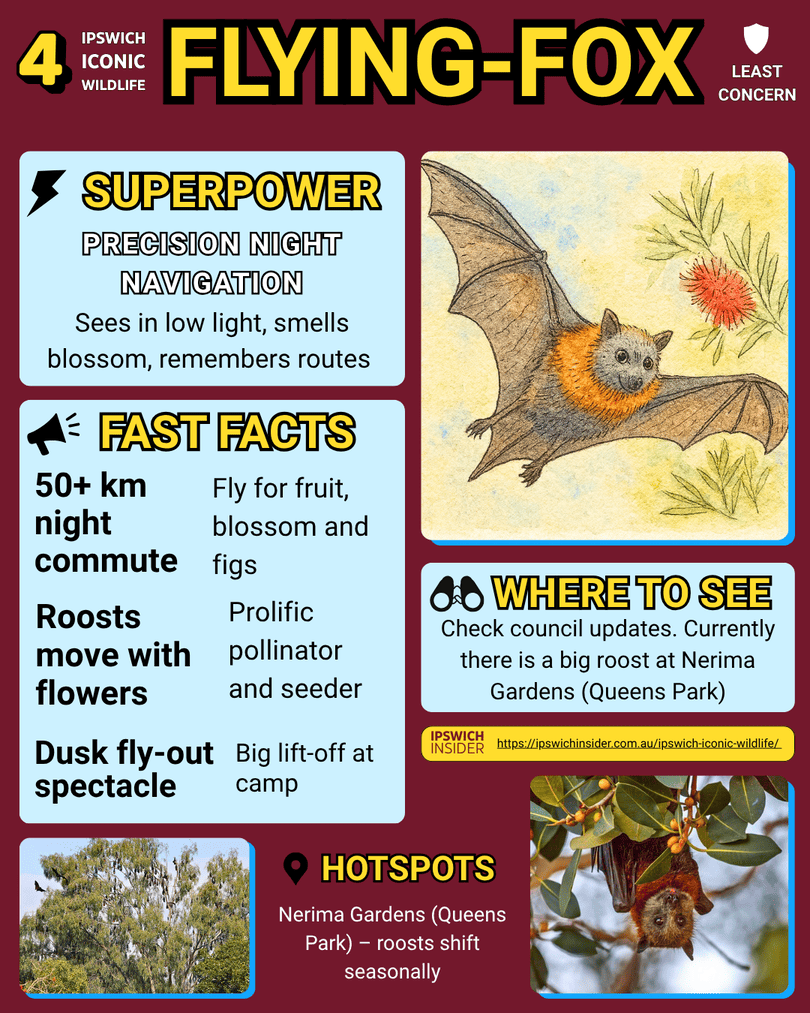
👥 Estimated number of individual grey‑headed flying‑foxes within Ipswich
- Population (est.): Low thousands to tens of thousands. 2,000–30,000 seasonally.
⚡ Superpower
- Low light vision plus smell plus memory — finds blossom and remembers routes at night
📣 Fast Facts
- 50+ km night commute — heads out for blossom and figs
- Roosts move with flowers — camps shift season to season
- Dusk fly out spectacle — Nerima Gardens roost
ℹ️ More Info
- Status: Vulnerable EPBC and QLD Least Concern
- Where to see them: Arrive before dusk and watch the fly out stream
- Exact Hotspots: Nerima Gardens in Queens Park with roost location shifting with food
- Diet: Nectar and pollen from eucalypts melaleucas and banksias and native fruits like figs and lilly pilly
#5 Eastern Grey Kangaroo
True Aussie. Loved and mythic with regular fringe sightings. Reliable mobs at dawn and dusk keep it in the five.
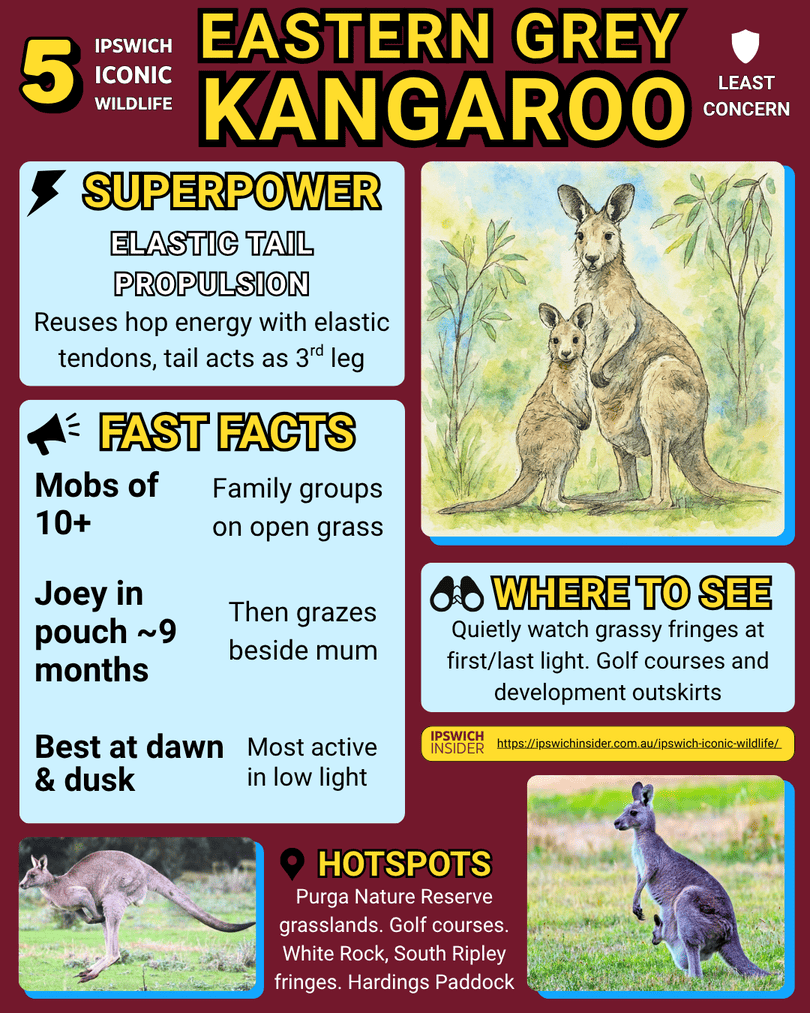
👥 Estimated number of individual eastern grey kangaroos within Ipswich
- Population (est.): Thousands. 1,000–7,000.
⚡ Superpower
- Elastic tendons and tail propulsion — reuses hop energy and tail acts like a leg
📣 Fast Facts
- Best at dawn and dusk — most active then
- Mobs of 10+ — family groups on open grass
- Joey in pouch ~9 months — then grazes beside mum
ℹ️ More Info
- Status: Least Concern IUCN and QLD
- Where to see them: Grassy fringes at first and last light
- Exact Hotspots: Purga Nature Reserve grasslands
- Diet: Grasses plus herbs and shrubs
#6 Rainbow Lorikeet
Colour riot. Very common and very reliable at dusk roosts. Loved status and daily visibility keep it high.
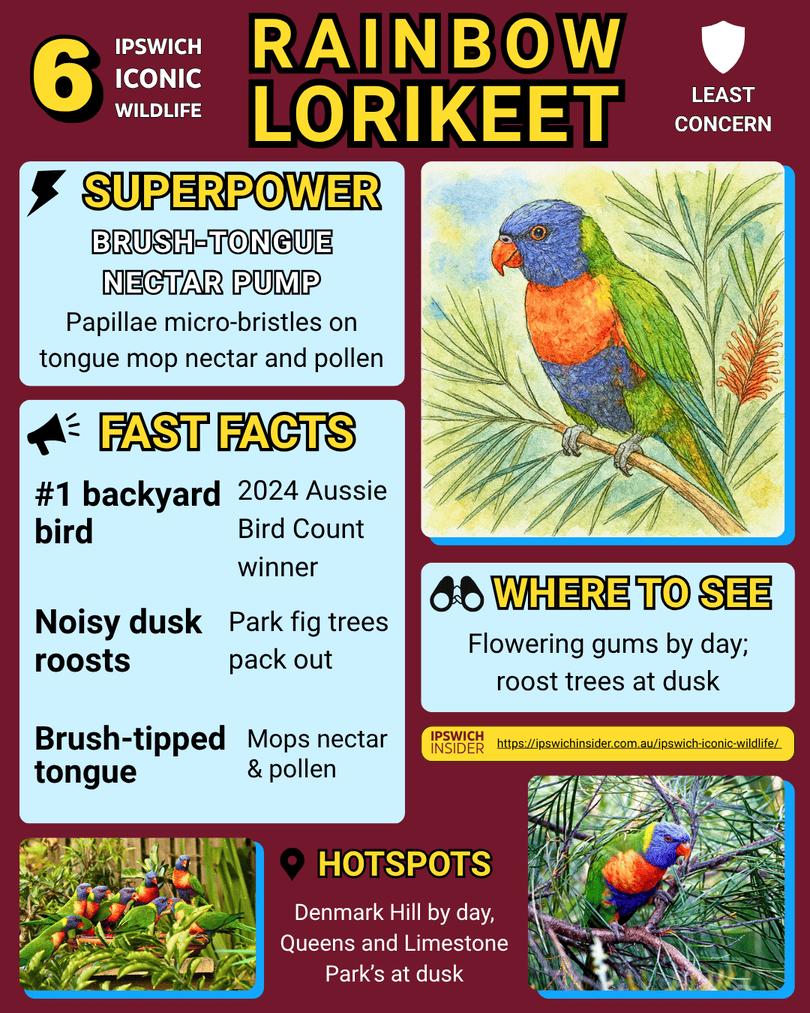
👥 Estimated number of individual rainbow lorikeets within Ipswich
- Population (est.): Tens of thousands. 10,000–60,000.
⚡ Superpower
- Brush tongue papillae — micro bristles mop nectar and pollen fast
📣 Fast Facts
- Australia’s #1 backyard bird — 2024 Aussie Bird Count leader
- Brush tipped tongue — laps nectar quickly
- Big dusk roosts — trees erupt with chatter
ℹ️ More Info
- Status: Least Concern
- Where to see them: Flowering gums by day and noisy roosts at dusk
- Exact Hotspots: Denmark Hill for day foraging and Queens Park figs and Upper Brisbane Street roost at dusk
- Diet: Nectar and pollen plus fruit and seeds and some insects
#7 Australian Magpie
Local soundtrack. Extremely reliable and common on ovals and verges. Loved with a spring wobble keeps it mid‑top.
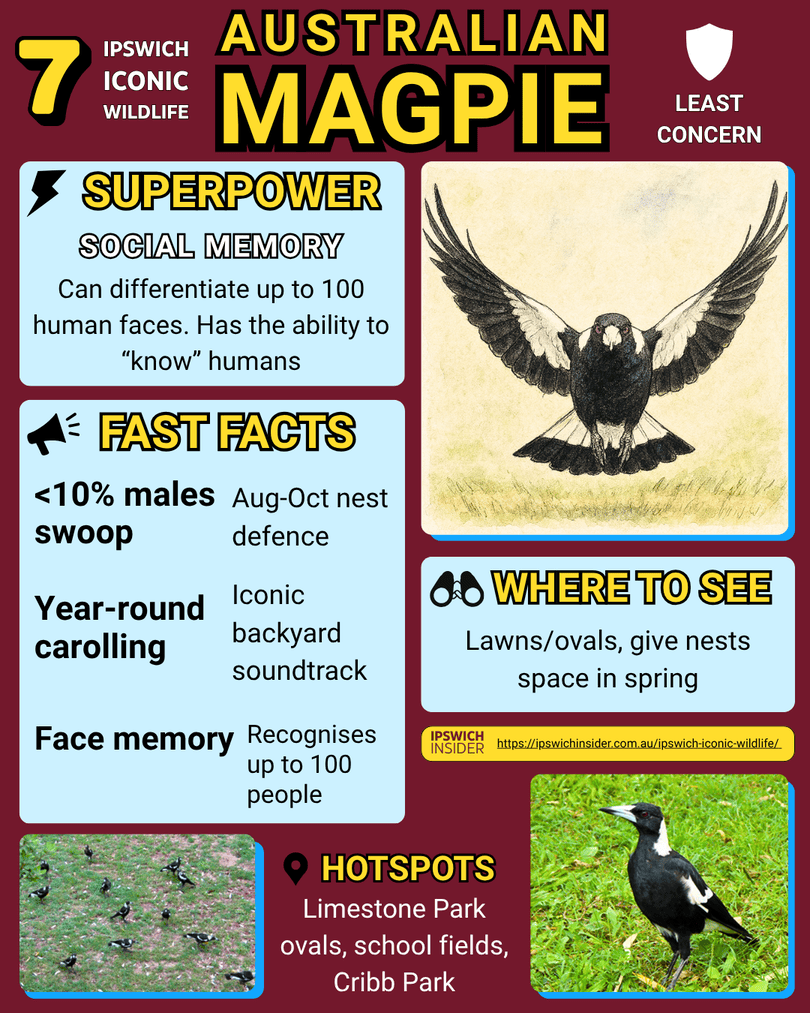
👥 Estimated number of individual Australian magpies within Ipswich
- Population (est.): Tens of thousands. 10,000–30,000.
⚡ Superpower
- Face recognition and memory — learns people and routes and changes behaviour
📣 Fast Facts
- <10% swoop — Aug to Nov nest defence
- Recognises faces — remembers people across seasons
- About 50 m nest zone — give nesting trees space
ℹ️ More Info
- Status: Least Concern
- Where to see them: Lawns verges and ovals with mornings busiest
- Exact Hotspots: Limestone Park fields and school ovals city wide
- Diet: Ground insects and grubs plus small vertebrates and some seeds and fruit
#8 Laughing Kookaburra
Dawn laugh. Loved family bird with a classic call. Reliable along creeks at first light keeps it top ten.

👥 Estimated number of individual laughing kookaburras within Ipswich
- Population (est.): Hundreds to low thousands. 500–3,000.
⚡ Superpower
- Perch ambush and crushing bill — dives from a perch then branch bash
📣 Fast Facts
- Dawn laugh equals territory — family chorus at first light
- Helpers at the nest — older young feed chicks
- Branch bash finisher — stuns bigger prey
ℹ️ More Info
- Status: Least Concern
- Where to see them: Creekline trees and park edges at first light
- Exact Hotspots: Denmark Hill and Kholo Gardens
- Diet: Insects and worms plus small reptiles mammals and birds
#9 Sulphur‑crested Cockatoo
Street clown. Loved and visible in big noisy flocks. Daily reliability with cultural charm keeps it in the nine slot.
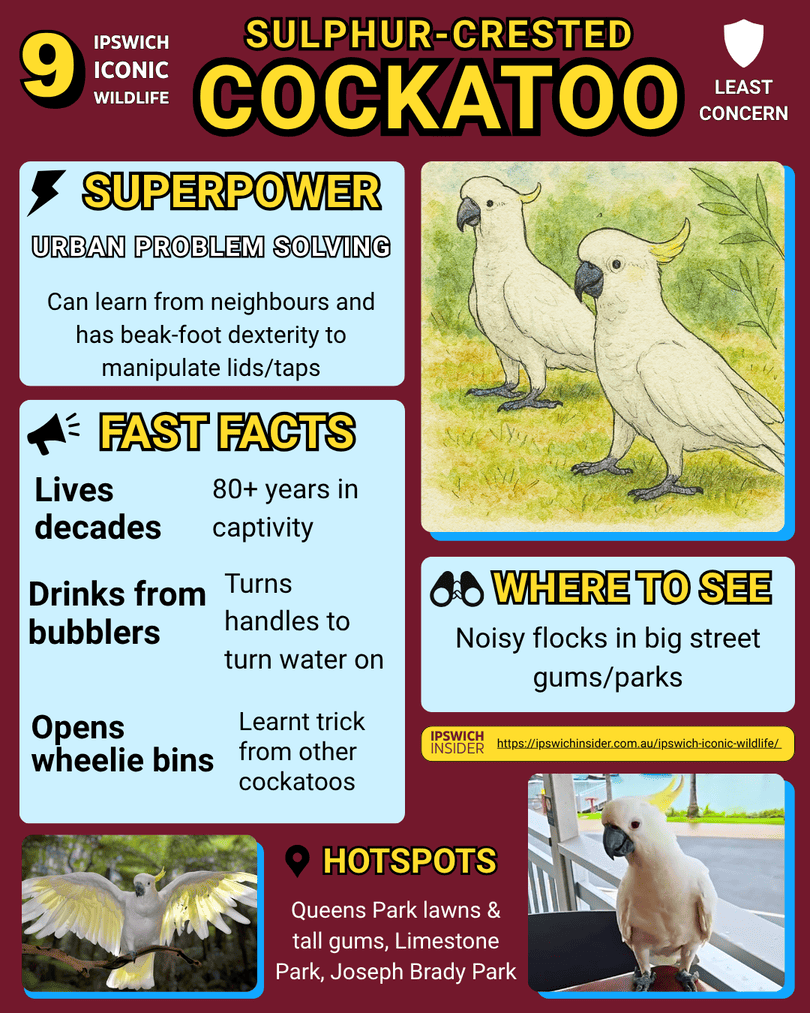
👥 Estimated number of individual sulphur‑crested cockatoos within Ipswich
- Population (est.): Thousands. 2,000–10,000.
⚡ Superpower
- Social learning and beak–foot dexterity — copies neighbours and manipulates lids and taps
📣 Fast Facts
- Opens wheelie bins — behaviour spreads neighbour to neighbour
- Drinks from bubblers — turns tap and sips running water
- Up to 80+ years — captive birds can live decades
ℹ️ More Info
- Status: Least Concern
- Where to see them: Big noisy flocks in street gums and parks
- Exact Hotspots: Queens Park and Limestone Park
- Diet: Seeds and nuts and bulbs plus fruits and berries
#10 Common Brushtail Possum
Roof thumper. Very common and very reliable in suburbia. Mixed love but nightly visibility secures a top ten place.

👥 Estimated number of individual common brushtail possums within Ipswich
- Population (est.): Tens of thousands. 15,000–60,000.
⚡ Superpower
- Supergrip and gymnast balance — opposable hind toe and prehensile tail
📣 Fast Facts
- Roof thumps at night — common ceiling guest
- Tail equals fifth hand — grips branches and wires
- Release rule 25 m — QLD law with licensed handlers only
ℹ️ More Info
- Status: Least Concern QLD
- Where to see them: After dark on fences and powerlines with bright eyeshine
- Exact Hotspots: Denmark Hill after dusk and leafy suburbs city wide
- Diet: Leaves and blossoms and fruit with opportunistic extras
#11 Tawny Frogmouth
Branch ghost. Loved for perfect camouflage and calm presence. Common enough in treed streets to be a regular night wow.
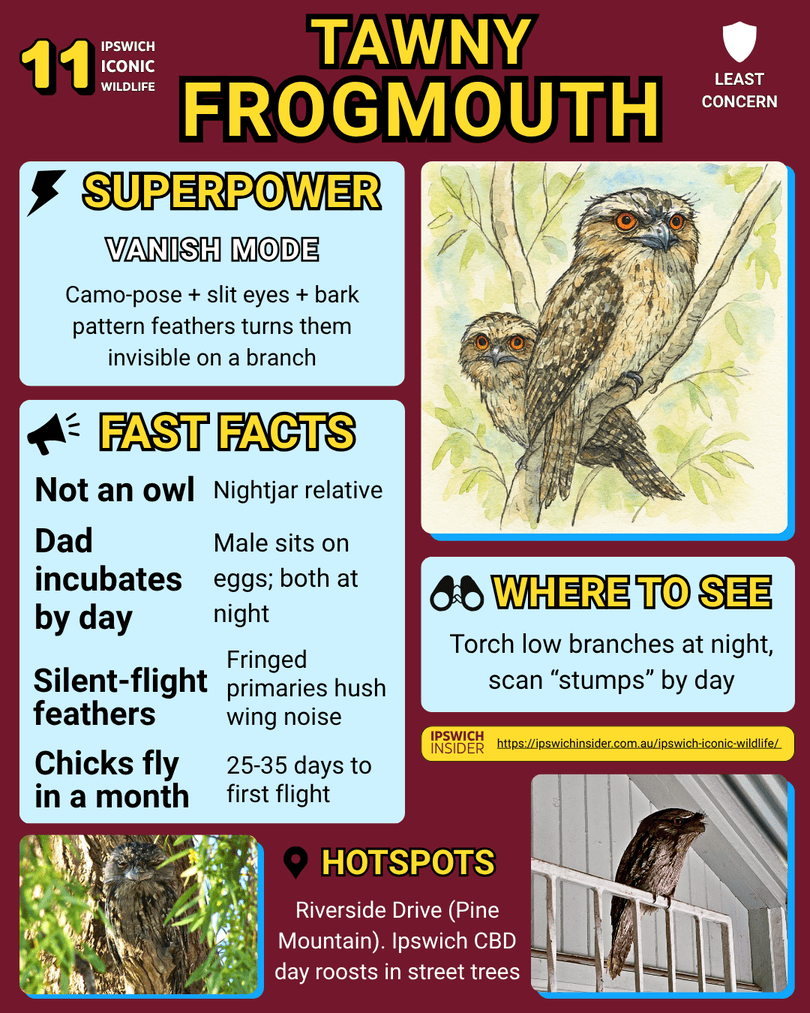
👥 Estimated number of individual tawny frogmouths within Ipswich
- Population (est.): Low thousands. 1,000–4,000.
⚡ Superpower
- Broken branch pose and bark pattern feathers — vanishes on a branch
📣 Fast Facts
- Dad incubates by day — shared care at night
- Silent flight feathers — fringed primaries hush wing noise
- About 25–35 days to fledge — chicks fly in a month
ℹ️ More Info
- Status: Least Concern
- Where to see them: Torch low branches at night and scan stumps by day
- Exact Hotspots: Denmark Hill and CBD street trees at night
- Diet: Night insects like moths and beetles plus worms and small lizards
#12 Short‑beaked Echidna
Spiky digger. Loved and mythic with unique biology. Scarcer and less reliable which lands it mid pack.
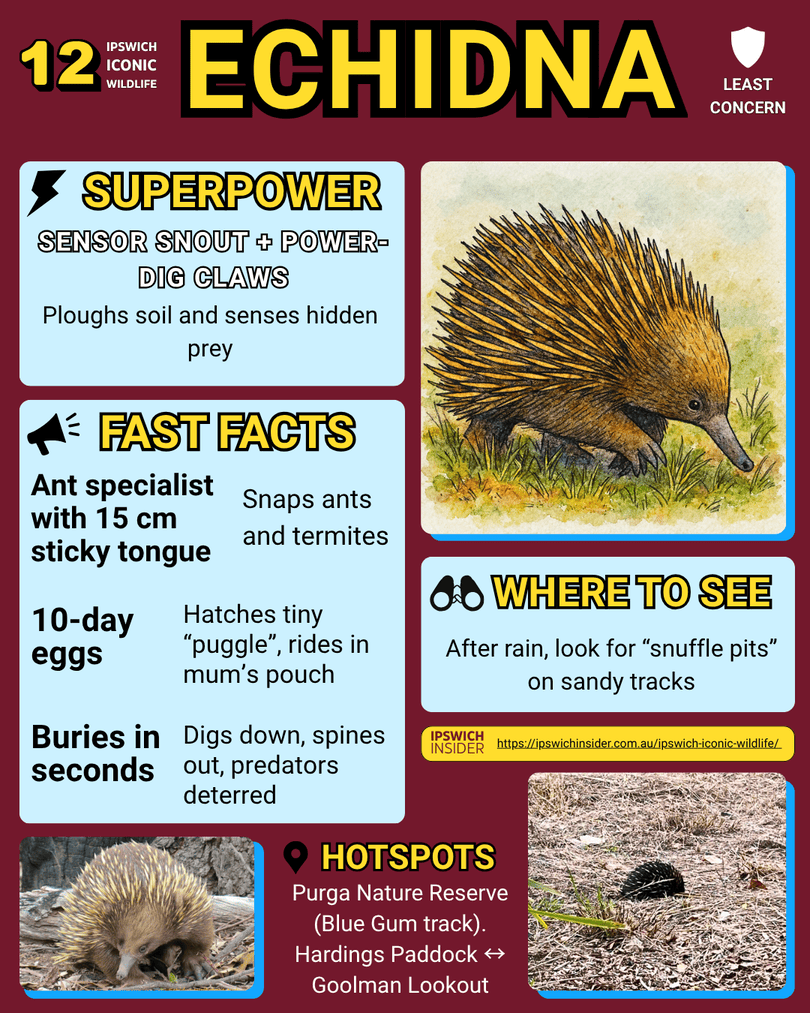
👥 Estimated number of individual short‑beaked echidnas within Ipswich
- Population (est.): Hundreds. 100–600.
⚡ Superpower
- Power dig claws and electro sense snout — ploughs soil and senses hidden prey
📣 Fast Facts
- 10 day egg to puggle — egg hatches quickly
- Buries in seconds — spines out deters predators
- 15 cm sticky tongue — snaps ants and termites
ℹ️ More Info
- Status: Least Concern
- Where to see them: After rain check sandy tracks for snuffle pits
- Exact Hotspots: Purga Nature Reserve Blue Gum track and Flinders–Goolman trails
- Diet: Ants and termites and larvae
#13 Bush Stone‑curlew
Night caller. Distinct city pairs with haunting voices. Reliable after dark and often motionless by day under shrubs.

👥 Estimated number of individual bush stone‑curlews within Ipswich
- Population (est.): Hundreds. 100–500.
⚡ Superpower
- Statue still pose and bark pattern feathers — vanishes on lawns and under shrubs
📣 Fast Facts
- Eerie weeloo — night call across suburbs
- Freeze and blend — stands motionless by day
- 10–25 ha territory — pairs patrol big patches
ℹ️ More Info
- Status: Least Concern QLD
- Where to see them: Open lawns and streetscapes with shrubs for day roosts
- Exact Hotspots: Ipswich CBD and fringing suburbs and Queens Park lawns and nearby streets
- Diet: Ground insects and molluscs and small lizards with some seeds
#14 Carpet Python
Quiet neighbour. Strong ecological role as rat control. Common around bushy edges though love is mixed which keeps it lower.
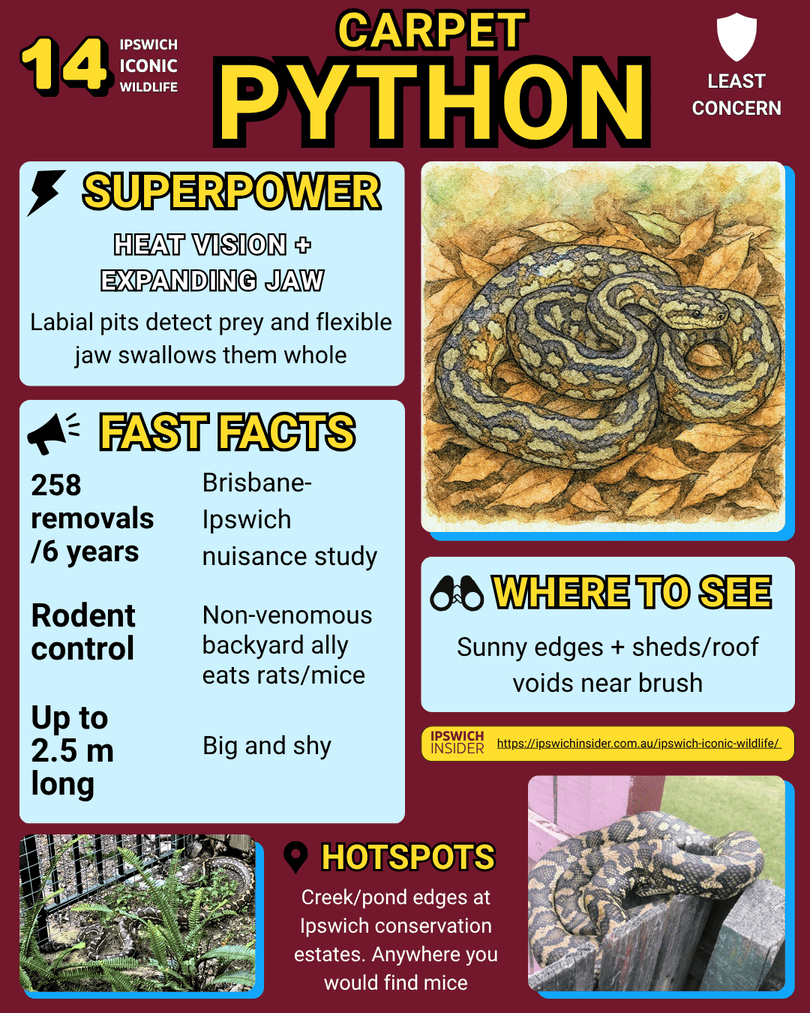
👥 Estimated number of individual carpet pythons within Ipswich
- Population (est.): Low thousands. 1,000–5,000.
⚡ Superpower
- Heat sensing pits and flexible jaws — detects warm prey and swallows whole
📣 Fast Facts
- 258 removals in 6 years — Brisbane and Ipswich study
- Non venomous constrictor — great rat control
- Up to about 2.5 m — big shy backyard snake
ℹ️ More Info
- Status: Least Concern QLD
- Where to see them: Sunny edges plus sheds and roof voids near bush
- Exact Hotspots: White Rock–Spring Mountain Paperbark Flats to Six Mile Creek boardwalk and Kholo Gardens and Hardings Paddock margins
- Diet: Mammals like rats and possums plus birds and lizards
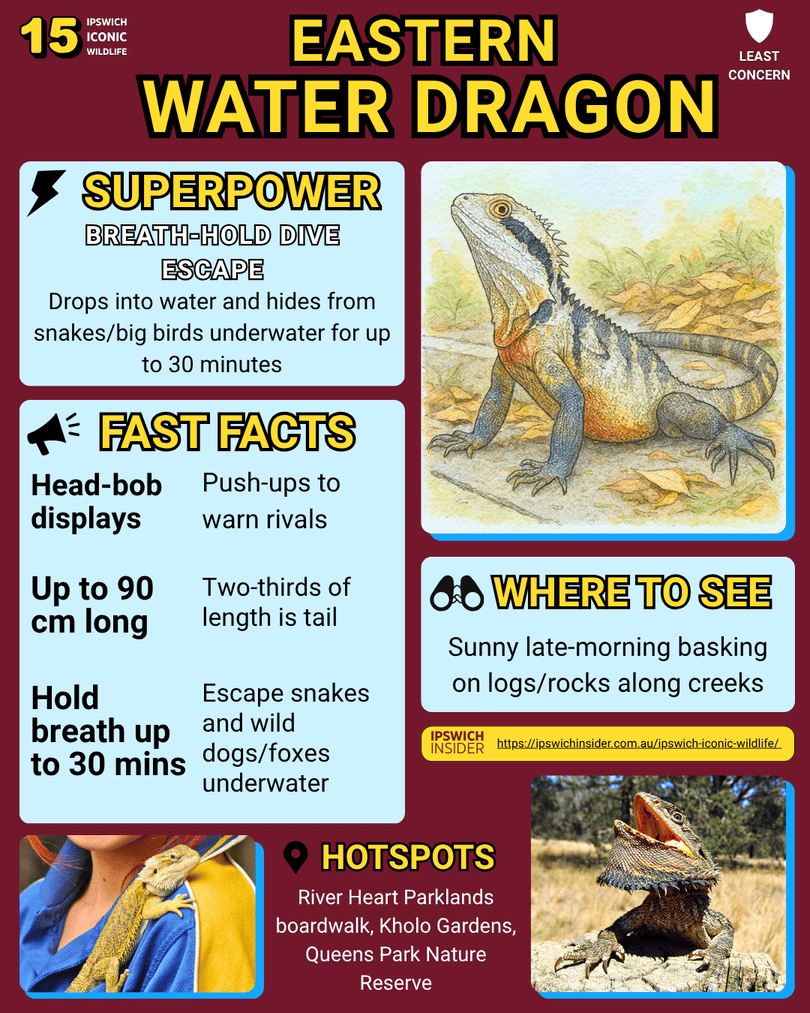
#15 Eastern Water Dragon
Creek superstar. Loved and reliable along the Bremer and park ponds. Common where basking spots and water meet.
👥 Estimated number of individual eastern water dragons within Ipswich
- Population (est.): Thousands to low tens of thousands. 3,000–15,000.
⚡ Superpower
- Breath hold dive escape — drops into water and hides for up to 30 minutes
📣 Fast Facts
- Underwater about 30 minutes — breath hold hide
- Up to 90 cm — two thirds is tail
- Head bob displays — push ups warn rivals
ℹ️ More Info
- Status: Least Concern
- Where to see them: Basking on logs and rocks along the Bremer and creeks
- Exact Hotspots: River Heart Parklands boardwalk and Kholo Gardens ponds and river edge
- Diet: Insects and aquatic bugs and small frogs with some fruit and flowers
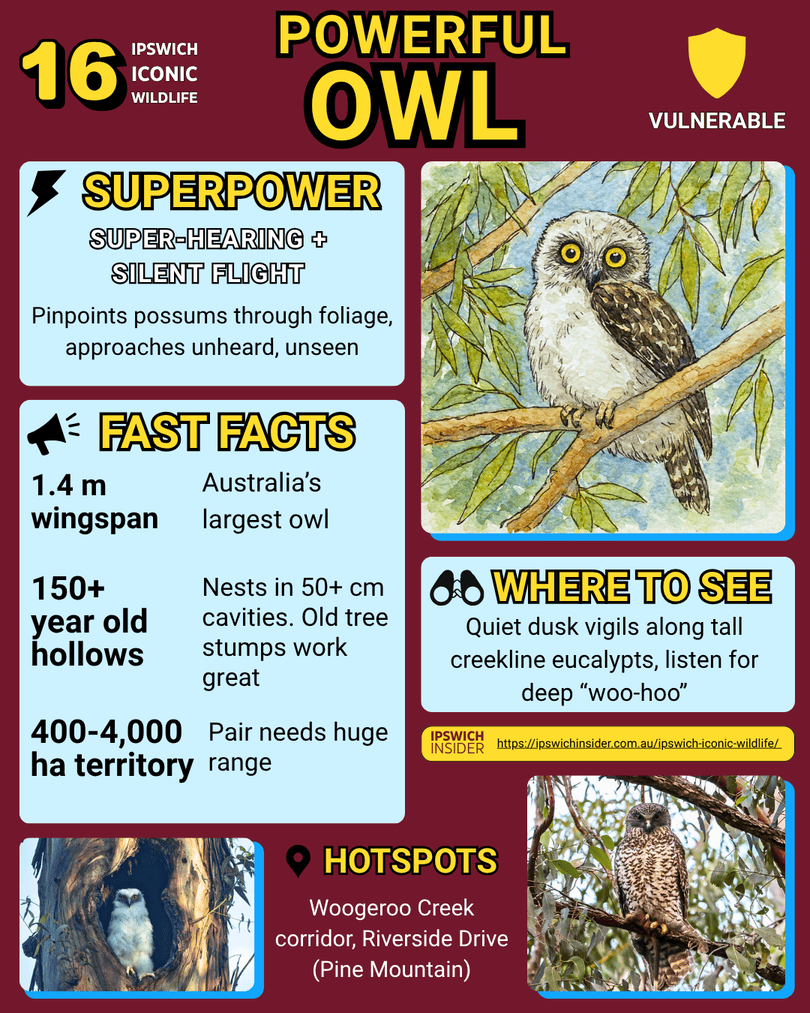
#16 Powerful Owl
Top predator. Big ecological role and strong civic concern. Rare and sensitive which lowers common and reliable dials.
👥 Estimated number of individual powerful owls within Ipswich
- Population (est.): Dozens. 4–20.
⚡ Superpower
- Super hearing and silent flight — pinpoints possums through foliage and arrives unheard
📣 Fast Facts
- About 1.4 m wingspan — Australia’s largest owl
- Very old hollows — deep cavities in 150 plus year eucalypts
- Huge territory — roughly 400 to 4,000 hectares per pair
ℹ️ More Info
- Status: Vulnerable QLD and EPBC not listed and IUCN Least Concern
- Where to see them: Quiet dusk vigils along tall creekline eucalypts and listen for deep woo hoo
- Exact Hotspots: Woogaroo Creek corridor at Goodna and Bellbird Park and Riverside Drive Pine Mountain at night
- Diet: Mainly ringtail possum and greater glider plus roosting birds
#17 Green Tree Frog
Backyard favourite. Loved by families and easy to find after rain. Reliable around houses which earns the final spot.

👥 Estimated number of individual green tree frogs within Ipswich
- Population (est.): Thousands to tens of thousands. 5,000–25,000.
⚡ Superpower
- Sticky toe pads — micro hex pads and mucus grip on glass
📣 Fast Facts
- Lives up to about 16 years — in captivity
- Turns up in toilets and drainpipes — classic house guest
- Sometimes eats small snakes and bats — not just insects
ℹ️ More Info
- Status: Least Concern QLD and IUCN
- Where to see them: After summer rain on downpipes and windows and around porch lights
- Exact Hotspots: Kholo Gardens ponds and boardwalks and Purga Nature Reserve frog pond in season
- Diet: Invertebrates and sometimes small vertebrates
How we estimated the Ipswich populations
These are order of magnitude ranges not a census. We sized the city and habitat first then applied typical densities or territory sizes and cross checked with local signals like roost counts and eDNA. We rounded to clear bands and allowed for seasonal movement.
Why these are not made up
- Area anchor — the Ipswich LGA is roughly 1,090–1,100 km² which sets an upper ceiling
- Local signals — flying fox roost counts at Nerima Gardens and historical roosts and lorikeet dusk roost counts and Brisbane–Ipswich snake removals
- Habitat scaling — mapped corridors for koala and creek kilometres for platypus and creekside parks for water dragons
Method anchors we used
- Bush Stone‑curlew territories — about 10–25 ha per pair which limits pair numbers in suburbs
- Common Brushtail Possum density — around two per hectare in treed urban habitat which supports tens of thousands across suburbs
- Platypus density — often ~0.2–2+ per km of good creek which with Ipswich eDNA positive creeks gives tens to low hundreds
- Flying‑fox roosting — multiple roosts across the LGA and a single active roost can hold thousands with location shifting as trees flower
- Water dragon clustering — urban parks can hold hundreds at one site which scales to thousands city wide
Caveats
- Populations move with seasons and flowering pulses
- Extreme weather and habitat change can shift numbers quickly
- Figures are rounded bands for clarity and will be refined as new local data arrives
How We Ranked Iconic Wildlife in Ipswich
Ipswich has more than 700 native species of wildlife.
We built a longlist of about 70 familiar, well-recorded species, ranked a shortlist of 29, and are spotlighting the Top 17 here.
How we went from 700 to 17: we used 7 simple dials: Common, Loved, Civic, Mythic, Distinct, Role, Reliable.
Each dial was scored from 0 to 5, then weighted to make one score out of 5 for each species.
The full dial-by-dial scores are shown below so you can check the maths or try your own.
Ranking Dials
- D1 Common — how often it’s seen or heard
- D2 Loved — public affection vs conflict
- D3 Civic — plans, emblems, programs
- D4 Mythic — national cultural icon value
- D5 Distinct — Ipswich-specific hotspots or emphasis
- D6 Role — ecological importance
- D7 Reliable — repeatable time or place
Our Ipswich Wildlife Longlist: 70 Species
The breakdown: 18x mammals, 36x birds, 10x reptiles and 6x amphibians.
Mammals
Monotremes
- Short-beaked Echidna, Platypus
Marsupials
- Koala, Brush-tailed Rock-wallaby, Eastern Grey Kangaroo, Swamp Wallaby, Red-necked Wallaby, Common Brushtail Possum, Common Ringtail Possum, Sugar Glider, Squirrel Glider, Greater Glider, Feathertail Glider
Bats
- Grey-headed Flying-fox, Black Flying-fox, Little Red Flying-fox, Gould’s Wattled Bat
Native rodents
- Rakali (Water Rat)
Birds
Parrots and cockatoos
- Rainbow Lorikeet, Scaly-breasted Lorikeet, Galah, Sulphur-crested Cockatoo, Little Corella, Pale-headed Rosella, Australian King-Parrot
Kingfishers
- Laughing Kookaburra, Sacred Kingfisher
Songbirds and honeyeaters
- Australian Magpie, Magpie-lark, Pied Butcherbird, Grey Butcherbird, Noisy Miner, Blue-faced Honeyeater, Noisy Friarbird, Australasian Figbird, Mistletoebird, Willie Wagtail
Cuckoos
- Eastern Koel, Channel-billed Cuckoo
Night birds
- Tawny Frogmouth, Bush Stone-curlew, Powerful Owl, Southern Boobook
Raptors
- Wedge-tailed Eagle, Whistling Kite, Peregrine Falcon
Waterbirds
- Australian White Ibis, Straw-necked Ibis, Pacific Black Duck, Australian Wood Duck, White-faced Heron, Eastern Great Egret, Little Pied Cormorant, Australasian Darter
Reptiles
Lizards
- Eastern Water Dragon, Lace Monitor (Goanna), Eastern Blue-tongue, Eastern Bearded Dragon
Pythons
- Carpet Python
Non-venomous snakes
- Common Tree Snake, Keelback, Brown Tree Snake
Venomous snakes
- Red-bellied Black Snake, Eastern Brown Snake
Amphibians
Tree frogs
- Green Tree Frog, Eastern Dwarf Tree Frog, Graceful Tree Frog, Peron’s Tree Frog
Ground and marsh frogs
- Striped Marsh Frog, Tusked Frog
We then filtered to a shortlist of 29 for detailed scoring, and from those the Top 17 emerged as the most iconic for locals, families and visitors.
Our Ipswich Wildlife Shortlist: 29 Species
How we cut from 70 to 29
- Confirmed current presence: kept species with recent Ipswich records in council or Queensland datasets, or consistent local birding notes
- Everyday encounter potential: favoured species that typical residents can see or hear in suburbs, or at reliable spots and times
- Clear resonance: strong lovedness or cultural pull in Ipswich or nationally
- No near-duplicates: merged close look-alikes or overlapping backyard experiences into one representative
- Reliability: set aside irregular vagrants or species without stable vantage points in Ipswich
- Mix across groups: ensured mammals, birds, reptiles and amphibians were all represented to reflect Ipswich life, not just backyard birds
The shortlist:
- Mammals: Koala, Brush-tailed Rock-wallaby, Platypus, Grey-headed Flying-fox, Eastern Grey Kangaroo, Common Brushtail Possum, Short-beaked Echidna, Swamp Wallaby, Greater Glider.
- Birds: Rainbow Lorikeet (Scaly-breasted merged here), Australian Magpie, Laughing Kookaburra, Sulphur-crested Cockatoo, Galah, Pale-headed Rosella, Tawny Frogmouth, Powerful Owl, Wedge-tailed Eagle, Peregrine Falcon, Grey-crowned Babbler, Apostlebird, Magpie-lark, Willie Wagtail, Bush Stone-curlew (added at shortlist stage).
- Reptiles and Amphibians: Eastern Water Dragon, Carpet Python, Lace Monitor (Goanna), Eastern Blue-tongue, Green Tree Frog.
- Merged at source: Scaly-breasted Lorikeet under Rainbow Lorikeet. Common Ringtail Possum under Common Brushtail Possum.
Full Scoring – Iconic Wildlife in Ipswich, Queensland
Here we go. Let’s find the most iconic wildlife in Ipswich.
This ranking is transparent by design. We scored local species with 7 clear dials and published every number.
Check the maths below. If you disagree, apply the same dials and share your results.
Entries include raw rank, weighted score, and a dial breakdown.
How the ranking dials work
To figure out what makes wildlife truly iconic in Ipswich, we scored each species from 0 to 5 using these seven factors, each with its own weighting:
- D1 Common (30%) — How often do locals actually see or hear it?
- D2 Loved (25%) — How much affection (or conflict!) does it create?
- D3 Civic (15%) — Is it part of council plans, emblems, or programs?
- D4 Mythic (10%) — How iconic is it across Australia?
- D5 Distinct (10%) — Does Ipswich have unique spots or emphasis on it?
- D6 Role (5%) — What’s its importance in nature?
- D7 Reliable (5%) — Can we tell you exactly where or when to see it?
Scoring scale: 0 = not at all, 3 = typical, 5 = very strong for Ipswich.
1. Koala
(Phascolarctos cinereus)
Weighted score: 3.77
- D1 Common: 2.5
- D2 Loved: 5.0
- D3 Civic: 5.0
- D4 Mythic: 5.0
- D5 Distinct: 3.0
- D6 Role: 2.5
- D7 Reliable: 2.0
2. Brush-tailed Rock-wallaby
(Petrogale penicillata)
Weighted score: 3.66
- D1 Common: 2.2
- D2 Loved: 4.5
- D3 Civic: 5.0
- D4 Mythic: 3.5
- D5 Distinct: 5.0
- D6 Role: 2.0
- D7 Reliable: 3.5
3. Platypus
(Ornithorhynchus anatinus)
Weighted score: 3.61
- D1 Common: 1.3
- D2 Loved: 5.0
- D3 Civic: 4.5
- D4 Mythic: 5.0
- D5 Distinct: 5.0
- D6 Role: 3.8
- D7 Reliable: 2.0
4. Grey-headed Flying-fox
(Pteropus poliocephalus)
Weighted score: 3.58
- D1 Common: 3.8
- D2 Loved: 2.3
- D3 Civic: 4.5
- D4 Mythic: 3.0
- D5 Distinct: 4.2
- D6 Role: 5.0
- D7 Reliable: 4.5
5. Eastern Grey Kangaroo
(Macropus giganteus)
Weighted score: 3.55
- D1 Common: 3.5
- D2 Loved: 4.5
- D3 Civic: 2.0
- D4 Mythic: 5.0
- D5 Distinct: 2.5
- D6 Role: 2.5
- D7 Reliable: 4.0
6. Rainbow Lorikeet
(Trichoglossus moluccanus)
Weighted score: 3.53
- D1 Common: 4.8
- D2 Loved: 3.9
- D3 Civic: 1.3
- D4 Mythic: 3.5
- D5 Distinct: 1.8
- D6 Role: 2.8
- D7 Reliable: 5.0
7. Australian Magpie
(Gymnorhina tibicen)
Weighted score: 3.52
- D1 Common: 5.0
- D2 Loved: 3.3
- D3 Civic: 1.5
- D4 Mythic: 3.8
- D5 Distinct: 2.1
- D6 Role: 2.5
- D7 Reliable: 5.0
8. Laughing Kookaburra
(Dacelo novaeguineae)
Weighted score: 3.45
- D1 Common: 3.8
- D2 Loved: 4.3
- D3 Civic: 1.5
- D4 Mythic: 5.0
- D5 Distinct: 1.8
- D6 Role: 2.5
- D7 Reliable: 4.0
9. Sulphur-crested Cockatoo
(Cacatua galerita)
Weighted score: 3.40
- D1 Common: 4.0
- D2 Loved: 4.0
- D3 Civic: 1.5
- D4 Mythic: 4.5
- D5 Distinct: 2.0
- D6 Role: 2.5
- D7 Reliable: 4.0
10. Common Brushtail Possum
(Trichosurus vulpecula)
Weighted score: 3.39
- D1 Common: 4.3
- D2 Loved: 3.3
- D3 Civic: 2.0
- D4 Mythic: 3.5
- D5 Distinct: 2.5
- D6 Role: 3.0
- D7 Reliable: 4.5
11. Tawny Frogmouth
(Podargus strigoides)
Weighted score: 3.34
- D1 Common: 3.0
- D2 Loved: 4.6
- D3 Civic: 1.5
- D4 Mythic: 4.0
- D5 Distinct: 3.5
- D6 Role: 2.5
- D7 Reliable: 3.8
12. Short-beaked Echidna
(Tachyglossus aculeatus)
Weighted score: 3.32
- D1 Common: 2.5
- D2 Loved: 4.6
- D3 Civic: 2.0
- D4 Mythic: 5.0
- D5 Distinct: 3.0
- D6 Role: 3.8
- D7 Reliable: 2.5
13. Bush Stone-curlew
(Burhinus grallarius)
Weighted score: 3.28
- D1 Common: 3.0
- D2 Loved: 4.0
- D3 Civic: 2.5
- D4 Mythic: 3.0
- D5 Distinct: 4.0
- D6 Role: 2.5
- D7 Reliable: 3.5
14. Carpet Python
(Morelia spilota mcdowelli)
Weighted score: 3.22
- D1 Common: 4.0
- D2 Loved: 2.8
- D3 Civic: 1.5
- D4 Mythic: 3.0
- D5 Distinct: 4.2
- D6 Role: 4.0
- D7 Reliable: 3.5
15. Eastern Water Dragon
(Intellagama lesueurii)
Weighted score: 3.21
- D1 Common: 3.5
- D2 Loved: 4.0
- D3 Civic: 1.5
- D4 Mythic: 3.0
- D5 Distinct: 3.0
- D6 Role: 2.5
- D7 Reliable: 4.2
16. Powerful Owl
(Ninox strenua)
Weighted score: 3.20
- D1 Common: 1.7
- D2 Loved: 4.2
- D3 Civic: 3.8
- D4 Mythic: 3.8
- D5 Distinct: 3.9
- D6 Role: 4.2
- D7 Reliable: 1.8
17. Green Tree Frog
(Litoria caerulea)
Weighted score: 3.19
- D1 Common: 3.1
- D2 Loved: 4.1
- D3 Civic: 1.8
- D4 Mythic: 3.8
- D5 Distinct: 2.5
- D6 Role: 3.0
- D7 Reliable: 3.6
18. Galah
(Eolophus roseicapilla)
Weighted score: 3.18
- D1 Common: 3.9
- D2 Loved: 3.9
- D3 Civic: 1.0
- D4 Mythic: 4.0
- D5 Distinct: 1.7
- D6 Role: 2.3
- D7 Reliable: 4.0
19. Eastern Blue-tongue
(Tiliqua scincoides)
Weighted score: 3.13
- D1 Common: 4.0
- D2 Loved: 3.8
- D3 Civic: 1.0
- D4 Mythic: 3.0
- D5 Distinct: 2.0
- D6 Role: 2.5
- D7 Reliable: 4.0
20. Willie Wagtail
(Rhipidura leucophrys)
Weighted score: 3.08
- D1 Common: 4.0
- D2 Loved: 3.6
- D3 Civic: 0.8
- D4 Mythic: 3.5
- D5 Distinct: 1.8
- D6 Role: 2.5
- D7 Reliable: 4.0
21. Magpie-lark
(Grallina cyanoleuca)
Weighted score: 2.98
- D1 Common: 4.0
- D2 Loved: 3.3
- D3 Civic: 1.0
- D4 Mythic: 3.0
- D5 Distinct: 2.0
- D6 Role: 2.0
- D7 Reliable: 4.0
22. Wedge-tailed Eagle
(Aquila audax)
Weighted score: 2.85
- D1 Common: 1.5
- D2 Loved: 4.5
- D3 Civic: 1.5
- D4 Mythic: 5.0
- D5 Distinct: 2.5
- D6 Role: 4.0
- D7 Reliable: 2.0
23. Peregrine Falcon
(Falco peregrinus)
Weighted score: 2.85
- D1 Common: 2.0
- D2 Loved: 4.0
- D3 Civic: 2.0
- D4 Mythic: 3.5
- D5 Distinct: 3.0
- D6 Role: 3.5
- D7 Reliable: 2.5
24. Grey-crowned Babbler
(Pomatostomus temporalis)
Weighted score: 2.83
- D1 Common: 2.5
- D2 Loved: 3.5
- D3 Civic: 2.0
- D4 Mythic: 2.0
- D5 Distinct: 4.5
- D6 Role: 2.0
- D7 Reliable: 3.0
25. Swamp Wallaby
(Wallabia bicolor)
Weighted score: 2.80
- D1 Common: 2.5
- D2 Loved: 4.0
- D3 Civic: 1.5
- D4 Mythic: 3.0
- D5 Distinct: 2.5
- D6 Role: 2.5
- D7 Reliable: 3.0
26. Pale-headed Rosella
(Platycercus adscitus)
Weighted score: 2.78
- D1 Common: 2.5
- D2 Loved: 4.0
- D3 Civic: 1.0
- D4 Mythic: 3.0
- D5 Distinct: 3.0
- D6 Role: 2.5
- D7 Reliable: 3.0
27. Apostlebird
(Struthidea cinerea)
Weighted score: 2.70
- D1 Common: 2.5
- D2 Loved: 3.0
- D3 Civic: 2.0
- D4 Mythic: 2.0
- D5 Distinct: 4.5
- D6 Role: 2.0
- D7 Reliable: 3.0
28. Greater Glider
(Petauroides volans)
Weighted score: 2.70
- D1 Common: 1.5
- D2 Loved: 4.0
- D3 Civic: 2.5
- D4 Mythic: 3.5
- D5 Distinct: 3.0
- D6 Role: 3.0
- D7 Reliable: 1.5
29. Lace Monitor (Goanna)
(Varanus varius)
Weighted score: 2.43
- D1 Common: 2.0
- D2 Loved: 3.0
- D3 Civic: 1.0
- D4 Mythic: 3.5
- D5 Distinct: 3.0
- D6 Role: 3.0
- D7 Reliable: 2.5
Note: the feature article highlights the Top 17 from this list. The cut line sits at #17.
Frequently Asked Questions
Why did you end up with 17?
Because the scoring created a clear break around that point. After applying the bird cap, merges, and our tiebreakers, the top 17 formed the strongest and most balanced set for locals, families and visitors. Any longer diluted “iconic”. Any shorter lost Ipswich-specific favourites.
“That animal isn’t iconic.” Why include it?
Here “iconic” blends lovedness, familiarity, civic identity and Ipswich distinctiveness. A species can be controversial yet still define everyday wildlife experiences or carry civic weight. That still counts as iconic in a local sense.
Why cap birds in the Top 10?
Backyard bird frequency can eclipse everything else. We capped birds so the list reflects Ipswich’s broader wildlife, including marsupials, reptiles and amphibians.
Why merge lorikeets and suburban possums?
Most residents experience them as single backyard moments. Lorikeet flocks often mix Rainbow and Scaly-breasted. Suburban possum encounters often blur Brushtail and Ringtail. Merging avoids double-counting near-identical experiences.
How will you update this?
We will update only with reader suggestions when they warrant a correction or addition. If a large number of readers nominate a species and we can verify current presence in Ipswich, we will add it.
Sources
- Koala Conservation and Habitat Management Plan. Ipswich City Council
- Ipswich Pteropus Conservation Park. Ipswich City Council
- Ipswich platypus population on the brink after devastating 2022 floods. Ipswich City Council
- Bird Places of Ipswich (2024). Birds Queensland
- 2024 Results – Aussie Bird Count. AussieBirdCount.org
- Native birds of Ipswich local government area. WetlandInfo (Queensland Government)
- Grey-headed flying-fox. Queensland Government
- Bush stone-curlew. Queensland Government
- Powerful owl. Queensland Government
- Birdwatching. Discover Ipswich