

Booval House at a Glance:
- Classic. Ipswich’s oldest two-storey brick homestead (1857–59).
- Name-maker. “Booval” comes from Ugarapul / Yuggera word for frilled lizard; the house spread the name to the suburb.
- Storied. George Faircloth funded it with his huge bank salary and cotton profits; Sisters of Mercy ran St Gabriel’s Convent / school (1930-80), a $1 million restoration (1998-2002) returned it to glory.
- Heritage-listed. On Heritage Register since 1992 and shown on tours in 2013 and 2017 after its revival.
🔢 By The Numbers

- Address: 14 Cothill Road, Booval QLD 4304.
- Heritage: Place 600549
- Construction: 1857-59 – Two-year build, when Queensland was still part of New South Wales.
- Age: ≈ 166 years old in 2025 – Ipswich’s senior two-storey brick home.
- Rooms: 14 original rooms; 5 upstairs bedrooms after restoration.
- Footprint: 4,818 m² current block (about 1.2 acres) with 14-inch lower-storey brick walls.
- Convent: 1930-80 – 50 years as St Gabriel’s Convent; 1969 brick chapel annex added.
- Restoration: $1 million restoration 1998-2002 earned the National Trust’s Gold Award.
- Value: A$230 000 → A$1.8 million – price growth from 1997 purchase to 2021 sale.
Built in 1859—five years before the famous Gooloowan on Denmark Hill—Booval House started making Ipswich history as soon as its bricks set.
Queensland’s first governor, Sir George Bowen, showed it off when he stopped for tea during his first visit that December, turning the new house into an official pit-stop.
From 1930 to about 1980, the place buzzed with children as St Gabriel’s Convent and the next-door Sacred Heart school taught thousands of locals.
Jump to 1998–2002: a careful $1-million fix-up—new stumps, re-opened verandahs, updated wiring, and more—won the National Trust’s top gold award and drew 1,800 visitors on one open day.
Today, Booval House is one of Queensland’s few two-storey brick homes from the 1850s: a rare survivor that has beaten floods and changed roles many times.
Here’s the full story of Booval House.
Part of a Series—Also Check Out These Ipswich Icons:
📜 Origins & History
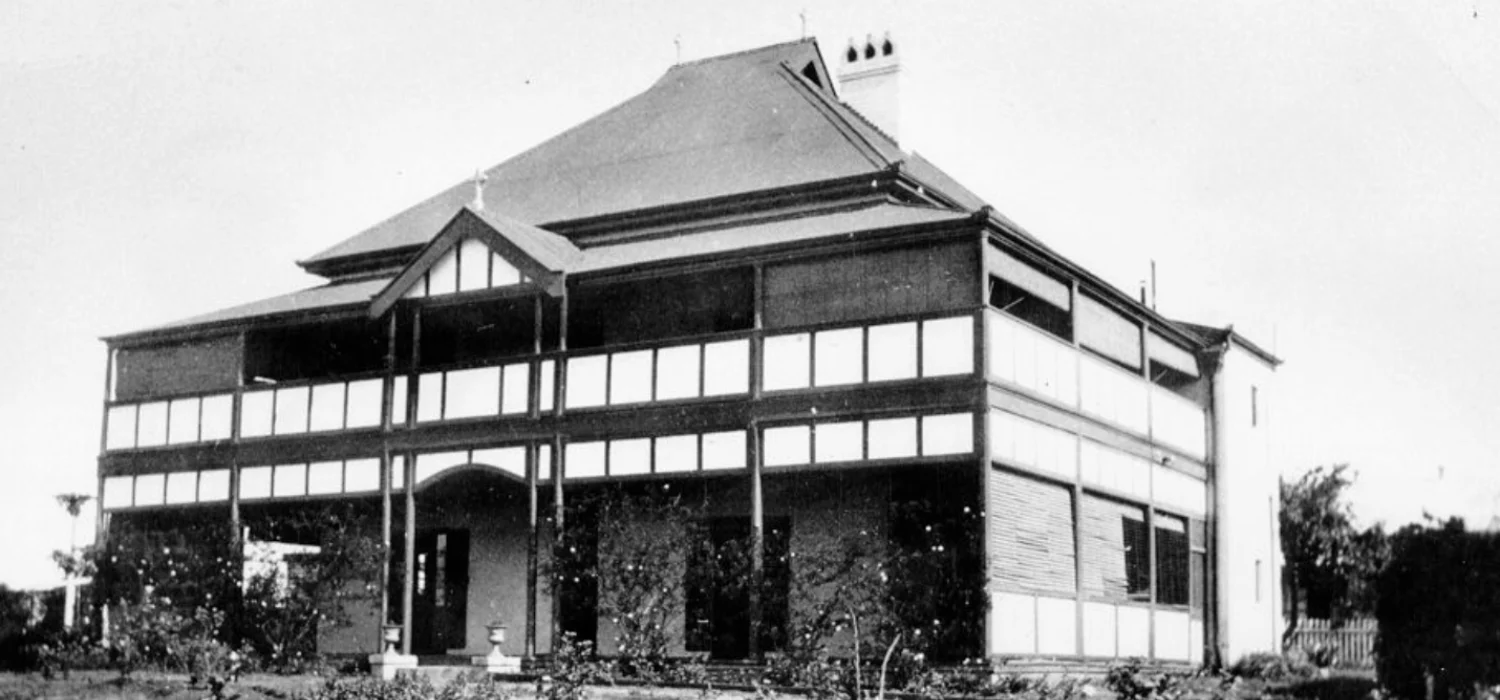
Booval House — c.1930 (Source: Picture Ipswich)
Highlight
- Built in the late 1850s on expansive farm land, Booval House gave the suburb its name and even served drinks to Queensland’s first governor. Early wheat and cotton crops plus a bank scandal coloured its first years.
- Address. 14 Cothill Road, Booval, Ipswich QLD – 4 km east of the city centre on a 4,818 m² block that once sat inside a 310-acre farm.
- Map. 27°36′55″ S 152°47′38″ E; a little higher than the road and right next to Sacred Heart Primary School (the old convent school).
- Name. “Booval” comes from the local Ugarapul tongue (maybe “frilled lizard”); Faircloth’s house spread the word (Booval) to the whole area.
- Owners. First a Crown grant to C. V. Daveney, sold at the 1855 “Booval Estate” auction, then bought by banker George Faircloth.
- Build. Between 1857 and 1859 Faircloth hired builder William Hancock and likely architect William Wakeling to put up a 14-room brick house.
- Farming. A good wheat crop in 1856 and 40 acres of cotton in 1861-62 made the place a farm show-piece.
- Visit. On 20 Dec 1859 Governor Sir George Bowen and Lady Bowen stopped here for a quick refreshment on their first trip to Ipswich.
- Bank-trouble. In 1861 Faircloth mis-used bank funds on a mine idea; the bank shut him down and took the house.
- Sale. On 17 Aug 1868 the bank sold “Booval House” with 40 acres, ending the Faircloth story.
🏗️ Architecture & Design
Highlight
- The two-storey brick house mixes British balance with warm-weather ideas: thick walls, wide verandahs and a palm-lined drive plus cedar woodwork and hoop-pine floors.
- Shape. Long, two-storey brick block with a steep 45° hipped roof (first wood shingles, later tin) and a lean-to verandah roof on three sides.
- Materials. Local sand-stock bricks 35 cm thick on the lower floor, stone footings, lime plaster finish; tin roof put on in 1896 and re-done 1998-2000.
- Verandahs. Square timber posts (many original) and straight timber railings put back after 2000; a small roof peak sits over the front steps.
- Layout. Central hall front to back; four main rooms each side on both floors; cedar stair with turned post; tall French doors in every main room open to the verandahs for breezes.
- Inside. Cedar doors, door frames and stair; 3.3 m ceilings; mixed hardwood floors downstairs, original hoop-pine boards upstairs; plaster, VJ and sheet ceilings; six fireplaces (three still work) – one ground-floor mantel keeps its fake-marble paint.
- Kitchen-wing. Single-storey rear timber kitchen (1896 Brockwell Gill plan) with brick cooking range; brick cellar about 5 × 5 m underneath for cool food storage.
- Extras. 1969 two-storey brick chapel/annex (now guest wing); modern garage (one lock-up and three carports) and back workshop.
- Yard. Curved drive between 100-year-old coconut palms; open lawns, figs and jacarandas; round carriage turn in front; total land 4,818 m² inside suburban Booval.
- Modern-fit. Full new wiring and pipes (1998-2002); hidden split-system air-con in some rooms; new kitchen and baths fitted without cutting old wood; neat roller shutter on the front cedar door.
- Splash. Pool added in front of guest wing.
⏳ Through the Years
Highlight
- Eight sets of owners—from banker to miners, nuns and surgeons—show how Ipswich changed; the house has been a home, shelter, convent, school and star heritage site.
- Welsby. 1868-1876 – William P. Welsby bought the place at the 17 Aug 1868 sale; he never lived here and died in 1876.
- Ferrett. 1876-1921 – John Ferrett then nephew Henry “Harry” Ferrett farmed here; Harry backed the Bundamba “Borehole” coal mine; during the 1893 flood the family took in wet neighbours.
- Nuns. 1921-1997 – Archdiocese of Brisbane paid £900; Sisters of Mercy opened *St Gabriel’s Convent* and Sacred Heart School on 19 Jan 1930; the house served as dorms and meeting hall until about 1980.
- Vacant. 1980-1997 – Empty years under church control; little repair, verandahs closed in, cheap fittings used, but the shell stayed solid.
- Jackson. 1997-2017 – Dr John & Dr Helen Jackson bought the run-down place for A$230 000; spent five years and A$1 m fixing it; won the 2002 National Trust John Herbert Gold Award; opened to the public in 2013 and 2017.
- Baartz. 2017-2021 – Dr Baartz bought for A$1.25 m; kept gardens tidy and house sound; put it up for sale in 2021.
- Mansour. 2021-now – Dr Omar Mansour paid A$1.8 m; lives here with family; joins heritage open days; pool added.
🛠️ Renovations & Restorations
Highlight
- From a new kitchen wing in 1896 to a million-dollar makeover in 1998-2002, each change kept the old look while adding new use—and won the state’s top heritage prize.
- Sheds. About 1861 some sheds or stables went up but records are thin; no big house changes in the 1860s-70s.
- Kitchen. 1896 – Architect George Brockwell Gill added a timber kitchen wing and a two-storey gabled back block; the tin roof was also fitted.
- Convent-fit. 1929-1930 – Hennessy & Hennessy turned the house into a convent: new inside rooms for the nuns and a school next door; verandahs partly screened.
- Fix-up. 1946 – Termites forced repairs: timber verandah posts swapped for brick bases; verandahs first closed with timber blinds, later glass louvres; some trim lost.
- Chapel. 1969 – Two-storey brick chapel/annex built on the north-east, joined to both floors by closed verandahs.
- Big-resto. 1998-2002 – Jackson work: new stumps and floors, full new roof, louvres removed, posts and railings put back, full new wires and pipes, fresh heritage paint; chapel wing reused; won 2002 Trust Gold Award.
- Upkeep. 2012-2017 – Fresh paint and garden work; sold as “beautifully restored.”
- Care. 2021-2025 – Mansour years: keeping the early-2000s work sound; pool added early 2024.
🌟 Why it Matters / Heritage Importance
Highlight
- On the Queensland Heritage Register since 1992, Booval House is Ipswich’s oldest two-storey brick home—rare, loved and a model for fixing up old places.
- Listing. Queensland Heritage Register ID 600549 (added 21 Aug 1992) – under state law; also in Ipswich town plan; once on the old National Estate list.
- Award. 2002 National Trust Gold Award for top-class fix-up; regular stop on the “Great Houses of Ipswich” open-day route.
- Rare. One of very few 1850s two-storey brick homes left in Queensland; shows early Colonial-Georgian style before timber “Queenslanders” took over.
- People. Ties to pioneers Faircloth and Ferrett, the Sisters of Mercy (1930-1980 schooling and charity), flood help in 1893, and strong local love shown by tour crowds and media.
- Compare. Older than Gooloowan (1864) and more whole than many peers; matches stone Claremont (1857-58) as Ipswich’s twin Georgian mansions; rare for still having a roomy garden.
- Stories. Many visitors on open days; haunted convent tales from the empty 1980s; often featured in tours, news and heritage talks as a living history home.
Want more Ipswich icons to your inbox?
Sources:
- Booval House. Wikipedia.
- Booval House (PDF). Ipswich City Council.
- Booval House. Picture Ipswich.
- 14-16 Cothill Road, Booval, QLD 4304. Realestate.com.au.
- Ipswich Houses: Booval House. Ipswich Libraries.
- Booval House. CourierMail.
- Addition of pool in 2023/24. Council approval.