
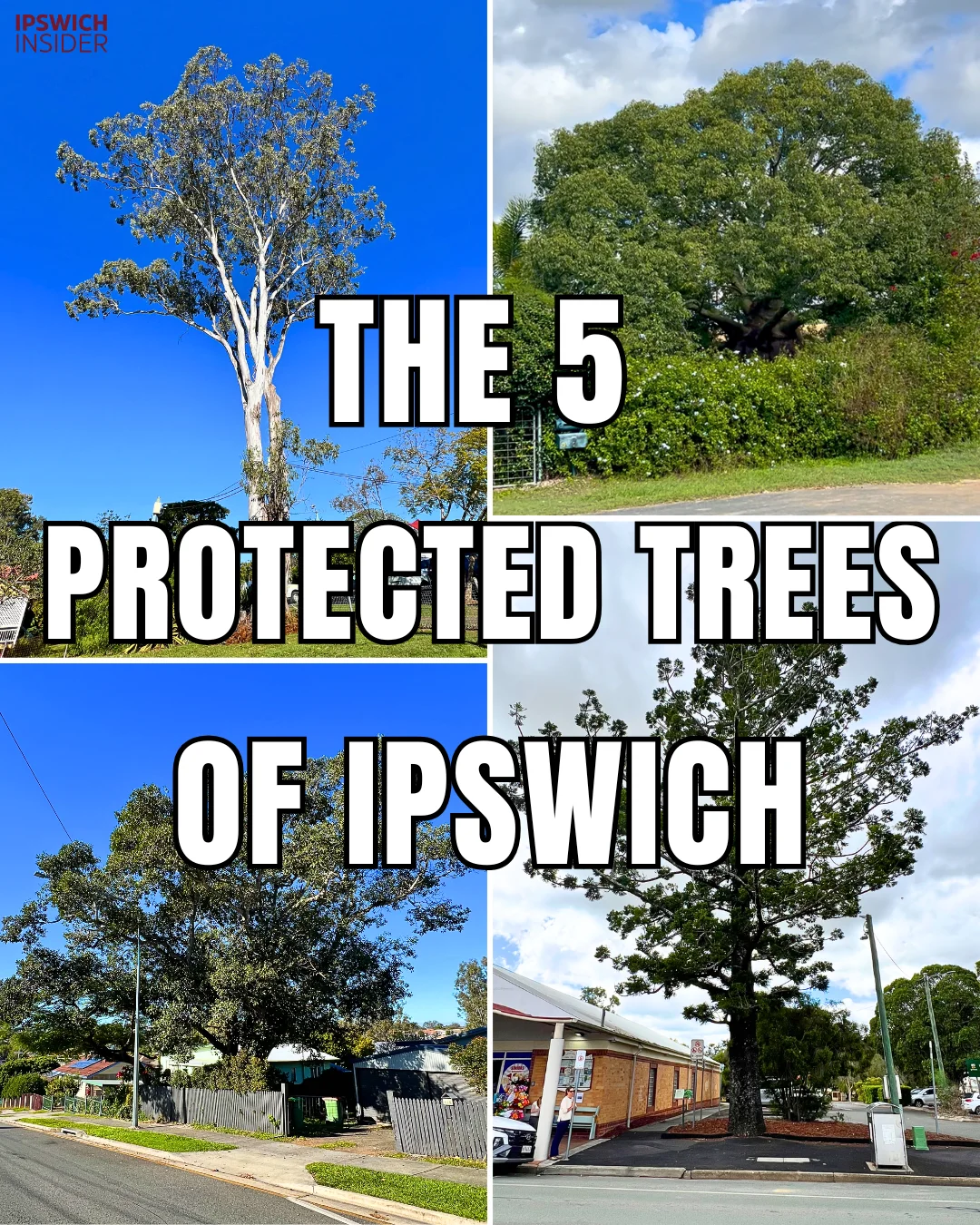
Ipswich Protected Trees at a Glance
- How are they protected? You nominate a tree or vegetation area. If council agrees it meets the test, it gets a Vegetation Protection Order. If you damage or remove it, you can face penalties up to $146,795 (850 penalty units).
- Why are they protected? Can be one, some, or all of: natural heritage, threatened species, scientific value, history, recreation, native animal habitat, amenity, beauty, age, size, canopy, landscape value, erosion control, planning objectives.
- Which ones are protected? Ipswich’s current VPO tree sites are a Hoop Pine in Rosewood, a Port Jackson Fig in Goodna, Queensland Blue Gums in Goodna and Brassall, and a Bottle Tree in Marburg.
🔢 By The Numbers
- 1997: Ipswich’s important vegetation law was established
- 15 business days: council’s stated assessment window after a VPO nomination is lodged
- 21 days: the minimum public submission period after council gives notice of a proposed VPO
- 4 months: how long an interim VPO can last before it is confirmed, revoked or replaced
- 850 penalty units: the maximum penalty is $146,795 for wilfully and unlawfully damaging protected vegetation
- 500 penalty units: the maximum penalty is $86,350 for unlawfully damaging protected vegetation
- 2 blue gums: Ipswich’s current VPO list includes Queensland Blue Gums in Goodna and Brassall
- 2 trees listed as 100+ years old: council gives 100+ age estimates for the Marburg Bottle Tree and Brassall Blue Gum
- 1 confirmed landowner application: council says the Marburg Bottle Tree protection followed an application by the landowner
Okay, so you’ve just learned Ipswich has 5 protected trees.
What does that even mean and why were these 5 chosen?
Let’s find out…
More Ipswich Gold
Jump to
What is a Vegetation Protection Order?

A Vegetation Protection Order, or VPO, is council’s way of legally protecting an important tree or vegetation area.
The maximum penalties for wilfully damaging a vegetation/tree under a Vegetation Protection Order is $146,795. While unlawful damage can carry a maximum penalty of $86,350.
Protected does not mean untouchable.
It means you cannot just remove or damage the tree without council approval or a lawful reason, such as approved work, necessary work or a safety issue.
Specific Details
- What: A VPO can protect one tree, a cluster of trees or a larger vegetation area.
- Who: Anyone can request a VPO, but the request has to show why the tree meets the legal test.
- How: Council assesses the nomination, can inspect the site, then decides whether the order should proceed.
- Penalty: Unlawful damage can mean major fines, stop orders, repair orders, replanting or compensation for the tree’s value.
- Why: Council can consider natural heritage, age, history, culture, native animal habitat, landscape value, amenity and exceptional form.
Where are Ipswich’s 5 Protected Trees?
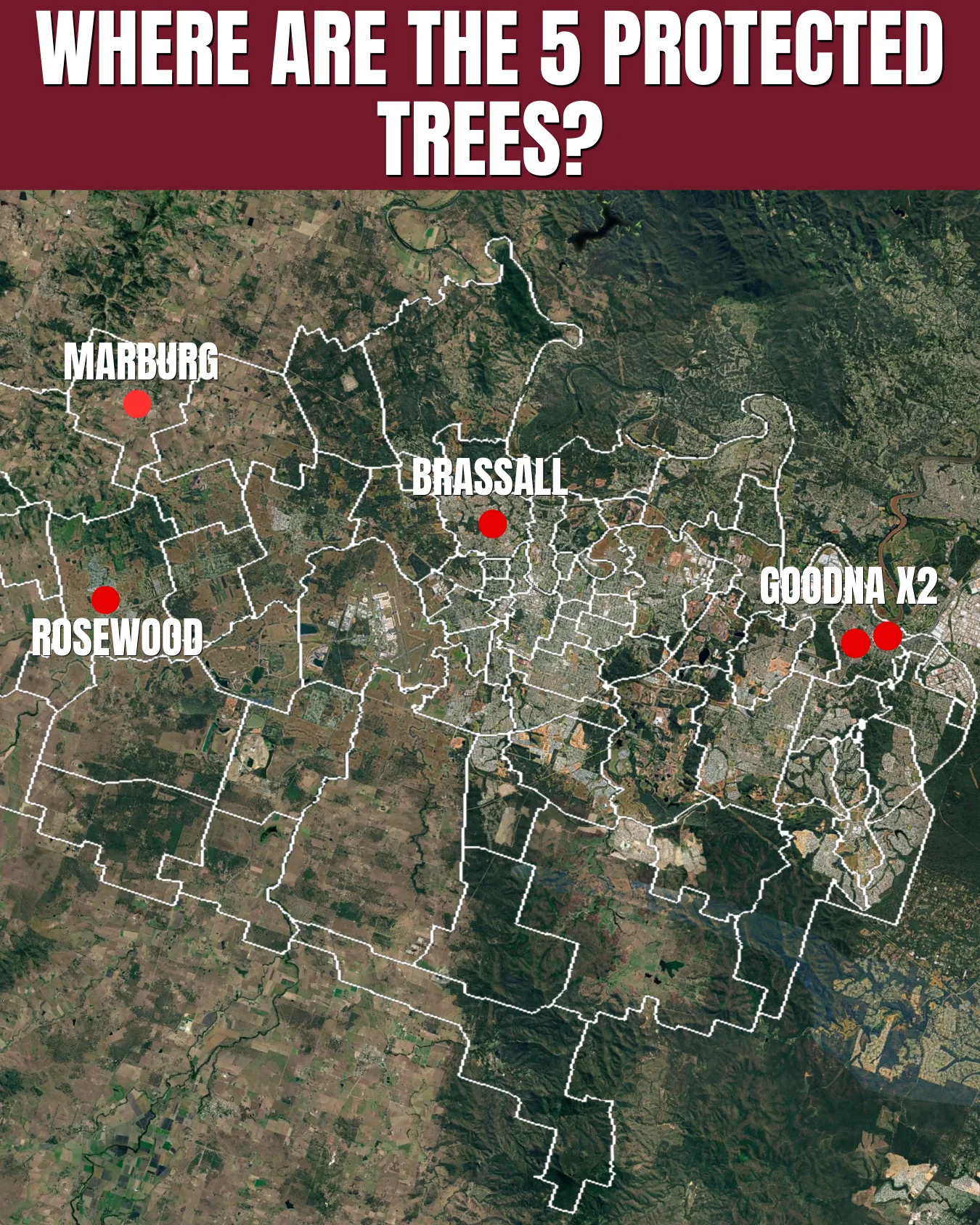
The five current VPO tree sites are spread across Rosewood, Goodna, Marburg and Brassall. Goodna has two of the five, with one Port Jackson Fig on Alice Street and one Queensland Blue Gum on Church Street.
Specific Details
- Rosewood: 7-9 John Street – Hoop Pine
- Goodna: 118 Alice Street – Port Jackson Fig
- Goodna: 14 Church Street – Queensland Blue Gum
- Marburg: 40 Lawrence Street – Bottle Tree
- Brassall: 7 Theodore Street – Queensland Blue Gum
1. The Town Champion – Rosewood Hoop Pine
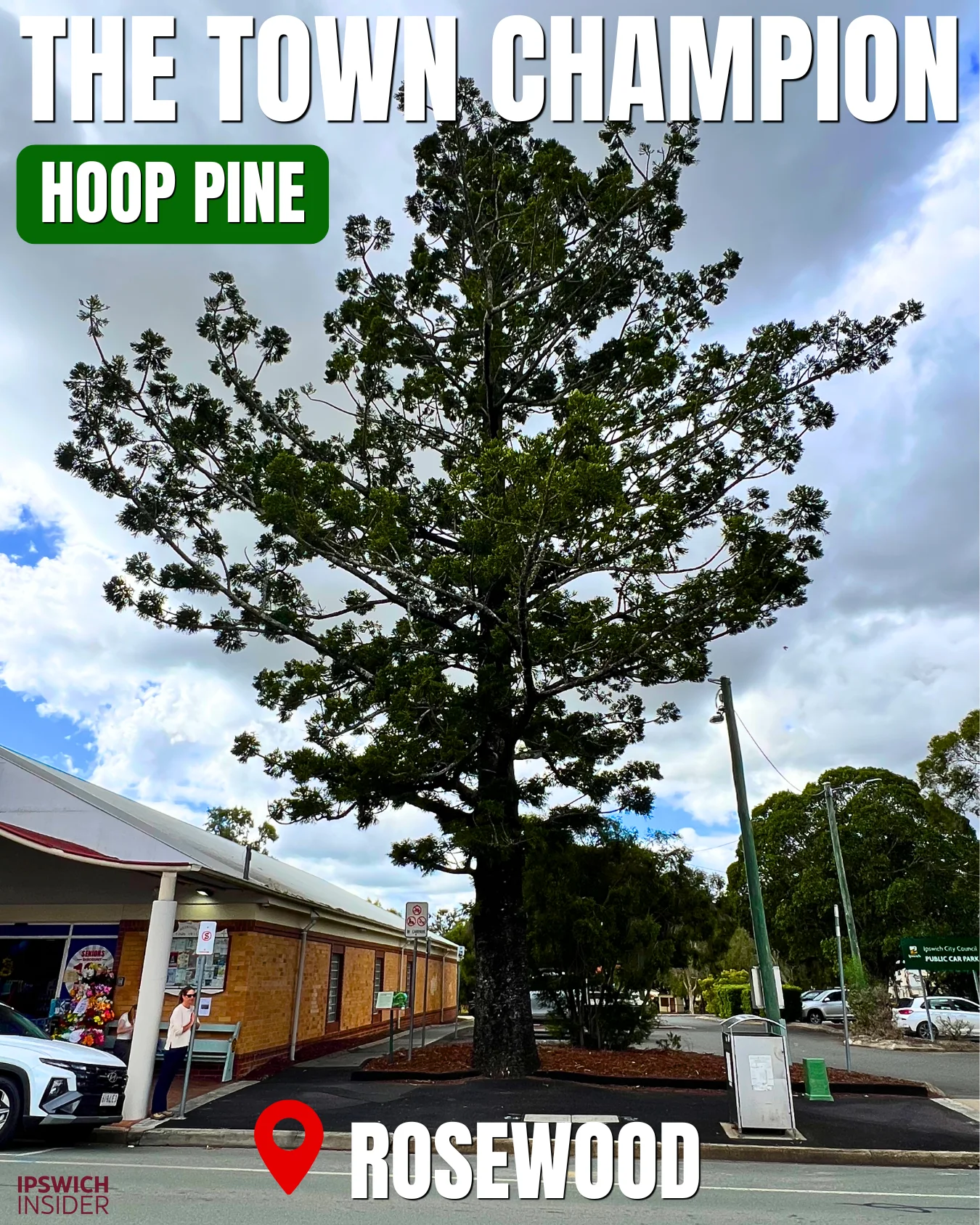
This is the cleanest case on the list.
Council says it is the largest remaining Hoop Pine in Rosewood. Its main-street (John Street) position, age and connection to the town make it exactly the kind of local champion a VPO was built for.
Specific Details
- Address: 7-9 John Street, Rosewood
- Tree type: Hoop Pine
- Order made: 8 October 2001
- Status: Current
- Why it made the list: largest remaining Hoop Pine in Rosewood township, with age, prominent position and town association adding to its value.
2. The Local Landmark – Goodna Port Jackson Fig
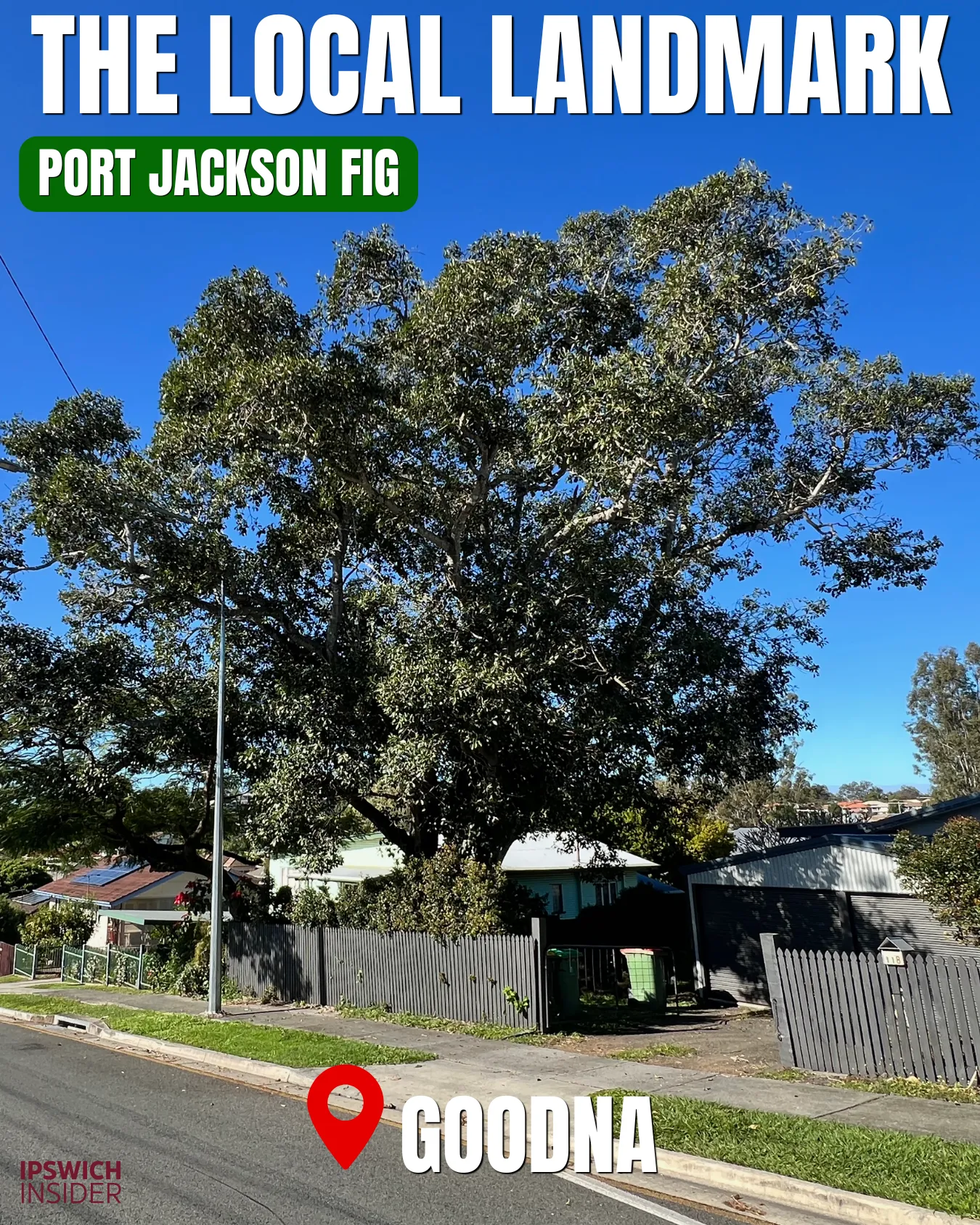
This fig is not on the list because it is the biggest fig in Ipswich. Its real value is local landmark value: a strong old fig in a visible Goodna position, near Westside Christian College Primary Campus, with a long association with local residents.
Specific Details
- Address: 118 Alice Street, Goodna
- Tree type: Port Jackson Fig, Ficus rubiginosa
- Order made: 11 December 2002
- Status: Current
- Why it made the list: age, size, local landmark value, long association with residents, aesthetic value and wildlife value.
3. The Civic Sentinel – Goodna Queensland Blue Gum
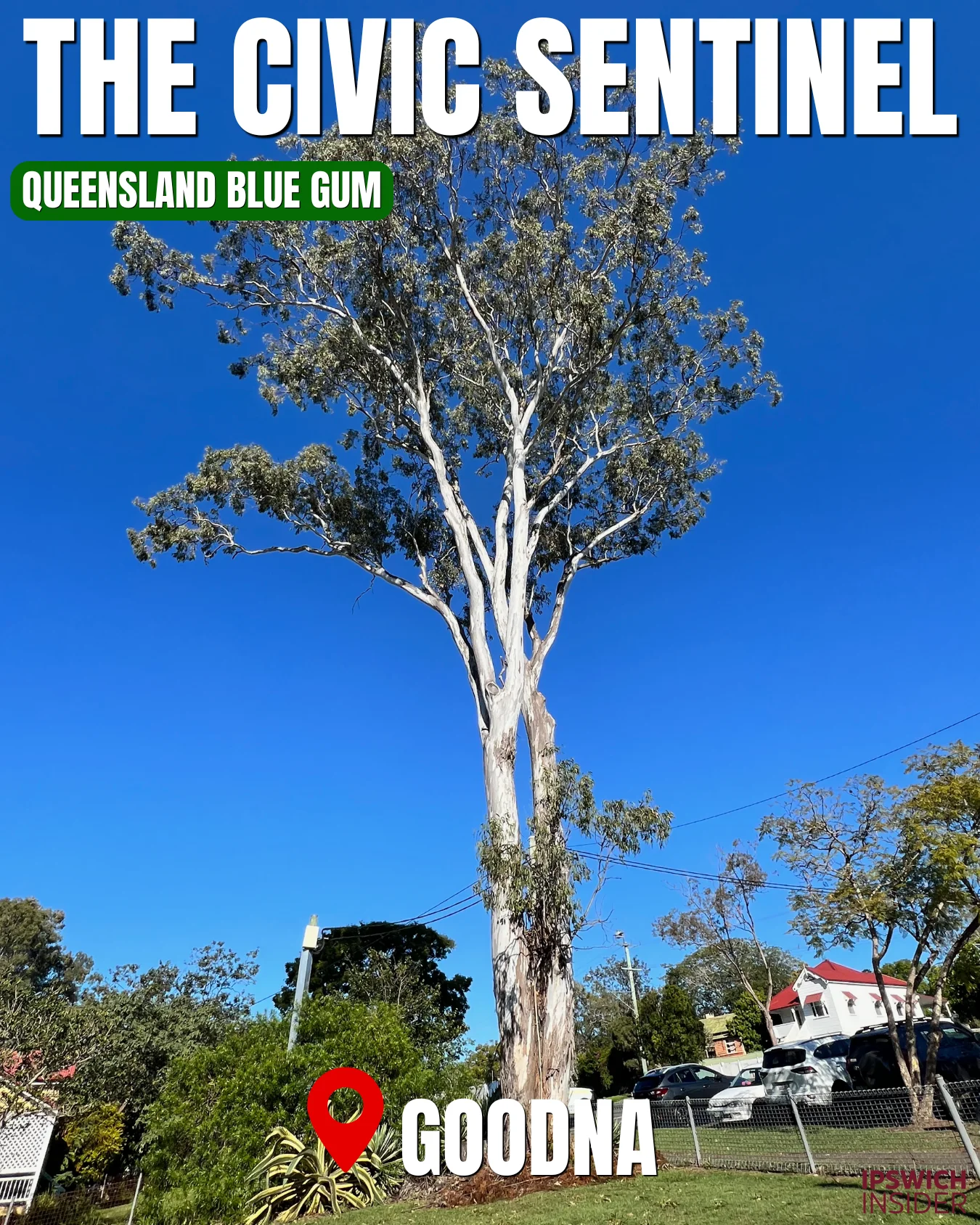
This one makes more sense when you look at where it stands. It is a large Church Street eucalypt beside Goodna Police Station, so its value is not just size or age, but its place in Goodna’s streetscape.
Specific Details
- Address: 14 Church Street, Goodna
- Tree type: Queensland Blue Gum, Eucalyptus tereticornis
- Order made: 2 April 2003
- Status: Current
- Why it made the list: one of the largest remaining eucalypts in the area, with historical and cultural association plus native bird habitat value.
4. The Standout Specimen – Marburg Bottle Tree
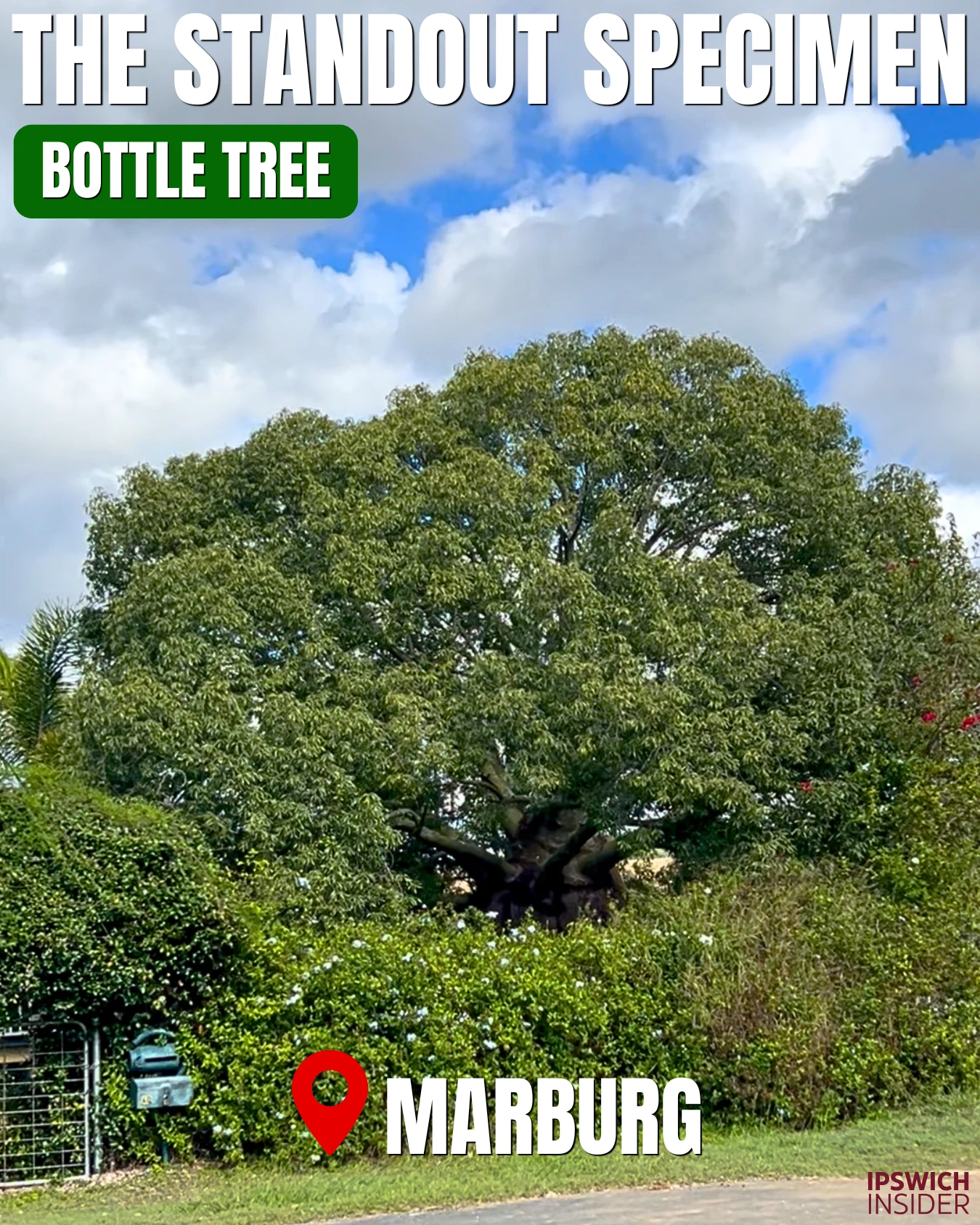
The Marburg Bottle Tree is the strongest specimen case on the list. It is tucked away at the end of Lawrence Street, but council found it was more than 100 years old, in sound condition and an exceptional example of the species.
Specific Details
- Address: 40 Lawrence Street, Marburg
- Tree type: Bottle Tree, Brachychiton rupestris
- Order made: 19 August 2025
- Status: Current
- Why it made the list: estimated 100+ years old, good form, sound condition, streetscape value, biodiversity value and traditional Aboriginal uses of the species.
- Extra note: council said the permanent order followed an application by the landowner.
5. The Backyard Survivor – Brassall Queensland Blue Gum
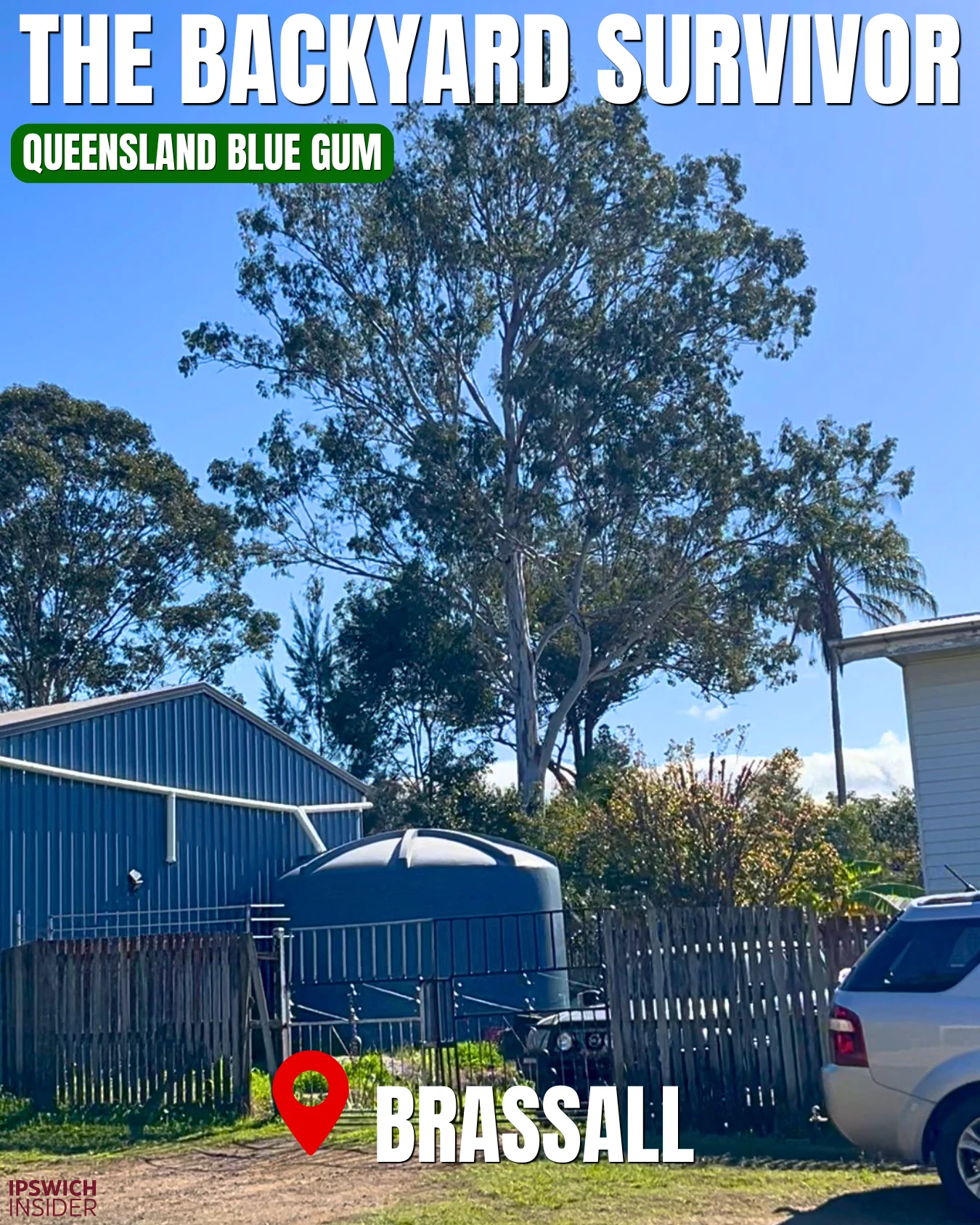
The Brassall blue gum is the least obvious tree on the list, but that is probably the point. It is a 100+ year old native tree surviving inside an ordinary suburban backyard, not pushed back to a creek line, quarry or bushland reserve.
Specific Details
- Address: 7 Theodore Street, Brassall
- Tree type: Queensland Blue Gum, Eucalyptus tereticornis
- Order made: 24 June 2026
- Status: Current
- Why it made the list: exceptional specimen, good condition, estimated 100+ years old, landscape value, cultural heritage value and native fauna habitat.
- Best way to understand it: rare context, not rare species. It is an old blue gum still standing inside this dense Brassall neighbourhood.
Other Protected Trees Around Ipswich
This report is about Ipswich’s Vegetation Protection Order trees. But VPOs are not the only way trees can be protected around Ipswich.
Some trees are protected because they sit inside a Queensland Heritage Register place. Others are protected through Ipswich’s planning scheme as Character Places or local character places.
That is a different kind of protection. A VPO protects important vegetation directly. Heritage and character listings usually protect the wider place, setting, garden, streetscape or historic fabric the tree is part of.
Not VPOs, But Still Protected:
- The Moreton Bay Figs out front Garowie, Eastern Heights: the Queensland Heritage Register entry includes trees/plantings as significant components, and notes several very large Moreton Bay Fig trees on the original property. These are heritage-setting trees, not VPO trees.
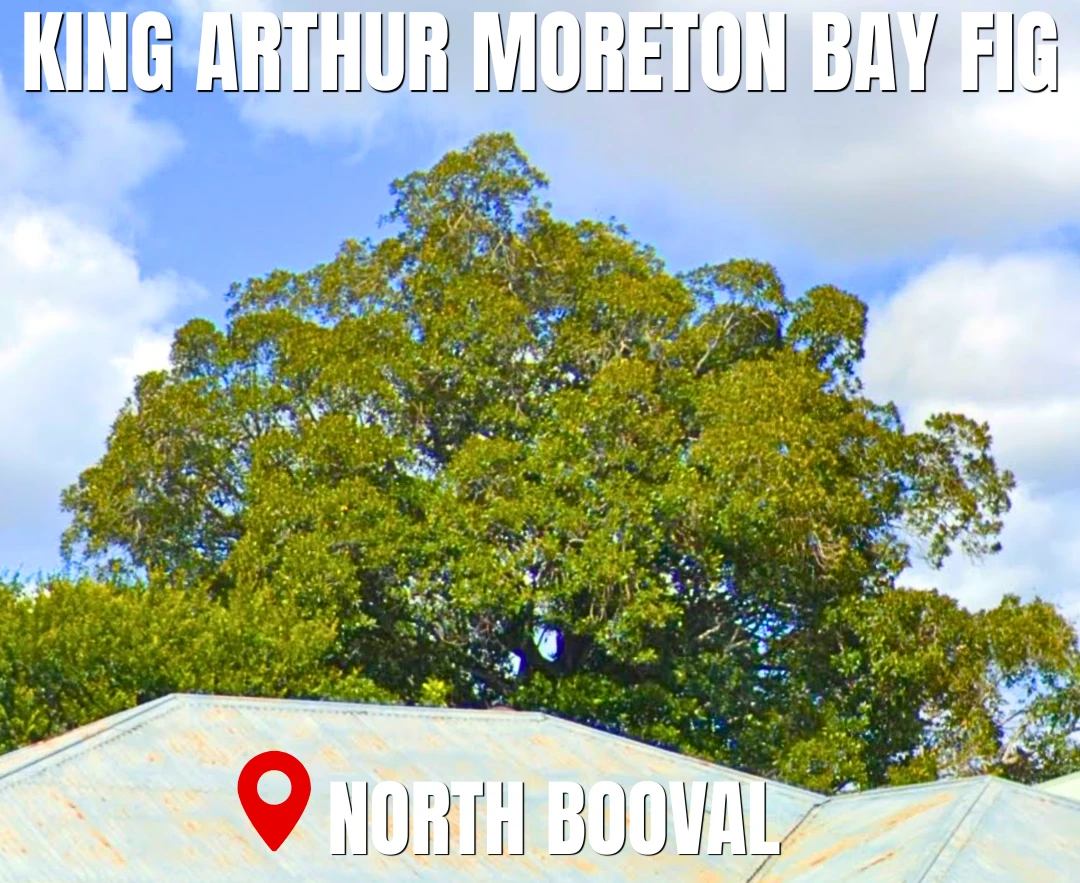
- King Arthur Moreton Bay Fig, North Booval: this 270-year-old Moreton Bay Fig at 3 Roma Street is protected as a character place, not a VPO. It is about 18m high, has a 30m canopy, and was described by council as the oldest known tree of its genus in Ipswich.
- Queen Victoria Parade Plantings, Ipswich: these are not a single protected tree. They are part of a character streetscape listing connected to Queen Victoria Parade, limestone kerbing, garden beds and historic plantings near Queens Park.
- Thomas Street Railway Station Plantings, Sadliers Crossing: these are mature station-side plantings on the southern side of Tallon Street, between Challinor Street and Stephenson Street. They are protected through the planning scheme character system, not through a VPO
- And more…
How to Nominate a Tree for a VPO
Here is what the VPO nomination form looks like.
Anyone can fill one out and submit it.
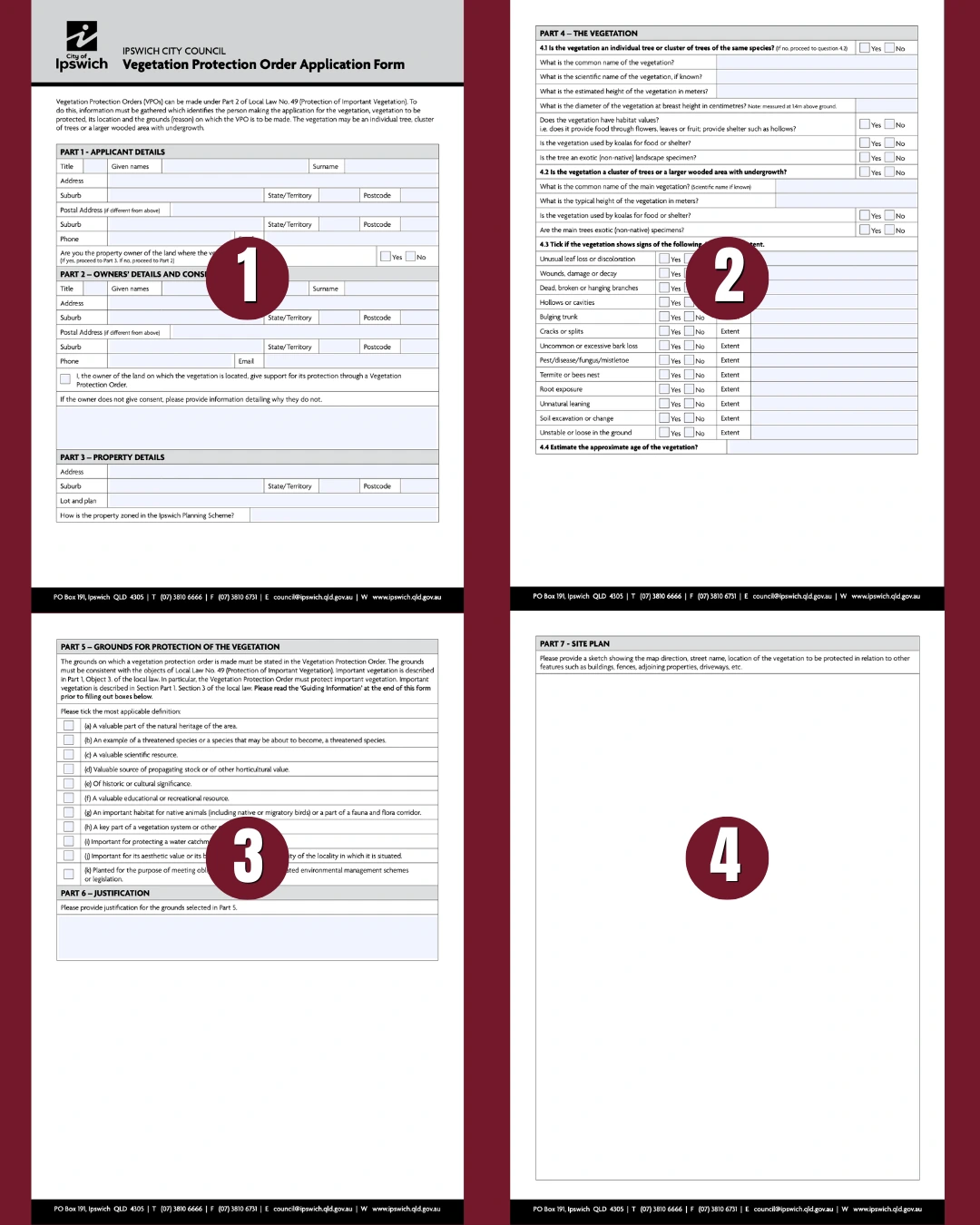
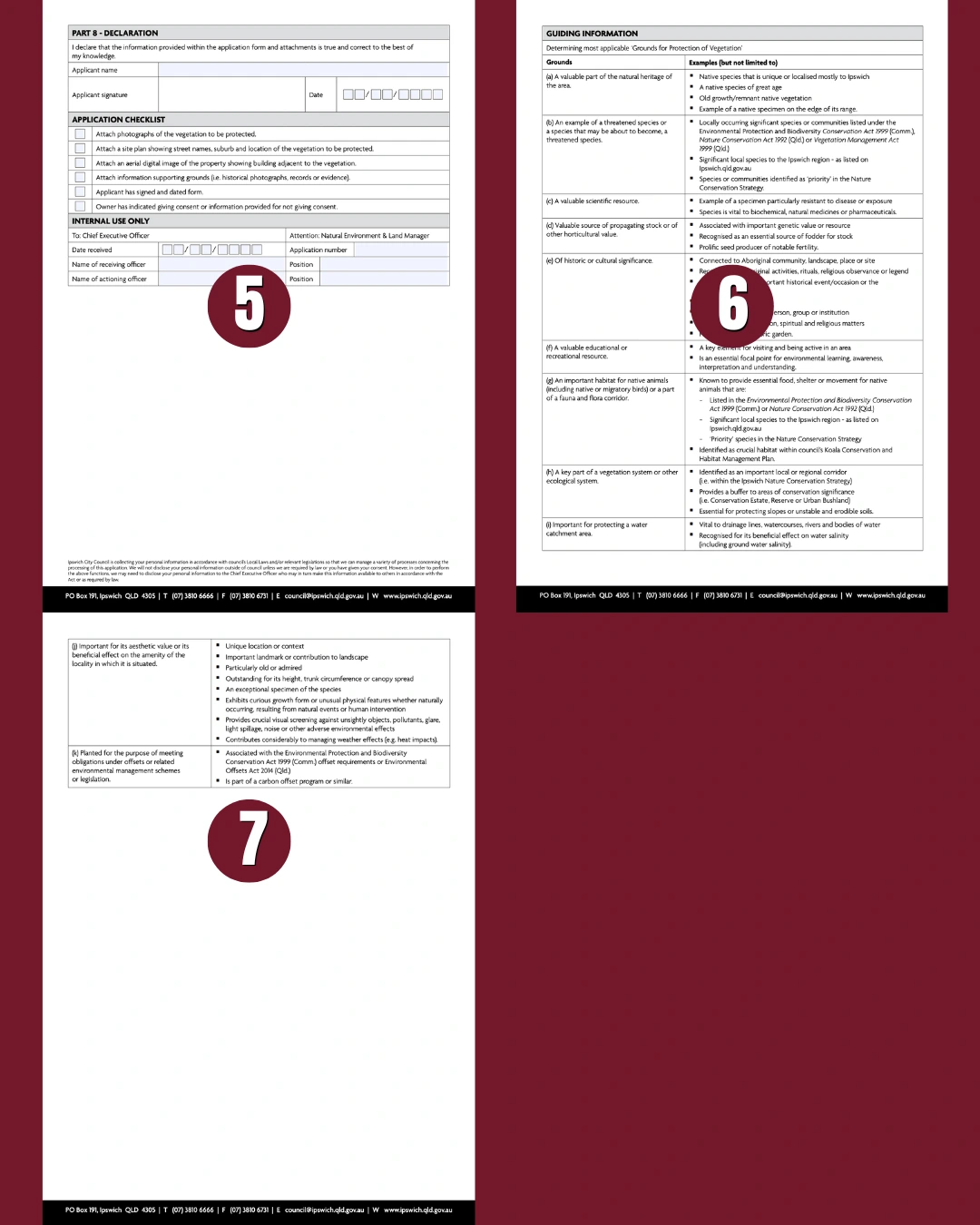
Yes, you can nominate any tree.
But the nomination form (shown above) needs more than “this is a nice old tree”. You need to show council why the tree is important enough to protect.
The strongest nominations tell a clear story: what the tree is, where it stands, who knows it, what lives in it, and why losing it would matter.
Before You Start
- Do it early: council says a VPO is not meant to change the course of an existing civil, planning or legal dispute.
- Know the owner situation: if you are not the landowner, the form asks whether the owner supports the nomination. If not, you need to explain why consent was not given.
- Be clear what you are nominating: it can be one tree, a cluster of trees or a larger wooded area with undergrowth.
What to Include
- Tree details: common name, scientific name if known, estimated height, and trunk diameter measured about 1.4m above the ground.
- Location details: street address, suburb, lot/plan if known, and a simple site plan showing the tree near fences, buildings, driveways and street names.
- Photos: include wide shots, street view, trunk, canopy, hollows, roots, flowers, fruit, damage, and any wildlife using the tree.
- Aerial image: council asks for an aerial digital image showing the property and nearby buildings.
- Supporting evidence: old photos, local history, records, wildlife notes, neighbour memories, or anything that proves why the tree matters.
What Council Looks For
- Natural heritage: old native trees, remnant vegetation, rare local species, or trees on the edge of their natural range.
- History or culture: links to Aboriginal places, early settlers, important people, institutions, events, churches, schools, civic places or historic gardens.
- Habitat: food, shelter, hollows, koala use, bird habitat, native animal movement, or part of a fauna and flora corridor.
- Landscape value: a tree people recognise, a unique location, major streetscape value, big canopy, unusual form, or an exceptional specimen.
- Environmental value: trees that help protect waterways, drainage lines, slopes, erodible soil, catchments, buffers or local ecological systems.
Download Ipswich City Council’s Vegetation Protection Order application form here.
For urgent nominations where the tree is under immediate threat, council says to phone (07) 3810 6666.
Sources
- Vegetation Protection. ipswich.qld.gov.au
- Local Law No. 49 – Protection of Important Vegetation. ipswich.qld.gov.au
- Ipswich City Council protects Marburg Bottle tree. ipswich.qld.gov.au