

Attenborough’s Ipswich Footage at a Glance
- Found. David Attenborough, the world’s most famous nature broadcaster, filmed Ipswich’s Woodend flying-fox colony for the BBC in 1990. It aired in Jan-1992 as part of Wildlife on One: Flying Foresters. Almost no one in Ipswich knows it exists.
- What he filmed. Attenborough interviews 2 sets of Woodend neighbours on opposite sides of the gully. The Holman sisters, who loved the bats. An elderly widow, Mrs Berry, who hated them—her house later became Woodend Nature Centre.
- The mixup. Ipswich City Council’s 2015 flying-fox plan says Woodend featured in Attenborough’s 1979 Life on Earth. It can’t have. The Woodend colony didn’t arrive until 1984.
Watch Attenborough’s Woodend flying-fox footage
This video is clipped from David Attenborough’s BBC documentary series called Wildlife on One. It is considered Episode 122 and is called Flying Foresters. It aired 27 January 1992. You can view the entire episode on archive.org. The Woodend clip is at 19:25. Have a look:
🔢 By The Numbers

- 1990. The year the BBC filmed Attenborough’s Woodend flying-fox footage
- 27 January 1992. The date Wildlife on One: Flying Foresters aired on BBC One
- 250,000. The number of flying-foxes Attenborough says were roosting at Woodend
- 500,000. The peak count of flying-foxes using the broader Woodend precinct, around the year 2000
- 1984. The year flying-foxes first arrived at Woodend, after the Sapling Pocket dispersal
- 6 years. How long Mrs Berry had been living with the bats when Attenborough filmed her
- 1966. The approximate year Mrs Berry and her husband built the house that became Woodend Nature Centre
- 1995. The year the gully was gazetted as Ipswich Pteropus Conservation Park
- 14km. The distance from Ipswich CBD to Sapling Pocket at Pine Mountain, the older flying-fox camp
- 4 to 10. The number of active flying-fox roosts across Ipswich today
Have you ever heard someone say David Attenborough filmed in Ipswich?
Did you ever bother to look it up?
There are places that say he filmed Life on Earth in 1979 at Woodend.
Sunshine Coast Council just says a famous Ipswich colony was filmed by Attenborough and BBC.
Well the thing is, it’s true.
He did film here.
But all the evidence points away from Life on Earth and towards Wildlife on One: Flying Foresters.
We tracked down the actual footage and clipped it (above) for you to watch. It was filmed in 1990, with the key scenes at Woodend.
Let’s also take a closer look at the Woodend roost at its peak.
More Ipswich Gold
Satellite Plan View, Woodend Roost

Details
A small bushland gully in Woodend sits above the Bremer River. Two houses face each other across it, and in 1990 they were both private homes whose front gardens hosted 250,000+ flying-foxes. Plenty enough to attract David Attenborough and the BBC to come have a look.
- The setting. A small bushland gully above the Bremer River in Woodend, less than 10 minutes from the Ipswich CBD. Two houses sit on opposite sides owning several hectares of land each.
- The west side. Mrs Berry’s house, built in the mid-1960s, sits on the western edge of the gully. The house still stands today as Woodend Nature Centre (Ipswich Pteropus Conservation Park).
- The east side. The Holman sisters’ house on Williams Street East, where Chris and Hazel Holman had been living with their dogs and cats since at least 1978 according to Picture Ipswich records.
- The gully between. A vegetated gully running down to the river. Council still describes the reserve today as having roosts along a gully in Woodend.
- No reserve yet. When Attenborough filmed here in 1990, there was no Woodend Nature Centre. No viewing deck, no car park, no signage. Just two homes on a gully.
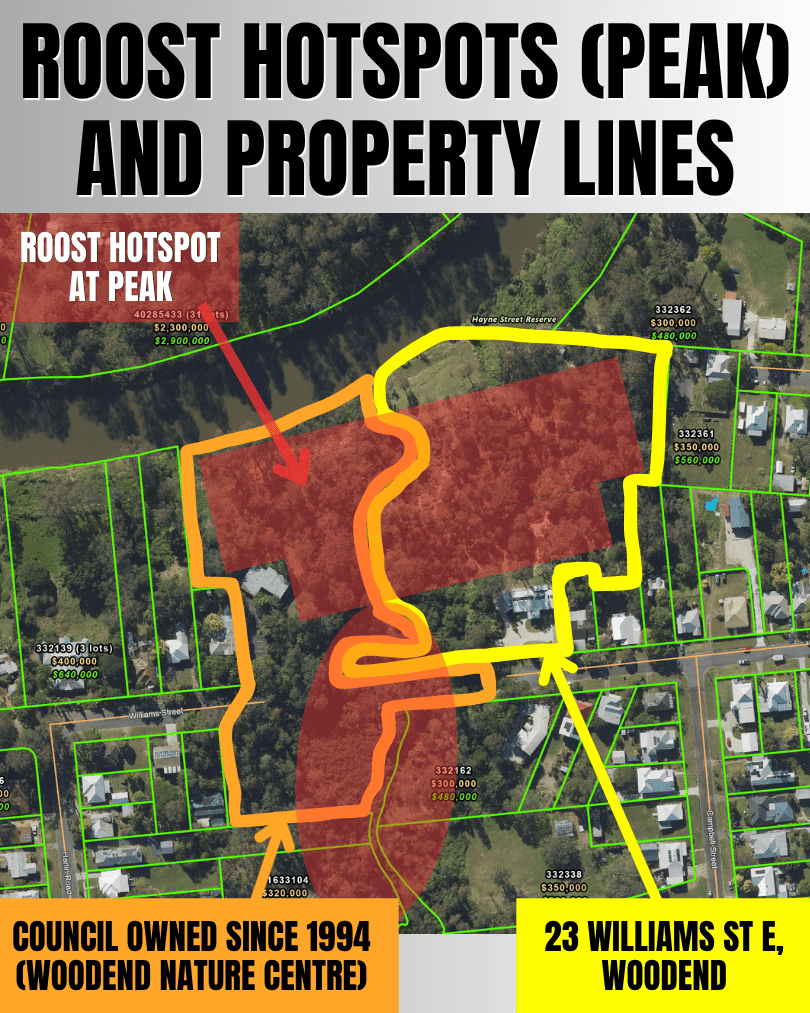
Woodend Roost in Private Gardens (Peak)
Details
At its peak the Woodend roost didn’t sit in a distant reserve. It sat in two families’ front gardens.
- Right in the garden. The translucent-red area marks where the flying-foxes roosted at peak.
- Half the camp. A 1993 Australasian Bat Society newsletter states that half of the Woodend camp was on the Holman sisters’ property alone.
- 250,000 bats. Attenborough says in the footage that the Woodend roost held around 250,000 flying-foxes. At its later peak around 2000, council estimates suggested up to 500,000 using the broader precinct. Including Macrae Street Reserve, Smith Park and Hayne Street Reserve.
- Council since 1994. The lot now known as Woodend Nature Centre was in council hands by 1994, when the park was formally established.
- 23 Williams Street East. The Holman house sits directly alongside the roost. The sisters lived with the bats rather than beside them.
Two Neighbours

Details
Attenborough interviews two Woodend locals with opposite views on the bats. One loved them. One had to escape them.
- Chris Holman. Lived at 23 Williams Street East with her sister Hazel. Half the Woodend flying-fox camp roosted on their property. She tells Attenborough on camera: “I do love every one of them.”
- Mrs Berry. Widow on the opposite side of the gully. She and her husband built their home in the mid-1960s. When Attenborough filmed in 1990, she had been living with the bats for six years and she was over it.
- Her words. Mrs Berry tells Attenborough the noise and smell were hard to put up with. She mentions having to come inside because the smell was so bad.
- Two sides, one gully. The footage captures both views without taking sides. Attenborough lets the two neighbours speak for themselves.
- Dated by her words. Mrs Berry says the bats arrived six years ago. Council records say the Woodend colony formed in 1984. Her maths dates the filming to 1990.
Australian Bat Society Newsletter, 1993

Details
The Holman sisters weren’t just local characters. Their role at Woodend was on the record nationally with the bat research community.
- Primary source. The Holman sisters’ role was documented in the Australasian Bat Society Newsletter, the national publication of the country’s bat researchers, in the exact era Attenborough was filming.
- The quote. “Half of the camp is on the property of the bat-loving Holman sisters.” Five words of characterisation that say everything about who Chris and Hazel were.
- The purchase. The same newsletter describes Ipswich City Council and the Queensland Department of Heritage and Environment jointly buying one side of the valley to create a conservation park.
- The other side. The newsletter noted the Holmans were hoping to sell their property too and was essentially putting out a call for “flying-fox-fans” to buy it.
- National record. This wasn’t just a local story. The Woodend colony was being tracked by bat researchers across Australia.
Woodend Nature Centre, 35 Williams Street

Details
The house Mrs Berry wanted to escape became the public centre dedicated to the very bats she complained about.
- Same house. This is the house Mrs Berry told Attenborough she had to escape from because of the bats. It still stands on its original footings at 35 Williams Street.
- Jointly purchased. Ipswich City Council and Queensland’s Heritage department jointly bought the Williams Street property in the early 1990s. The sale funded her move.
- From home to centre. The house was modified with interpretive facilities outside and meeting rooms inside. A viewing deck was added at the rear, facing the roost.
- Gazetted in 1995. The gully was gazetted Ipswich Pteropus Conservation Park in 1995, making it a protected state conservation area.
- Closed today. Ipswich City Council’s current park page notes the Woodend Nature Centre is no longer available for public bookings. The viewing deck remains accessible.
Ipswich City Council Roost Management Plan Mentions Attenborough’s Life on Earth

Details
This is where the confusion lives in writing. The council’s own 2015 plan names the wrong documentary.
- The source. The 2015 Ipswich Flying-Fox Roost Management Plan is a formal council document, written to guide how the city manages its flying-fox sites.
- The claim. The plan states the Woodend site has featured in Sir David Attenborough’s Life on Earth series of documentaries.
- No citation. The line appears without a source, date, episode number, or production note. Just the claim.
- The problem. Life on Earth aired in March 1979. Council’s own plan says the Woodend flying-fox colony didn’t form until 1984, five years later.
- Both lines in the same plan. The contradiction lives in the same document. Council wrote both sentences.
Sunshine Coast Council, Attenborough Reference

Details
Sunshine Coast Council also mentions Attenborough and an Ipswich colony. Their wording is broader, and closer to the truth.
- Broader claim. Sunshine Coast Council’s little red flying-fox page says Sir David Attenborough filmed much of his documentary on flying-foxes at a famous Ipswich colony.
- Closer to right. This version doesn’t name Life on Earth. It just says “his documentary on flying foxes” which matches Wildlife on One: Flying Foresters almost exactly.
- The bonus line. The page also says Attenborough later described the Ipswich filming as one of his most memorable Australian experiences. The original interview isn’t publicly cited.
- Written by experts. The page is credited to Clancy Hall, a conservation biologist, with imagery by Dr Les Hall, a flying-fox researcher with decades of Woodend experience.
- A second witness. Two separate councils have put the Attenborough-in-Ipswich story on the record. Something real happened here.
Mass Movement from Sapling Pocket to Woodend, 1984

Details
Before Woodend, Ipswich’s big flying-fox camp was somewhere else entirely. The story drifted across town with the bats.
- The older colony. Before Woodend, Ipswich’s big flying-fox camp was at Sapling Pocket, a dry vine scrub at Pine Mountain about 14km from the CBD.
- Mother of all camps. Council’s own roost plan calls Sapling Pocket the “mother” of all Ipswich camps. At times it held hundreds of thousands of flying-foxes.
- The 1984 dispersal. Shooting and disturbance at nearby Cameron’s Scrub pushed the colony out. The animals scattered across Ipswich. Most landed at Woodend.
- Fair to council. If Attenborough really did film Ipswich flying-foxes for Life on Earth in 1979, it wasn’t at Woodend. The colony didn’t exist there yet. Sapling Pocket is the more plausible candidate.
- The memory drifted. As Woodend became the famous Ipswich flying-fox site, the old Attenborough story may have migrated across town with the bats.
Life on Earth, 1979 Stills

Details
Here is what Life on Earth actually contains. Flying-foxes, yes. An Ipswich address, no.
- The episode. Life on Earth episode 10, “Theme and Variations”, aired on BBC Two on 20 March 1979. The programme included a flying-fox sequence around the 31-minute mark.
- What it shows. The narration describes fruit-eating bats, tree roosts called camps, and wings up to two metres across. The animals are called flying-foxes.
- What it doesn’t show. The episode names no location for the flying-fox footage. No Ipswich. No Queensland. No Australia.
- Named elsewhere. The same episode names plenty of other places. Southeast Asia, the Pyrenees, New Mexico, Arizona, Mexico, Central America, Hawaii. Just not here.
- Could be Sapling Pocket. If this footage is Ipswich, it’s more likely the older Sapling Pocket / Cameron’s Scrub camp than Woodend. Either way, council’s specific Woodend claim doesn’t line up.
The Two Attenborough Flying-Fox Episodes

Details
Two Attenborough flying-fox episodes. The claim points to the top one. The footage is in the bottom one.
- 1979 Life on Earth. Life on Earth, Episode 10, “Theme and Variations”, aired 20 March 1979. Contains a flying-fox segment, but no Ipswich mention. Could potentially be filmed in Saplings Pocket, Pine Mountain. No way to prove this.
BBC Wildlife on One – Fast forward to 19:25 for the Woodend Part
Wildlife on One, Episode 122, “Flying Foresters“, aired 27 January 1992. The Woodend footage starts at 19 minutes 25 seconds. Mrs Berry, Chris Holman, and the 250,000 bats are all in it.
- Both narrated by Attenborough. He narrates both episodes but does not appear on screen at Woodend.
- Easy to confuse. Life on Earth is the famous one. Flying Foresters is the one almost no one remembers. Easy mistake to make in a planning document written decades later.
Ipswich Flying-Fox Roosts Today

Details
The Woodend colony has largely dispersed. The bats are now scattered in smaller camps across Ipswich and beyond.
- Scattered now. Ipswich has between four and ten active flying-fox roosts at any given time, depending on season, food availability and migration patterns.
- Woodend much smaller. The gully Attenborough filmed once held 250,000 bats. The colony peaked around 500,000 near 2000 before the roosting trees were stripped by sheer numbers.
- Second resurgence. Council monitoring data shows a brief return to 250,000 bats at Woodend in 2010 before numbers fell sharply again.
- Current roosts. Active or seasonal sites include Queens Park Nature Centre, Poplar Street Raceview, Marburg, Sapling Pocket, Yamanto, Chuwar, and smaller camps across Redbank Plains, Camira and Bundamba. (Source)
Do you know anything more? Email me.
Sources
- Ipswich Flying-fox Roost Management Plan 2015.
- Little red flying fox. SunshineCoast.qld.gov.au