
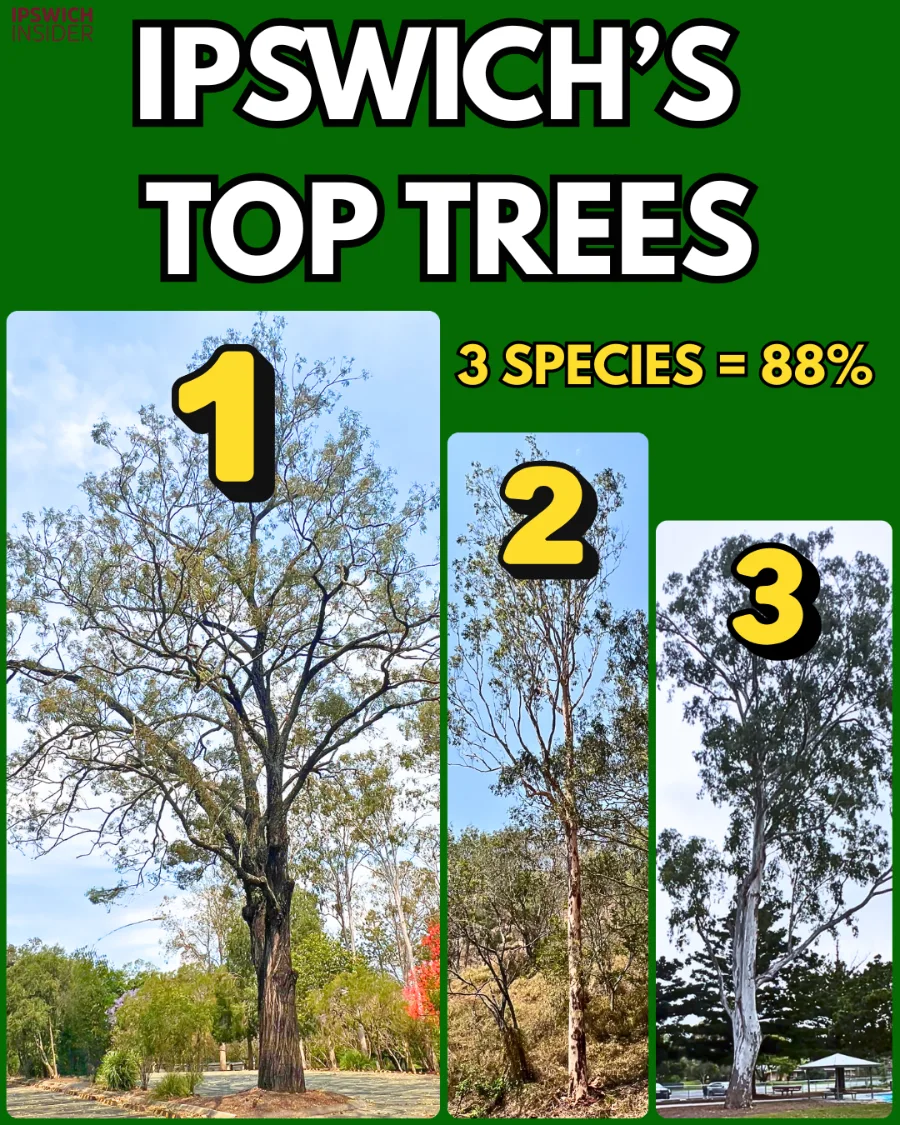
Ipswich’s Most Common Trees at a Glance
- What’s inside: Ipswich’s 18 most common trees—how many, how tall, where they grow, and how to recognise them. (Ipswich has ~690,000 trees total.)
- Big three: Ironbarks, spotted gums, and blue gums dominate, making up nearly 90% of all trees. Popular urban picks (jacaranda, tuckeroo, palms, poinciana, citrus) are common but far far fewer overall.
- How we counted: Estimated from Queensland bush maps, typical densities, and street/yard patterns. Closely related trees are grouped by familiar local names.
Did you know?
The City of Ipswich has ~690,000 trees.
That’s about 5 trees for every footy field’s worth of land across Ipswich.
47% are one group: ironbarks.
88% are just three species.
Wild, right?
How we worked it out: not by walking every street. We used Queensland ecosystem maps to size bushland, applied realistic stems-per-hectare bands, then layered in streets, parks and yards using road length and common planting patterns.
Names and grouping: where locals use one name for close relatives, we grouped them (Ironbarks, Lilly pillies, Urban palms, Backyard citrus). Yard staples like citrus are included even if some sit under 3 m.
Keep reading for the top 18 trees of Ipswich, ranked – with numbers, height band, why they thrive here, where you’ll see them, and a quick how to ID guide.
More Ipswich Guides & Rankings
1) Ironbarks

Ironbarks: By the numbers
- Estimated trees (mid; low–high): 320,000 (240k–400k)
- Share (approx): ~46.5%
- Confidence: High
- Ipswich height range: 18–30 m (rarely ~40–45 m)
- Tallest recorded (where): No single audited champion; best-documented max ~45 m (NSW/SEQ range)
Ironbarks in Ipswich
- Scientific name(s): Eucalyptus crebra; E. melanophloia; E. siderophloia
- Where you’ll see it: Ridges & hills (dry sclerophyll woodland/open forest)
- Why Ipswich? Inland sandstone ridges, poor soils, frequent fire — ironbarks dominate.
- Best: Bushfire resilience — thick ironbark + ultra-durable hardwood
- ID note: Black, deeply furrowed bark; narrow leaves; upright open canopy
2) Spotted gum

Spotted gum: By the numbers
- Estimated trees (mid; low–high): 210,000 (160k–260k)
- Share (approx): ~30.5%
- Confidence: High
- Ipswich height range: 25–35 m (occasionally ~45 m)
- Tallest recorded (where): “Spotted gum complex” audited to 70.9 m (C. maculata, NSW); variegata commonly ~45–50 m in SEQ
Spotted gum in Ipswich
- Scientific name(s): Corymbia citriodora subsp. variegata
- Where you’ll see it: Upland open forests on sedimentary hills and ridges
- Why Ipswich? Sedimentary hills, seasonal dryness, regular burns — spotted gums thrive.
- Best: Straight timber — prized poles/flooring; wind-firm trunks
- ID note: Tall straight trunk; smooth mottled bark patches; lemony leaf scent
3) Blue gum (Forest red gum)
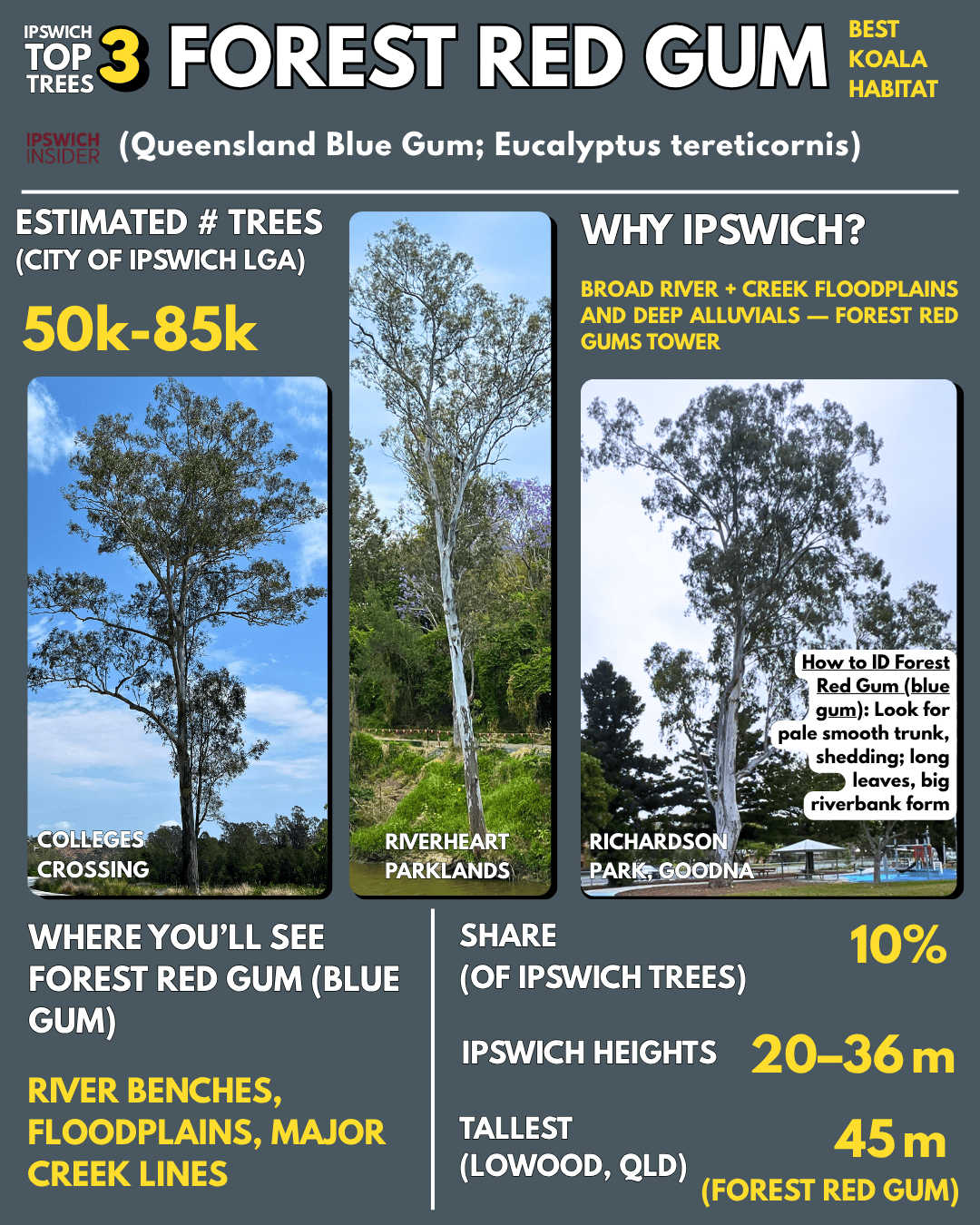
Blue gum: By the numbers
- Estimated trees (mid; low–high): 70,000 (50k–85k)
- Share (approx): ~10.2%
- Confidence: Medium
- Ipswich height range: 28–38 m (local river trees often ~36 m)
- Tallest recorded (where): Best-documented species max ~50 m (SEQ/NSW floodplains); local measured examples ~36 m
Blue gum in Ipswich
- Scientific name(s): Eucalyptus tereticornis
- Where you’ll see it: River benches, floodplains, major creek lines
- Why Ipswich? Broad river floodplains and deep alluvials — blue gums tower.
- Best: Koala habitat — top local food tree + big hollows
- ID note: Pale smooth trunk, shedding; long leaves; big riverbank form
4) River oak
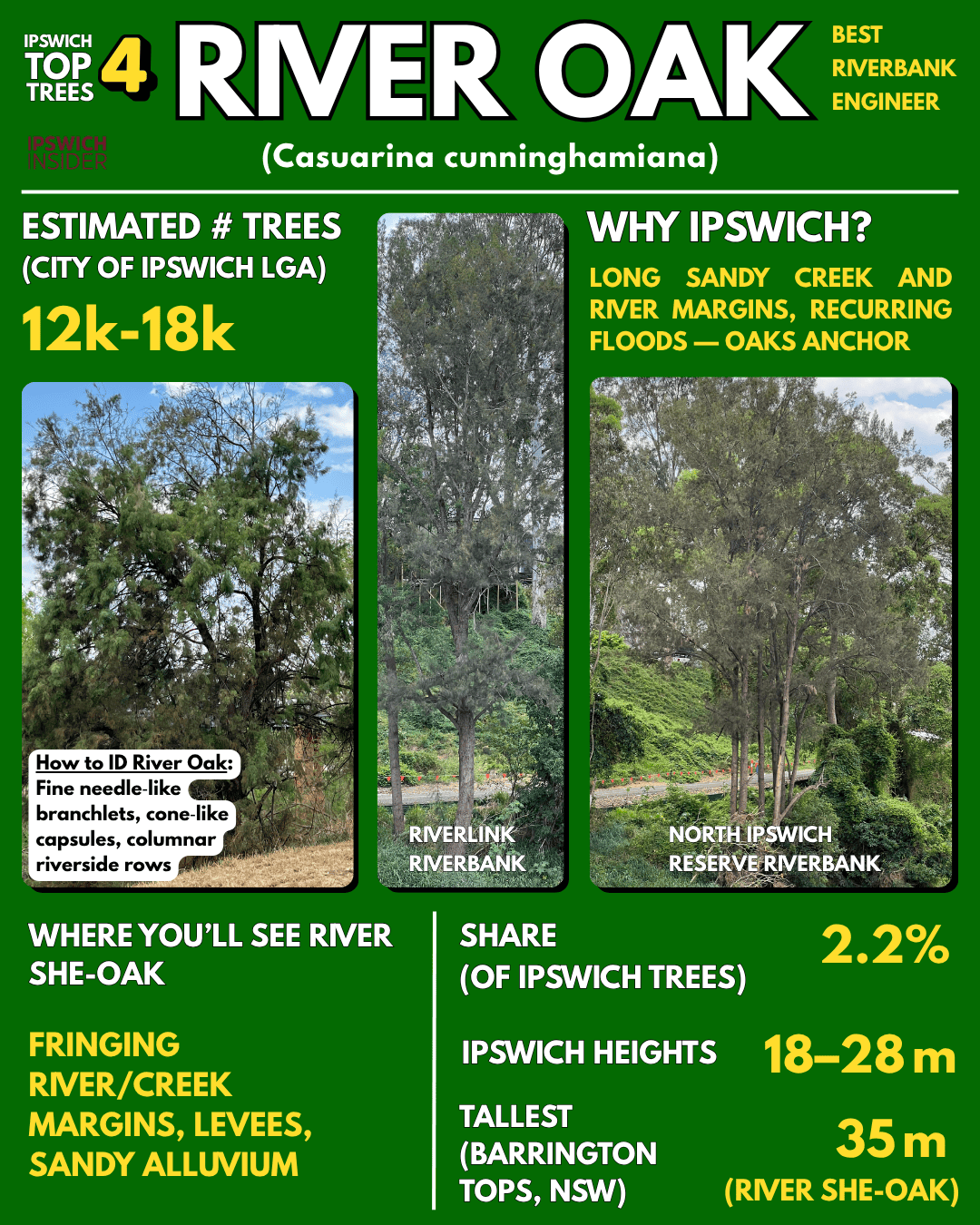
River oak: By the numbers
- Estimated trees (mid; low–high): 15,000 (12k–18k)
- Share (approx): ~2.2%
- Confidence: Medium
- Ipswich height range: 18–28 m (tall stands to ~35 m)
- Tallest recorded (where): 35 m, Barrington Tops NP (NSW), audited tall record
River oak in Ipswich
- Scientific name(s): Casuarina cunninghamiana
- Where you’ll see it: Fringing river/creek margins, levees, sandy alluvium
- Why Ipswich? Long sandy creek and river margins, recurring floods — oaks anchor.
- Best: Riverbank engineer — roots bind banks; nitrogen-fixing partners
- ID note: Fine needle-like branchlets; cone-like capsules; columnar riverside rows
5) Weeping bottlebrush

Weeping bottlebrush: By the numbers
- Estimated trees (mid; low–high): 11,000 (7k–17k)
- Share (approx): ~1.6%
- Confidence: Medium
- Ipswich height range: 5–8 m
- Tallest recorded (where): Typical forms 8–10 m; tall ssp. rhododendron to ~35 m (Injune district, QLD)
Weeping bottlebrush in Ipswich
- Scientific name(s): Melaleuca (Callistemon) viminalis
- Where you’ll see it: Creeklines, verges, roundabouts, yard specimens
- Why Ipswich? Abundant creeklines and flood-tolerant streetscapes — bottlebrush flourish.
- Best: Pollinator magnet — nectar pumps for honeyeaters & native bees
- ID note: Pendulous branches; bright red brush flowers; narrow leaves
6) Lilly pillies (group)

Lilly pillies: By the numbers
- Estimated trees (mid; low–high): 9,000 (6k–13k)
- Share (approx): ~1.3%
- Confidence: Low–Medium
- Ipswich height range: 8–13 m (many hedged smaller)
- Tallest recorded (where): Waterhousea floribunda to ~30 m (riverine rainforest); no audited champion
Lilly pillies in Ipswich
- Scientific name(s): Waterhousea floribunda; Syzygium spp.
- Where you’ll see it: Parks, moist gully edges, backyard privacy screens
- Why Ipswich? Moist gullies and generous yards for screening — lilly-pillies flourish.
- Best: Native privacy tree — glossy screens, bird-friendly fruit
- ID note: Glossy opposite leaves; pink new flush; edible berries
7) Paperbark (broad-leaved)
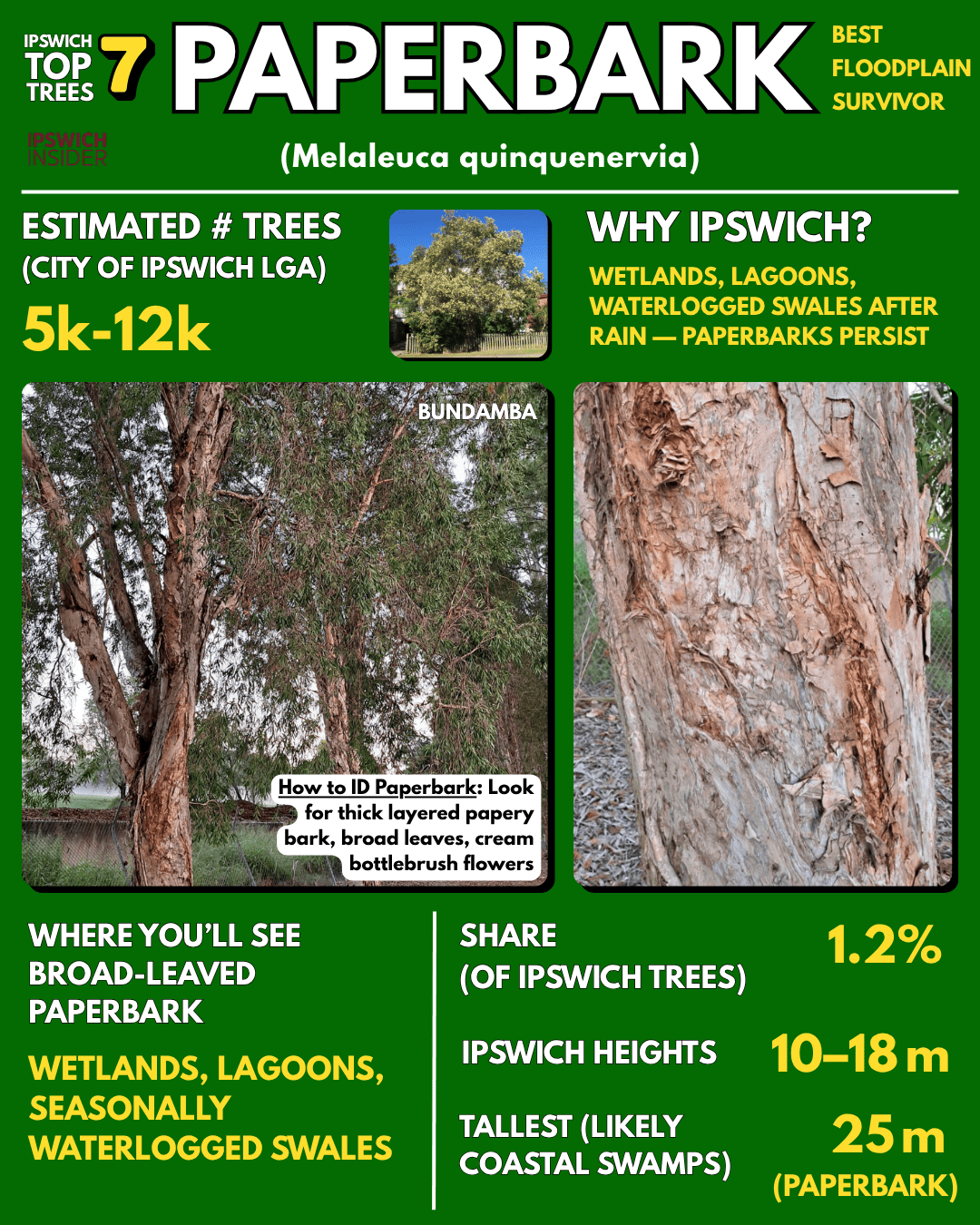
Paperbark: By the numbers
- Estimated trees (mid; low–high): 8,000 (5k–12k)
- Share (approx): ~1.16%
- Confidence: Medium
- Ipswich height range: 10–18 m
- Tallest recorded (where): Best-documented max ~25 m (SEQ/NSW coastal swamps)
Paperbark in Ipswich
- Scientific name(s): Melaleuca quinquenervia
- Where you’ll see it: Wetlands, lagoons, seasonally waterlogged swales
- Why Ipswich? Wetlands, lagoons, waterlogged swales after rain — paperbarks persist.
- Best: Floodplain survivor — shrugs off inundation; resprouts after fire
- ID note: Thick layered papery bark; broad leaves; cream bottlebrush flowers
8) Brush box
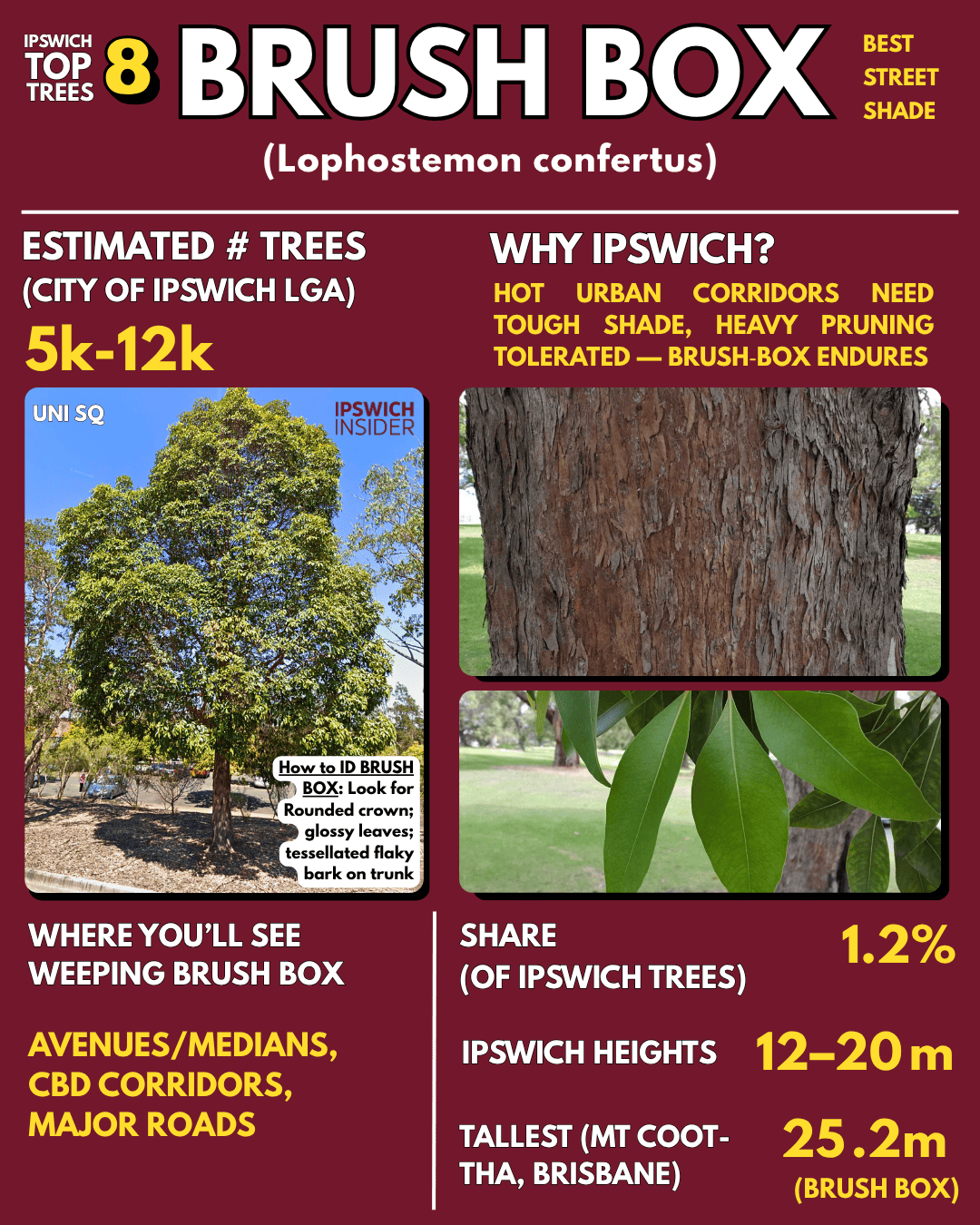
Brush box: By the numbers
- Estimated trees (mid; low–high): 8,000 (5k–12k)
- Share (approx): ~1.16%
- Confidence: Low–Medium
- Ipswich height range: 12–20 m (street form)
- Tallest recorded (where): 25.2 m, Brisbane Botanic Gardens (Mt Coot-tha), audited urban record
Brush box in Ipswich
- Scientific name(s): Lophostemon confertus
- Where you’ll see it: Avenues/medians, CBD corridors, major roads
- Why Ipswich? Hot urban corridors need tough shade; heavy pruning tolerated — brush-box endures.
- Best: Tough street shade — heat, pruning, traffic corridors
- ID note: Rounded crown; glossy leaves; tessellated flaky bark on trunk
9) Grey box / Gum-topped box
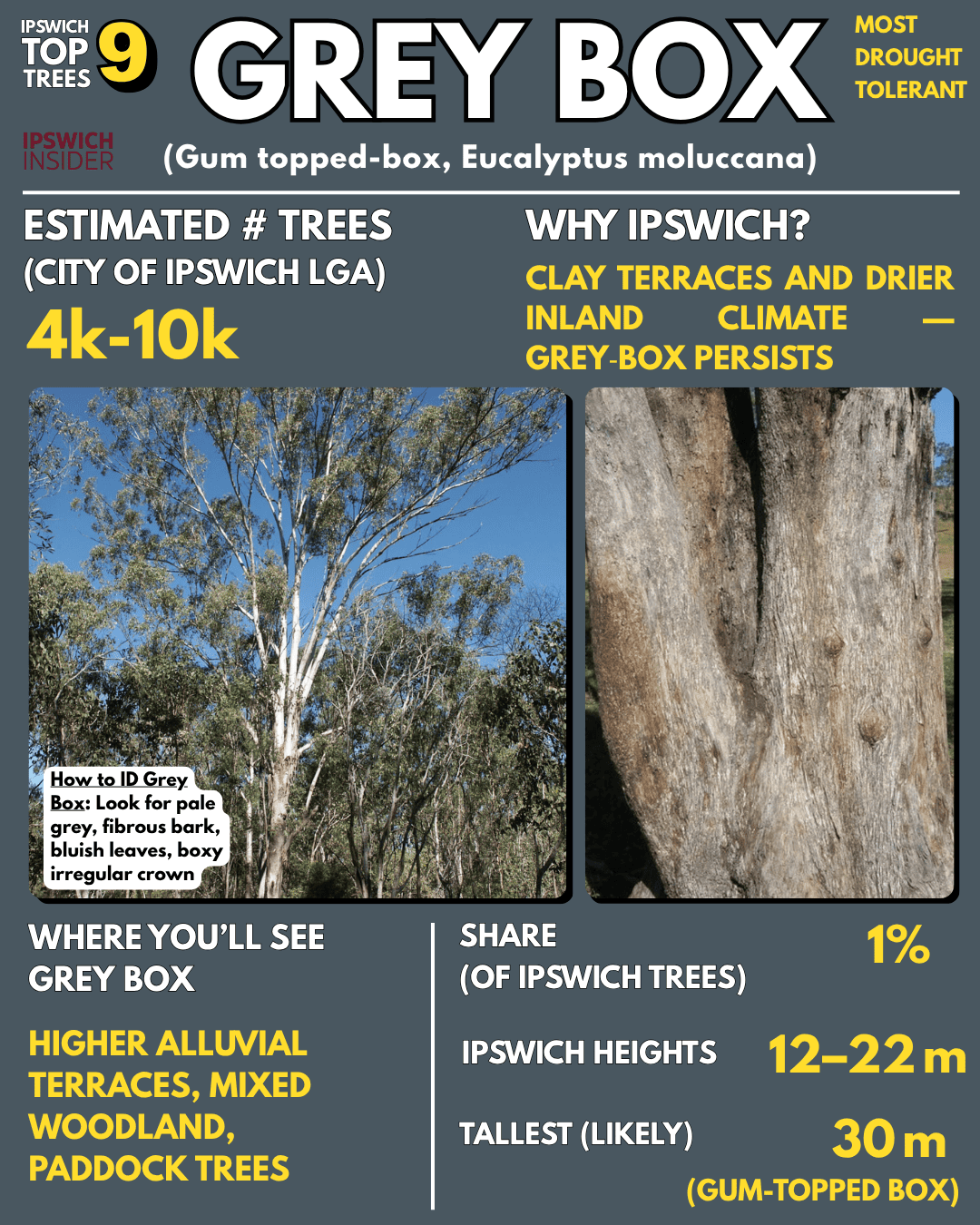
Grey box: By the numbers
- Estimated trees (mid; low–high): 7,000 (4k–10k)
- Share (approx): ~1.02%
- Confidence: Low–Medium
- Ipswich height range: 12–22 m (some to ~25–30 m)
- Tallest recorded (where): No audited champion; floras cite ~30 m on fertile terraces
Grey box in Ipswich
- Scientific name(s): Eucalyptus moluccana
- Where you’ll see it: Higher alluvial terraces, mixed woodland, paddock trees
- Why Ipswich? Clay terraces and drier inland climate — grey-box persists.
- Best: Drought stalwart — reliable shade on heavier soils
- ID note: Pale grey, fibrous bark; bluish leaves; irregular “boxy” crown
10) Tuckeroo

Tuckeroo: By the numbers
- Estimated trees (mid; low–high): 6,000 (4k–9k)
- Share (approx): ~0.87%
- Confidence: Low–Medium
- Ipswich height range: 8–12 m
- Tallest recorded (where): No audited champion; horticultural maxima to ~15 m (coastal SEQ)
Tuckeroo in Ipswich
- Scientific name(s): Cupaniopsis anacardioides
- Where you’ll see it: Newer boulevards, medians, some yards
- Why Ipswich? New boulevards, heat, and poor verge soils — tuckeroos excel.
- Best: Low-mess coastal-tough street tree
- ID note: Rounded canopy; paired glossy leaflets; orange three-valved fruit
11) Jacaranda

Jacaranda: By the numbers
- Estimated trees (mid; low–high): 5,500 (3.3k–8k)
- Share (approx): ~0.80%
- Confidence: Low–Medium
- Ipswich height range: 9–13 m
- Tallest recorded (where): ~13 m (audited TrustTrees avenue, Toowoomba); global audited ~17.6 m (Madeira)
Jacaranda in Ipswich
- Scientific name(s): Jacaranda mimosifolia
- Where you’ll see it: Older streets, parks, and many yards (spring purple)
- Why Ipswich? Hot summers and heritage street culture — jacarandas dazzle.
- Best: Spring showstopper — purple canopy
- ID note: Fern-like bipinnate leaves; purple bloom; round coin-like pods
12) Water gum
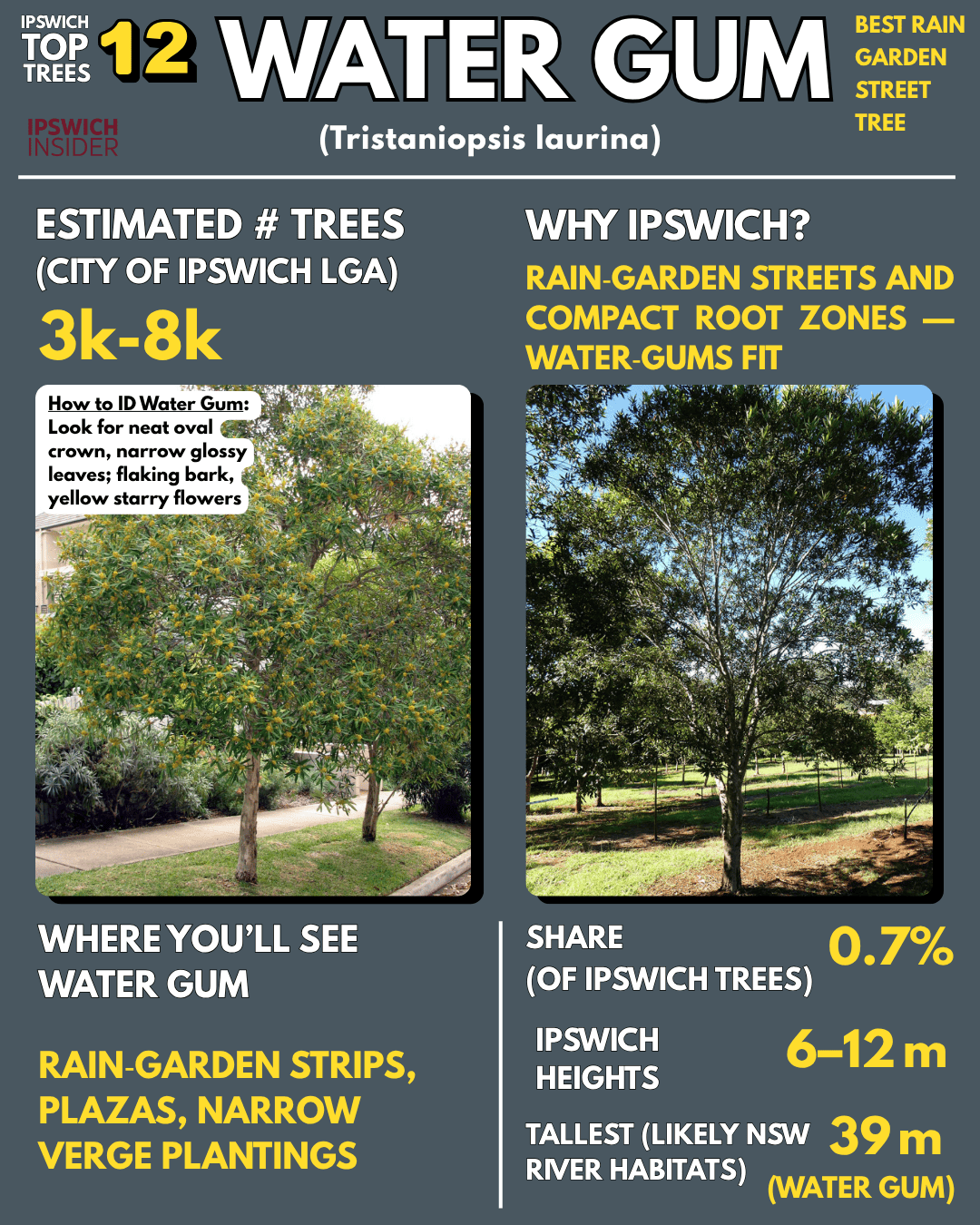
Water gum: By the numbers
- Estimated trees (mid; low–high): 5,000 (3k–8k)
- Share (approx): ~0.73%
- Confidence: Low–Medium
- Ipswich height range: 6–12 m
- Tallest recorded (where): Botanical refs to ~39 m in native NSW river habitats; no audited champion
Water gum in Ipswich
- Scientific name(s): Tristaniopsis laurina
- Where you’ll see it: Rain-garden strips, plazas, narrow verge plantings
- Why Ipswich? Rain-garden streets and compact root zones — water-gums fit.
- Best: Rain-garden street tree — compact roots, tidy crown, handles wet feet
- ID note: Neat oval crown; narrow glossy leaves; flaking bark; yellow starry flowers
13) Urban palms (group)

Urban palms: By the numbers
- Estimated trees (mid; low–high): 3,500 (2.3k–5.3k)
- Share (approx): ~0.51%
- Confidence: Low
- Ipswich height range: 6–15 m (some species to ~20 m)
- Tallest recorded (where): Livistona australis ~30 m; Archontophoenix ~25 m (no single audited champion)
Urban palms in Ipswich
- Scientific name(s): Livistona australis, Archontophoenix cunninghamiana, Syagrus romanzoffiana, Phoenix canariensis, Wodyetia bifurcata, Archontophoenix alexandrae
- Where you’ll see it: Warm microclimates, modern streetscapes, civic features
- Why Ipswich? Warm microclimates and vertical streetscapes — palms punctuate.
- Best: Tiny-footprint skyline — vertical shade, near-zero sideways spread
- ID note: Single smooth trunk; crown of fronds; dangling fruit clusters
14) Backyard citrus (group)
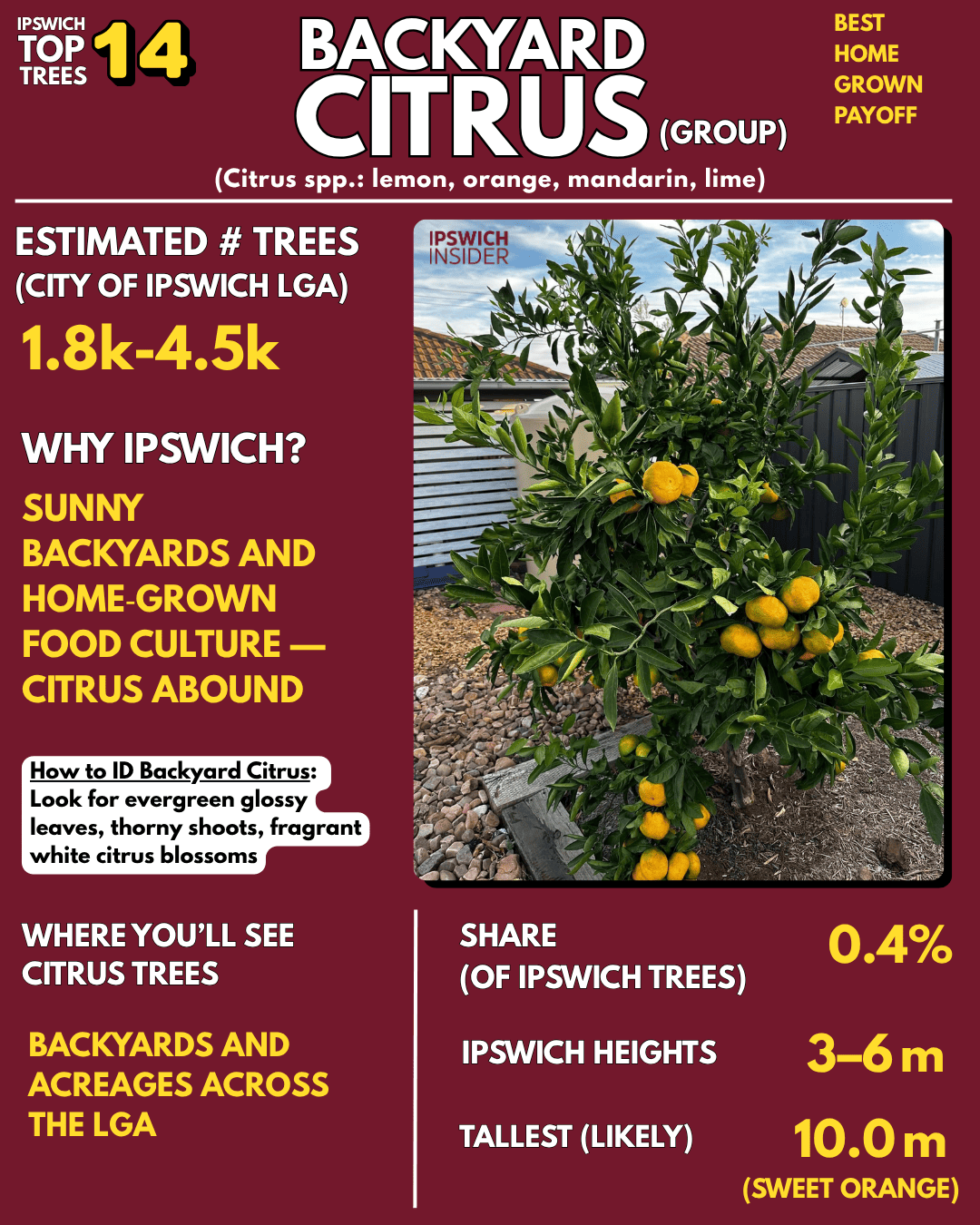
Backyard citrus: By the numbers
- Estimated trees (mid; low–high): 3,000 (1.8k–4.5k)
- Share (approx): ~0.44%
- Confidence: Low
- Ipswich height range: 3–6 m (older trees to ~8 m)
- Tallest recorded (where): No champion register; horticultural maxima ~6–10 m (species/rootstock)
Backyard citrus in Ipswich
- Scientific name(s): Citrus spp. (lemon, orange, mandarin, lime)
- Where you’ll see it: Backyards and acreages across the LGA
- Why Ipswich? Sunny backyards and home-grown food culture — citrus abound.
- Best: Home-grown payoff — kilos of fruit from a modest space
- ID note: Evergreen glossy leaves; thorny shoots; fragrant white blossoms
15) Poinciana
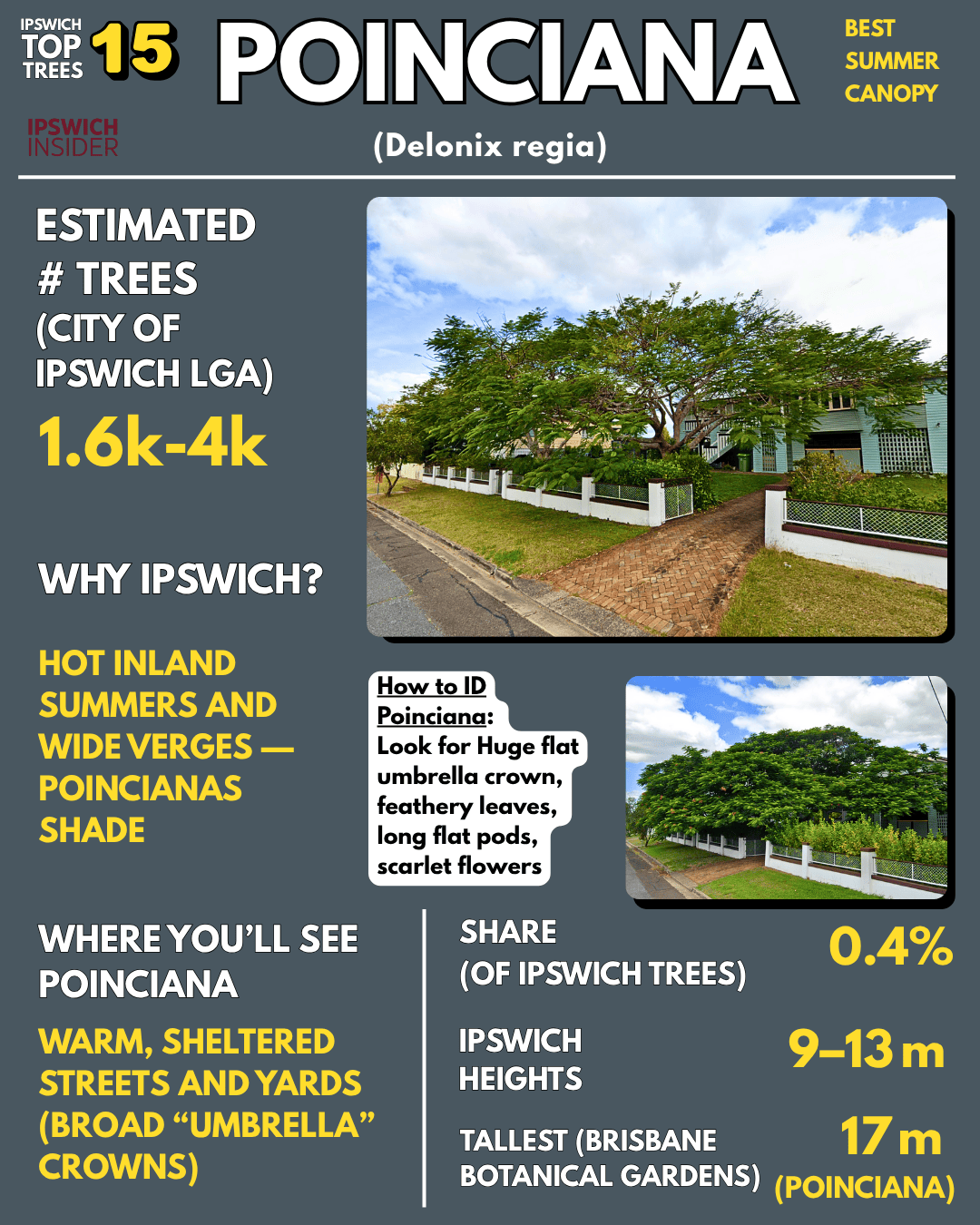
Poinciana: By the numbers
- Estimated trees (mid; low–high): 2,800 (1.6k–4.0k)
- Share (approx): ~0.41%
- Confidence: Low
- Ipswich height range: 9–13 m
- Tallest recorded (where): 17 m, Brisbane Botanic Gardens (Mt Coot-tha), audited urban record
Poinciana in Ipswich
- Scientific name(s): Delonix regia
- Where you’ll see it: Warm, sheltered streets and yards (broad “umbrella” crowns)
- Why Ipswich? Hot inland summers and wide verges — poincianas shade.
- Best: Summer canopy — widest, coolest lawn umbrella
- ID note: Huge flat umbrella crown; feathery leaves; long flat pods; scarlet flowers
16) Golden penda
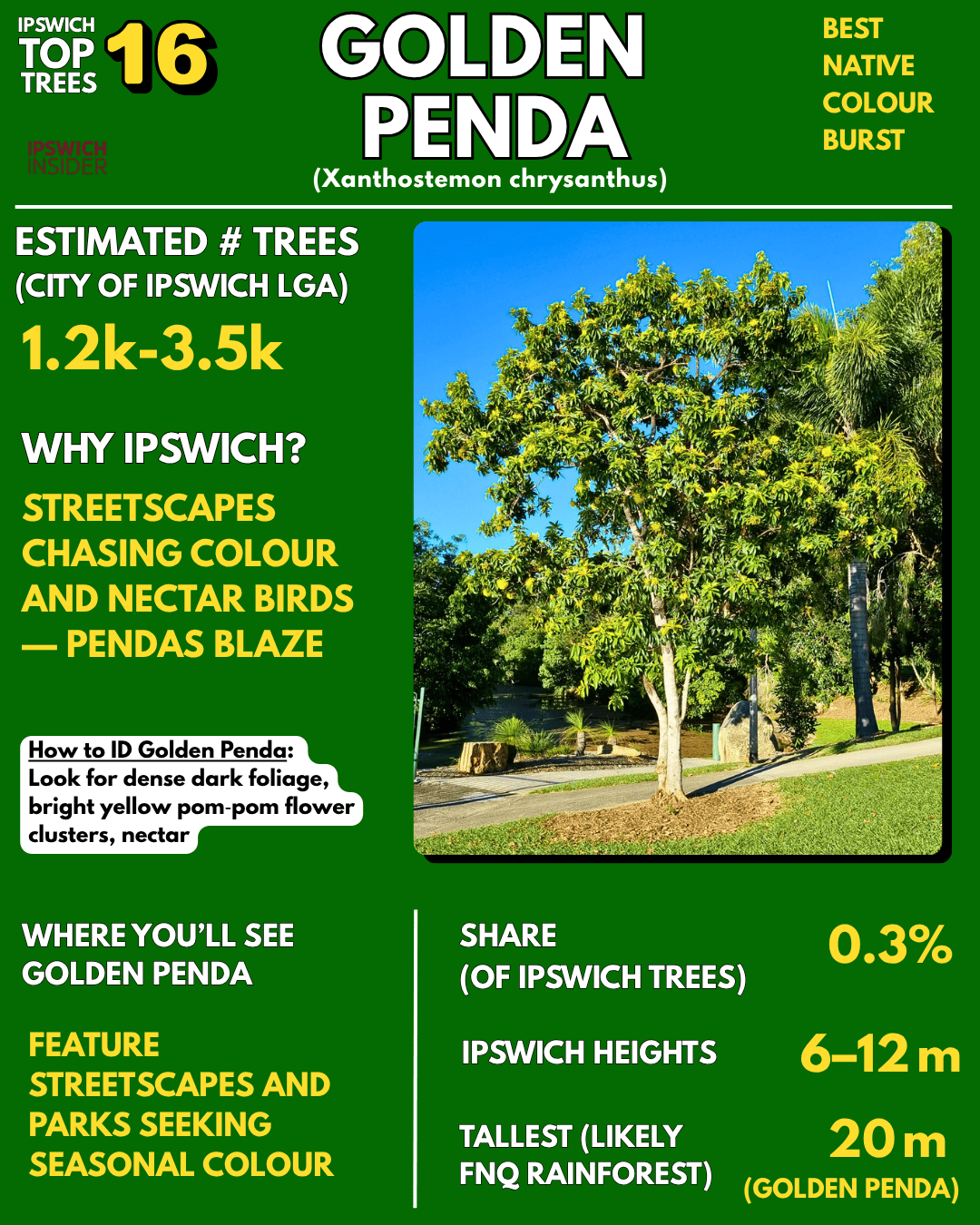
Golden penda: By the numbers
- Estimated trees (mid; low–high): 2,300 (1.2k–3.5k)
- Share (approx): ~0.33%
- Confidence: Low
- Ipswich height range: 6–12 m
- Tallest recorded (where): Best-documented max ~20 m (FNQ rainforests)
Golden penda in Ipswich
- Scientific name(s): Xanthostemon chrysanthus
- Where you’ll see it: Feature streetscapes and parks seeking seasonal colour
- Why Ipswich? Streetscapes chasing colour and nectar birds — pendas blaze.
- Best: Native colour burst — giant gold blooms; bird-and-bee frenzy
- ID note: Dense dark foliage; bright yellow pom-pom clusters; nectar rich
17) Urban figs (group)

Urban figs: By the numbers
- Estimated trees (mid; low–high): 1,400 (700–1,900)
- Share (approx): ~0.20%
- Confidence: Low
- Ipswich height range: 10–20 m (park specimens larger)
- Tallest recorded (where): Many species routinely >30 m (urban/rainforest); no single audited Australian “tallest”
Urban figs in Ipswich
- Scientific name(s): Ficus microcarpa var. hillii; F. rubiginosa; F. obliqua; F. macrophylla; F. benjamina; F. virens
- Where you’ll see it: Civic corridors and large parks; occasional heritage yard specimens
- Why Ipswich? Deep soils and civic corridors with space — figs shade.
- Best: Urban heat shield — densest, all-day, deep-cooling shade
- ID note: Dense dome canopy; glossy leaves; figs on branches; occasional aerial roots
18) Urban pines (group)
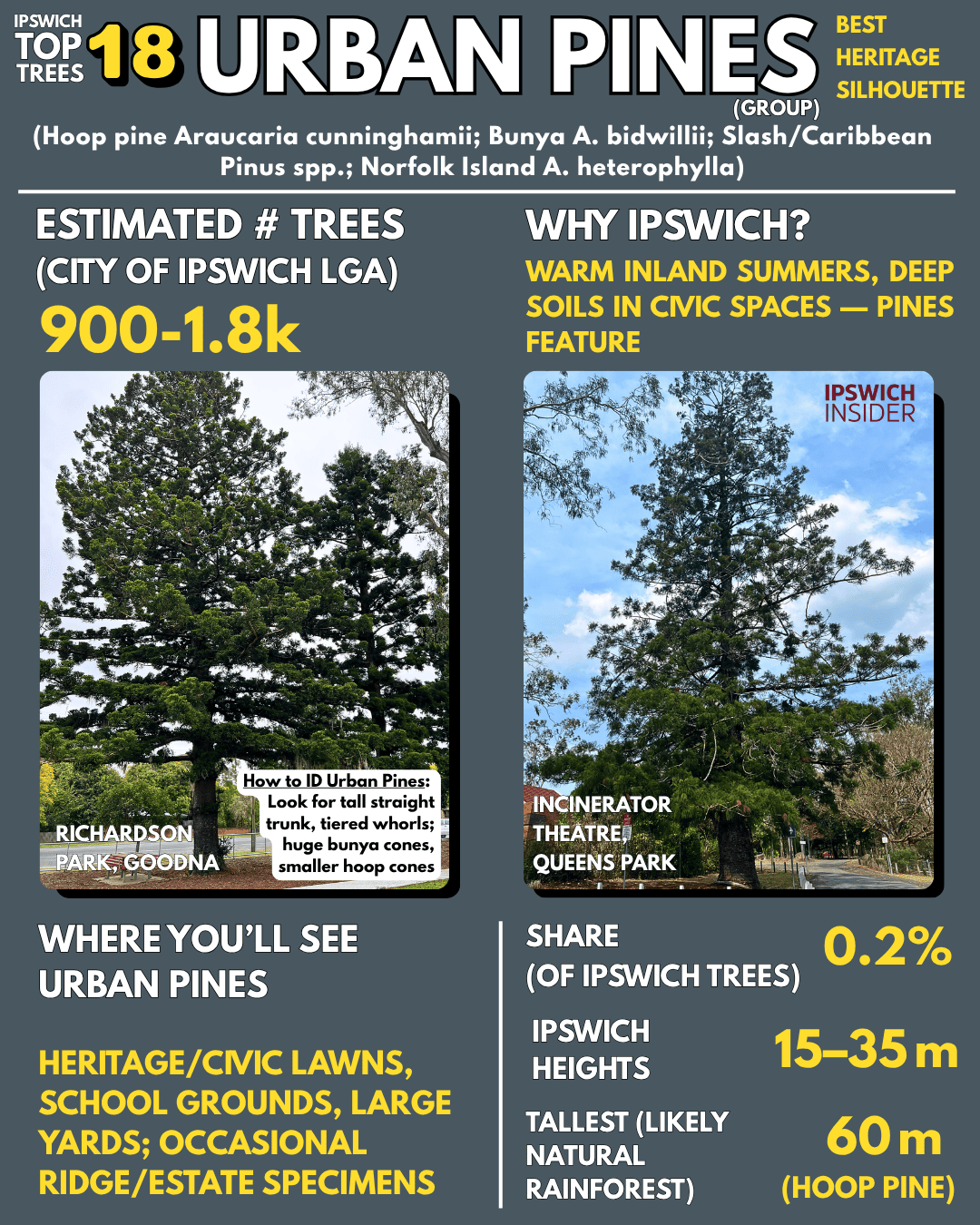
Urban pines: By the numbers
- Estimated trees (mid; low–high): 1,300 (0.9k–1.8k)
- Share (approx): ~0.19%
- Confidence: Low
- Ipswich height range: 15–35 m (Hoop/Bunya the tall locals)
- Tallest recorded (where): Hoop pine can reach ~60 m in natural rainforest (not typical in parks here)
Urban pines in Ipswich
- Scientific name(s): Araucaria cunninghamii (Hoop); A. bidwillii (Bunya); Pinus spp.; A. heterophylla (Norfolk Island)
- Where you’ll see it: Heritage/civic lawns, school grounds, large yards; occasional ridge/estate specimens
- Why Ipswich? Warm inland summers, deep soils in civic spaces — pines feature.
- Best: Landmark silhouette — tiered whorls; instant heritage presence
- ID note: Tall straight trunk, tiered whorls; huge bunya cones, smaller hoop cones
Methodology (what we actually did)
Step 1 — Lock the boundary & time
We used the ABS ASGS 2021 boundary for the City of Ipswich (LGA33960). “Now” = 2025. Fixing the boundary and date avoids suburb creep and version mismatch.
- Helpful links: ASGS Edition 3 overview · ASGS (2021) boundaries dataset
Step 2 — Map the bush the way scientists do
Queensland’s Regional Ecosystem (RE) maps show which native (tree/vegetation) communities sit where. We clipped REDD v13.1 / Remnant Vegetation 2021 to the LGA, then focused on Ipswich’s big players: ironbark–spotted-gum hills (12.9–10.2; 12.9–10.7), blue-gum floodplains (12.3.3), paperbark swamps (12.3.6) and river-fringing forests (12.3.7). Each RE spells out its dominant canopy species.
- Helpful links: Search regional ecosystem descriptions (RE Explorer) · Remnant vegetation cover 2021 (v13.1) dataset
Step 3 — Turn hectares into tree counts
For each RE we converted area to trees using structure-based densities (e.g., woodland vs open forest), then apportioned stems to the species the RE describes as dominant. Sensitivity tests covered density and mix.
- Helpful links: BioCondition benchmarks (Queensland Herbarium) · RE survey & mapping methodology (v7.0, PDF)
Step 4 — Add the urban layer you actually walk under
Street trees came from total road kilometres × a realistic “trees per planted kilometre”. Parks used scattered-tree densities by park type. Yard-heavy species (jacaranda, poinciana, lilly pillies, palms, citrus) used local occurrence signals to ground estimates.
- Helpful links: Ipswich Urban Greening Plan · Brisbane trees (street tree guidance) · Native plants of Ipswich LGA (WetlandInfo) · Gold Coast Urban Forest dataset (comparator)
Step 5 — Merge, rank, sanity-check
We summed the natural + street + park + yard trees for each species/group, then stress-tested assumptions: ±25% on density, ±10% on species mix, ±30% on yard factors. The headline didn’t budge — ironbarks + spotted gum + blue gum rule by area; urban favourites are visible but small in the LGA-wide totals.
What to keep in mind
- These are ranges, not magic exact counts.
- Urban favourites feel common because we live near them, but the LGA’s native hill and floodplain forests are vast — that’s where the numbers are.
- At the margins (#9–#18), a place or two can swap without changing the story.
Sources
- Search regional ecosystem descriptions. des.qld.gov.au.
- Remnant regional ecosystem vegetation in Queensland. qld.gov.au.
- Native plants of Ipswich local government area. wetlandinfo.des.qld.gov.au.
- Urban Greening – Ipswich City Council. ipswich.qld.gov.au.
- Brisbane trees (street tree species). brisbane.qld.gov.au.