

SEQ’s Biggest Reservoirs at a Glance
- Uses: Drinking water, irrigation, flood mitigation and water security backup.
- Strategic Locations: Somerset sits on the Stanley River with Wivenhoe downstream on the Brisbane River. Together they support downstream flood mitigation and raw water supply to Mt Crosby for Brisbane, Ipswich and Logan. Others like Moogerah support irrigation districts such as the Warrill Valley.
- Seqwater: Seqwater manages 26 dams, 47 weirs and 57 recreation areas across SEQ. In 2024-25 it supplied 326,060 ML of drinking water to more than 3.7 million people, recorded $1.188 billion in revenue and spent $389.3 million on capital works.

SEQ’s 17 biggest water reservoirs ranked by capacity
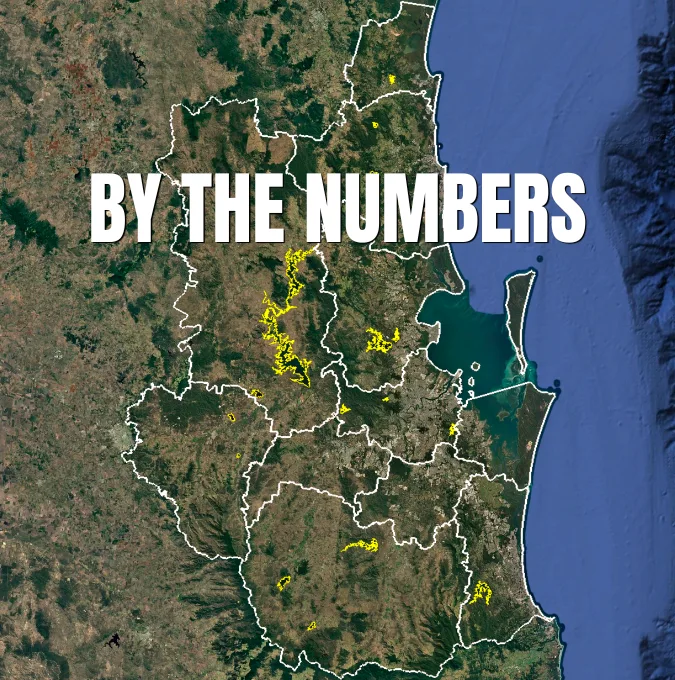
🔢 By The Numbers
- ~450–500 staff – Seqwater’s Ipswich HQ (ICON Tower) estimated employee headcount
- 2,497,800 ML – combined full supply volume across the top 17
- 1,165,240 ML – Lake Wivenhoe alone
- 4,260 ML – Enoggera Reservoir, the smallest in the top 17
- 274x – Wivenhoe holds about 274 times more water than Enoggera
- 70% – Wivenhoe and Somerset’s combined share of the region’s water supply
- 4.2 km – Lake Clarendon’s dam wall, the longest in SEQ
- 188 m – Lake Manchester’s dam wall, the shortest in this report
- 48 m – Wyaralong’s maximum dam wall height
- 1866 – Queensland’s first major dam completed, Enoggera Reservoir
- 2011 – Wyaralong completed, the newest dam in SEQ
- 57 – recreation areas managed by Seqwater across SEQ
- 326,060 ML – drinking water supplied by Seqwater in 2024-25
- 3.7 million – SEQ residents supplied by Seqwater in 2024-25
- $389.3 million – Seqwater capital works in 2024-25
- 2.7 million – annual visits to Seqwater lakes and recreation sites
How many SEQ water reservoirs have you been to?
Seqwater, headquartered at ICON Tower in Ipswich, manages 26 dams and welcomes about 2.7 million visits a year across its lakes, parks and recreation areas.
At one end of the timeline is Enoggera Reservoir, built in 1866 as Queensland’s first major dam. At the other is Wyaralong (between Boonah and Beaudesert), completed in 2011 as SEQ’s newest dam.
Some are giant drinking water storages.
Some act as irrigation spigots.
Some help protect Brisbane from flood flows.
We know you love a good list, so here are the 17 biggest reservoirs in SEQ by volume.
Let’s jump in.
More Ipswich Gold
Jump to:
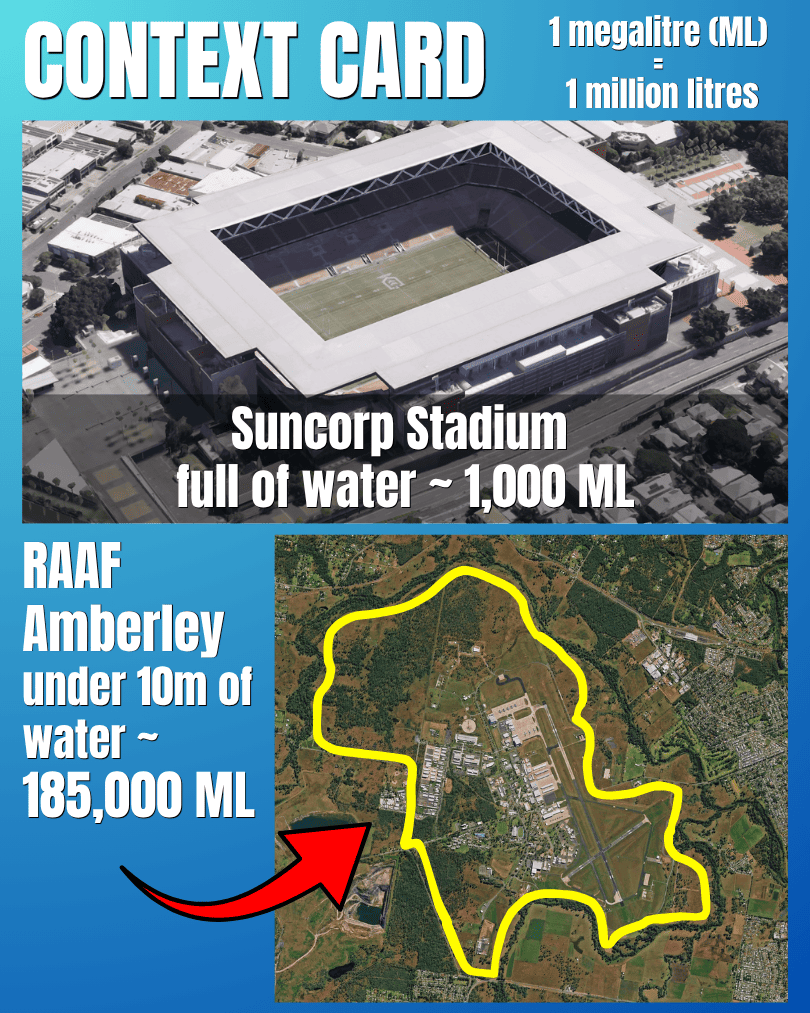
How Big is a Megalitre?
Details
- 1 megalitre (ML): 1 million litres
- 2.5 ML: 1 Olympic-size swimming pool
- 15 ML: roughly 1 Denmark Hill water tank
- 1,000 ML: roughly Suncorp Stadium filled with water
- 185,000 ML: roughly RAAF Amberley under 10m of water
1. Lake Wivenhoe
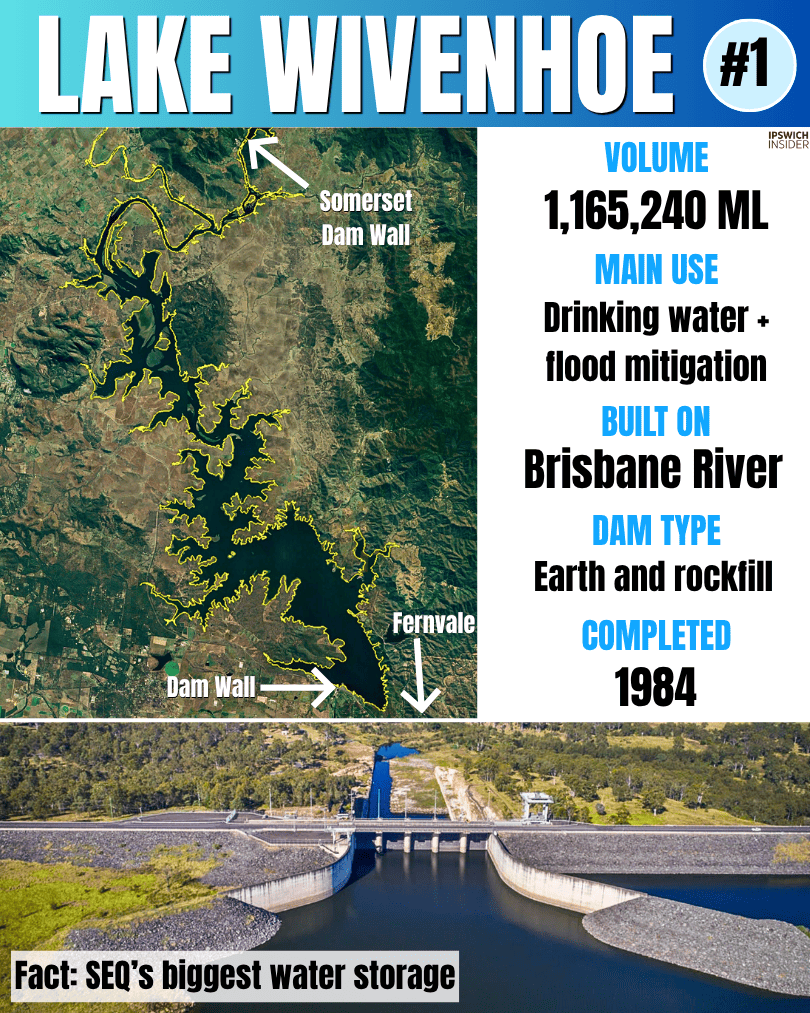
Lake Wivenhoe is the giant of this list. It is easily SEQ’s biggest water storage. It stores drinking water and helps manage major flood flows on the Brisbane River.
Details
- Volume: 1,165,240 ML
- Main use: Drinking water + flood mitigation
- Built on: Brisbane River
- Dam type: Earth and rockfill
- Dam wall length: 2,300 m
- Completed: 1984
2. Lake Somerset
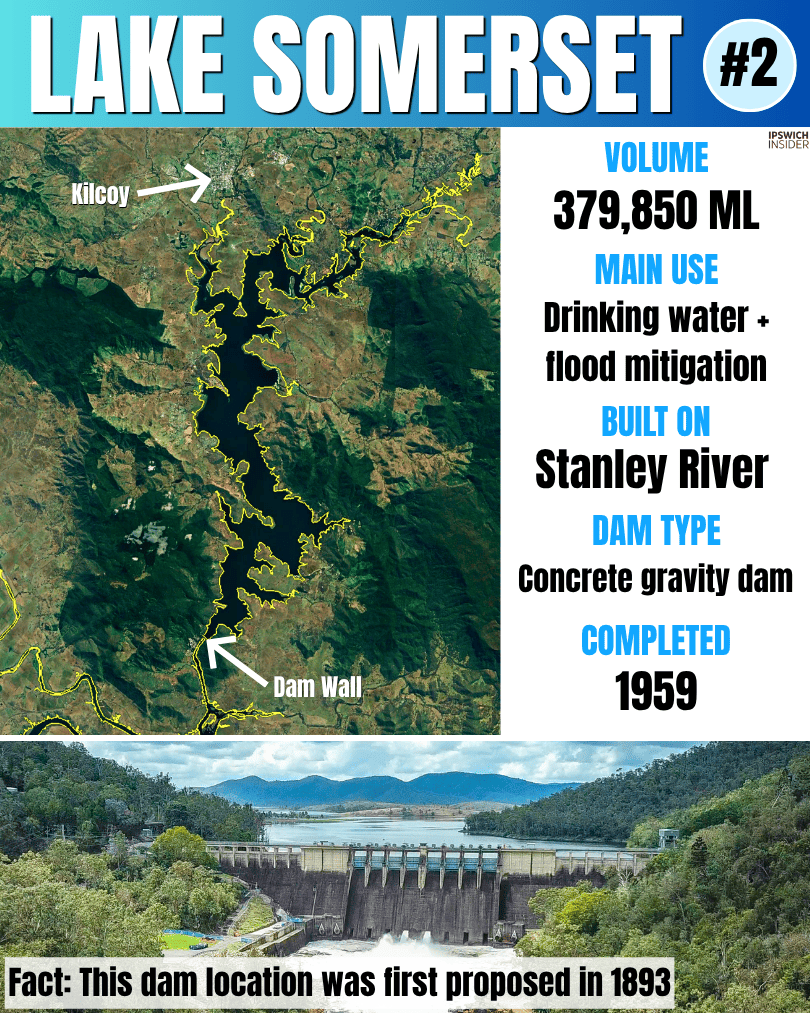
Lake Somerset has been on planners’ minds for a long time. The site was first proposed for a dam in 1893. The storage itself was completed decades later.
Details
- Volume: 379,850 ML
- Main use: Drinking water + flood mitigation
- Built on: Stanley River
- Dam type: Concrete gravity dam
- Dam wall length: 305 m
- Completed: 1959
3. Advancetown Lake
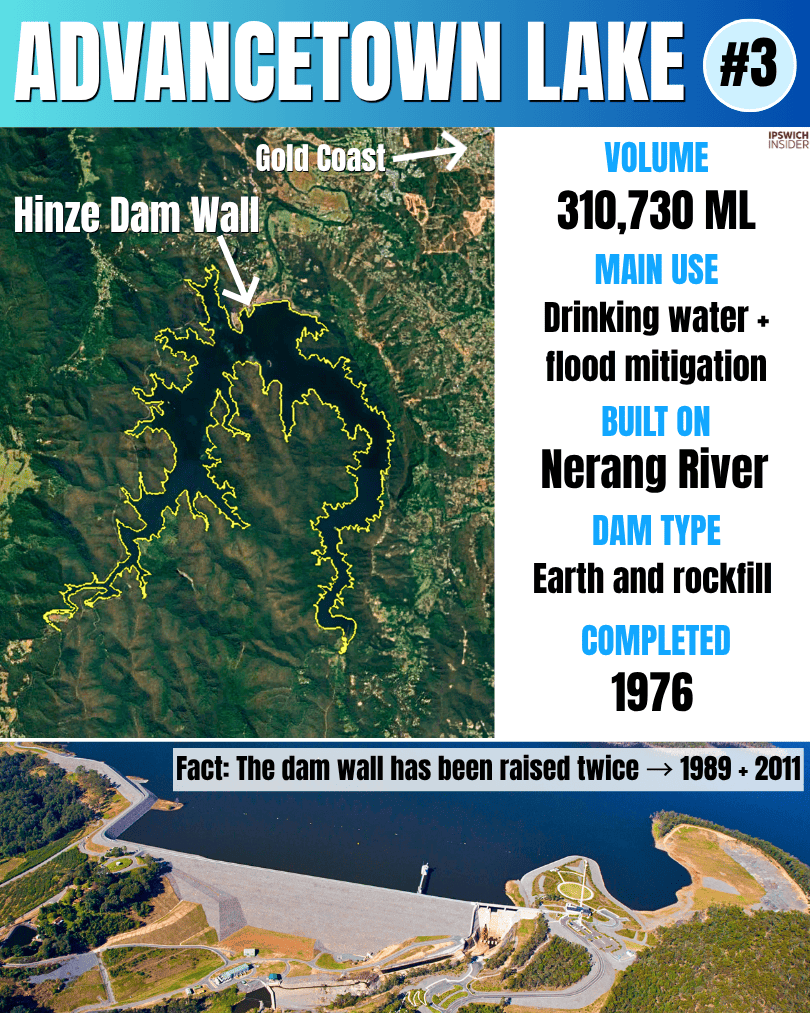
Advancetown did not stay in its original form. The dam wall has been raised twice. That happened in 1989 and again in 2011.
Details
- Volume: 310,730 ML
- Main use: Drinking water + flood mitigation
- Built on: Nerang River
- Dam type: Earth and rockfill
- Dam wall length: 1,850 m
- Completed: 1976
4. Lake Samsonvale

Lake Samsonvale came with a major local trade-off. About 105 homes were flooded to build it. That is one of the starkest human impacts on this list.
Details
- Volume: 214,300 ML
- Main use: Drinking water
- Built on: North Pine River
- Dam type: Concrete and earthfill
- Dam wall length: 579 m
- Completed: 1976
5. Lake Wyaralong
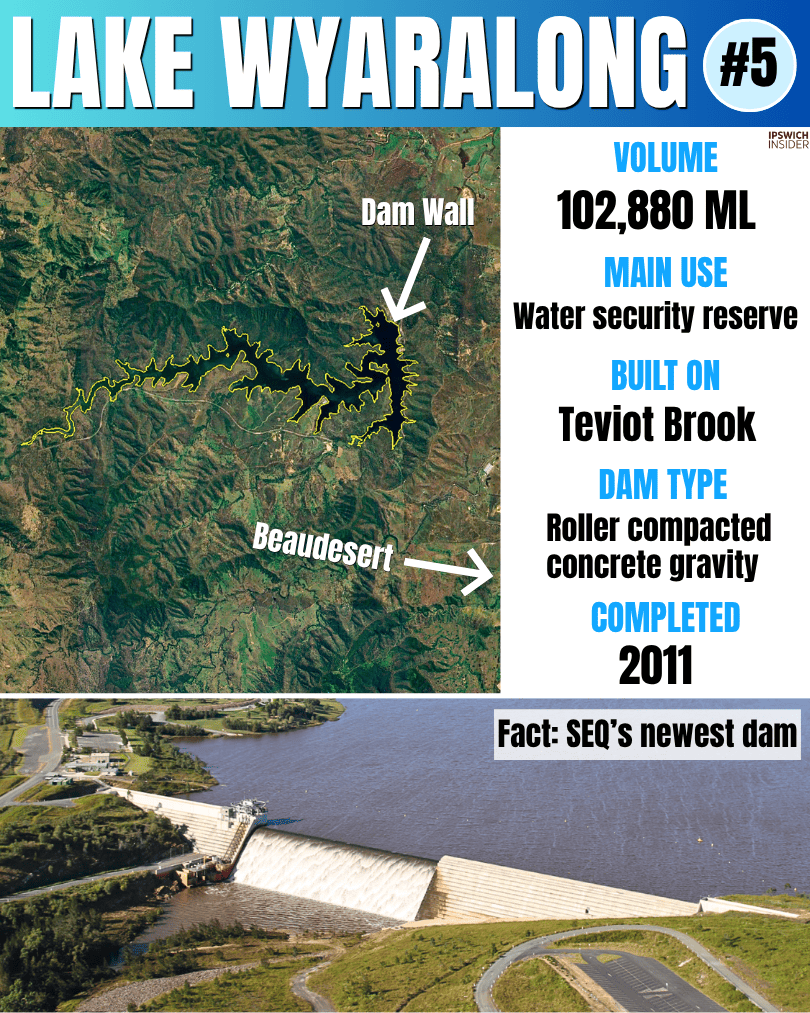
Wyaralong stands out for one simple reason. It is SEQ’s newest dam. It was completed in 2011, much later than most storages in this ranking.
Details
- Volume: 102,880 ML
- Main use: Water security reserve
- Built on: Teviot Brook
- Dam type: Roller compacted concrete gravity dam
- Dam wall length: 463.6 m
- Completed: 2011
6. Lake Moogerah
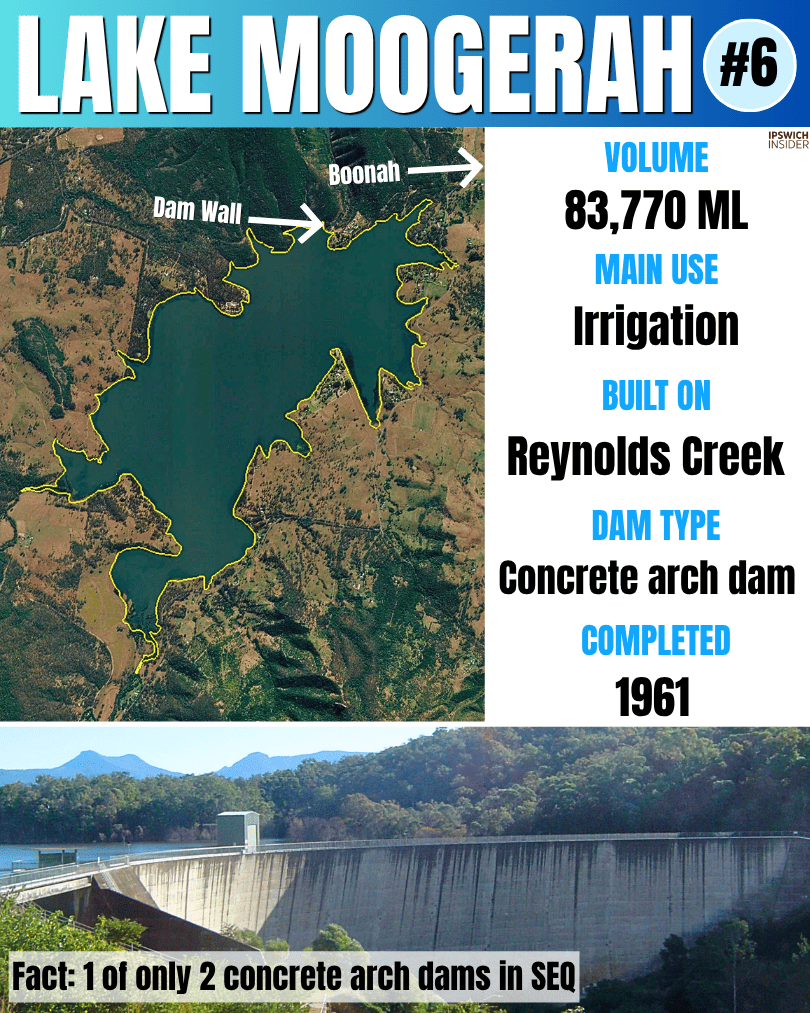
Moogerah is unusual by SEQ standards. It is one of only two concrete arch dams in the region. That makes it stand apart from the many earthfill and gravity dams on this list.
Details
- Volume: 83,770 ML
- Main use: Irrigation
- Built on: Reynolds Creek
- Dam type: Concrete arch dam
- Dam wall length: 219 m
- Completed: 1961
7. Lake Baroon
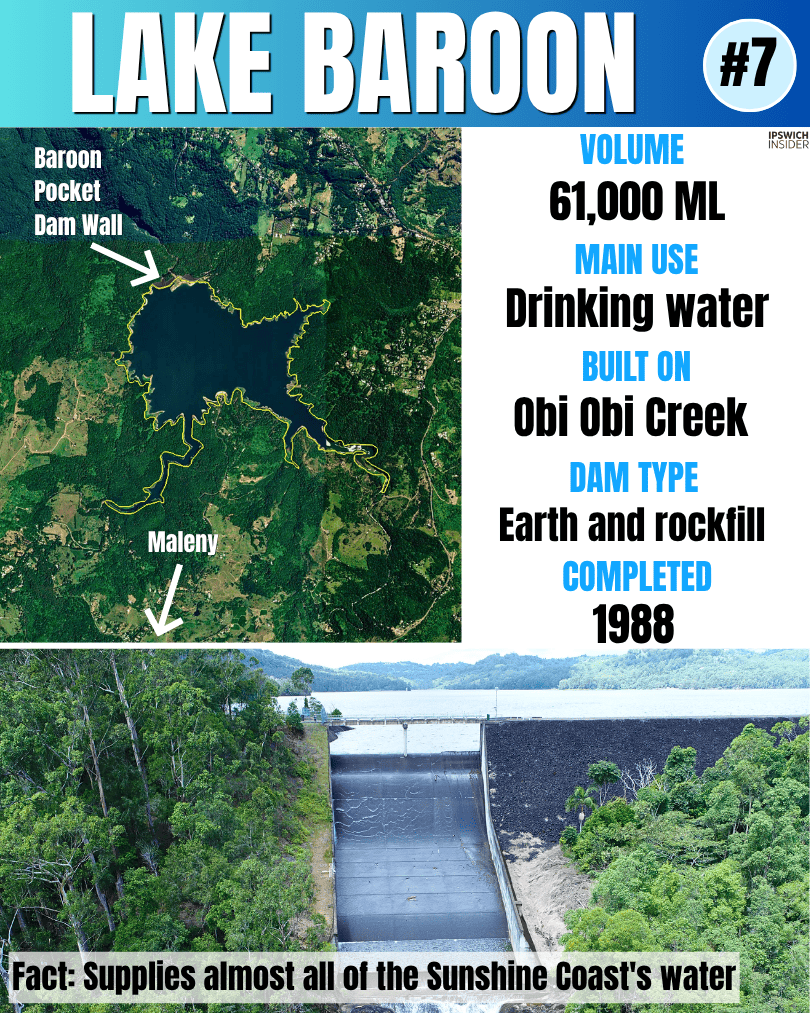
Lake Baroon is not one of the very biggest storages. But it carries a big job. It supplies almost all of the Sunshine Coast’s water.
Details
- Volume: 61,000 ML
- Main use: Drinking water
- Built on: Obi Obi Creek
- Dam type: Earth and rockfill
- Dam wall length: 370 m
- Completed: 1988
8. Lake Maroon
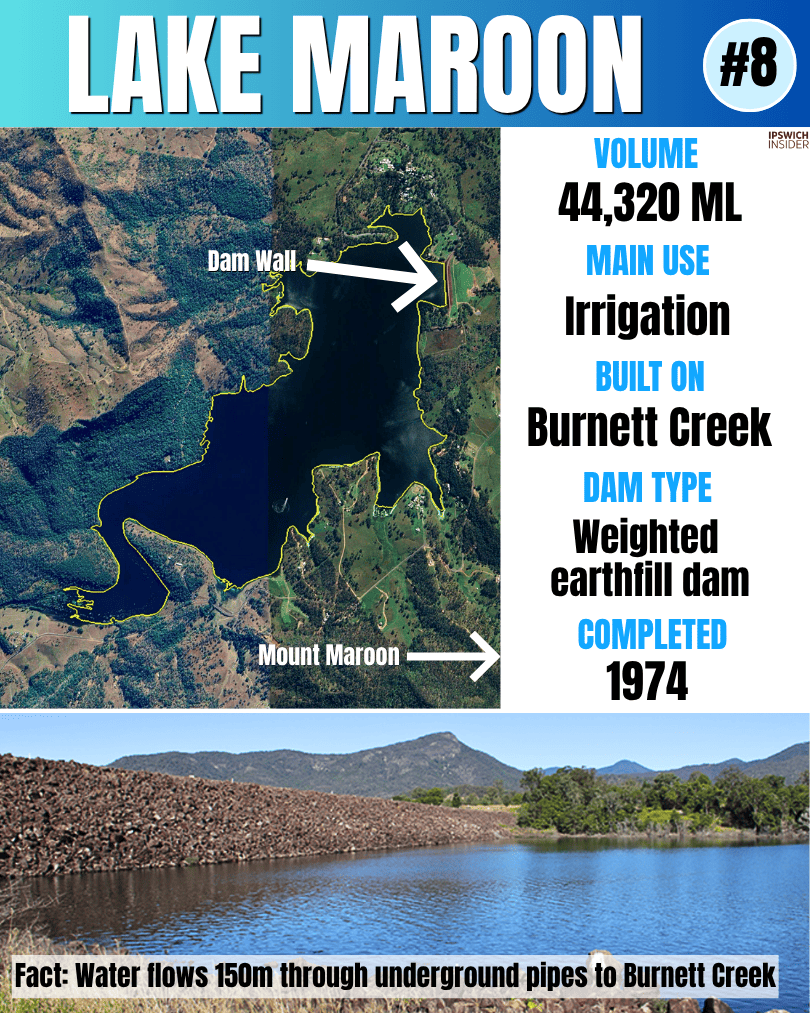
Lake Maroon has one of the more unusual engineering details here. Water flows about 150 metres through underground pipes. It then returns to Burnett Creek.
Details
- Volume: 44,320 ML
- Main use: Irrigation
- Built on: Burnett Creek
- Dam type: Weighted earthfill dam
- Dam wall length: 457 m
- Completed: 1974
9. Lake Atkinson
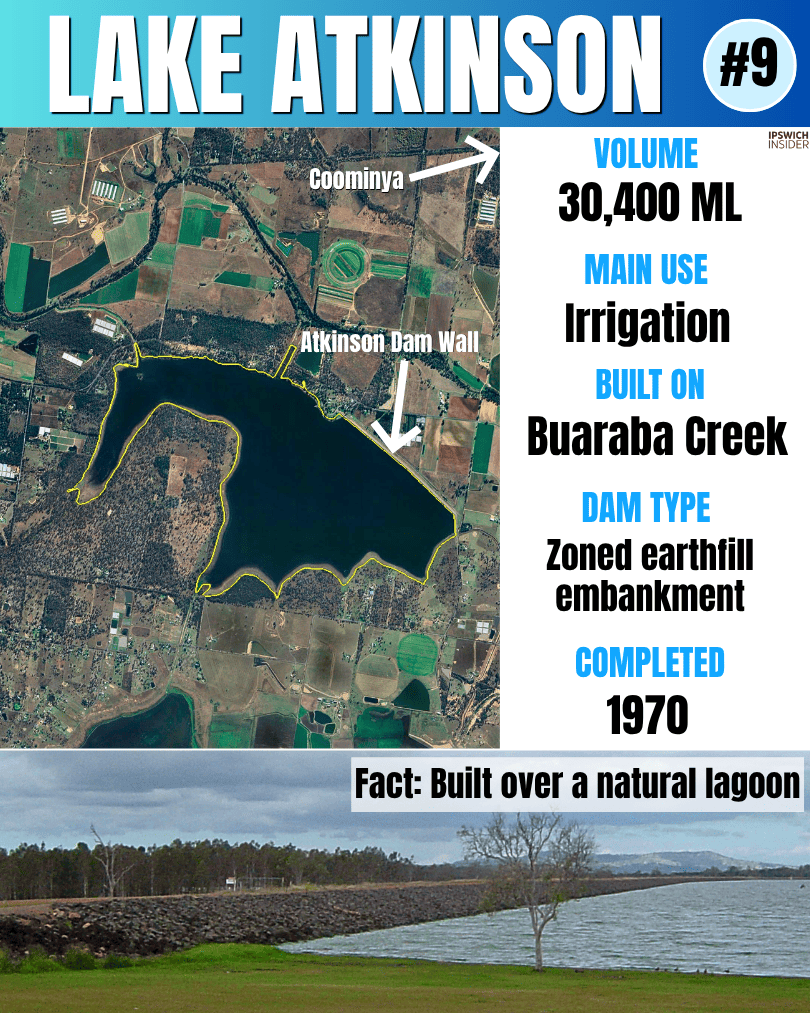
Lake Atkinson was not created in the usual way. It was built over a natural lagoon. That gives it a different origin story to most reservoirs in SEQ.
Details
- Volume: 30,400 ML
- Main use: Irrigation
- Built on: Buaraba Creek
- Dam type: Zoned earthfill embankment
- Dam wall length: 2,082 m
- Completed: 1970
10. Lake Manchester
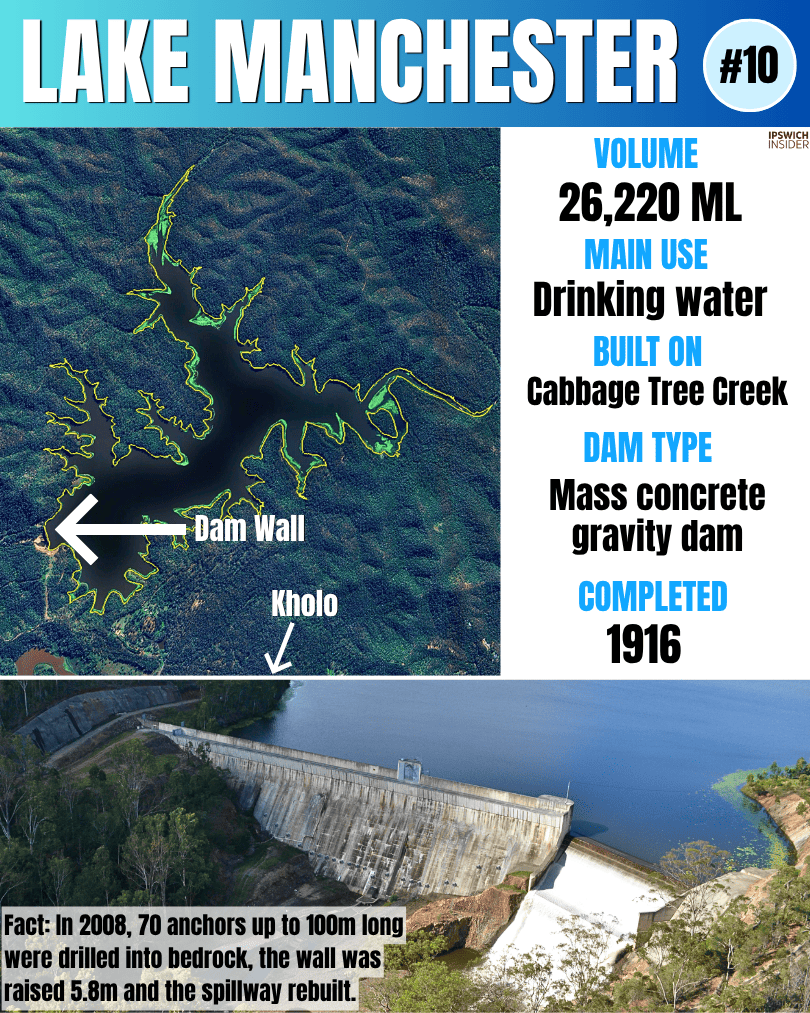
Lake Manchester’s big modern story is its 2008 upgrade. Anchors up to 100 metres long were drilled into bedrock. The wall was raised 5.8 metres and the spillway was rebuilt.
Details
- Volume: 26,220 ML
- Main use: Drinking water
- Built on: Cabbage Tree Creek
- Dam type: Mass concrete gravity dam
- Dam wall length: 188 m
- Completed: 1916
11. Lake Clarendon

Lake Clarendon’s standout stat is not just its volume. Its dam wall stretches 4.2 kilometres. That makes it one of the more unusual structures in the group.
Details
- Volume: 24,280 ML
- Main use: Irrigation
- Built on: Lockyer Creek
- Dam type: Clay core earthfill
- Dam wall length: 4,200 m
- Completed: 1992
12. Lake Kurwongbah
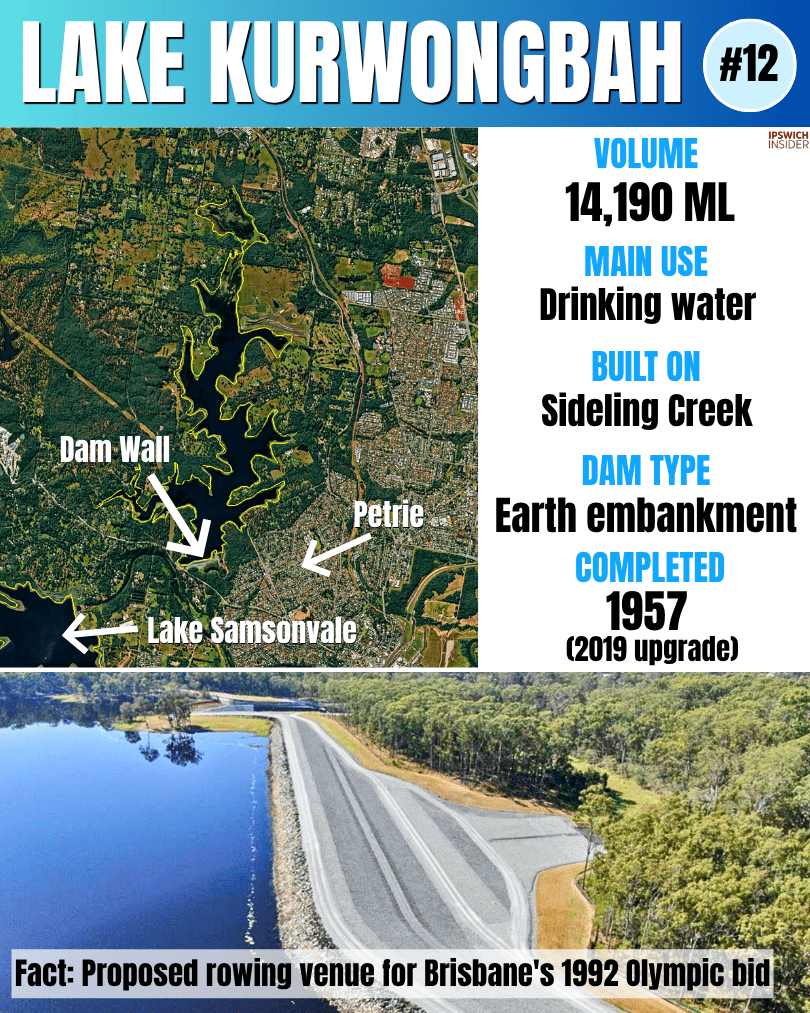
Lake Kurwongbah has an unexpected Olympic link. It was proposed as the rowing venue for Brisbane’s 1992 Olympic bid. Not many reservoirs can say that.
Details
- Volume: 14,190 ML
- Main use: Drinking water
- Built on: Sideling Creek
- Dam type: Earth embankment
- Dam wall length: 500 m
- Completed: 1957 (2019 upgrade)
13. Tingalpa Reservoir

Tingalpa Reservoir has already been reworked over time. Spillway gates were added in 1984. They were removed in 2014 to reduce flood risk downstream.
Details
- Volume: 13,210 ML
- Main use: Drinking water
- Built on: Tingalpa Creek
- Dam type: Earth embankment
- Dam wall length: 535 m
- Completed: 1967
14. Lake Cooloolabin
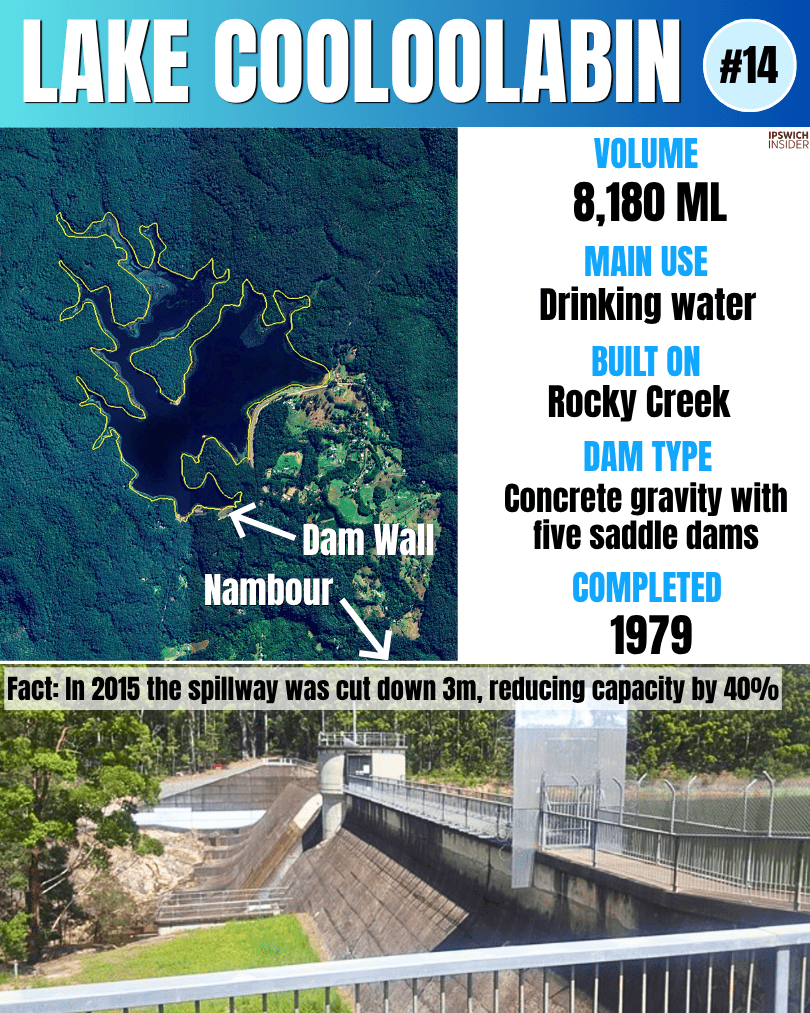
Lake Cooloolabin used to be much bigger. In 2015 the spillway was cut down by 3 metres. That reduced the reservoir’s capacity by about 40%.
Details
- Volume: 8,180 ML
- Main use: Drinking water
- Built on: Rocky Creek
- Dam type: Concrete gravity with five saddle dams
- Dam wall length: 243 m
- Completed: 1979
15. Lake Macdonald
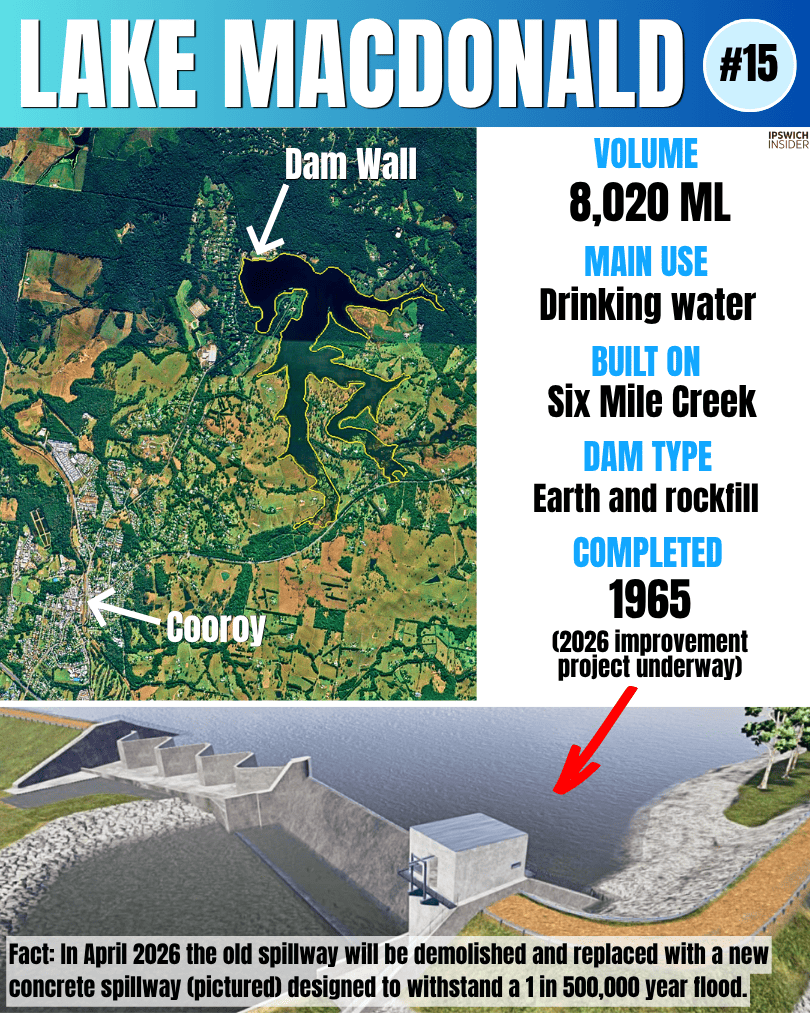
Lake Macdonald is in the middle of a major update. The old spillway is being replaced. The new concrete spillway is designed to handle an extreme flood event.
Details
- Volume: 8,020 ML
- Main use: Drinking water
- Built on: Six Mile Creek
- Dam type: Earth and rockfill
- Dam wall length: 501 m
- Completed: 1965
16. Lake Dyer
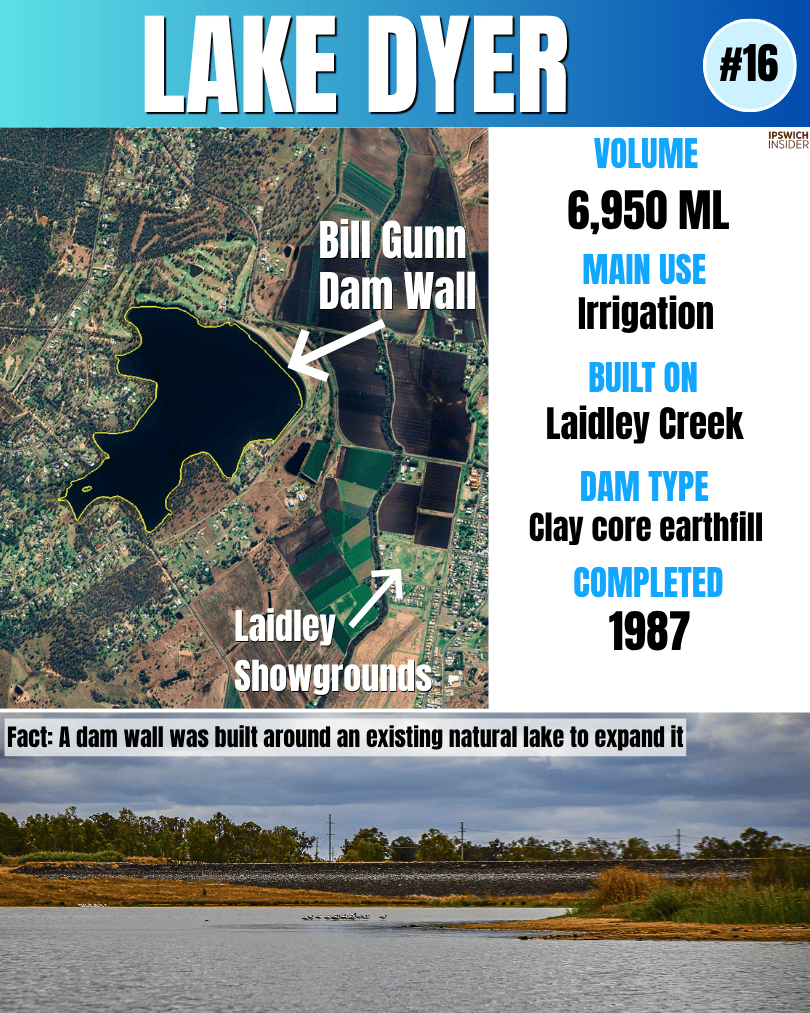
Lake Dyer was expanded in a different way to most reservoirs. A dam wall was built around an existing natural lake. That made the lake larger.
Details
- Volume: 6,950 ML
- Main use: Irrigation
- Built on: Laidley Creek
- Dam type: Clay core earthfill
- Dam wall length: 1,050 m
- Completed: 1987
17. Enoggera Reservoir
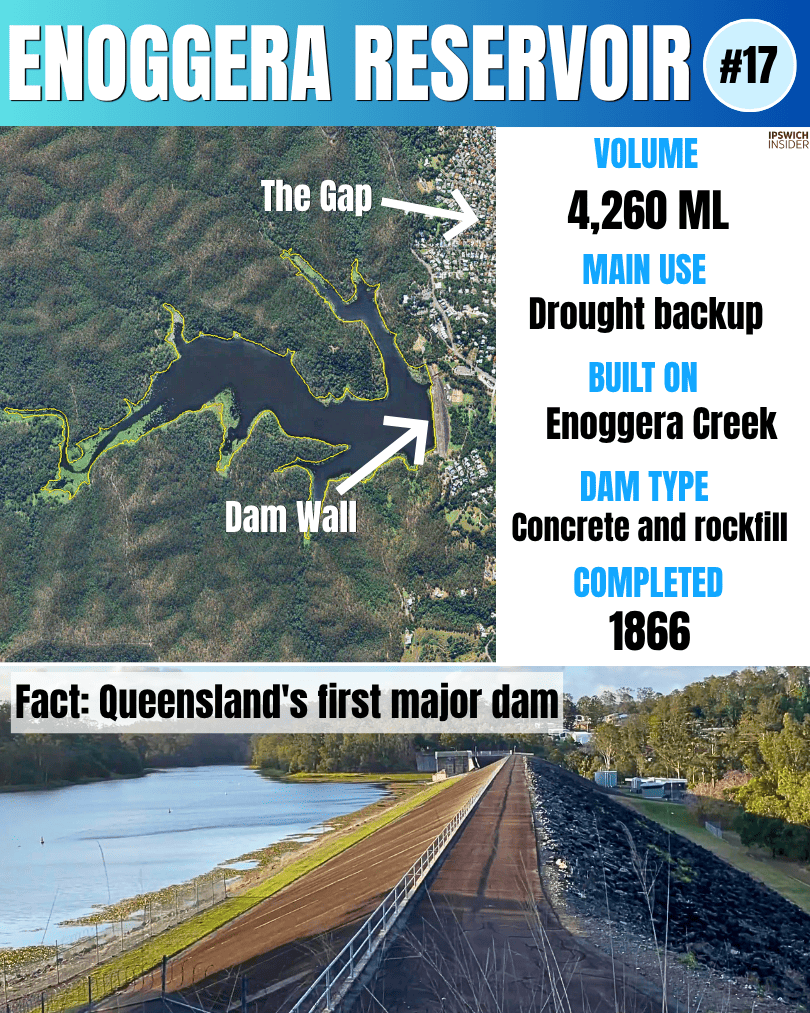
Enoggera Reservoir is the oldest and smallest storage in this top 17. But it matters historically. It was Queensland’s first major dam.
Details
- Volume: 4,260 ML
- Main use: Drought backup
- Built on: Enoggera Creek
- Dam type: Concrete and rockfill
- Dam wall length: 380 m
- Completed: 1866
16 Interesting Facts About Seqwater
Seqwater is the bulk water authority behind much of South East Queensland’s drinking water, flood mitigation, irrigation and dam recreation network.
Here are 16 quick facts worth knowing.
- Ipswich HQ: About 300 staff were based at Seqwater’s Ipswich HQ (ICON Tower) in 2014. Based on workforce growth since then, a rough like-for-like estimate puts the office at about 450–500 staff today, though Seqwater does not publish a current office-specific headcount.
- Government authority: Seqwater is the Queensland Bulk Water Supply Authority, a Queensland Government statutory authority created under the South East Queensland Water (Restructuring) Act 2007.
- Not a GOC: Seqwater is not a Queensland Government Owned Corporation, even though it has been directed to act commercially.
- Big asset base: Seqwater manages more than $11 billion of water supply assets across the region.
- Core network: It manages 26 dams, 47 weirs and 57 recreation areas across SEQ.
- Five retailers: Seqwater sells bulk drinking water to Urban Utilities, Unitywater and the water businesses of Logan, Redland and the Gold Coast.
- Annual supply: In 2024-25 it supplied about 326,060 ML of drinking water to more than 3.7 million residents.
- Irrigation customers: It also supplies water to about 1,200 rural customers across seven irrigation water supply schemes.
- Other customers: In 2024-25 Seqwater delivered around 3,190 ML to commercial customers and around 19,760 ML to raw water customers.
- SEQ Water Grid: Its bulk water supply pipeline network stretches more than 600 kilometres and can move water around the region when needed.
- Grid assets: The grid includes 12 dams, 31 conventional water treatment plants, 3 advanced water treatment plants, 1 desalination plant, 33 bulk water reservoirs and 22 pump stations.
- Off-grid towns: Seqwater also supplies drinking water to about 75,800 people living in 16 off-grid communities.
- Huge green space: Seqwater says its recreation facilities provide more than 50% of the green space in SEQ outside national parks.
- Popular outdoors: Its lakes and recreation sites attract more than 2.7 million visits a year for things like fishing, boating, camping and bushwalking.
- Ipswich HQ: Seqwater’s corporate headquarters is in Ipswich, in what it says is the first 5-Star Green Star rated building in the growing community of Ipswich.
- Future projects: Seqwater’s current Water Security Investment Program includes the Wyaralong Water Treatment Plant, Northern Pipeline Interconnector Stage 3, Mount Crosby East Bank Flood Resilience Program, Toowoomba to Warwick Pipeline and a proposed Gold Coast Desalination Plant expansion.
Sources
- Seqwater.com.au
- Google Earth. earth.google.com
- Icon Ipswich almost a full house as SEQ Water finalise move. CourierMail.com.au