
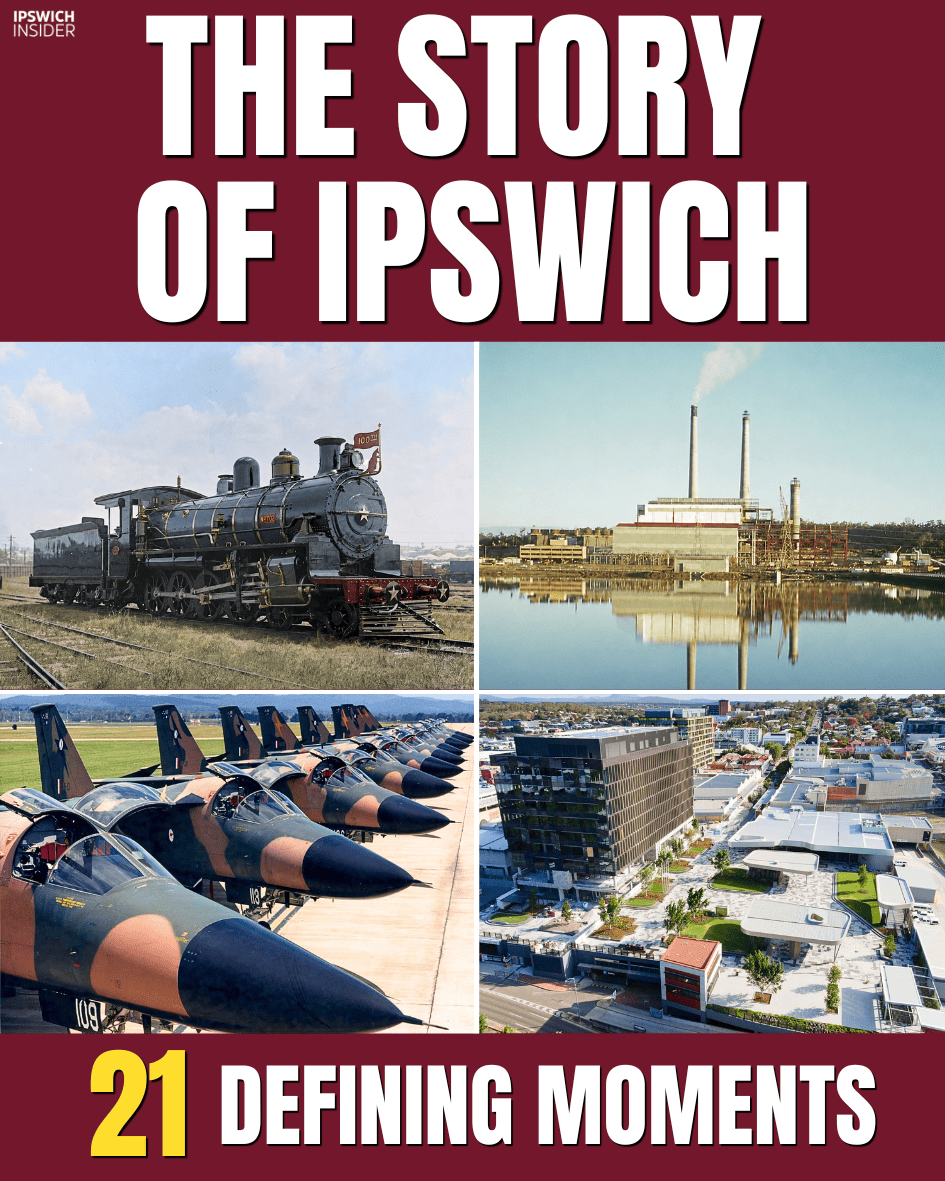
Defining Ipswich Moments at a Glance
- 197 years: The timeline begins with one supervisor and five convicts sent to quarry limestone in 1827. It ends with HOYTS, General Public and Hotel Commonwealth opening at Nicholas Street in 2024.
- Three firsts: Queensland’s first recorded coal mine opened at Redbank in 1843, Ipswich Grammar became Queensland’s first secondary school in 1863 and Queensland’s first railway left Ipswich in 1865.
- Queensland growth hot spot: Greater Springfield’s 2,860-hectare plan was approved in 1997. Ripley Valley was declared a separate 4,680-hectare growth area in 2010, with Ripley alone planned for 48,750 homes and 131,000 people.
🔢 By The Numbers
- 18 lives – Final death toll from the Box Flat mine disaster
- 80% – Queensland coal produced by the Ipswich and Rosewood fields
- £1,000 – Raised locally to help build Ipswich Grammar
- 500 passengers – Rode Queensland’s first official railway journey
- 24.5 metres – Ipswich’s highest recorded Bremer River flood
- 3,000+ workers – Peak North Ipswich Railway Workshops workforce
- 876MW – Combined generating capacity of Swanbank A and B
- 7,221 buildings – Affected when a quarter of Ipswich went under
- 131,000 people – Ripley Valley’s planned future population
- $311 million – Reported cost of the Nicholas Street Precinct redevelopment
Ipswich has heaps of cool history but it’s always presented so boringly.
Let’s change that.
Here are 21 defining Ipswich moments retold as newspaper front pages.
That’s today’s INSIDER GUIDE.
Let me know what you think
Cheers!
Jump to:
- 1827 – Limestone convict camp
- 1843 – Redbank coal mine
- 1863 – Ipswich Grammar opens
- 1865 – First railway journey
- 1893 – Record Bremer flood
- 1904 – Ipswich becomes city
- 1923 – Hundredth locomotive completed
- 1940 – RAAF Amberley opens
- 1966 – Swanbank starts generating
- 1972 – Box Flat disaster
- 1973 – F-111s reach Amberley
- 1974 – Devastating Bremer flood
- 1985 – Reid’s store destroyed
- 1997 – Greater Springfield approved
- 1997 – One Nation launches
- 2010 – Ripley Valley declared
- 2011 – Ipswich floods again
- 2015 – Jets win double
- 2018 – Entire council dismissed
- 2020 – QT printing ends
- 2024 – Anchor venues open
1827 – Convicts Are Sent to Limestone

Limestone Hill in Queen’s Park in 1899. Image: Picture Ipswich. Colourised and enhanced by Ipswich Insider.
Ipswich’s first colonial work camp was tiny: one supervisor and five convicts.
- First job: They burned limestone into lime used to make mortar for buildings in Brisbane.
- Weekly load: Between 300 and 400 baskets of lime were sent down the Bremer and Brisbane rivers every week.
- New name: Limestone became Ipswich in 1843, many believe it was named after Ipswich in England .
1843 – Queensland’s First Recorded Coal Mine Opens at Redbank
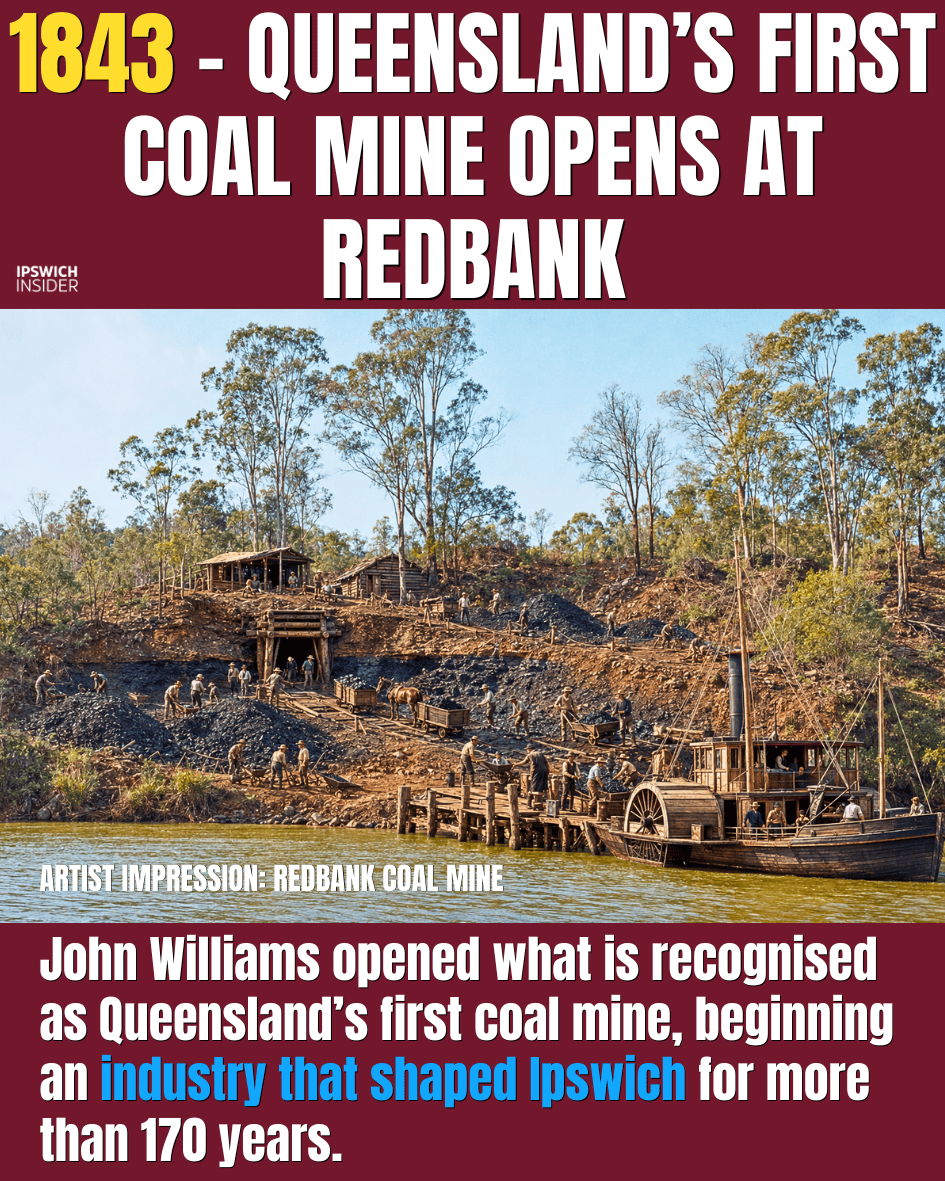
An artist’s impression of Queensland’s first recorded coal mine at Redbank.
John Williams opened the Pioneer Mine beside the Brisbane River at Redbank to fuel the paddle steamers calling at Brisbane.
- Exact spot: The mine was on the riverbank near what is now the Coles Redbank Automated Distribution Centre. Close to where Six Mile Creek enters the Brisbane River.
- First order: Its coal supplied the Hunter River Steam Navigation Company’s paddle steamer Sovereign.
- Flooded out: Brisbane River water filled the workings about four years later and forced the mine to close.
- Coal capital: By 1904, the Ipswich and Rosewood fields produced 80 per cent of Queensland’s coal.
1863 – Ipswich Grammar Opens as Queensland’s First Secondary School
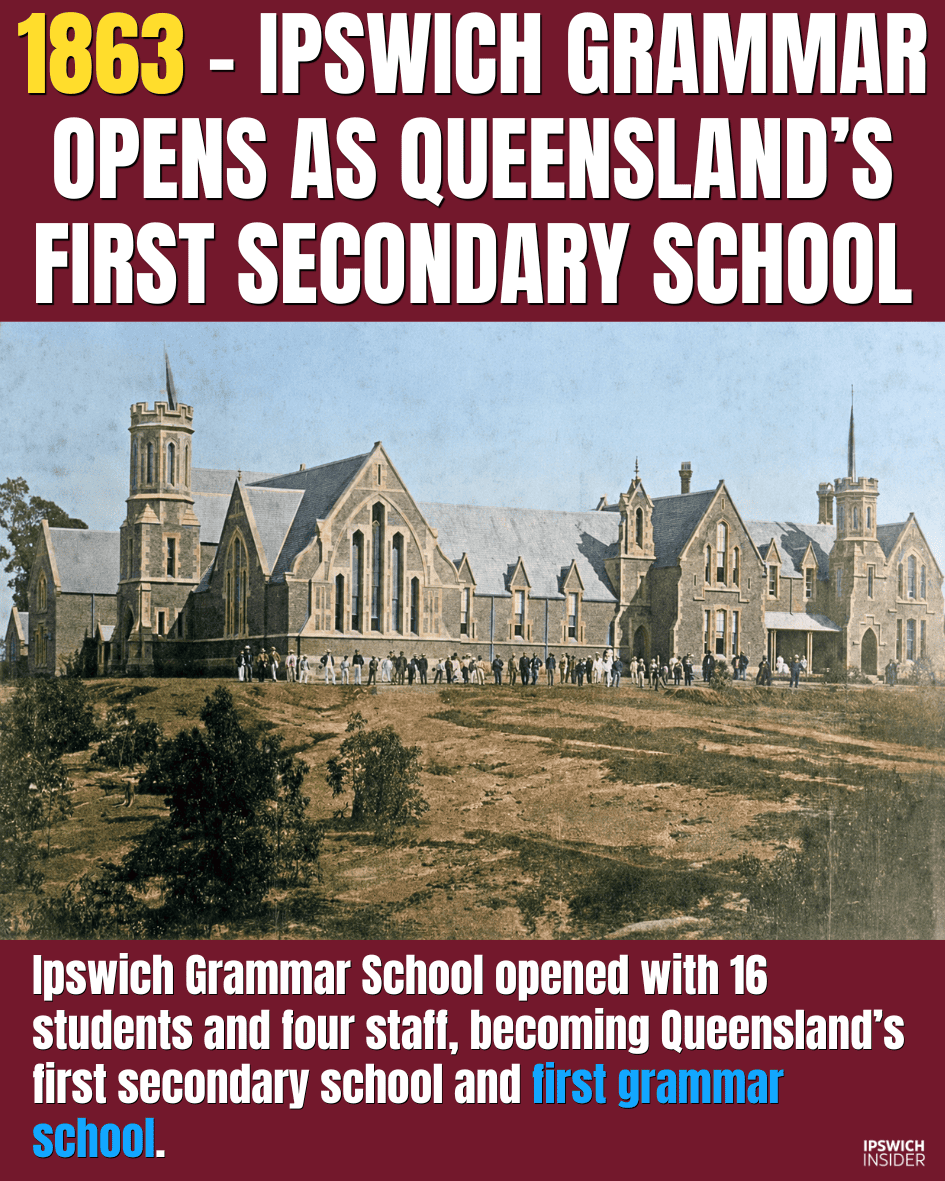
Ipswich Grammar School in 1868, five years after it opened. Image: Picture Ipswich. Colourised and enhanced by Ipswich Insider.
Before 1863, Queensland had never opened a school dedicated to secondary education. Parliament had passed the Grammar Schools Act in 1860, but Ipswich was the first town to turn it into a real school. Ipswich locals had to raise £1,000 — about $160,000 in 2026 money — before it could be built.
- 49-year lead: Ipswich Grammar opened 49 years before Queensland’s first state high schools in 1912. During the 1860s and 1870s, grammar schools provided almost all formal education beyond primary school.
- Nine followed: Brisbane, Toowoomba, Rockhampton, Maryborough and Townsville opened grammar schools. Girls’ grammar schools followed in Brisbane, Maryborough, Ipswich and Rockhampton.
- Eight remain: Eight of the original ten schools still operate under Queensland’s Grammar Schools Act. The two Maryborough schools became state schools in 1936.
1865 – Queensland’s First Railway Leaves Ipswich

The Lady Bowen locomotive and its crew in the 1860s. Image: Picture Ipswich. Colourised and enhanced by Ipswich Insider.
Before it had a railway to Brisbane, Ipswich worked like an inland port. Trains brought goods in from the west, then river boats carried them down the Bremer and Brisbane rivers to Brisbane.
- Narrow track: Queensland chose a track width of 1,067mm. It remains standard across most of Queensland Rail’s network.
- Moving west: Trains reached Toowoomba in 1867, Dalby in 1868 and Warwick in 1871.
- Brisbane wait: The railway did not connect Ipswich to Brisbane until 1875.
1893 – The Bremer Reaches a Record 24.5 Metres

Ipswich under water during the record flood of 1893. Image: State Library of Queensland. Colourised and enhanced by Ipswich Insider.
Three cyclones crossed South East Queensland in February 1893. Each dumped more rain onto already soaked land, and the Bremer flooded Ipswich on 3, 13 and 17 February.
- Record gap: The 24.5-metre peak is 3.8 metres higher than 1974 and 5.1 metres higher than 2011.
- Mine collapse: A roof support beneath a flooded gully gave way at Eclipse Colliery, Tivoli. Water rushed into the tunnel and killed seven miners.
- Three-month recovery: Volunteers pumped out the mine and cleared debris until the last miner was recovered on 16 May. The men left six widows and 25 children.
1904 – Ipswich Is Proclaimed a City
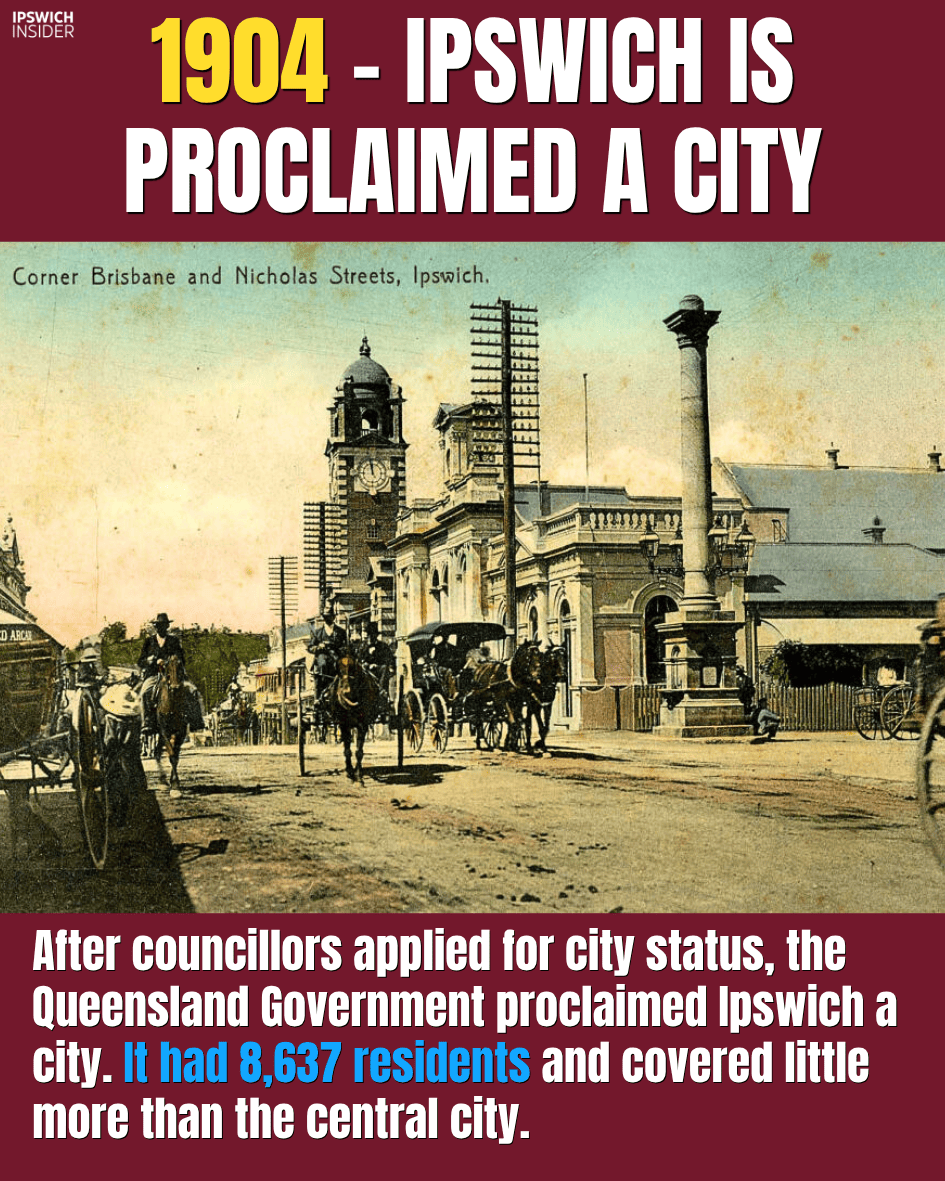
Brisbane and Nicholas streets around 1905, soon after Ipswich became a city. Image: Ipswich Art Gallery. Colourised and enhanced by Ipswich Insider.
Ipswich went from town to city in nine days. Council applied on 22 November and the proclamation came on 1 December.
- First mayor: Hugh Reilly became the first mayor of the new City of Ipswich.
- Small city: It had 8,637 residents and covered little more than central Ipswich.
- No minimum: Queensland law did not require a town to reach a set population before becoming a city.
1923 – North Ipswich Builds Its 100th Locomotive
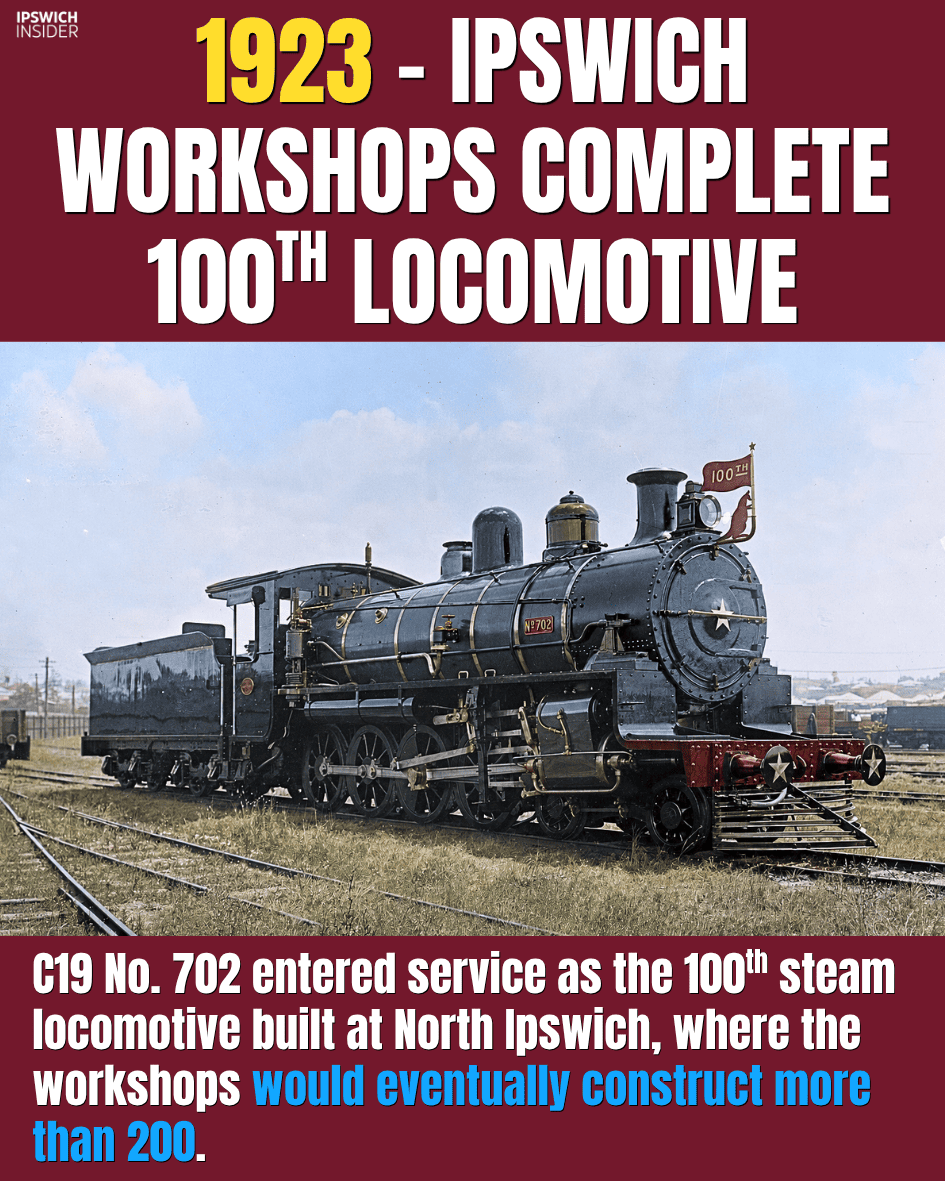
C19 No. 702, the 100th steam locomotive built at the North Ipswich Railway Workshops. Colourised and enhanced by Ipswich Insider.
The Railway Workshops began in 1864 to assemble and repair the engines and carriages needed for Queensland’s new railway. At their peak they employed 3,000 men and women, mostly locals, making them Queensland’s largest employer and Ipswich’s biggest workplace by far.
- Number 100: C19 No. 702 was the 100th steam locomotive built at the workshops.
- New name: The engine was renamed Centenary in June 1924.
- Long routes: C19 engines hauled trains as far as Bowen, Roma and Wallangarra.
1940 – RAAF Base Amberley Opens
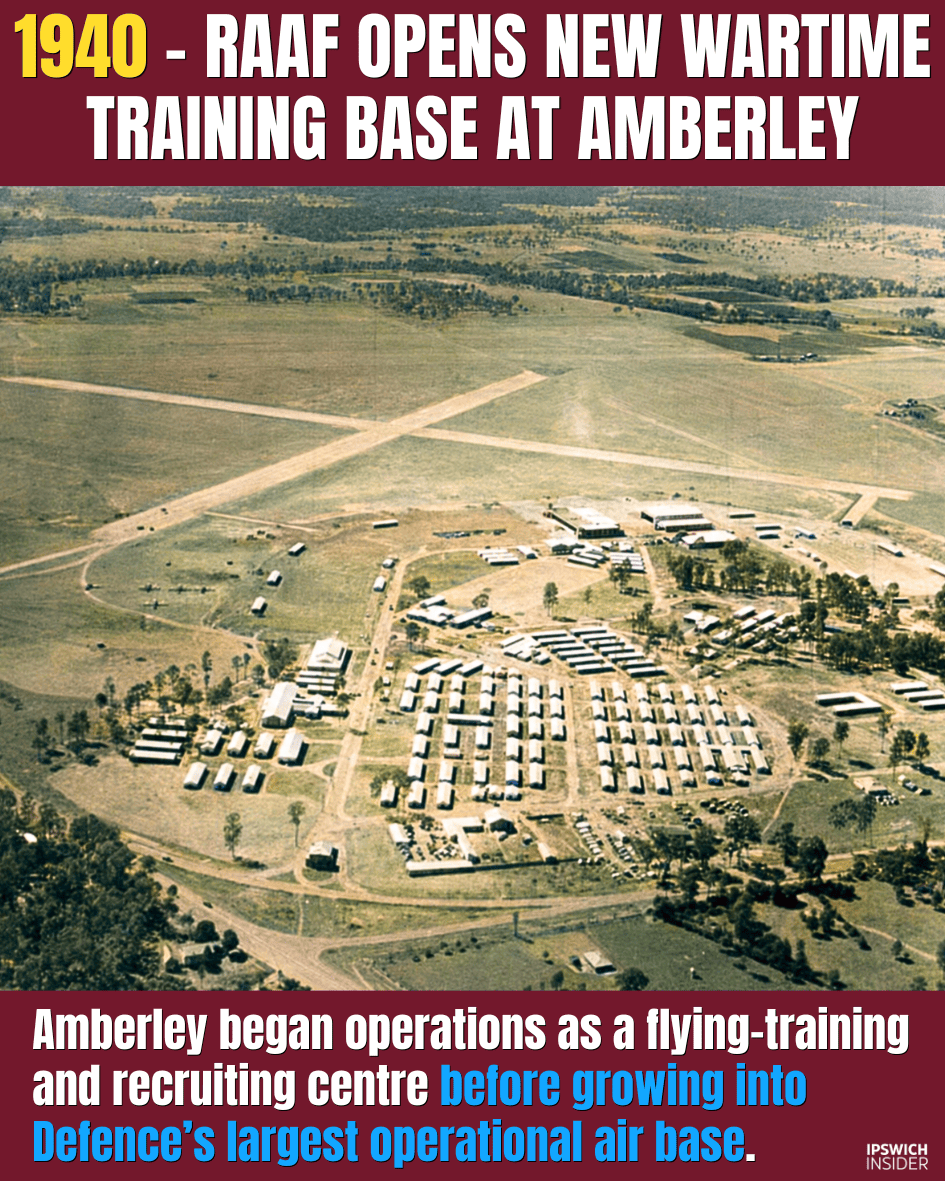
RAAF Base Amberley seen from the air during its early years. Colourised and enhanced by Ipswich Insider.
Amberley was chosen in 1938 because the land was flat, well drained and close to engineering works and the railway line to Brisbane. It opened on 17 June 1940, nine months after Australia entered the Second World War.
- Building rush: Hangars and accommodation went up quickly. The runways were sealed in September 1941, followed by a power station, emergency water supplies and satellite landing fields.
- American hub: After the United States entered the war, crated P-40 fighters and A-24 bombers arrived for assembly. At its busiest, 600 American troops passed through Amberley every day and were housed in Ipswich before leaving for New Guinea.
- 2,300 personnel: The original plan was for 300 people and 12 aircraft. By 1943, nearly 2,300 Australian and American personnel were based there.
1966 – Swanbank A’s First Unit Starts Making Electricity
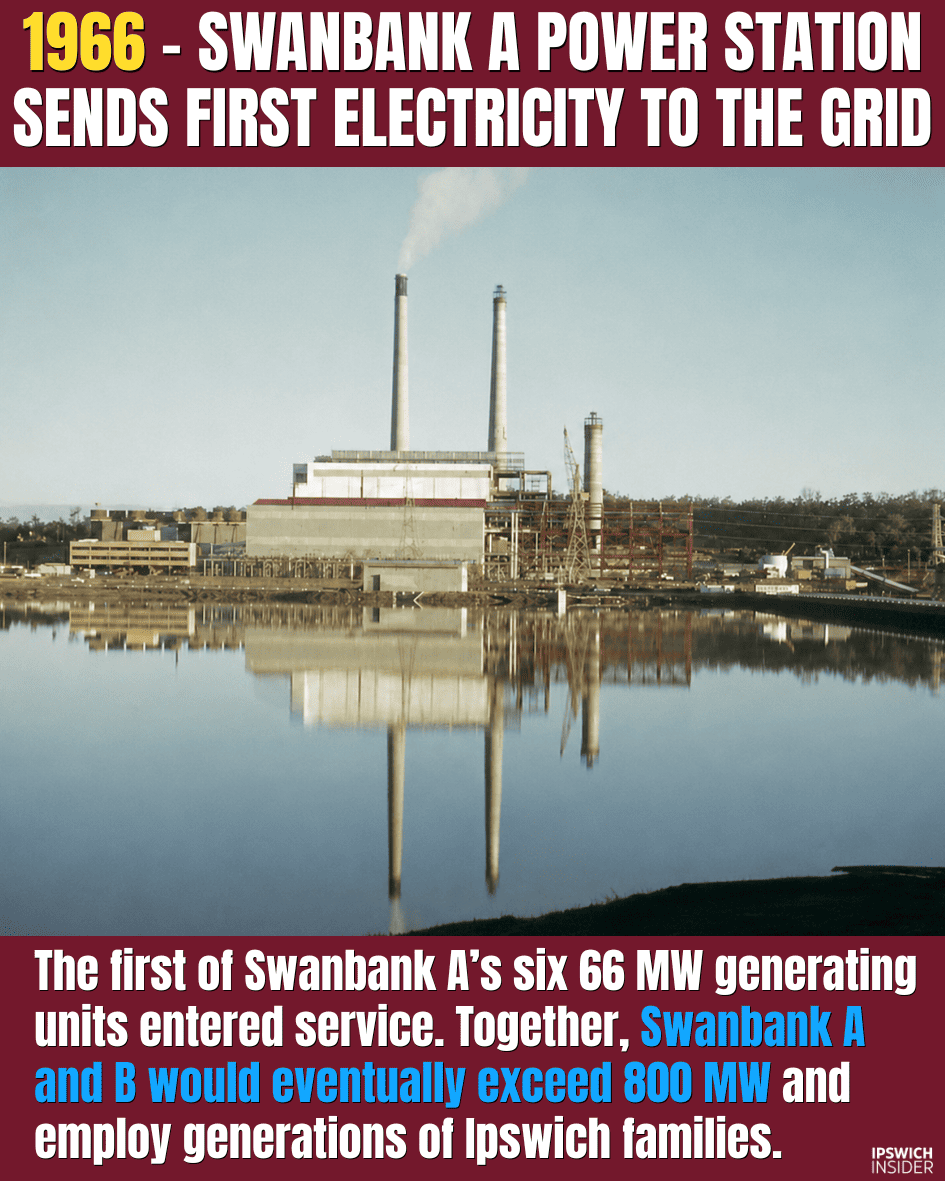
Swanbank A and its cooling lake during the coal-fired station’s operating years. Credit: Picture Ipswich. Colourised and enhanced by Ipswich Insider.
Swanbank was built on the Ipswich coalfield because South East Queensland needed far more electricity. It turned local coal into power for homes and businesses across the region and eventually replaced Brisbane’s ageing New Farm Powerhouse as the main supplier.
- Cooling system: The station needed so much cooling water that Berrys Weir, a pumping station and a pipeline were built to carry water from the Bremer.
- 250 miners: Box Flat alone produced about 16,000 tonnes of coal a week in 1972 and employed 250 miners. Most of its coal went to Swanbank.
- Bigger again: Swanbank B followed in 1971, eventually taking the two coal stations to 876MW. New high-voltage lines carried their power into Ipswich and Greater Brisbane.
1972 – The Box Flat Mine Disaster
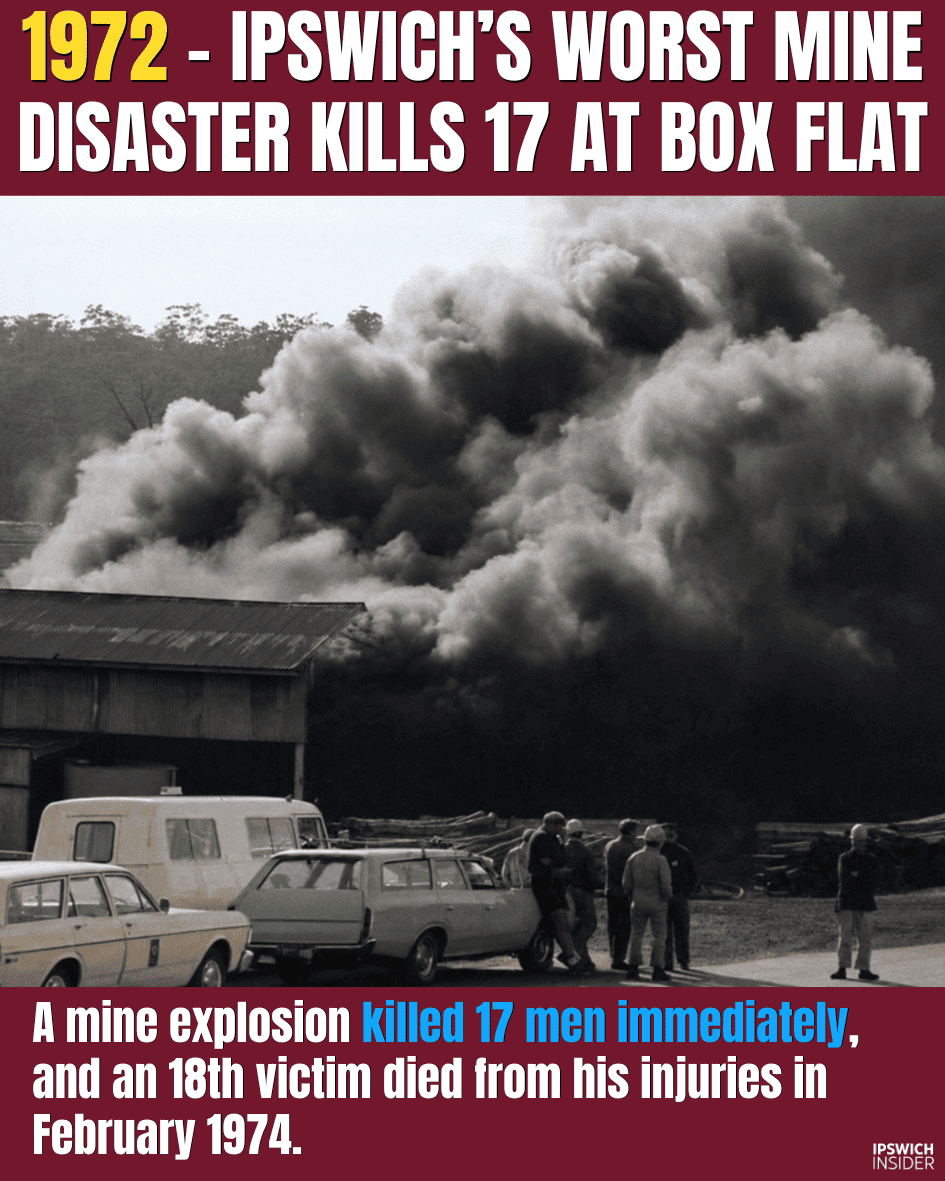
Smoke pours from Box Flat Mine after the explosion on 31 July 1972. Image: The Courier-Mail. Colourised and enhanced by Ipswich Insider.
At 2.47am, a mission to stop an underground fire became Ipswich’s worst mine disaster.
- Deep below: The fire they were fighting was burning about 300 metres underground.
- Rescue team: Eight of the 17 men killed were from the Mines Rescue Station.
- Still below: Fourteen of the men remain inside the sealed mine.
1973 – The F-111s Arrive at Amberley
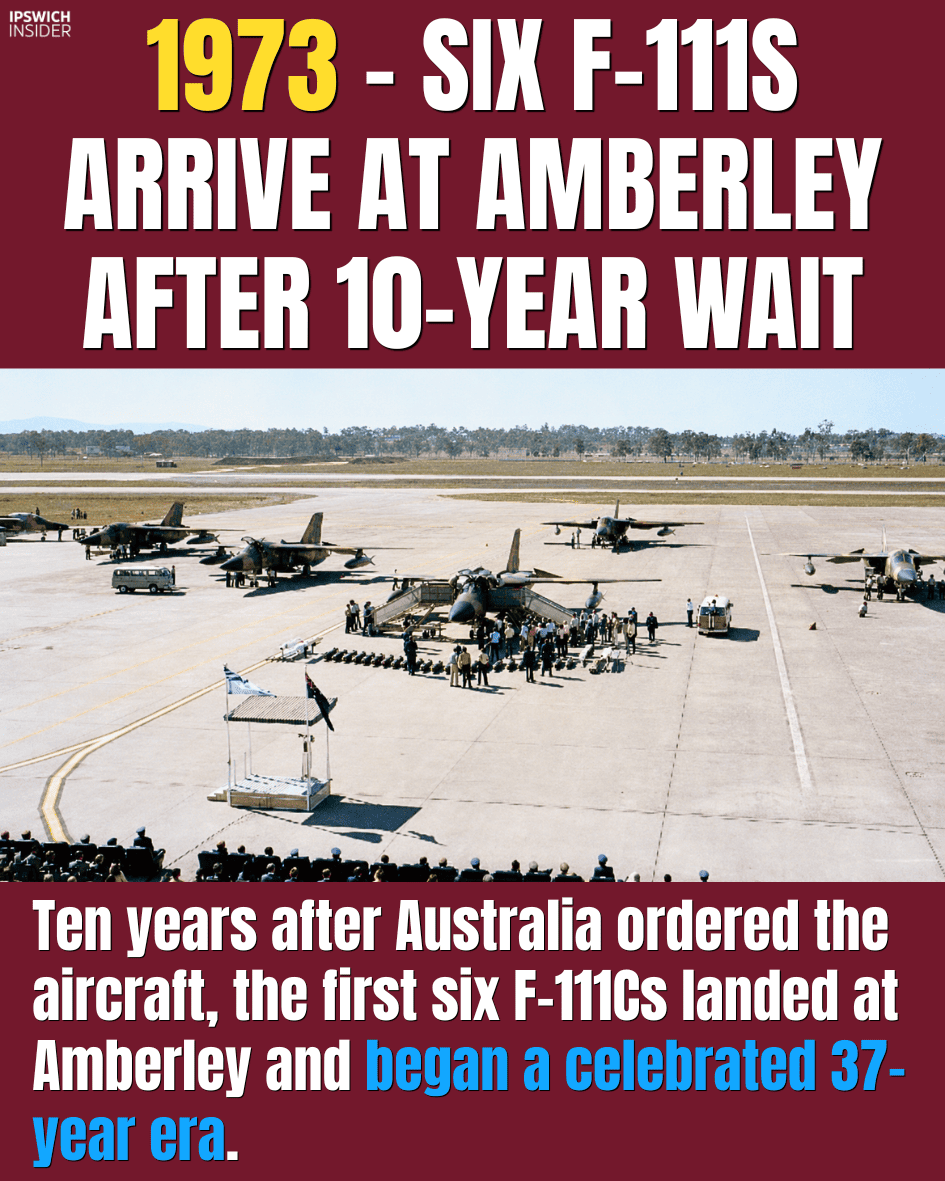
The first six F-111Cs lined up at RAAF Base Amberley on 1 June 1973. Image: Department of Defence. Colourised and enhanced by Ipswich Insider.
The F-111 did not just give Ipswich a famous jet. It made Amberley the home of Australia’s main long-range strike force and brought decades of highly skilled flying, maintenance and engineering work to the city.
- Whole fleet: Australia’s 24 F-111Cs arrived at Amberley in four groups of six during 1973. The jets remained based here until their retirement in 2010.
- 1,200 people: Two Amberley units responsible for F-111 maintenance joined to form No. 501 Wing in 1992. It became the largest unit in the RAAF.
- Local business: An F-111 maintenance contract helped launch TAE Aerospace at Amberley in 2000. By 2020, it employed 200 people at a 16,000-square-metre Bundamba facility.
1974 – The Bremer Reaches 20.7 Metres
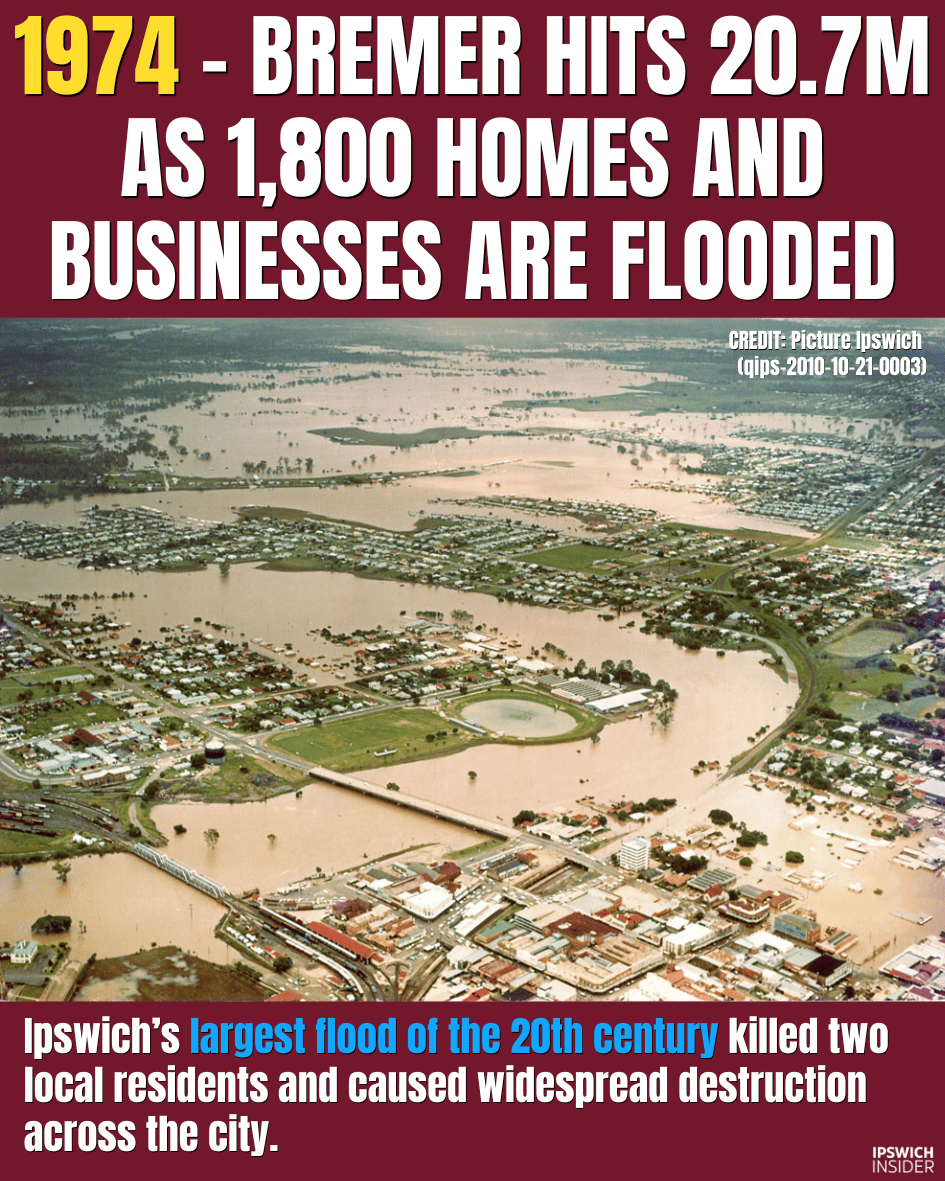
Floodwater spreads across Ipswich during the January 1974 flood. Image: Picture Ipswich. Colourised and enhanced by Ipswich Insider.
Ipswich copped 341 millimetres of rain in just 24 hours. The Bremer rose about 30 centimetres an hour and peaked at 20.7 metres on 27 January. At The Junction, the flooded Brisbane River pushed back against the Bremer, trapping water in Ipswich and keeping the river above 19 metres for another 39 hours.
- 15,000 evacuated: More than one in five Ipswich locals left 3,500 homes. The city was cut off from Brisbane by road and rail.
- 41 homes gone: Floodwater washed away 41 homes, including 12 in Sydney Street at Brassall and 11 in West Ipswich.
- City went dark: About 85% of Ipswich lost power. Phone lines went down and floodwater forced radio station 4IP off the air.
1985 – Reid’s Burns Down
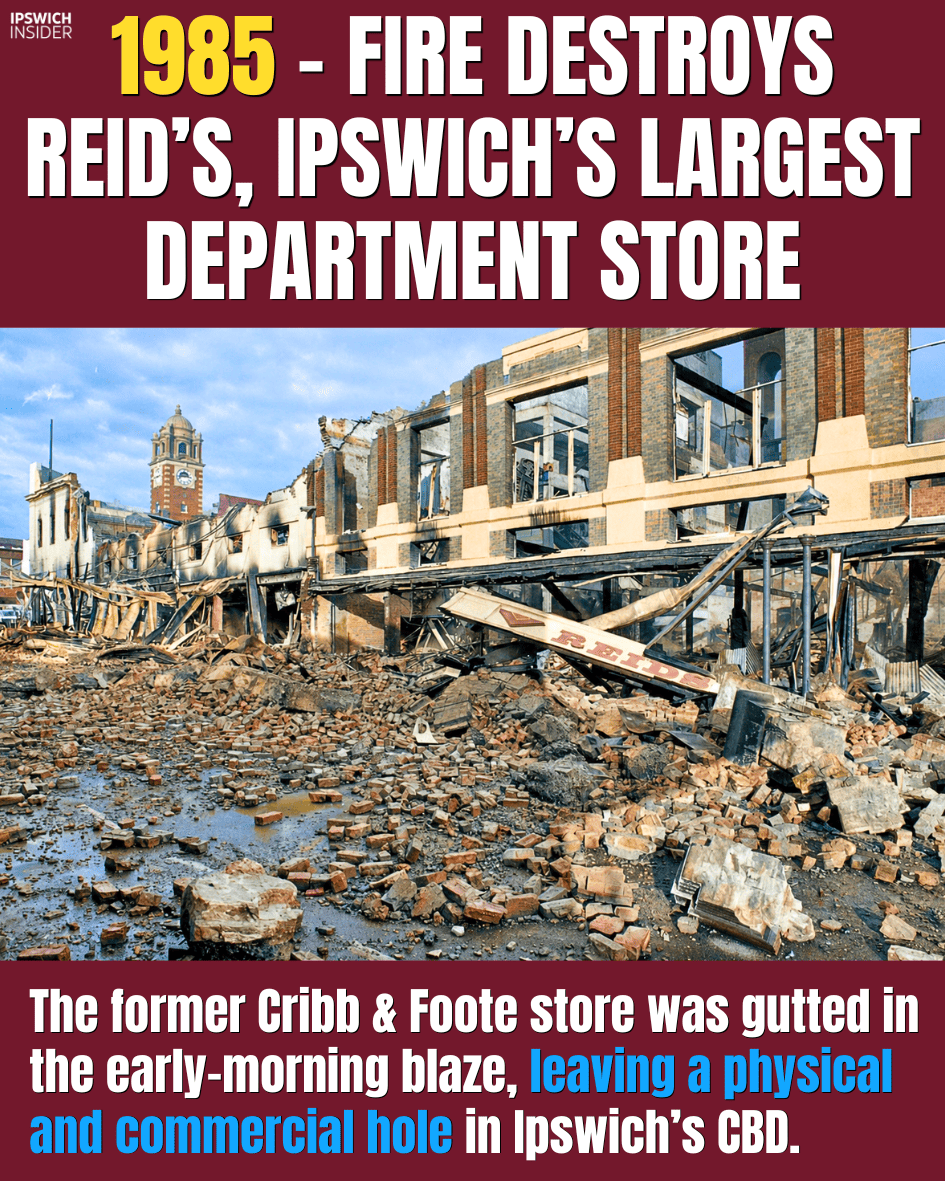
The burnt-out remains of Reid’s department store after the August 1985 fire. Image: The Queensland Times, Picture Ipswich. Colourised and enhanced by Ipswich Insider.
At 1.33am, flames had already spread from the ground floor to the third floor of Reid’s. Twenty-six firefighters and officers attacked the blaze with 18 hoses, but by 3.17am the roof had collapsed and a department store whose Ipswich story began in 1849 was gone. The heat was so fierce it melted the face of the Ipswich Clock Tower.
- 170 staff: Store assistants, lift workers, office staff and storeroom workers suddenly had no workplace. A smaller Reid’s reopened in the old Town Hall three months later, but closed in 1987.
- Arson mystery: Four people were found guilty of lighting the fire, but every conviction was overturned on appeal. Nobody else was tried.
- CBD changed: Kern Corporation had bought the building just 11 days before the fire as part of its plans to redevelop central Ipswich. The site became Ipswich City Square and Nicholas Street Mall.
1997 – Greater Springfield Gets the Green Light

An early masterplan showing how Greater Springfield would grow across 2,860 hectares.
Five years after Maha Sinnathamby and Bob Sharpless bought the land, the 1997 approval cleared the way for something much bigger than another housing estate. An entire new city would rise on Ipswich’s eastern edge, with homes, jobs, schools, shops, health care and transport planned together from the start.
- 55,000 locals: More than 55,000 people now live across Springfield, Springfield Lakes, Springfield Central, Spring Mountain, Brookwater and Augustine Heights.
- $17 billion: That much has now been invested in building Greater Springfield and its infrastructure.
- Key openings: UniSQ Springfield opened in 2006, Orion in 2007, passenger trains in 2013 and Mater Private Hospital in 2015.
1997 – One Nation Launches in Ipswich
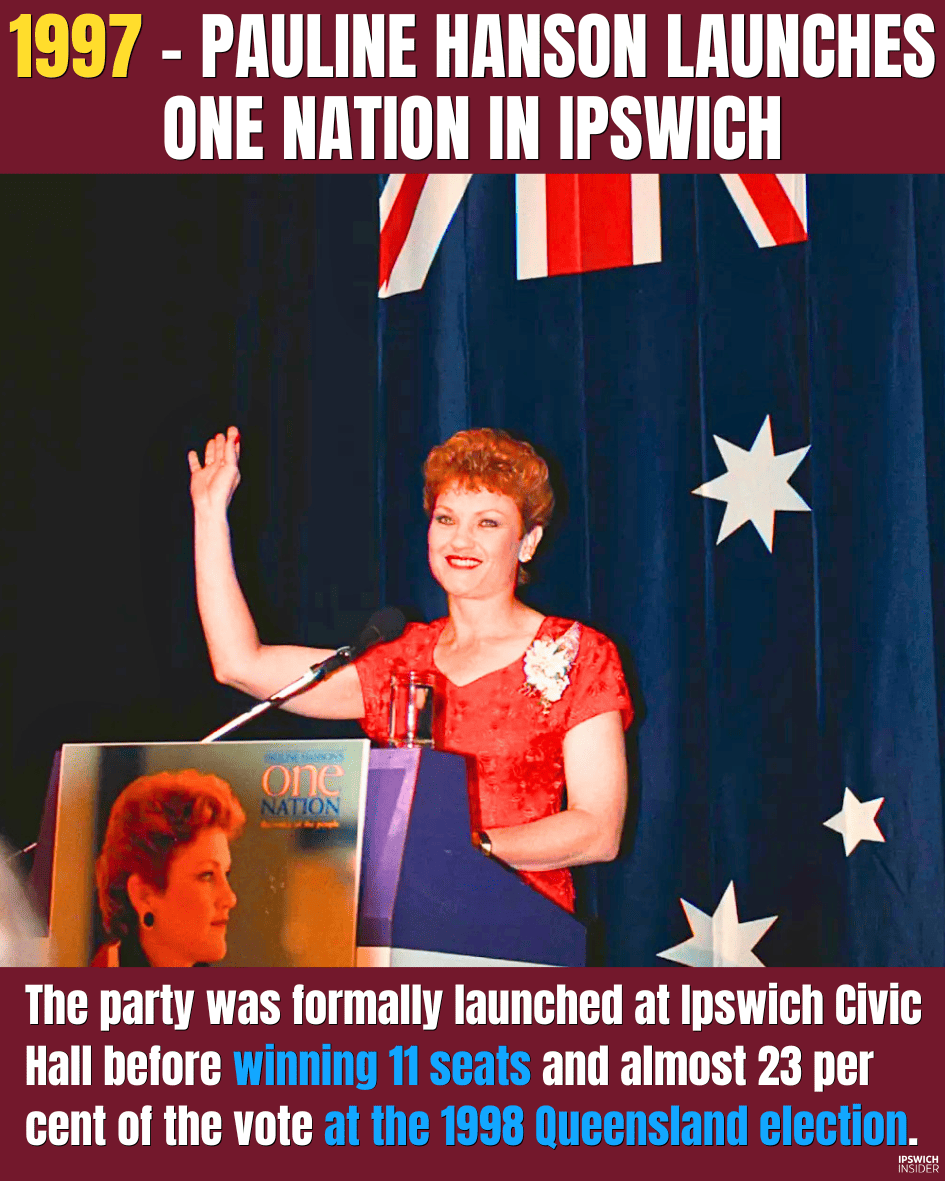
Pauline Hanson launches One Nation at Ipswich Civic Hall on 11 April 1997.
Pauline Hanson had won Oxley as an independent only a year earlier. Now she was back in Ipswich to launch a national party.
- Three founders: Hanson formed One Nation with David Ettridge and David Oldfield.
- Eleven weeks: The party was registered nationally on 27 June 1997, just 11 weeks after its Ipswich launch.
- Next election: One Nation won 11 seats and almost 23 per cent of the vote at Queensland’s 1998 election.
2010 – Ripley Valley Is Declared a Priority Development Area
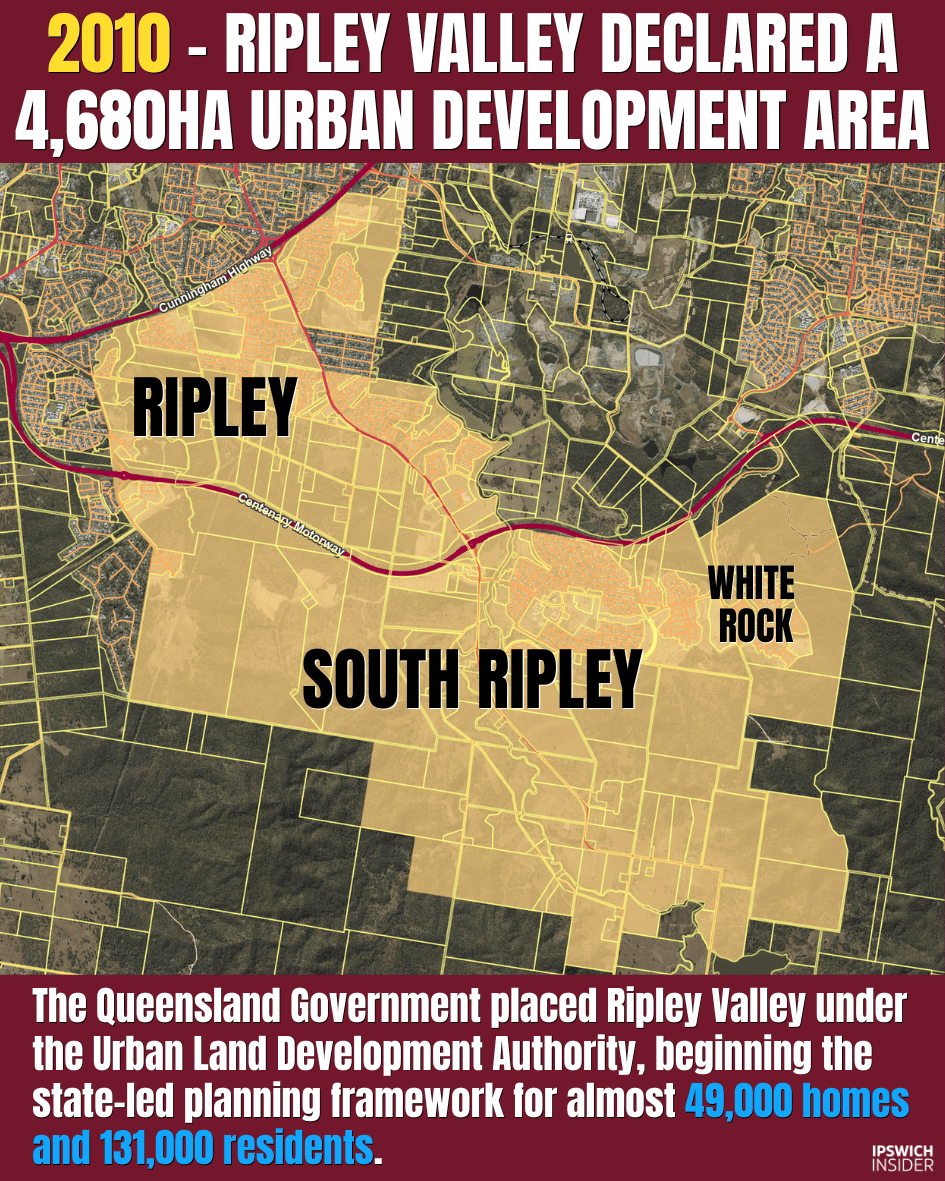
The Ripley Valley growth area covers Ripley, South Ripley and part of White Rock.
In 2010, the state drew a line around 4,680 hectares of rural Ipswich and declared it a Priority Development Area. That shifted Ripley Valley onto special state rules designed to plan and fast-track an entire new city, instead of approving one estate at a time.
- Why Ripley: Huge rural blocks made it possible to plan whole neighbourhoods, while the new Centenary Motorway connected the valley to Springfield and Yamanto.
- Fastest growth: Ripley added 3,131 residents in 2024–25 and grew 15.4%, making it Queensland’s fastest-growing community.
- 15% built: Around 7,200 of the planned 48,750 homes are now built (as of mid-2026), plus three schools, two town centres and new health, police and ambulance facilities.
More on the Rise of Ripley:
See the boundary, masterplan and full buildout in Ipswich Insider’s deep dive:
2011 – The Bremer Reaches 19.4 Metres
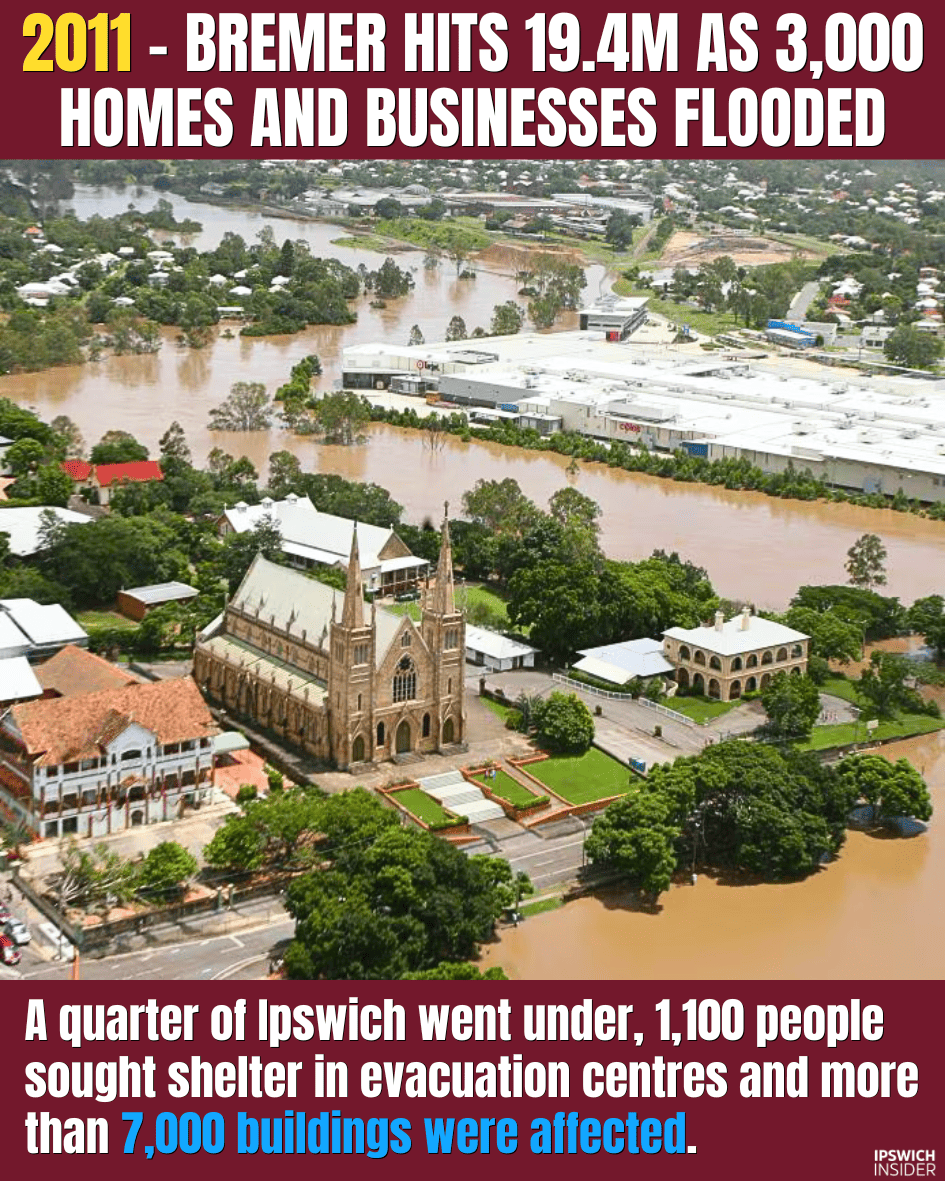
Floodwater surrounds St Mary’s Church and central Ipswich on 12 January 2011.
The Bremer stopped 1.3 metres short of the 1974 peak. But Ipswich had spent another 37 years growing, leaving far more homes, shops and roads in the water’s path.
- City stopped: Around 1,000 homes filled with water, nearly 500 businesses closed, 43 streets were cut and 30,000 homes lost power.
- Two lives: A man died after driving into floodwater at Wulkuraka. A four-year-old boy was swept from a rescue boat near Minden.
- Mud army: More than 4,000 volunteers hit Ipswich’s streets alongside hundreds of soldiers and emergency workers.
2015 – The Jets Win Two Titles in One Week

The Ipswich Jets celebrate their historic two-title week in 2015.
The NRL is Australia’s top rugby league competition. Directly below it sit the Queensland Cup and NSW Cup, the strongest statewide competitions. Ipswich won the Queensland title, then faced the NSW champions in a national playoff just seven days later. They won that too.
- First ever: The Jets beat minor premiers Townsville 32–20 to win their first premiership after four grand final losses across 33 years.
- Seven days: The following Sunday they beat Newcastle 26–12 at ANZ Stadium. Two grand finals, two cities and two trophies in one week.
- Walker football: Coaches Ben and Shane Walker won with short kick-offs, short drop-outs and an attacking style unlike anything other teams were playing.
2018 – The State Dismisses Ipswich City Council

Nine of the Ipswich councillors removed when the State dismissed the entire council in 2018.
Ipswich locals did not vote them out. After the CCC uncovered an integrity crisis reaching the top of Ipswich City Council, Queensland Parliament passed a law written specifically for the city. It removed the suspended mayor and all ten councillors in one hit.
- 86 charges: Operation Windage had left 15 people facing 86 criminal charges, including two Ipswich mayors and two council CEOs.
- Most uncharged: Most of the councillors removed were not facing criminal charges. The state said wider governance failures made a complete council reset necessary.
- 19 months: Ipswich had no elected council until March 2020. Greg Chemello ran it until January, then Steve Greenwood carried it through to the election.
2020 – The Queensland Times Ends Its Print Edition
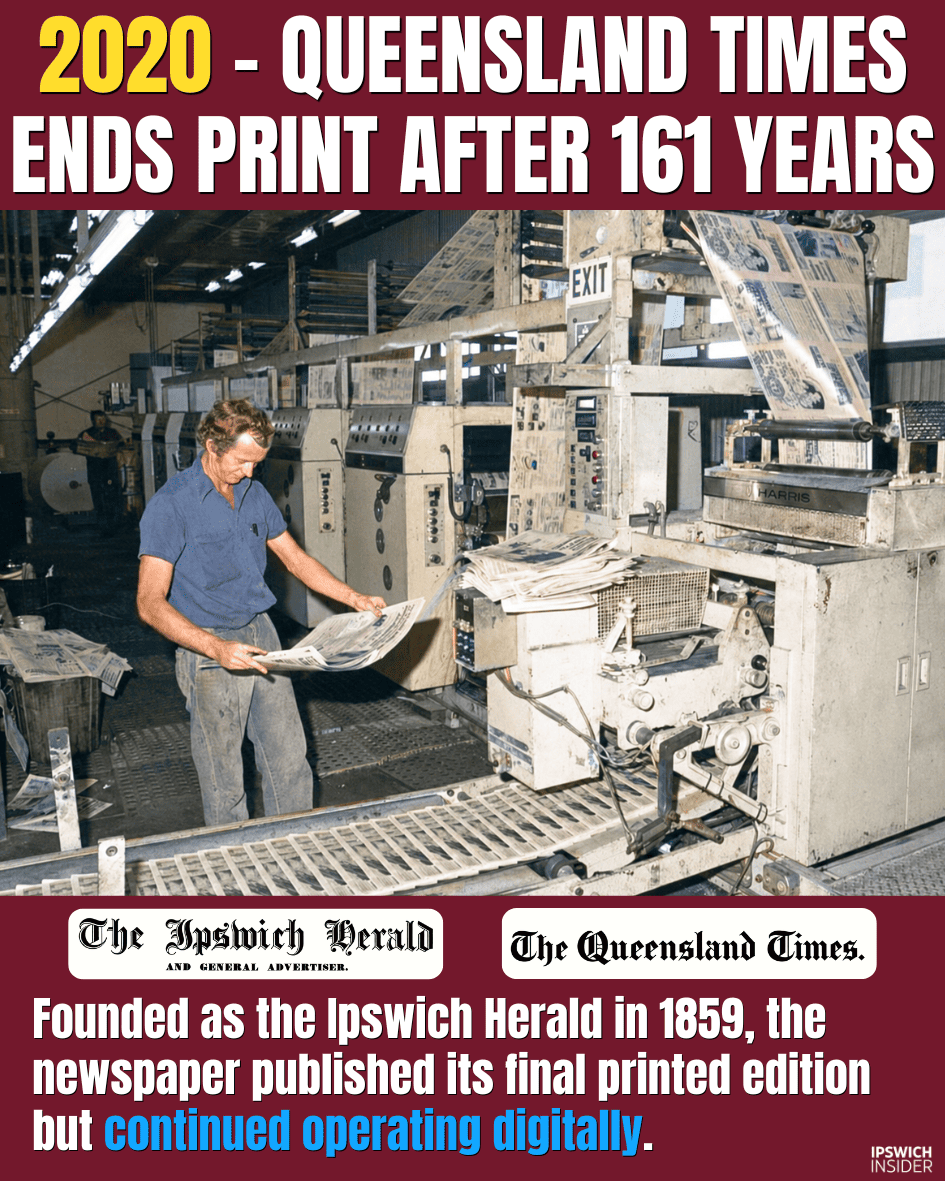
A Queensland Times press operator checks a fresh newspaper. Image: The Queensland Times Collection, Picture Ipswich. Colourised and enhanced by Ipswich Insider.
For generations, the QT was the paper Ipswich opened at breakfast. Queensland’s oldest regional newspaper put council fights, mine and flood disasters, school photos, football results, births, weddings and deaths into print.
Its pages preserve 161 years of Ipswich life, while hundreds of thousands of QT photo negatives are being saved through Picture Ipswich.
- Big reach: A 2008 audit counted 10,804 weekday sales and 14,153 on Saturdays, with copies reaching from Springfield and Brookwater to Boonah, Gatton and Esk.
- News Corp: News Corp bought the QT in December 2016 as part of a $36.6 million deal for APN’s 12 regional daily papers, 60 smaller papers and more than 30 websites.
- Print ends: Print ad money had been falling for years, and COVID made it much worse. The final printed edition rolled off the press on 27 June 2020. The QT continued as a paid digital paper before News Corp moved its Ipswich coverage inside The Courier-Mail website in 2021.
2024 – Three Major Venues Open After 15-Year, $311M Nicholas Street Rebuild
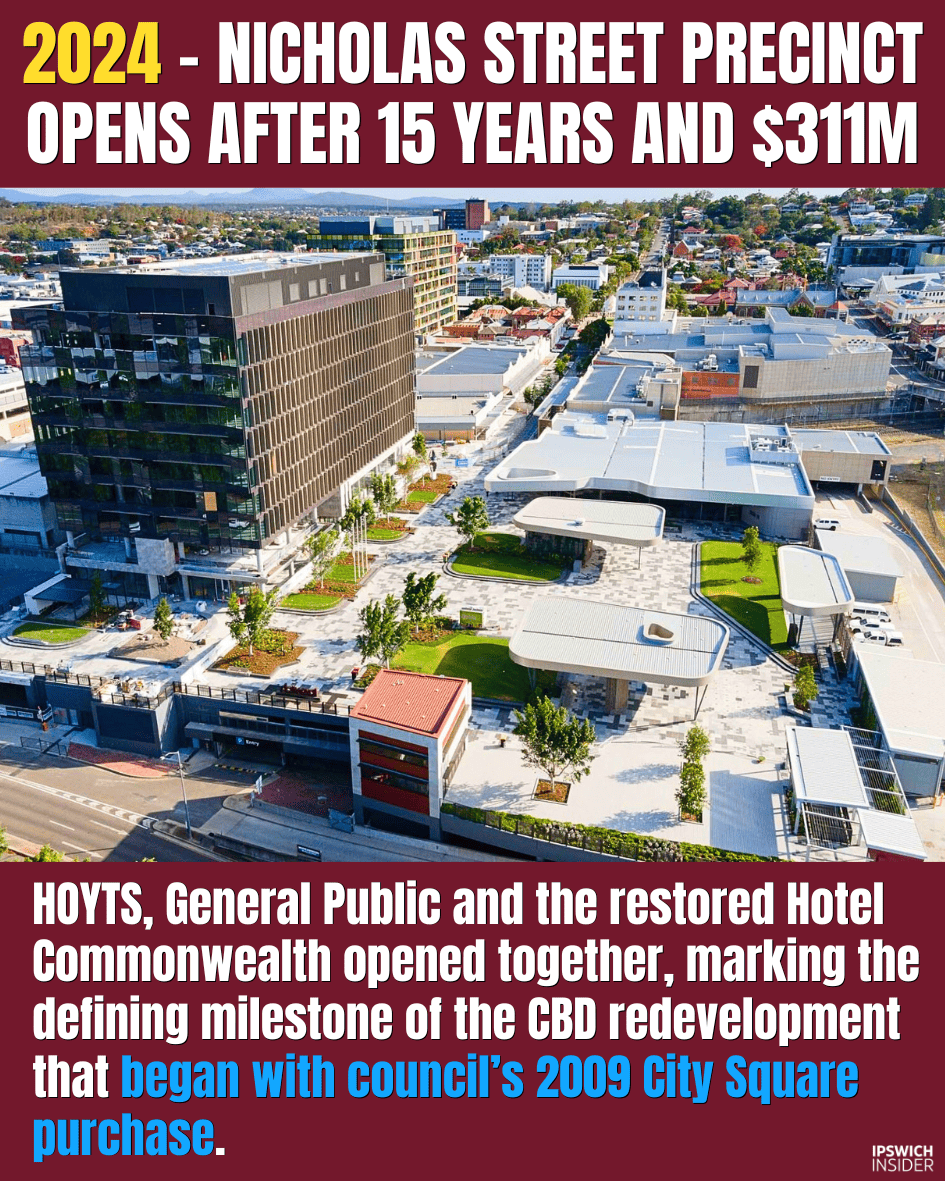
The rebuilt Nicholas Street Precinct, including Tulmur Place and the new council building. Image: Ipswich City Council.
By 2021, Tulmur Place, Ipswich Central Library, the new council building and Australia’s first stand-alone Children’s Library were already open. But the cinema building and Hotel Commonwealth were still unfinished.
That changed on 8 November 2024, when HOYTS, General Public and the restored Hotel Commonwealth opened together. After 15 years and $311 million, the old mall had become a civic and entertainment precinct with libraries, a public square, council offices, movies, bowling, restaurants and a pub.
- $45m start: Council bought Ipswich City Square from Memo Corp in 2009 using a $45 million State Government loan.
- Hidden damage: Hutchinson Builders found mould and damaged concrete inside the Venue building. The 65-week rebuild also required the old cinema complex to be demolished after structural problems were uncovered.
- Pub saved: The damaged Hotel Commonwealth was carefully taken apart in 2018 and stored offsite. It was later rebuilt and expanded in a restoration costing about $16 million.
Which Ipswich Moment Did We Miss?
21 moments can’t cover the whole Ipswich story. What event would you add to this list?
Let me know by replying to the weekly email.
Sources
- Defining Tulmur | Ipswich. PictureIpswich.com.au.
- Coal Mining Then & Now Heritage Trail. PictureIpswich.com.au.
- Group of men from the Railway Workshops, in front of a C19 Class Locomotive, No 702, North Ipswich, 1923. PictureIpswich.com.au.
- Establishment of RAAF Base Amberley. AirForce.gov.au.
- Bremer/Warrill Creek Flood Warning System. BOM.gov.au.
- Springfield Structure Plan. Ipswich.qld.gov.au.
- Pauline Lee Hanson. Explore.MoADOPH.gov.au.
- Ripley Valley. EDQ.qld.gov.au.
- Jets win State Championship in style. NRL.com.
- Regional Australia laments loss of print as News Corp titles go digital. ABC.net.au.