

Ipswich’s Core Bremer Bridges at a Glance
- 8 core bridges. 2 rail, 6 road. The “we need a 2nd bridge” debate has always been about a bypass to relieve the David Trumpy, not a true second crossing.
- 120 years of building. The oldest crossing dates to 1902 and the newest opened in 2004. Ipswich has been adding, replacing and strengthening bridges across the Bremer for over a century.
- 3 eras, 1 river. 2 heritage rail bridges from the Victorian era. 4 road bridges from the postwar building boom. 2 modern crossings from the highway age. Each generation built on what came before.

Have you heard all the talk of a second Bremer River crossing?
If you’re new to Ipswich, you’d think there’s just the one.
The David Trumpy Bridge connecting Ipswich with North Ipswich.
Not true.
There are quite a few, actually.
Today we are going to look at 8 Bremer River bridges.
Starting upstream and going downstream:
1. Leichhardt Bridge (1936)

The Leichhardt Bridge sits upstream of the newer Don Livingstone One Mile Bridge. And it’s also lower bridge deck elevation, so it floods faster.
Both were built in 1936 by the Main Roads Commission at the same crossing point. The Don Livingstone bridge was later rebuilt in 2004.
Today the Leichhardt Bridge carries Lobb Street between West Ipswich, Churchill and One Mile. It is one of the lesser known crossings despite being nearly 90 years old.
2-in-1
What makes Leichhardt Bridge unusual is that it’s actually 2 bridges in 1:
- The main 2 lane span crosses the Bremer River
- A narrower 1 lane span crosses Deebing Creek
- The 2 spans are joined by a Y intersection mid bridge.
Both were built together. The Main Roads Commission plaque sits on the Deebing Creek side, treating the whole thing as one named structure.
The bridge floods regularly and is one of the first crossings to go under when the Bremer rises.
2. Don Livingstone One Mile Bridge (2004)
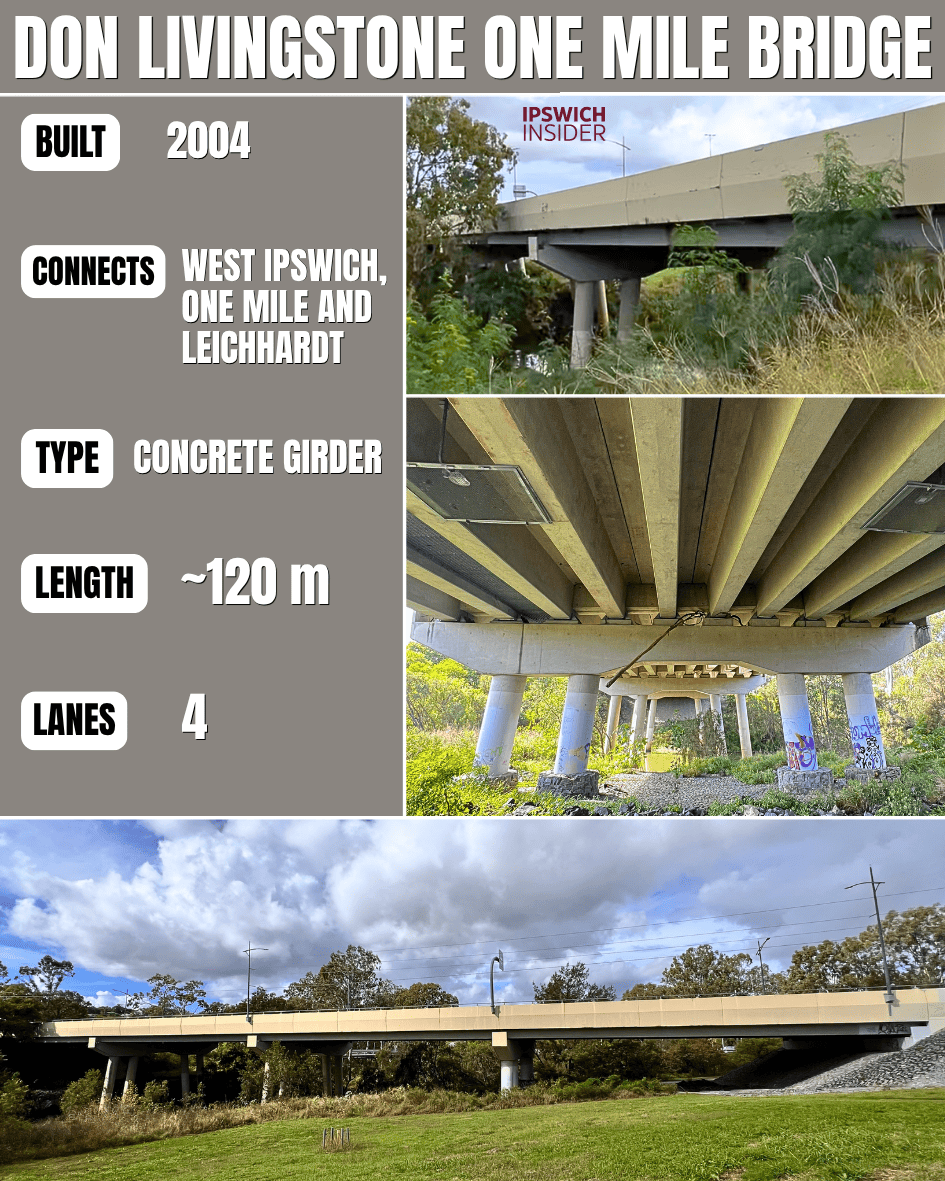
The newest of the 8.
The Don Livingstone One Mile Bridge is the modern 4 lane road crossing on Old Toowoomba Road.
It carries tens of thousands of vehicles a day.
The current structure was completed in 2004. But the crossing point has had a bridge for well over a century. The 2004 bridge is the 5th on the site.
The name
Originally just called the One Mile Bridge, it was renamed in February 2015 after Don “Deli Don” Livingstone. He was the former Ipswich West state MP and councillor who lived locally and died later that same year.
The “one mile” in the name refers to the distance from central Ipswich to this crossing on the old road to Toowoomba.
Flood history
Like Leichhardt, the bridge floods. It was damaged in the 2009, 2011 and 2013 flood events. Major flood recovery and betterment works were completed in early 2014.
3. Sadliers Crossing Railway Bridge (1902)
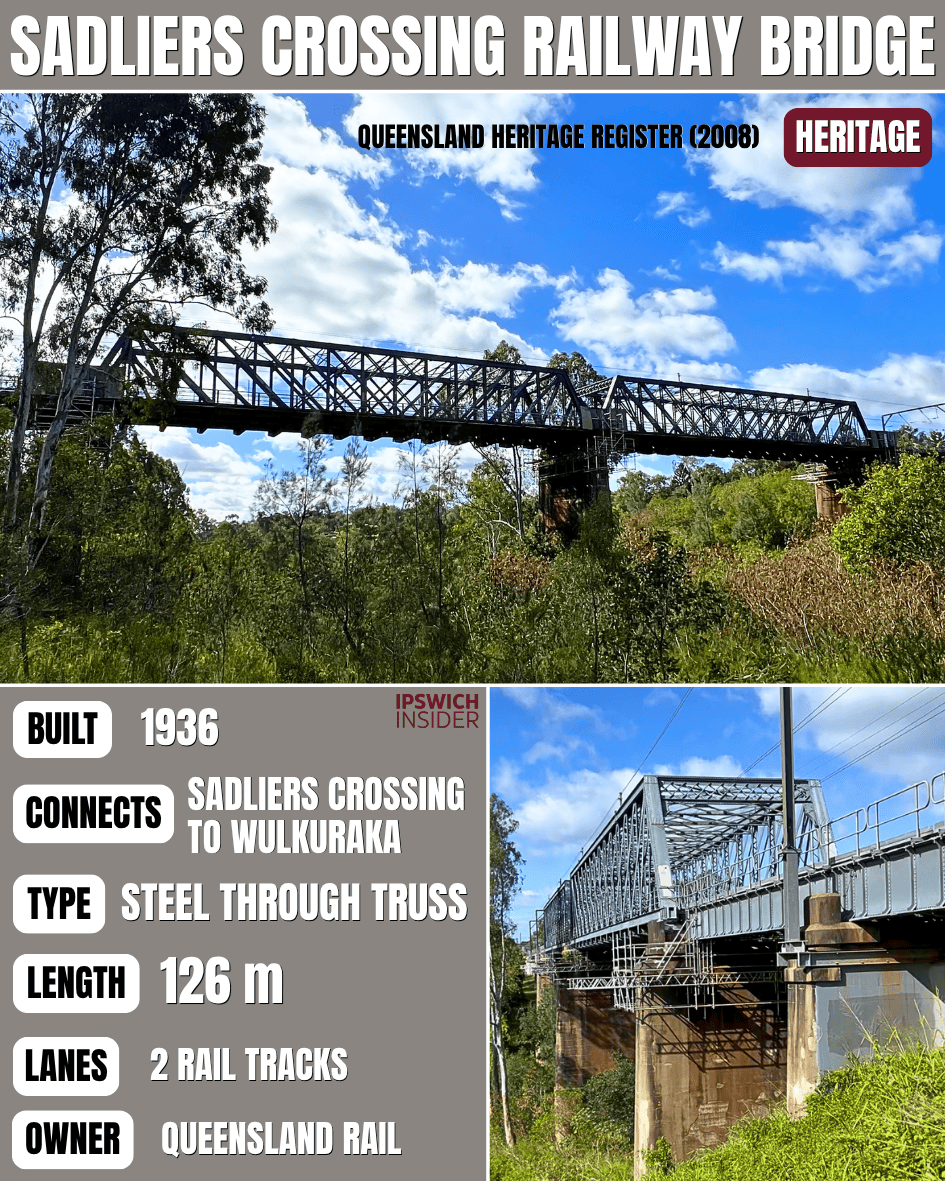
The oldest crossing of the 8.
The Sadliers Crossing Railway Bridge has carried trains between Sadliers Crossing and Wulkuraka since 1902. It still does today as part of the Ipswich-Rosewood line. And onwards through the Victoria Tunnel westward.
The current bridge replaced an earlier 1875 crossing that was damaged by the catastrophic 1893 flood. That prompted the decision to build the replacement higher and stronger.
Rare engineering
The 2 main spans use a Whipple double intersection through Pratt truss design. Its 45.7 metre main span is the 2nd longest of that type in Queensland.
Older locals know it as the “Red Bridge” from its original red oxide paintwork. Although it has been painted over, traces are reportedly still visible…
Heritage status
It was added to the Queensland Heritage Register in November 2008.
The steel trusses sit on concrete piers with stone cutwaters. Timber trestle approaches extend the structure further at each end.
4. Hancock Bridge (1961)
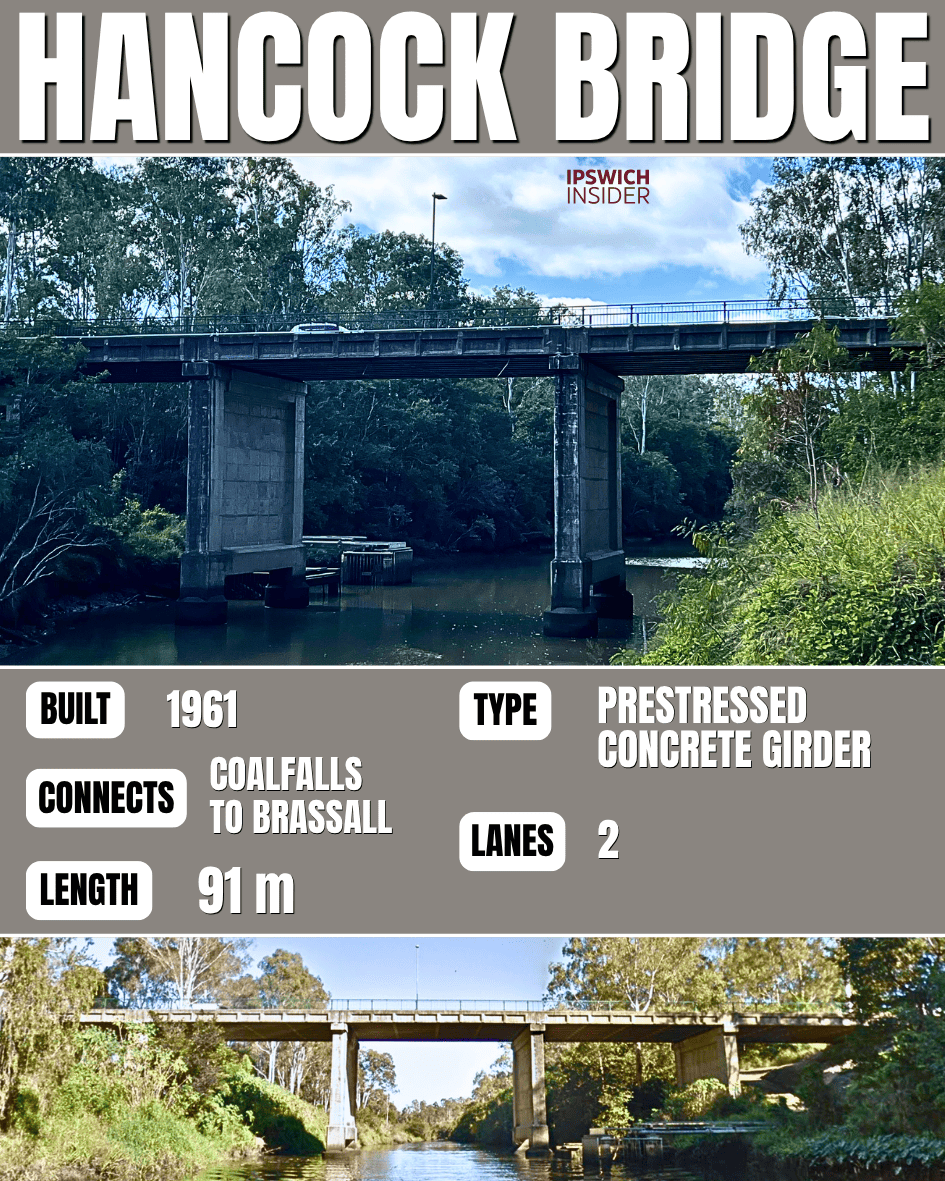
The Hancock Bridge carries Albion Street between Coalfalls and Brassall.
It is the only crossing of the Bremer west of the CBD that locals from those suburbs use daily to head north.
It was opened in March 1961 by Mayor Jim Finimore. At the time, it was believed to be the first bridge in Queensland with castings as large as its beams. 5 prestressed concrete spans totalling about 91 metres.
It replaced a community funded bridge
The bridge replaced the older 1918 Harlin Road Bridge. That earlier bridge was community funded by Brassall and Woodend residents who got tired of waiting for the council to build them a proper crossing.
The original 1918 plaque was unbolted and remounted on the southern approach of the new bridge, where it remains today.
The Hancock name
Hancock is named after the Hancock timber family. Their mill ran on the Bremer at North Ipswich from 1880 until Boral closed it in 2011.
The bridge was believed to be flood free at opening. It went under in 1974 and overtops in major events.
5. Bremer River Rail Bridge (1915)

The Bremer River Rail Bridge is the heritage giant.
The current 1915 structure is the 3rd bridge on the site. The 1865 sandstone abutments survive a short distance east of the current rail bridge. The 1897 cast iron cylinder piers survive on the neighbouring bridge line now used by the Bradfield Pedestrian Bridge. 4 eras of Ipswich engineering on 1 crossing.
The 1865 bridge
The original 1865 bridge was the most substantial structure on Queensland’s first railway. It was an uncommon combined road and rail crossing. It was demolished in March 1967 after the David Trumpy Bridge made it redundant for road traffic.
The sandstone abutments still stand, light-coloured and rusticated, with parapet walls, mouldings and shallow buttresses still visible.
The 1965 plaque
A Queensland Railway Centenary Memorial plaque was installed in 1965 on the eastern face of the 1865 abutment. It marks 100 years since the opening of Queensland’s first railway.
The 1897 bridge
The 1897 bridge was the first Pratt truss used on Queensland railways. It was removed in 1987. The dark grey cast iron cylinder piers still stand across the river, with steel girders still resting between each pair.
The 1915 bridge
The current 1915 bridge still carries trains today. It was added to the Queensland Heritage Register in December 2006.
The Bradfield Pedestrian Bridge
The Bradfield Pedestrian Bridge connecting Riverlink to the CBD was built on top of the 1897 pylons in 2010. It is named after John Job Crew Bradfield, the Sydney Harbour Bridge engineer who grew up in North Ipswich. He attended North Ipswich State School and Ipswich Grammar.
6. David Trumpy Bridge (1965)
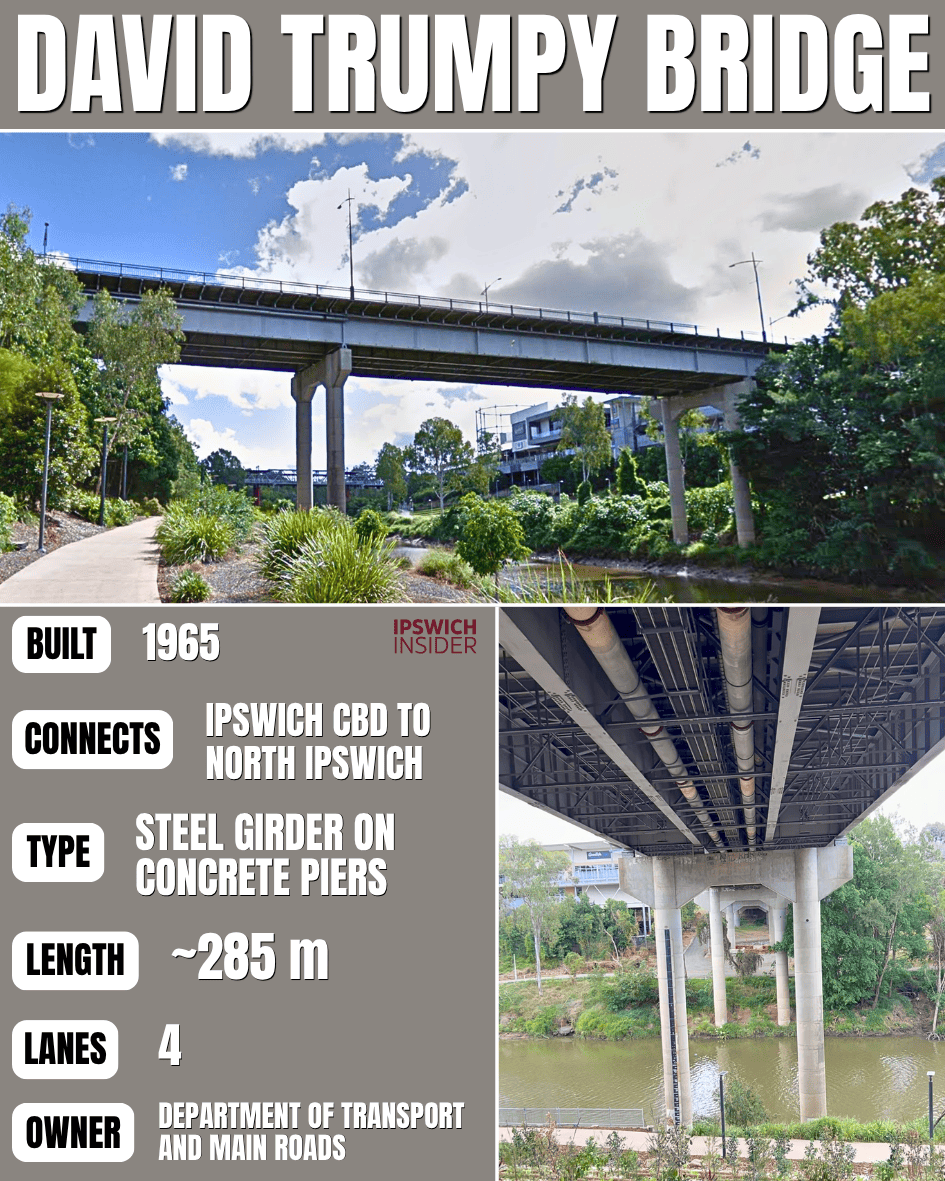
The bridge everyone knows.
The David Trumpy Bridge is the main CBD road crossing. It carries around 40,000 vehicles a day between East Street and Pine Street.
It opened on 26 June 1965, with Mayor Jim Finimore in attendance 4 years after he opened the Hancock Bridge upstream. At the time it included the longest single welded steel girder span in Australia.
The name
Named after Dr David Trumpy, who served as Medical Superintendent at Ipswich General Hospital for nearly 50 years from 1920 to 1967. Trumpy was awarded an MBE in 1960 and attended the bridge opening himself.
During construction the bridge was known as the High Red Wharf.
The “second bridge” question
The Trumpy is the bridge most often referenced in the second bridge debate. It is over capacity and ageing. That is what the proposed Norman Street Bridge from East Ipswich to North Ipswich is designed to address.
Flood history
The bridge escaped major damage in the 1974 and 2011 floods. Floodwaters came within a few feet of the carriageway in 1974.
7. Bremer River Bridge – Westbound (1958)

The Warrego Highway crossing of the Bremer at Karalee is the eastern edge of core Ipswich.
The westbound bridge is the older of the pair. It has been operational since January 1958. It now carries about 32,000 vehicles a day heading toward Toowoomba.
More than 4,000 of those are heavy vehicles.
The Warrego Highway is Queensland’s principal east-west freight route. It connects the Port of Brisbane to the Darling Downs and beyond.
The 2023 cracks
In late 2023, TMR identified fatigue cracks in the steel girders and imposed speed and load restrictions.
The Australian and Queensland Governments have since committed $85 million to a strengthening program. Works are expected to continue through 2026. The works keep the existing concrete deck and add steel girders and bolted connections underneath.
Construction
The bridge is a steel girder structure on concrete piers, similar in concept to the David Trumpy.
It cuts during major floods. That is when locals discover just how important this anonymous highway bridge actually is.
8. Bremer River Bridge – Eastbound (1993)
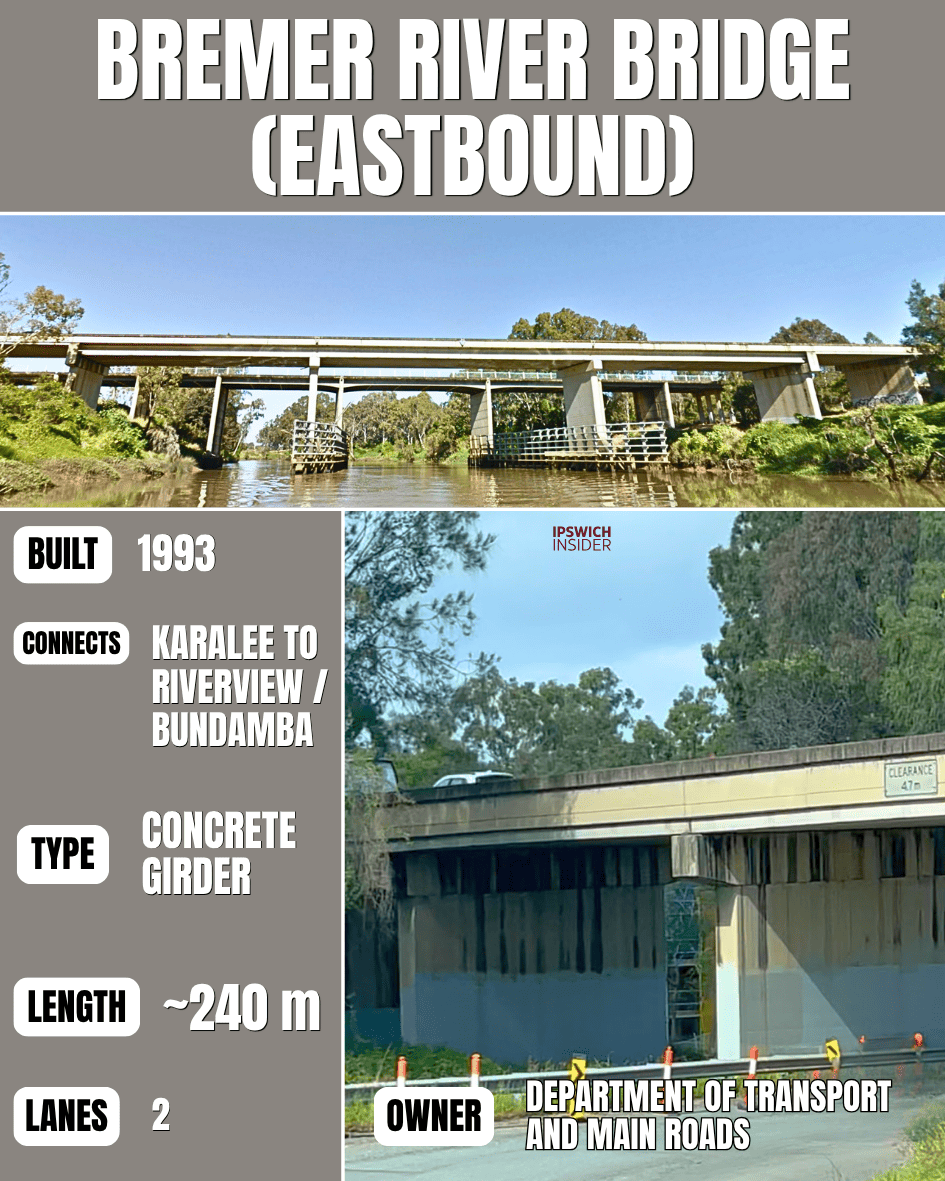
The newer of the Warrego pair.
The eastbound Bremer River Bridge opened on 29 January 1993 as the duplication of the 1958 westbound. It was opened by then federal transport minister Bob Brown.
It is a concrete girder structure rather than steel. This reflects the construction standards of the early 1990s. It carries Warrego Highway traffic heading east toward Brisbane.
The 2023 crossovers
During the 2023 restrictions on the westbound, median crossovers were built. This let oversize heavy vehicles use the eastbound carriageway in both directions. A temporary measure that highlighted how reliant the freight network is on this single crossing.
Flood history
Like the westbound, it cuts during major flood events. It overtops more often than locals realise.
Sources
- Bremer River Rail Bridge and pylons and abutments of old bridges — Queensland Heritage Register
- Sadliers Crossing Railway Bridge — Queensland Heritage Register
- Important bridge marks milestone — Ipswich First
- Ceremony to Commemorate the 50th Anniversary of the Opening of the David Trumpy Bridge — Government House Queensland
- Warrego Highway (Ipswich-Toowoomba), Bremer River Bridge, strengthening — Department of Transport and Main Roads
- Building of One Mile bridge, Ipswich, 1935 — Picture Ipswich
- Bremer River Rail Bridge — Wikipedia