
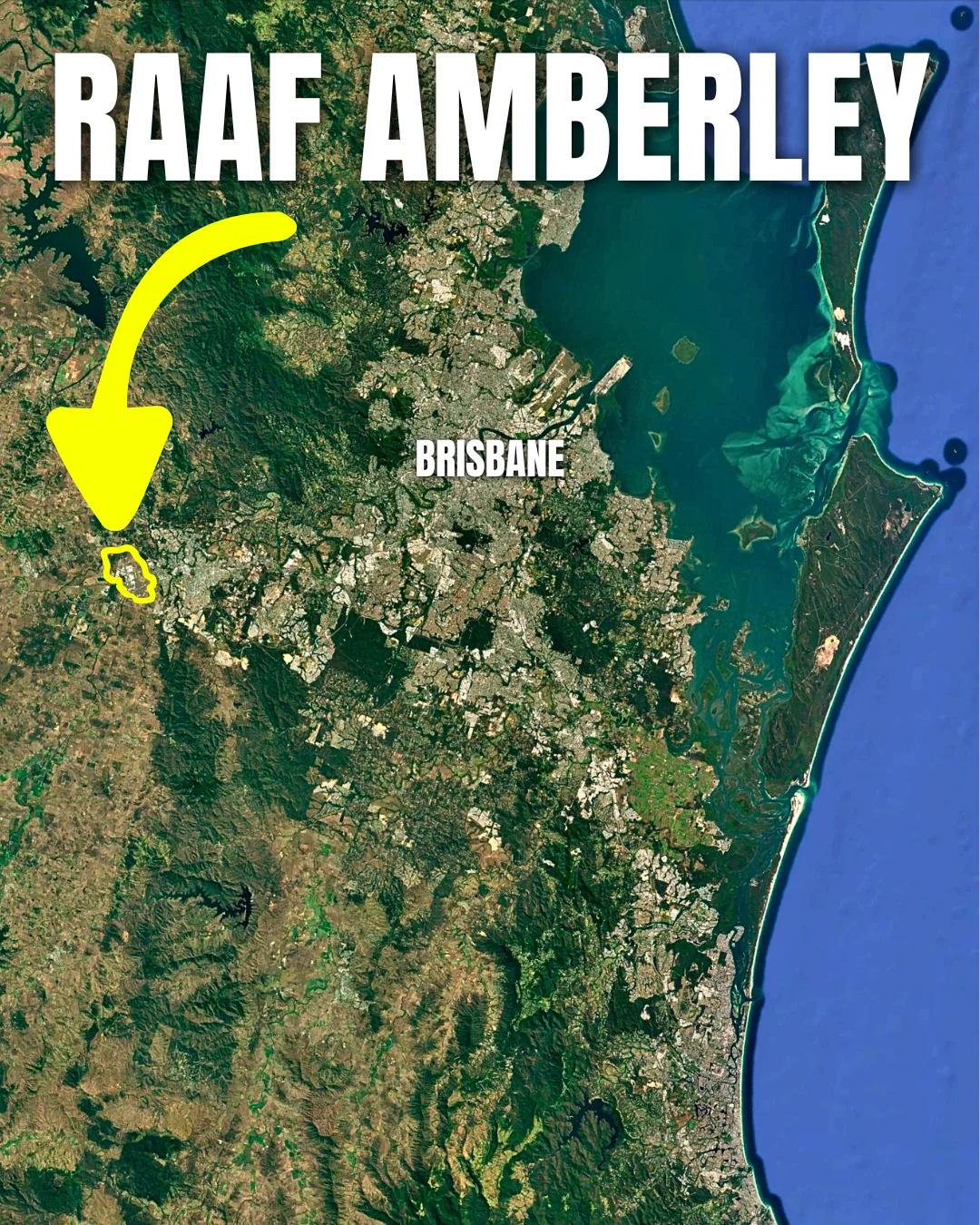
RAAF Amberley at a Glance
- Size: Australia’s largest operational air base has around 6,000 workers. Roughly equal to the entire population of Flinders View at the 2021 Census.
- Function: Alongside the aircraft are Army workshops, accommodation, dining halls, an Olympic-size pool, a synthetic running track, sewage treatment and a backup power station.
- Strategic: Chosen in 1938 for flat, well-drained land, good visibility and proximity to engineering works and the Brisbane railway line.
- Economic impact: Amberley topped Ipswich’s precinct rankings with an estimated $1.01 billion annual economic contribution.
🔢 By The Numbers

- 2,500 hectares – Base and buffer land size, almost Brisbane Airport’s size
- 3,047 metres – Main runway length
- 2,300 movements a month – Average military take-offs and landings (2022 plan)
- 30 million litres – Annual aviation fuel usage estimate
- 11.4 MW – Electricity generating capacity from its own power station
- 4 million litres – Rainwater held in the base’s underground tanks (there’s also many above ground tanks)
- 850 diners – Capacity of 3 main dining halls
You hear the aircraft!
But what else is at Amberley?
Have you ever looked around there on Google Earth or Maps?
It’s a proper mini-city:
- 400m track
- Indoor Olympic pool and sports courts
- 100s of unit-style accommodations
- Massive ~8 million litre fuel farm
- $41.7m upgraded state-of-the-art sewage treatment plant
- City-scale 11.4 MW power station.
This guide uses public satellite imagery and published sources to show Ipswich locals what’s where at RAAF Base Amberley.
Let’s get started.
Jump to:
#1 — Australia’s largest operational air base
That’s how Defence describes Amberley. The map shows accommodation, dining, medical services and sports facilities alongside the buildings needed to operate an air base. You can find these facilities labelled on Google Maps and publicly available RAAF Base Amberley maps.
6,000 — People working on base
Military personnel, public servants and contractors make up a workforce roughly equal to the entire population of Flinders View at the 2021 Census.
About 600 — Estimated residents on base
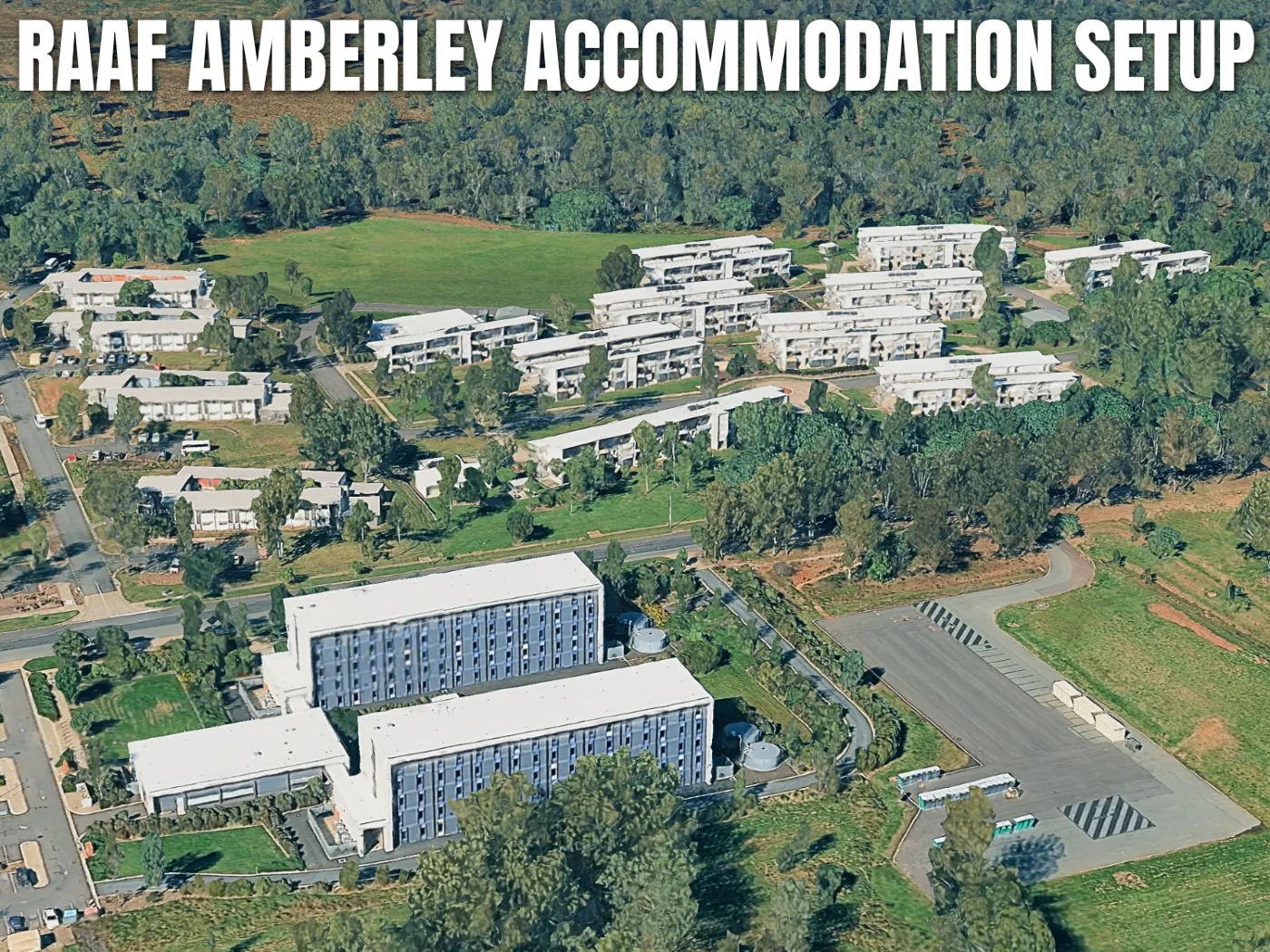
Living-in accommodation at Amberley, from low-rise blocks to larger multi-storey buildings. Mapping imagery: © Google (Google Maps / Google Earth). Annotations: Ipswich Insider.
Most workers commute, but people also live on site. Our rough estimate of about 600 uses the Amberley locality’s 619 residents in the 2021 Census as a guide. The locality is not identical to the base, and this is not a current Defence headcount.
850 — Diners in one sitting
Three dining halls share one central kitchen. The base’s transit accommodation also provides 200 rooms for people staying temporarily.
50 metres — An Olympic-size pool
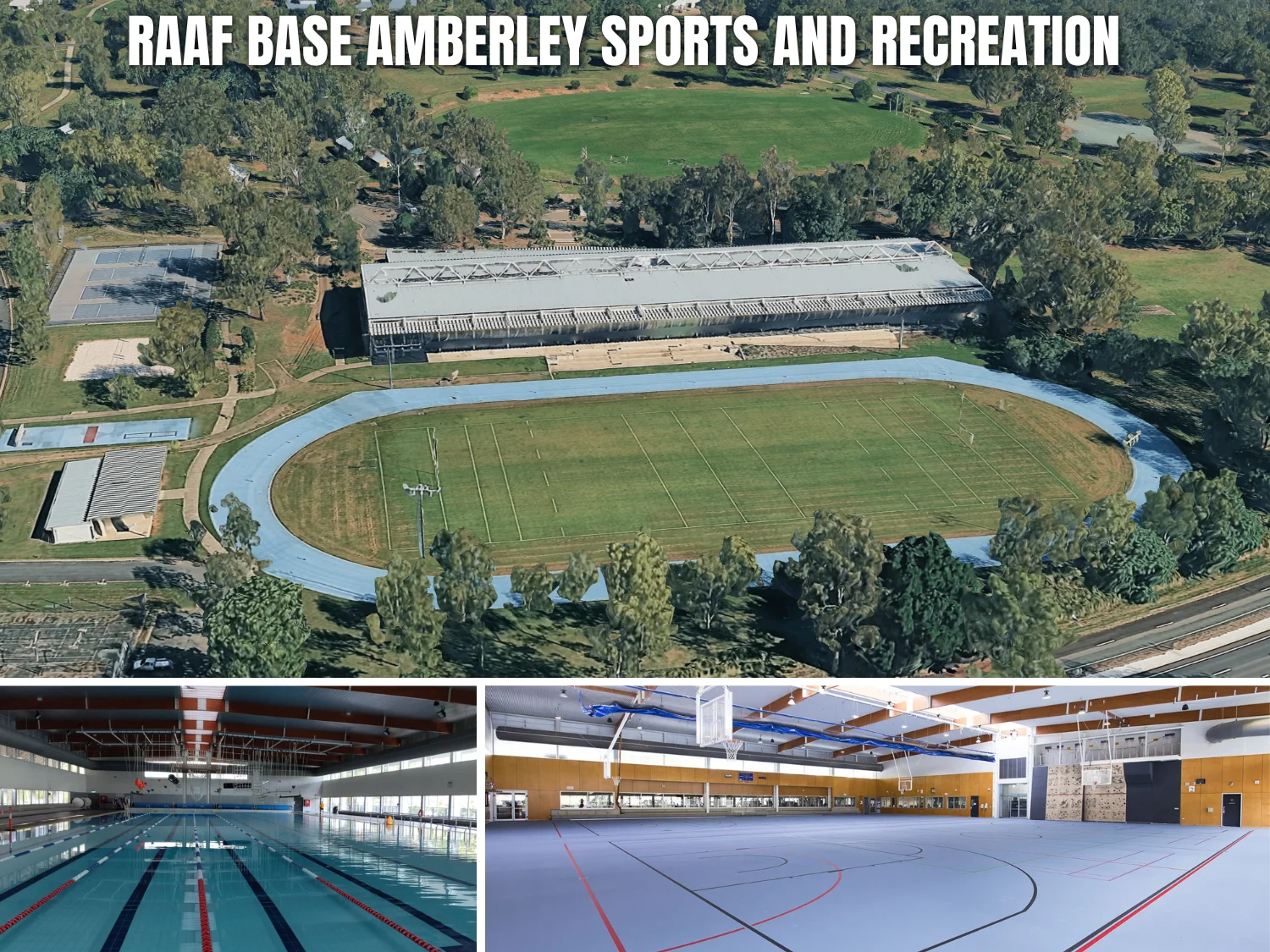
Amberley’s running track and fitness complex, with the indoor pool and sports hall pictured (Inside pics source). Mapping imagery: © Google (Google Maps / Google Earth). Annotations: Ipswich Insider.
The fitness complex includes the pool, a climbing wall, squash courts and rooms for weights, cardio, spin and boxercise.
400 metres — A synthetic running track
Outside are the athletics track, rugby and AFL ovals, tennis, beach volleyball and cricket nets.
Army logistics, stores and workshops
Amberley is an Army logistics base too. The front-gate map identifies 9 Force Support Battalion workshops, supply and transport headquarters, and a logistics support company in the B-labelled compound.
Army drivers move personnel, equipment, supplies and bulk fuel around Australia.
40,000 m² — Joint logistics buildings
The separate Joint Logistics Unit development delivered 40,000 m² of floor space across warehouses, workshops and other buildings. That’s nearly six full-size soccer pitches. The $150 million project was completed in 2015.
The base also opened an upgraded truck wash point, weighbridge, loading ramp and diesel tanker-loading arm in December 2025.
Banks, cafés, medical and more
Amberley’s everyday services are scattered around the base:
- Banks: Defence Bank and Australian Military Bank.
- Food and coffee: the Congo Club on Vung Tau Avenue, AAFCANS canteen, C17 Café and Pool Canteen.
- Medical centre: building 816, just north of the athletics track.
- Post office: building 346, near Oxford Street. Australia Post announced its closure for 28 August 2026, opposed by Ipswich Council. Whether it went ahead is unconfirmed.
- Aviation Heritage Centre: four WWII hangars displaying retired aircraft.
Combat Support Group headquarters and a Defence Aviation Safety Authority training facility are here too.
11.4 MW — Its own backup power station
Amberley is connected to the electricity grid, with its own emergency generation. At full output, that capacity is comparable to the average electricity demand of about 22,000 homes averaging 12.4 kWh per day each.
It also has four million litres of underground rainwater storage, less than a third of the larger Denmark Hill water tank.
$41.7 million — A replacement sewage treatment plant
Amberley treats its own sewage. Its replacement plant includes PFAS treatment, with a $41.7 million project budget published in 2023–24.
Aircraft based at RAAF Amberley
| Aircraft & role | Fleet | At Amberley since |
|
|---|---|---|---|
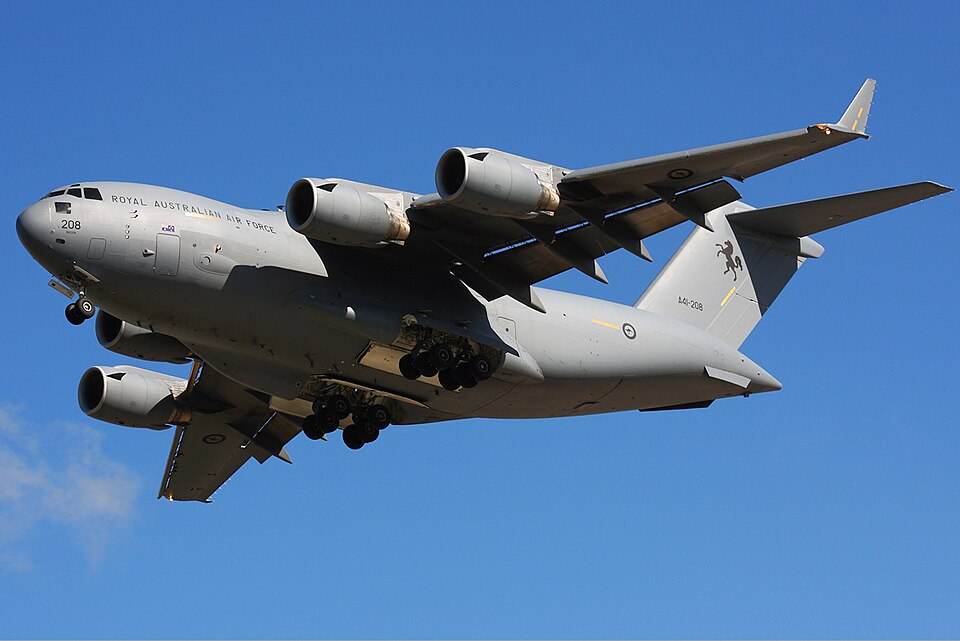 |
C-17A Globemaster III Heavy transport No. 36 Squadron |
Fleet8 | At Amberley since2006 |
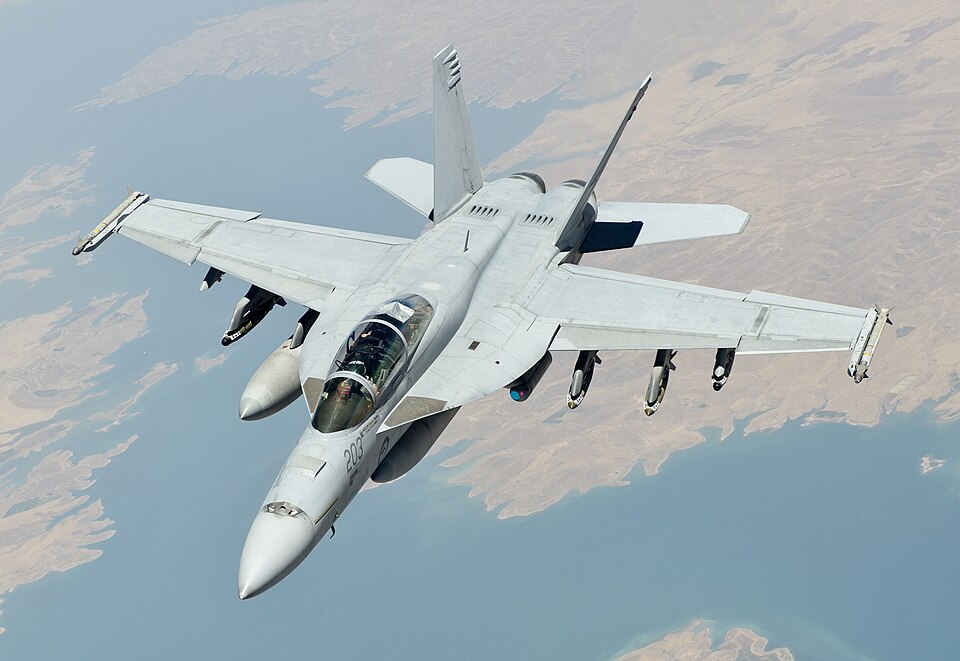 |
F/A-18F Super Hornet Strike fighter No. 1 Squadron |
Fleet24 | At Amberley since2010 |
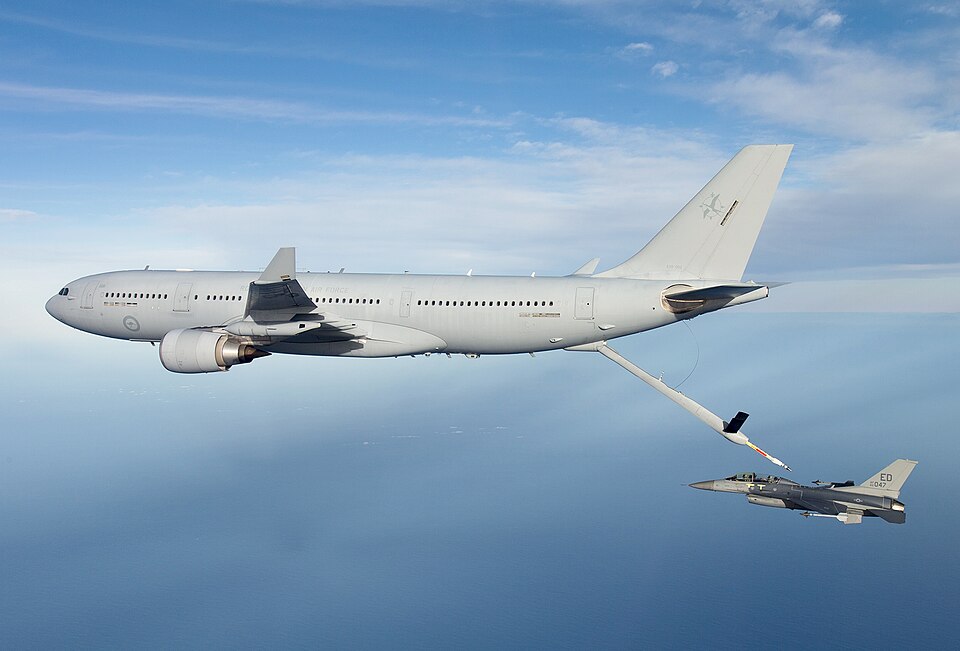 |
KC-30A Multi-Role Tanker Transport Aerial refuelling and transport No. 33 Squadron |
Fleet7 | At Amberley since2011 |
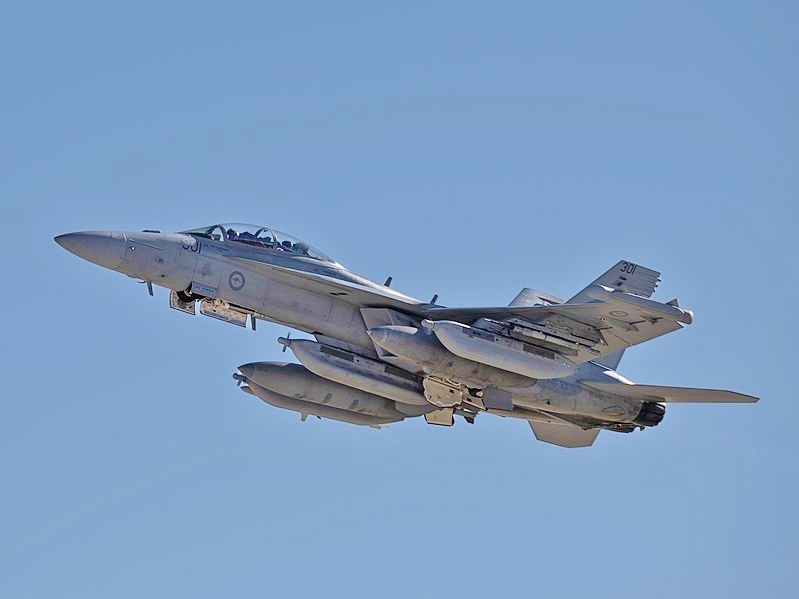 |
EA-18G Growler Disrupts radar and communications No. 6 Squadron |
Fleet12 | At Amberley since2017 |
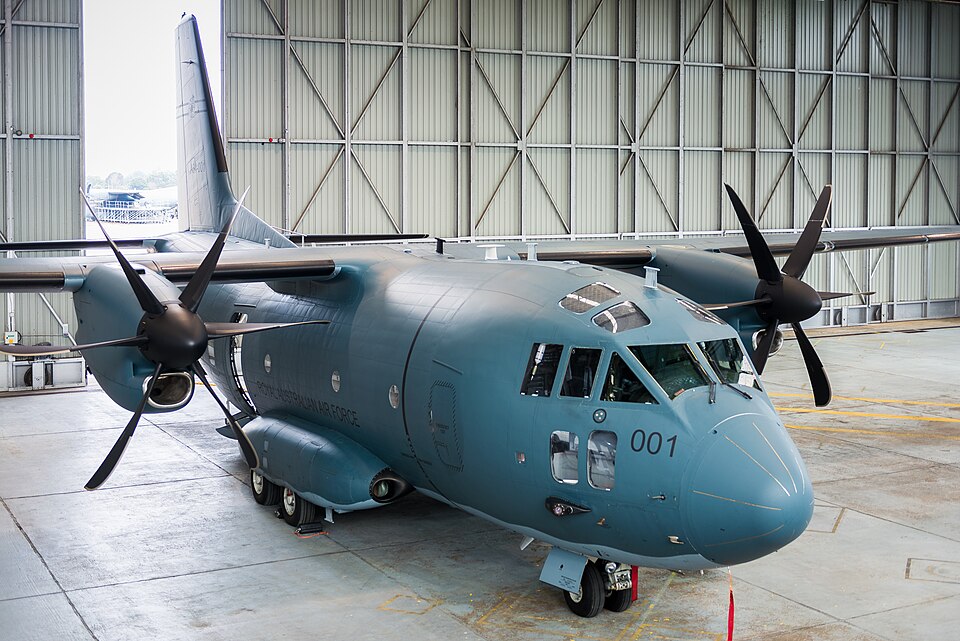 |
C-27J Spartan Tactical transport No. 35 Squadron |
Fleet10 | At Amberley since2019 |
Published fleet totals for Amberley-based squadrons. Aircraft also deploy and undergo maintenance elsewhere.
Also based here
Retired and former aircraft
Aircraft photo credits
Photos show the aircraft types at various locations. Thumbnails are resized with their proportions preserved.
- RAAF F/A-18F Super Hornet — Tech. Sgt. Amy Lovgren, US Air Force · Public domain.
- RAAF EA-18G Growler — William R. Lewis, US Air Force · Public domain.
- RAAF C-17A Globemaster III — Duan Zhu · CC BY 3.0.
- RAAF KC-30A tanker transport — Christian Turner, US Air Force · Public domain.
- RAAF C-27J Spartan — Hpeterswald · CC BY-SA 4.0.
- RAAF F-111 — Master Sgt. Kevin J. Gruenwald, US Air Force · Public domain.
- RAAF F-4E Phantom II — Kurt Finger · CC BY-SA 4.0.
- RAAF GAF Canberra bomber — US Air Force · Public domain.
- RAAF CH-47C Chinook — US Army · Public domain.
- CHC AW139 search and rescue helicopter — Bidgee · CC BY-SA 3.0 Australia.
- Air Force Cadets Diamond DA40 NG — CPL (AAFC) Edward Vincent / EFTS and Essendon aircraft spotters, via CONTACT.


F/A-18F Super Hornet
EA-18G Growler
C-17A Globemaster III
KC-30A Multi-Role Tanker Transport
C-27J Spartan
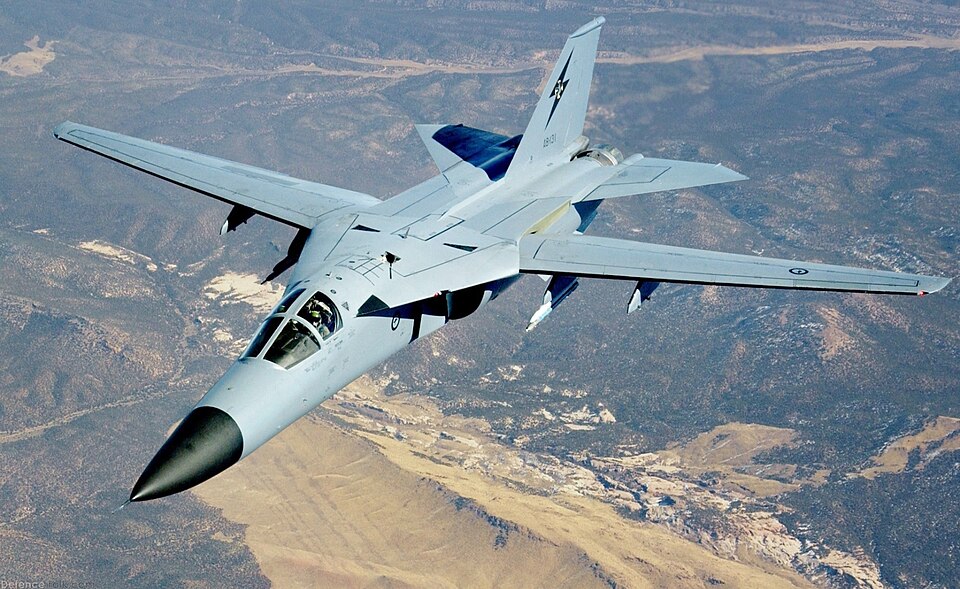
F-111
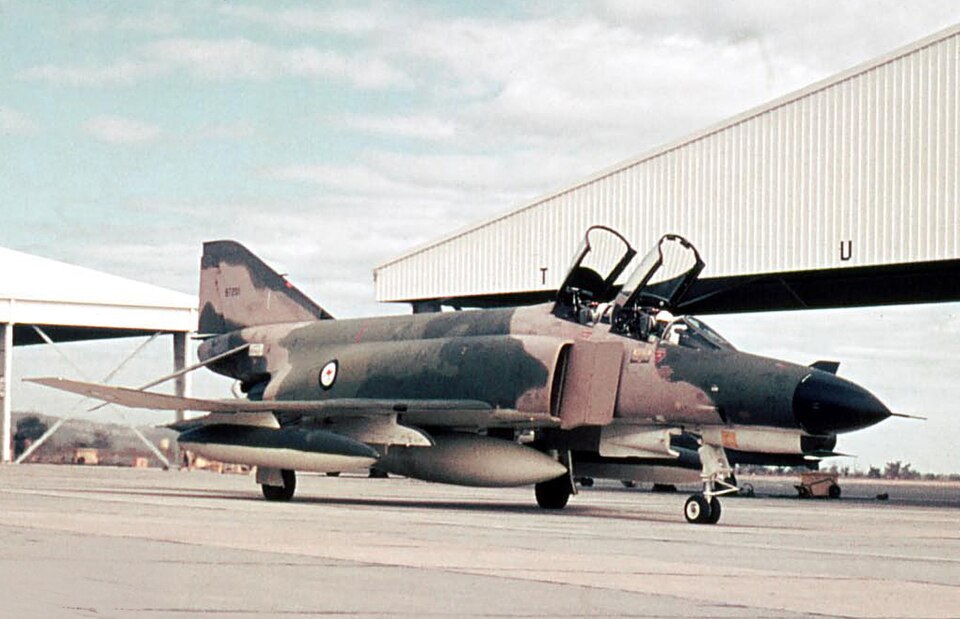
F-4E Phantom II
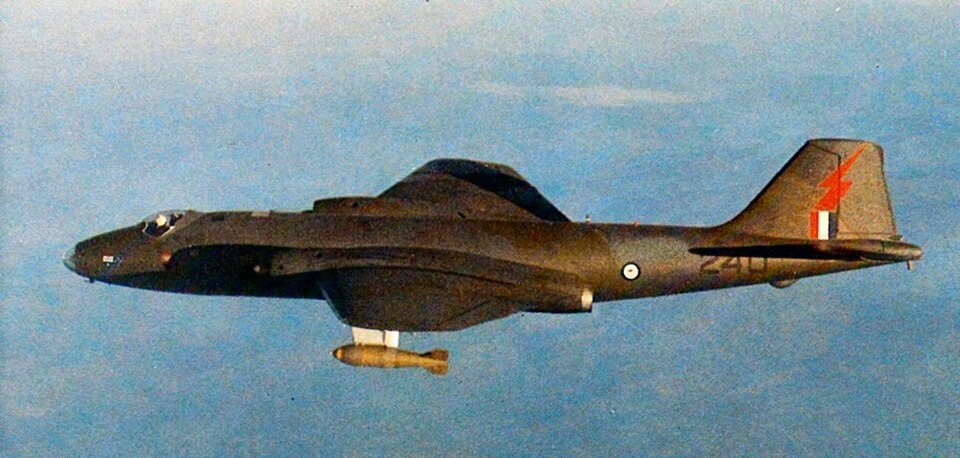
GAF Canberra
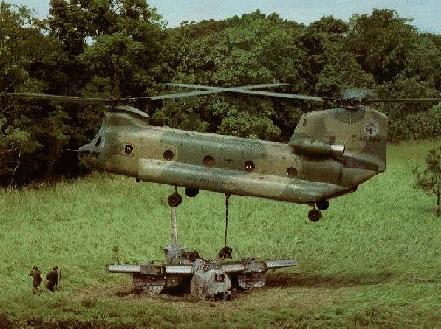
CH-47C Chinook
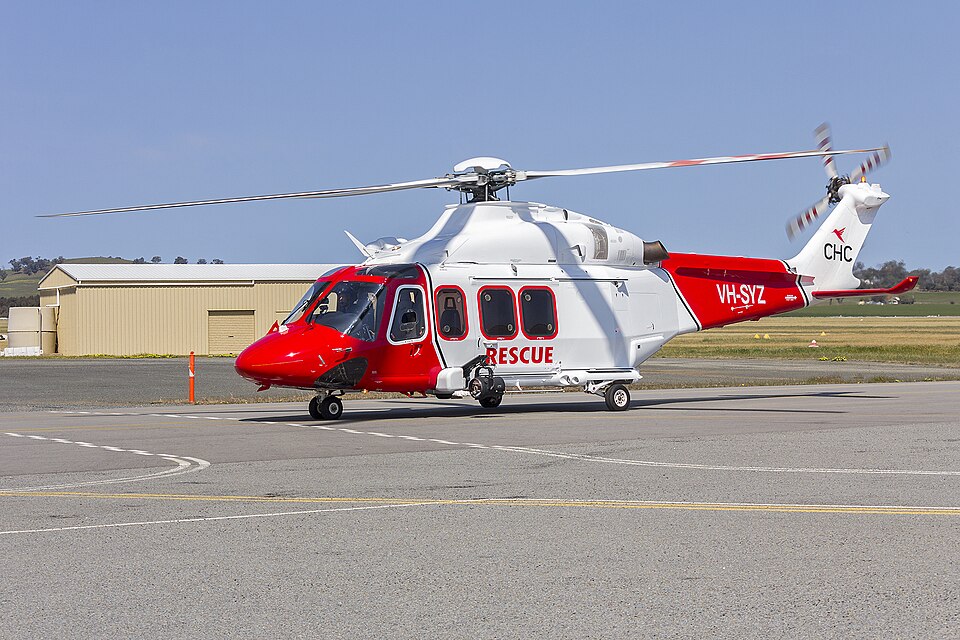
AW139

Diamond DA40 NG
Air traffic control
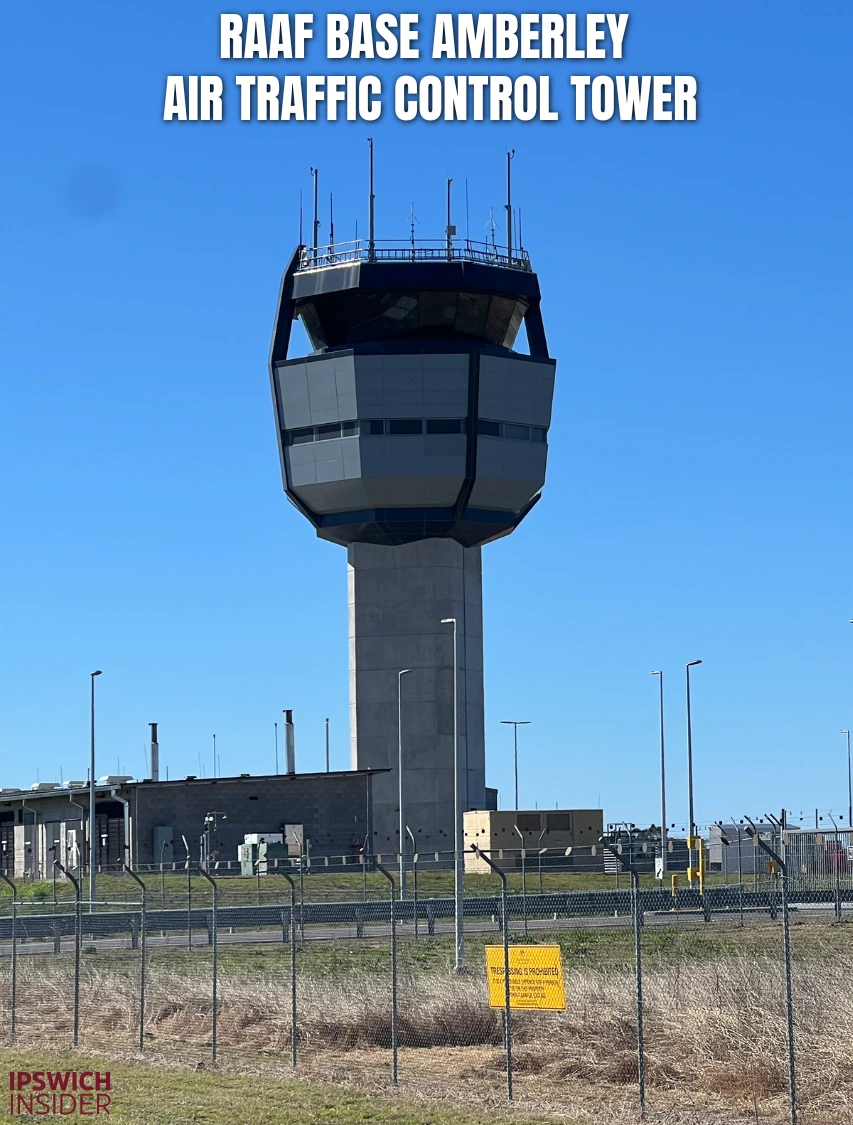
Amberley’s air traffic control tower from Ivor Marsden Sports Complex.
Across the runway from the hangars, the control tower overlooks the airfield. Amberley also provides training for air traffic controllers.
💡 Identifying jets by sound
Defence’s noise monitors recognise Super Hornets and Growlers by their sound signatures, helping count aircraft movements.
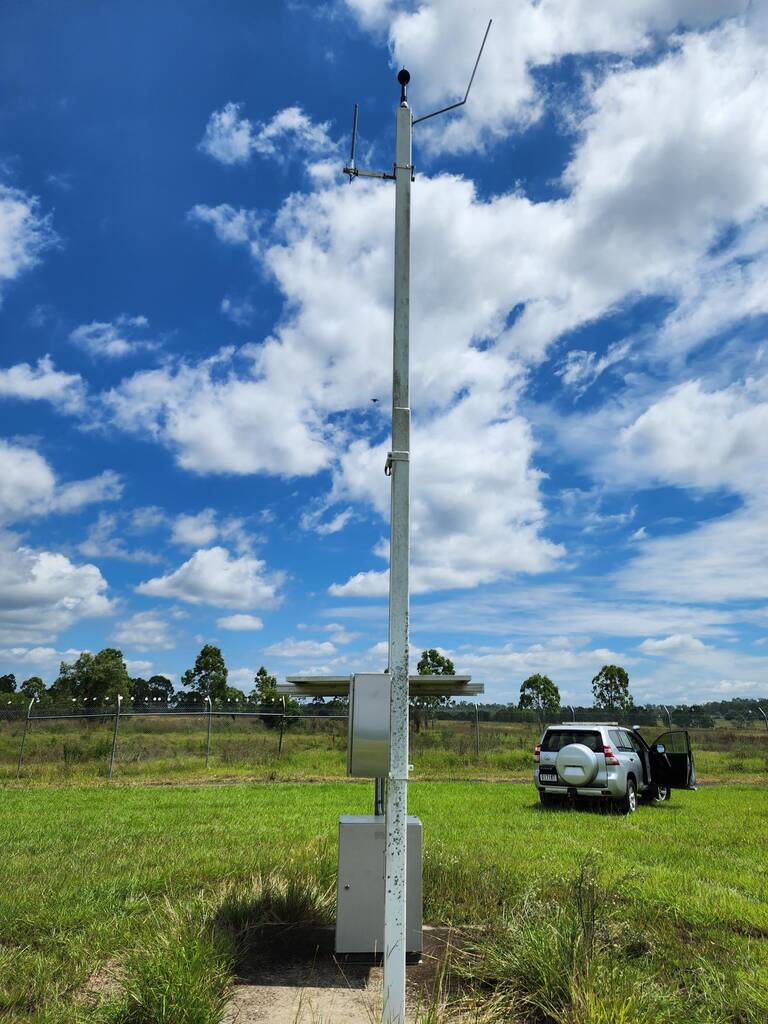
Example of an aircraft noise monitoring station from Casper’s Defence project. Photo: Casper. The pictured location is not specified.
4,900 m² — An aircraft maintenance hangar
The 36 SQN hangar (top right building in image above) has an uninterrupted floor area equivalent to 12 basketball courts. It accommodates a C-17 transport aircraft or a KC-30A tanker for maintenance.
💡 Aircraft refuelling from underground
The C-17 Globemaster parking apron has an underground hydrant system supplying aviation fuel.
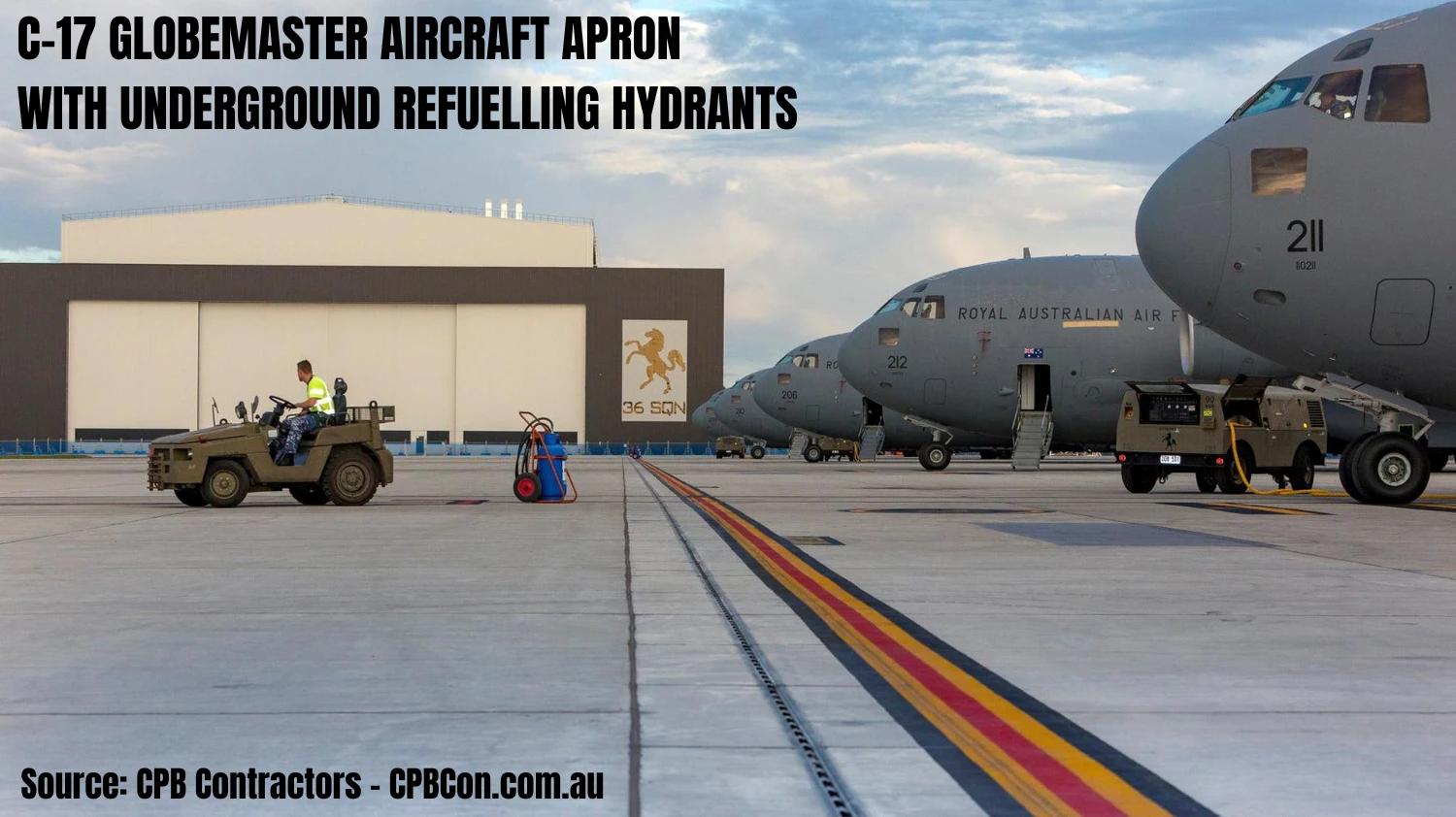
C-17 Globemasters parked outside 36 Squadron’s hangar. The apron has underground refuelling hydrants. Photo: CPB Contractors.
30 million litres — Estimated annual aviation fuel use
Our rough estimate works out to just over one 70,000-litre tanker load per day, averaged across a year. This is a volume comparison, not an actual delivery schedule or published Defence consumption figure.
20 weeks — Training an Air Force firefighter

Firefighters tackle a simulated aircraft fire at Amberley. Still from Defence Australia’s video.
Amberley hosts the Air Force’s only firefighting school. Trainees learn to tackle aircraft and building fires, rescue people from crashed vehicles and respond to hazardous materials.
3 — Fire training pads

The firefighting training area, with aircraft and building fire simulators. Mapping imagery: © Google (Google Maps).
The school’s three refurbished training pads reopened in 2026, giving crews places to practise responding to emergencies under controlled conditions.
1,000+ — Puppies bred for military work
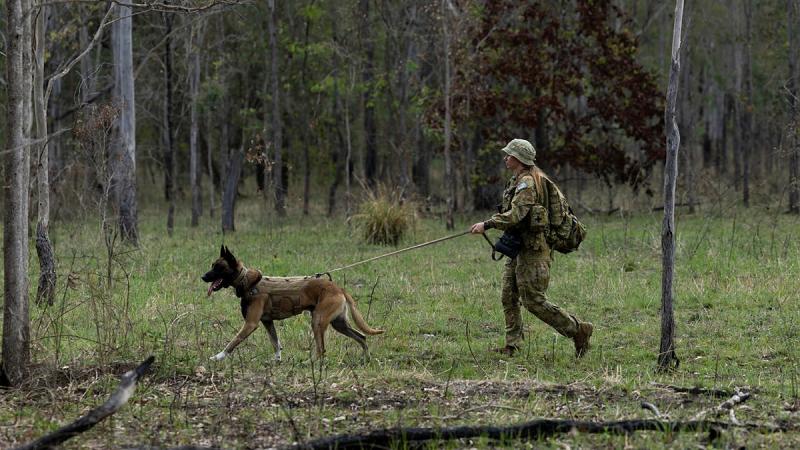
A military working dog and handler during Exercise Leopard Dawn 24 at Amberley. Photo: Defence.
Amberley’s dogs learn to detect and detain intruders, search buildings and patrol with handlers, protecting Defence personnel and aircraft. Graduates can serve at other bases and on overseas deployments.
Dogs at the training school live in kennels and dog runs at Amberley. Foster care is a temporary puppy stage, with military and civilian families taking pups home to help them socialise.
By 2020, Amberley had bred more than 1,000 puppies since 2003, with about half graduating. Dogs that don’t qualify are assessed for other roles, such as explosive detection or assistance work. If unsuitable for those too, they’re rehomed as family pets.
Can you visit RAAF Amberley?
You don’t need to be in Defence to visit Amberley’s Aviation Heritage Centre. Its four hangars house retired aircraft including an F-111, Canberra bomber and Black Hawk helicopter.
- When: Tuesdays, 9am–3pm, by appointment. Sunday open days are advertised separately.
- Book ahead: Submit the official booking request form at least seven days before your visit and wait for confirmation.
- Bring: Your booking confirmation, online base-induction completion email and the original photo ID listed in your booking.
Your visit covers the Heritage Centre. Access elsewhere on the working base requires approval and an escort.
Sources
- Royal Australian Air Force — aircraft profiles and fleet sizes
- Defence — The Heritage Values of RAAF Base Amberley: site selection and base history (PDF)
- Australian National Construction Review — Amberley redevelopment: dining, recreation and rainwater storage (PDF)
- CPB Contractors — C-17 hangar, backup power and underground aircraft refuelling
- Defence — Amberley Aircraft Noise Management Plan: average monthly aircraft movements (2022, PDF)
- Paynters — 6th Engineer Support Regiment: headquarters and earthmoving training area
- Defence — Australian Super Hornet Annual Noise Report 2024: identifying aircraft movements by sound (PDF)