
Updated 21 September 2026
Ipswich’s Rise at a Glance
- Population: Ipswich has more than doubled, from 128,646 residents in 2003 to 268,272 in June 2025. The median house price has climbed about 4.8×, from $192,500 in the March 2004 quarter to $915,000 in the June 2026 quarter. The latest medium projection puts the city at 411,439 residents by 2041.
- Industry: The region hosts the Southern Hemisphere’s largest automated distribution center (Coles) and Australia’s largest parcel hub (Australia Post). Separately, the $1.4B Ghost Bat program and Rheinmetall’s hub have established Ipswich as a premier defence export economy.
- New Cities: Master-planned cities have replaced traditional sprawl. Greater Springfield, an $85B project, established a regional CBD and hospital, while Ripley Valley is now the state’s fastest-growing corridor, converting 4,680 hectares for 131,000 future residents.
You YouTube? All our vids live here: Subscribe to Ipswich Insider on YouTube here →
🔢 By The Numbers

- 2.1× Ipswich population in June 2025 compared with 2003 (+109%)
- #1 Fastest-growing council area in Queensland (2024–25)
- 411,439 Projected Ipswich residents by 2041 (+53% from June 2025)
- 3.5% One-year population growth rate (2024–25)
- $915,000 Median house price (June 2026 quarter)
- ~4.8× House-price multiple since the March 2004 quarter
- $5.2b Army Boxer program total value at Rheinmetall Redbank Motorway Estate facility
- 4,000,000 Coles cases moved per week (#1 Witron robotics DC in Southern Hemisphere)
- 700,000 Parcels a day at AusPost (#1 in Australia)
- 5,500+ People working at Amberley base (#1 air base in Australia)
- +15.4% Ripley SA2 population growth (2024–25)
- 48,750 Homes planned in Ripley PDA
- $3.35b Ripley build wave unlocked (est.)
- $85b Greater Springfield City end value estimate
- 9,000,000 Orion visits per year
- $1.066b Ipswich Hospital Stage 2 build
- 200 New hospital beds being added
- $311m Nicholas Street Precinct investment
- 2,000,000+ Nicholas Street Precinct visits (12 months reported in February 2026)
- 85,000+ Cars/day on Centenary Bridge now
- 152,000 Centenary Bridge forecast by 2036
- 10,000–12,000 Trucks/day on Ipswich Motorway
- 3km Queue length at Amberley pinch point
Forget the old stereotypes.
In a little over 20 years, Ipswich didn’t just grow.
It exploded.
Since 2003, our population has more than doubled. Since 2004, house prices have climbed almost fivefold, and the “sleepy town” became a powerhouse.
We are now the industrial engine of Queensland. From building the Army’s Boxer combat vehicles to running the Southern Hemisphere’s largest automated distribution centre. The heavy lifting happens here.
We built entire cities from scratch. Springfield turned a failed forestry tract into an $85 billion master-planned project, while Ripley has officially become the fastest-growing development corridor in the state.
The rise isn’t coming…
…It’s already here.
With 411,439 residents projected by 2041, the transformation is undeniable.
Here is the story of the new Ipswich, told by the numbers.
More Ipswich Deep Dives
Ipswich LGA
Details
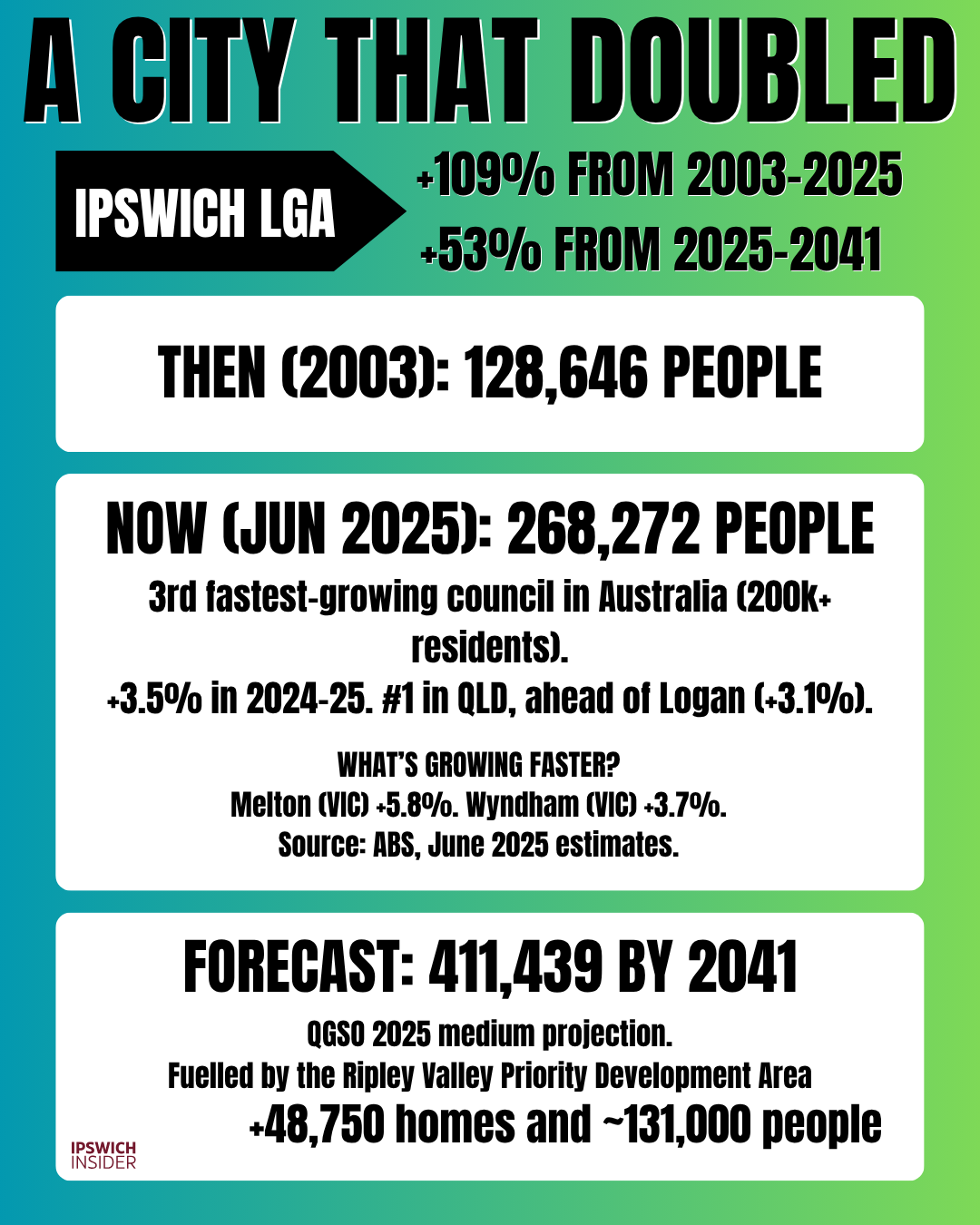
- Then: 128,646 residents (Jun 2003).
- Now: The ABS estimated 268,272 residents at June 2025, up about 109% from 2003. Growth in 2024–25 was 3.5%, the highest of any Queensland council area, ahead of Logan at 3.1%. Among Australian council areas with at least 200,000 residents at June 2025, Ipswich ranked third by growth rate, behind Melton (5.8%) and Wyndham (3.7%). Council’s separate, newer estimate puts the population at 274,582 in June 2026.
- Forecast: QGSO’s 2025-edition medium projection puts Ipswich at 411,439 residents by 2041 (about 53% above the June 2025 ABS estimate) and 480,856 by 2046.
Redbank Motorway Estate

Details
- Then: Rail Workshops, rail yards, and scrub.
- Now: Army’s $5.2b Boxer vehicle build (211 vehicles), plus mega logistics: Coles (up to 4 million cases a week), Australia Post (up to 700,000 parcels a day), and Officeworks (nearly 10× Bunnings floorspace in one shed).
- Forecast: More sheds + more automation. Estimate to 2040: ~0.55 million m² of floorspace (about 75 soccer fields) and ~5,000 jobs.
RAAF Amberley
Details
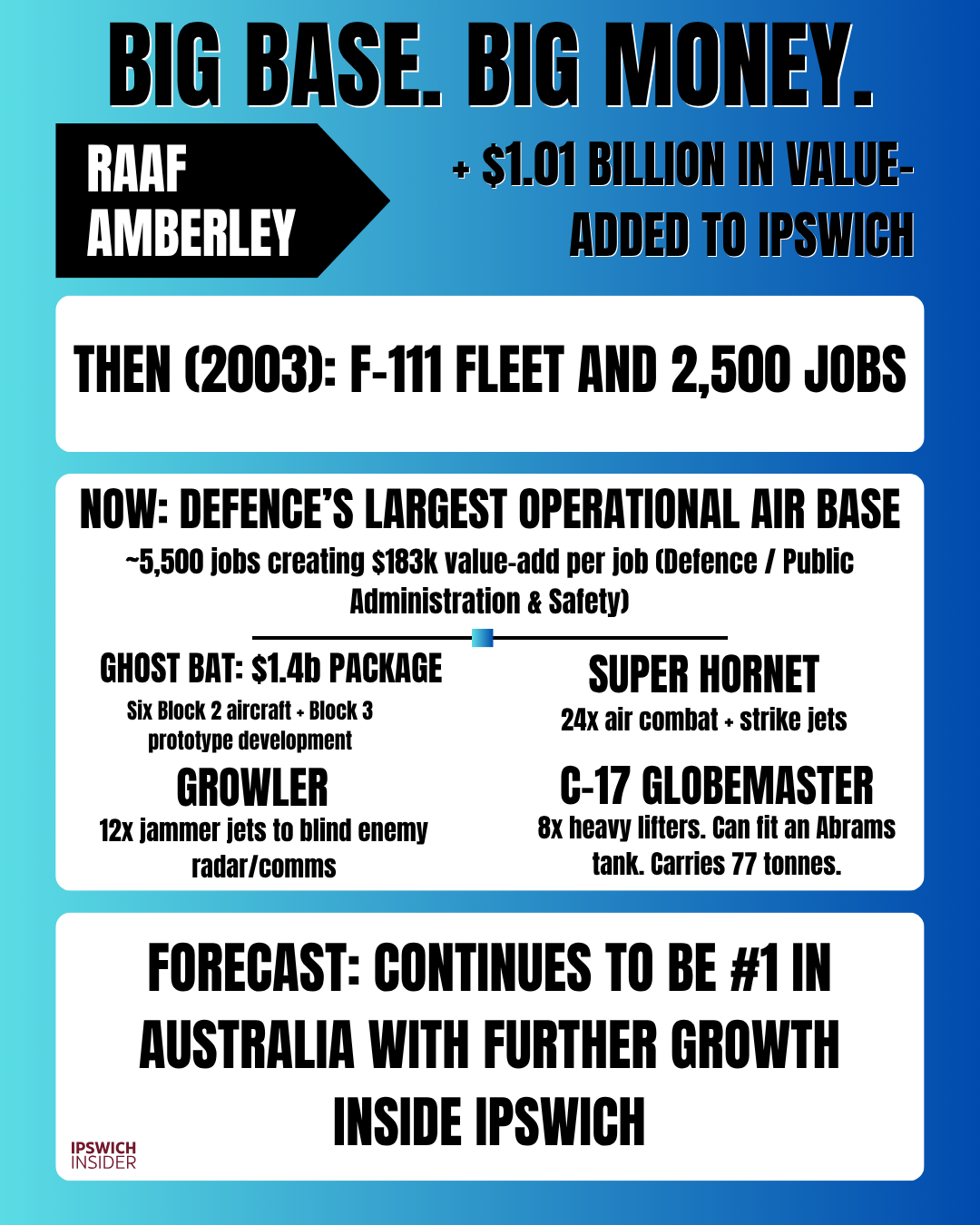
- Then: Smaller base focused on strike jets, with about 2,500 people on base (early 2000s).
- Now: Australia’s biggest operational air base with 5,000+ workforce. Key fleets here: Super Hornet fighters (24), Growler jammer jets (12), and C-17 heavy lifters (8).
- Forecast: The $1.4b Ghost Bat funding package announced in December 2025 includes six operational Block 2 aircraft and development of an enhanced Block 3 prototype, moving the program towards operational capability.
Ripley Valley Priority Development Area
Details
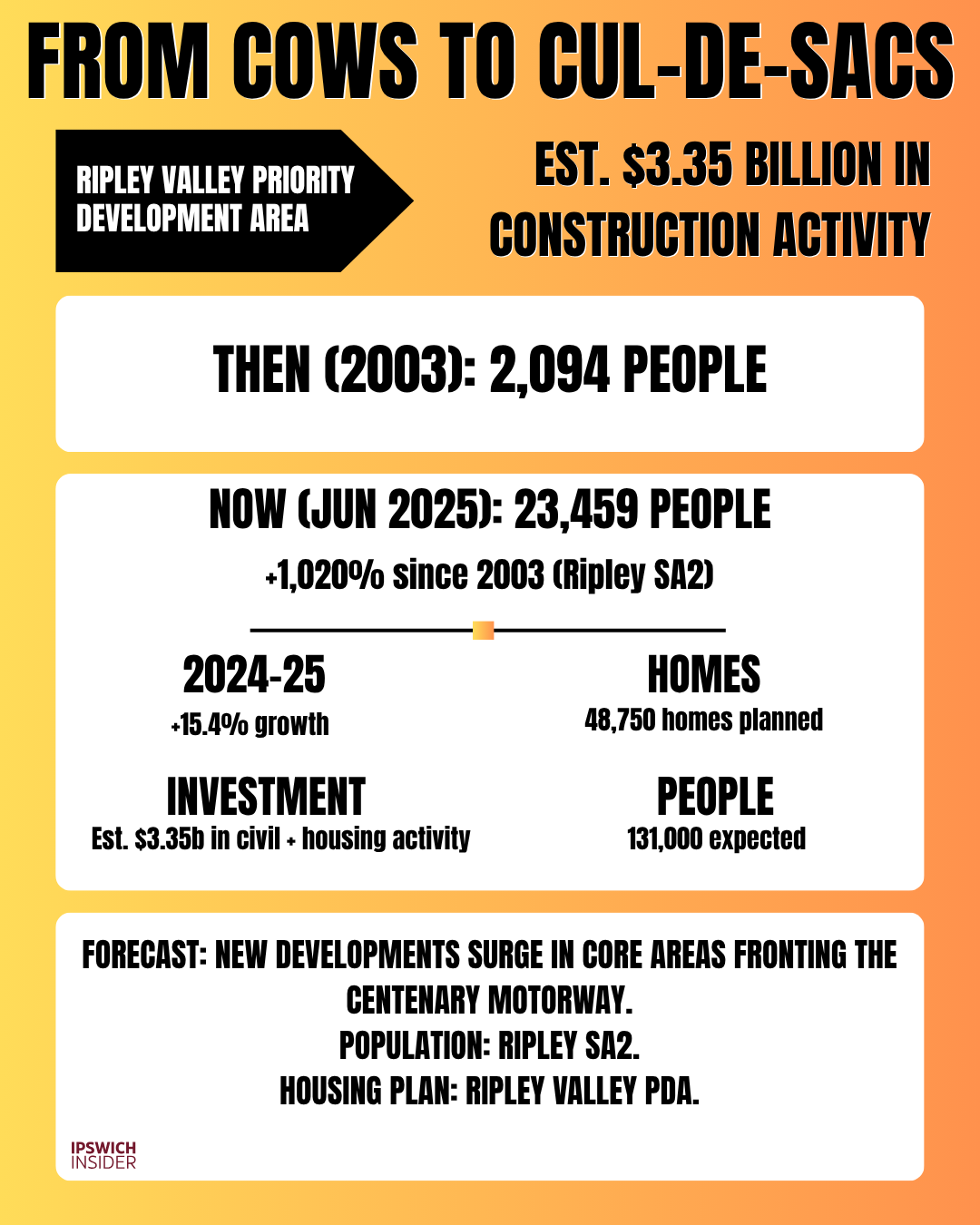
- Then: Ripley SA2 was 2,094 people (Jun 2003) and mostly rural.
- Now: Ripley SA2 had 23,459 residents in June 2025, up about 1,020% from 2003. It added 3,131 people in 2024–25 (+15.4%), the biggest SA2 population gain in Queensland. These population figures cover Ripley SA2, while the housing plan below covers the Ripley Valley PDA.
- Forecast: PDA plan: 48,750 homes for 131,000 people. 9,100 lots unlocked = ~$3.35b construction (civil + housing).
Greater Springfield
Details
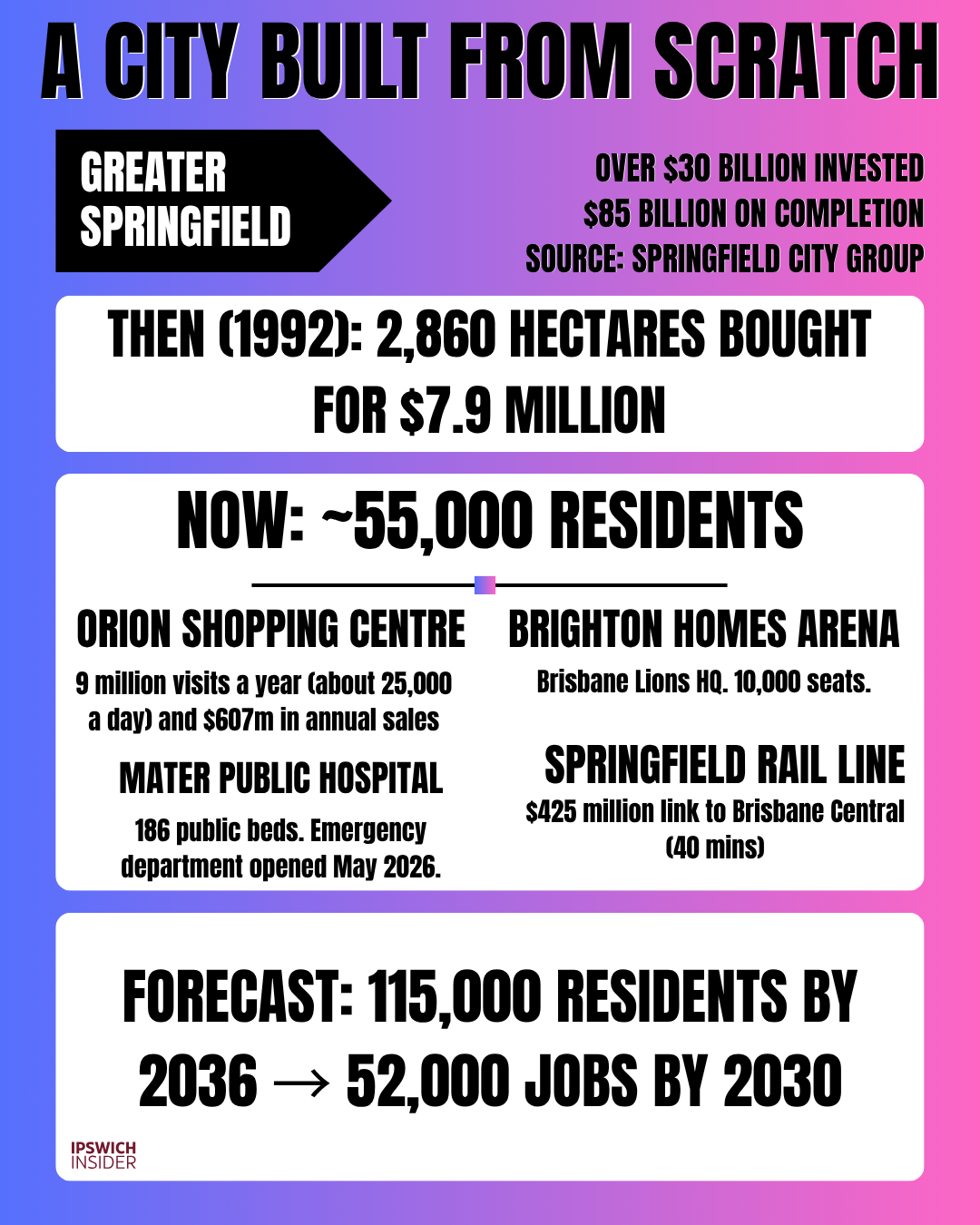
- Then: In 2003 there was no Orion, no rail line, and no hospital precinct.
- Now: Springfield City Group reports 55,000+ residents and more than $30b invested. Orion draws ~9 million visits a year. The new 186-bed Mater public hospital completed its phased opening in May 2026, including its emergency department.
- Forecast: End build-out estimate is $85b. Jobs target is 52,000 by 2030 (Springfield City Group).
Ipswich Central

Details
- Then: In 2003 the CBD was losing retail pull and Riverlink had not opened yet.
- Now: The CBD population figure was 6,920 in June 2024. Council now describes Nicholas Street Precinct as a $311m redevelopment. Ipswich Hospital Stage 2 remains a $1.066b expansion adding 200 beds and a new emergency department.
- Forecast: Hospital Stage 2 construction is expected to finish in 2028. An earlier planning forecast put the CBD population at 16,936 by 2041 (+145% from June 2024). North Ipswich Sport & Entertainment Precinct has $40m Stage 1 funded.
Ipswich Housing Market

Details
- Then: Median house price was $192,500 (Mar 2004 quarter).
- Now: REIQ reports a median house sale price of $915,000 for the June 2026 quarter, about 4.8× the March 2004 median. That is an increase of $722,500, or about 375%. For a suburb comparison, realestate.com.au reports 12-month house medians of $1,580,000 in Brookwater and $750,000 in Moores Pocket for September 2025 to August 2026. Moores Pocket’s figure is based on just three sales. These suburb figures cover a full year, while the citywide figure above covers one quarter.
- Forecast: From the June 2025 ABS estimate, Ipswich is projected to add about 143,000 residents by 2041 (+53%), increasing demand for homes and services.
Ipswich Demographics

Details
- Then: Ipswich was a smaller city at 128,646 residents (Jun 2003).
- Now: Using the 2021 Census figures, Ipswich’s median age was 33. There were 63,016 residents aged 17 and under, representing 27.5% of the population (SEQ average: 22.3%).
- Forecast: Ipswich is projected to reach 411,439 residents by 2041, about 53% above its June 2025 population. Youth services and schools will need to keep pace.
Roads and Rail
Details
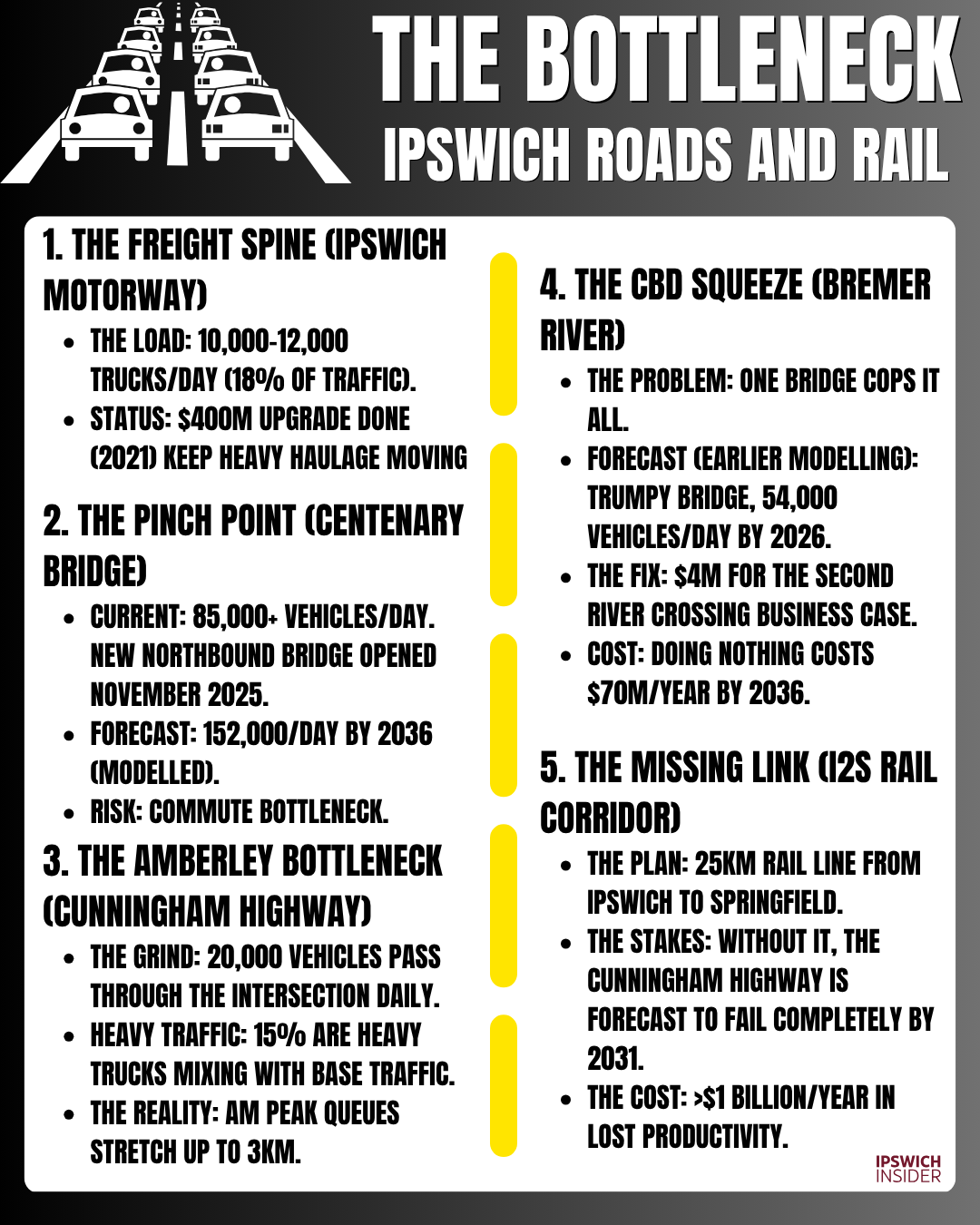
- Then: Big upgrades arrived in waves: Ipswich Motorway widenings completed in 2010 and 2012, then a $400m Rocklea–Darra upgrade completed in 2021.
- Now: The new northbound Centenary Bridge opened in November 2025. The crossing’s reported traffic volume is 85,000+ vehicles/day. Ipswich Motorway carries 10,000–12,000 heavy vehicles/day in key sections. Amberley intersection carries ~20,000 vehicles/day with queues up to 3 km.
- Forecast: Centenary Bridge is modelled at 152,000/day by 2036. “Do nothing” cost is estimated at >$1b per year. I2S corridor has been protected since 2007 and is the long-term relief option.
Sources
Text and key figures updated in September 2026. Population estimates, projections, Census results and property prices refer to the dates specified below.
- Population & Demographics: ABS Regional Population 2024–25, RDA Ipswich & West Moreton’s Ipswich profile, Council’s 2025–26 activity report and QGSO Population Projections, 2025 edition (medium series for the citywide forecasts). Demographic Census figures refer to 2021. The older CBD planning forecast is identified separately.
- Housing Data: The June 2026 quarterly median is from REIQ’s June-quarter 2026 release, using Cotality data. The historical March 2004 median is retained from the earlier CoreLogic / Pricefinder series.
- Infrastructure Costs: Traffic volumes sourced from TMR QLD Traffic Census. Economic impact figures (e.g., the $1B productivity cost for I2S and $70M for CBD congestion) are cited from Infrastructure Australia Priority List submissions and Ipswich City Council Strategic Business Case summaries.
- Project updates: Ipswich City Council on Nicholas Street Precinct, West Moreton Health on Ipswich Hospital, Springfield City Group’s economic overview, Mater’s hospital opening update, BMD’s Centenary Bridge opening announcement and Defence’s December 2025 Ghost Bat announcement.
- Industry & Employment: Employment figures for RAAF Amberley, Rheinmetall, and Coles/AusPost distribution centres are based on public corporate announcements and Defence annual reporting.