
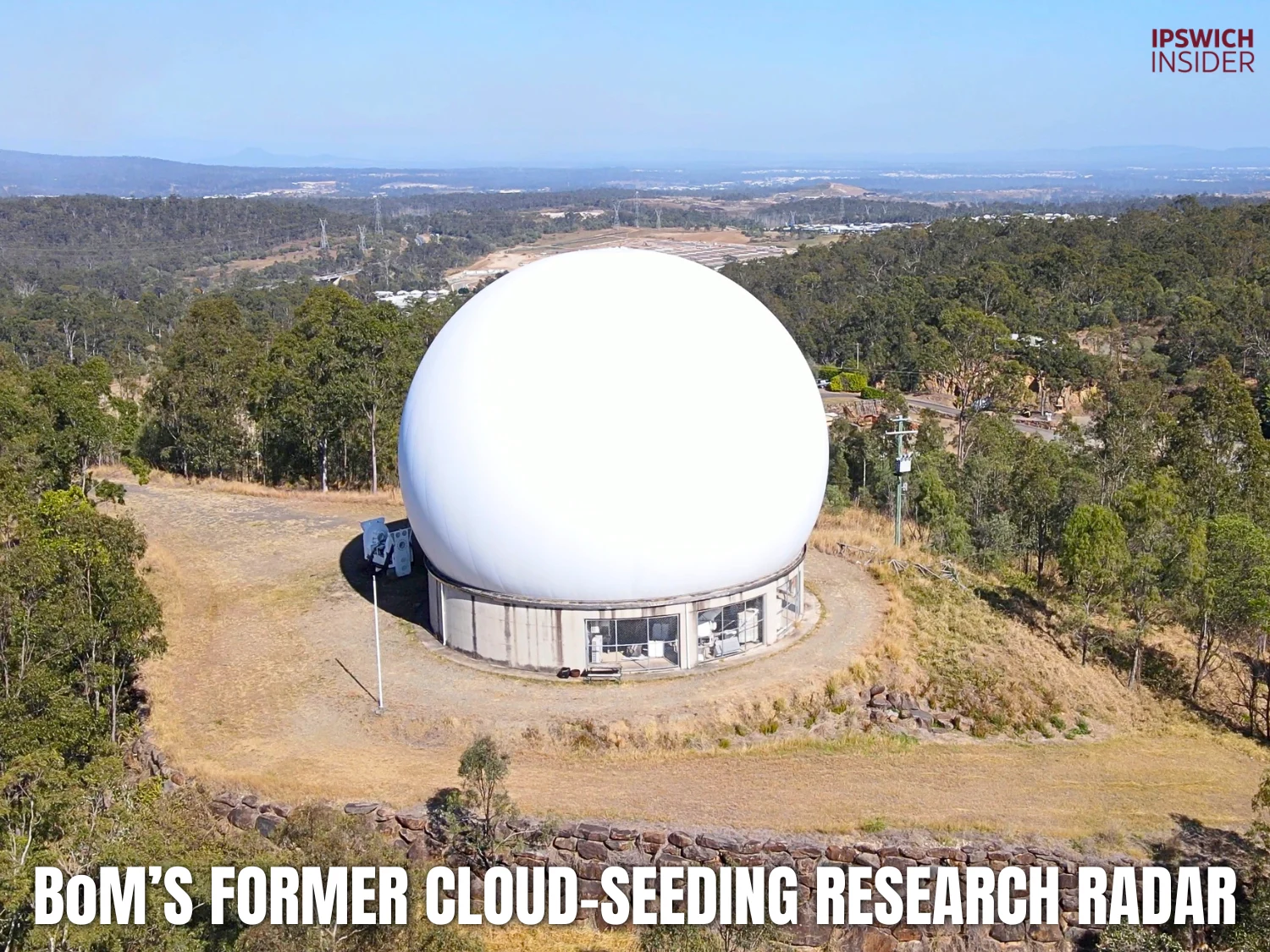
Redbank Plains’ CP2 radar dome sits atop Mt Juillerat, on the 83-hectare Hardrock Quarry property. Its base sits at 188 m AHD.
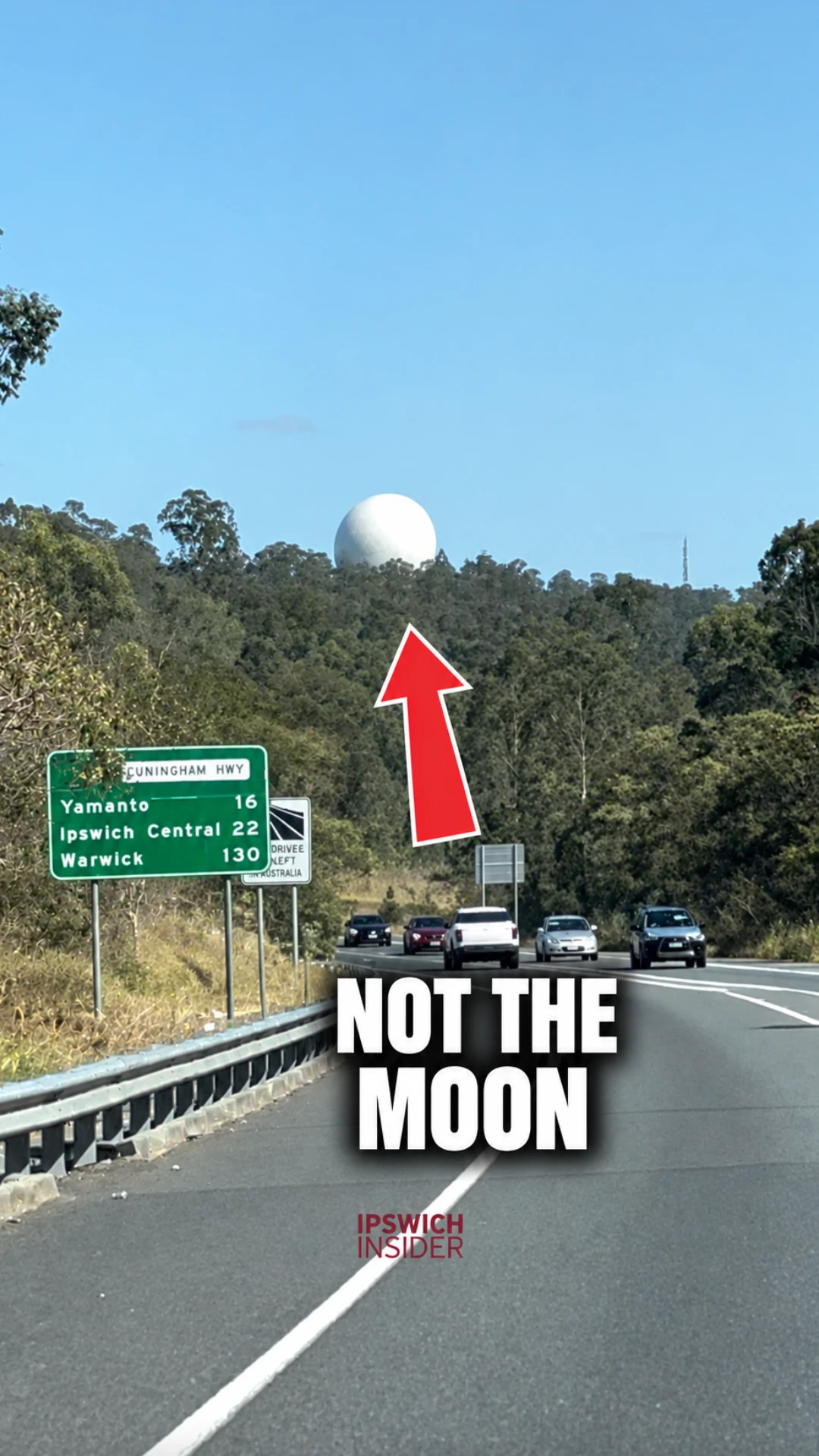
Redbank Plains Radar at a Glance
- Research radar: The white dome housed BoM’s CP2 radar (CP2→Cloud Physics 2). Built in 1970s America and later refurbished for Australia.
- Cloud seeding: It tracked clouds seeded by aircraft during the 2007–09 trials, which didn’t establish a clear increase in rainfall.
- Switched off: Radar operations ended in late 2016. The dome remains on private land at Hardrock Quarry.
- Why there: An open hilltop, 500m+ from the nearest homes, suited to studying the region’s severe storms.
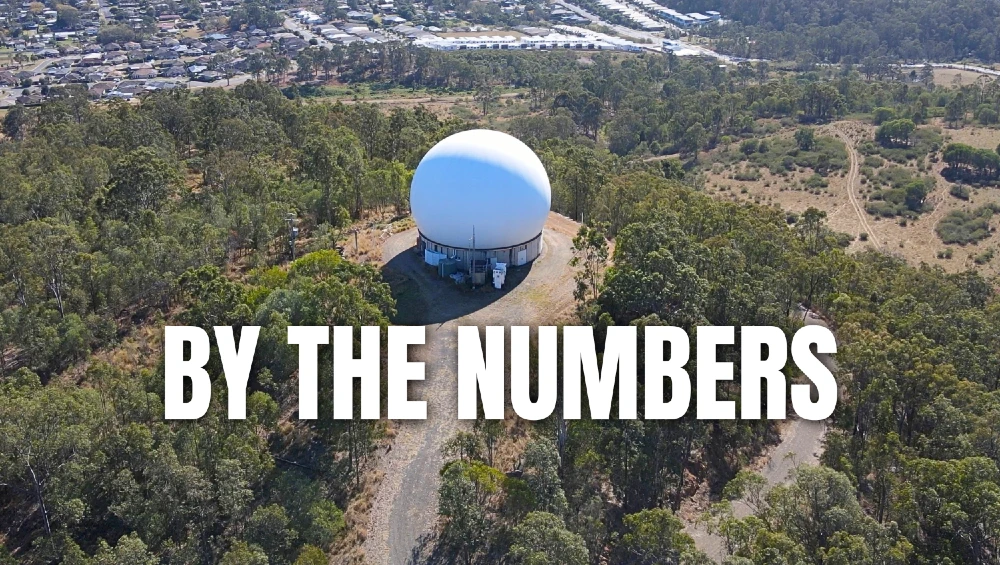
🔢 By The Numbers
- 21 m – Approximate diameter of the white dome.
- 188 m AHD – Elevation at the dome’s base.
- 8.5 m – Diameter of the main radar dish.
- 2 × 2.4 m – Smaller dishes above the main antenna.
- 13+ tonnes – Weight of the antenna structure.
- 2 blowers – Kept the fabric dome inflated.
- 360° – Could scan all the way around.
- 90° – Could tilt to look straight up.
- 10.7 cm and 3.2 cm – Its two radar wavelengths.
- 1.2 megawatts – Main radar’s peak transmission power.
- 6 minutes – Between full scans when running unattended.
- $2.5 million – Original research centre project cost.
- $750,000 – Cost to acquire and refurbish radar.
- 1970s – Radar instruments built in America.
- December 2006 – Installed at Redbank Plains.
- Late 2016 – Radar operations came to an end.
You know that giant golf ball-looking thing you see while driving along the Centenary Highway?
The one up on the hill near Redbank Plains and White Rock?
What even is that?
It’s not a telescope, and it’s not an active rain radar.
So why was it put there? What’s inside? And were scientists really trying to make it rain?
Let’s find out:
1. Meet the CP2 research radar

The familiar white dome seen from the Centenary Highway near Redbank Plains.
It’s not a UFO, a telescope or a machine that pushes storms away from Ipswich. It’s also separate from the weather radar at Marburg.
- Identity: The white sphere is a protective cover, called a radome, built to house the Bureau of Meteorology’s CP2 research radar.
- Name: CP2 stands for Cloud Physics 2.
- Purpose: Scientists used it to study thunderstorms, improve rainfall measurements and hail detection, and investigate cloud seeding.
2. From 1970s America to Ipswich
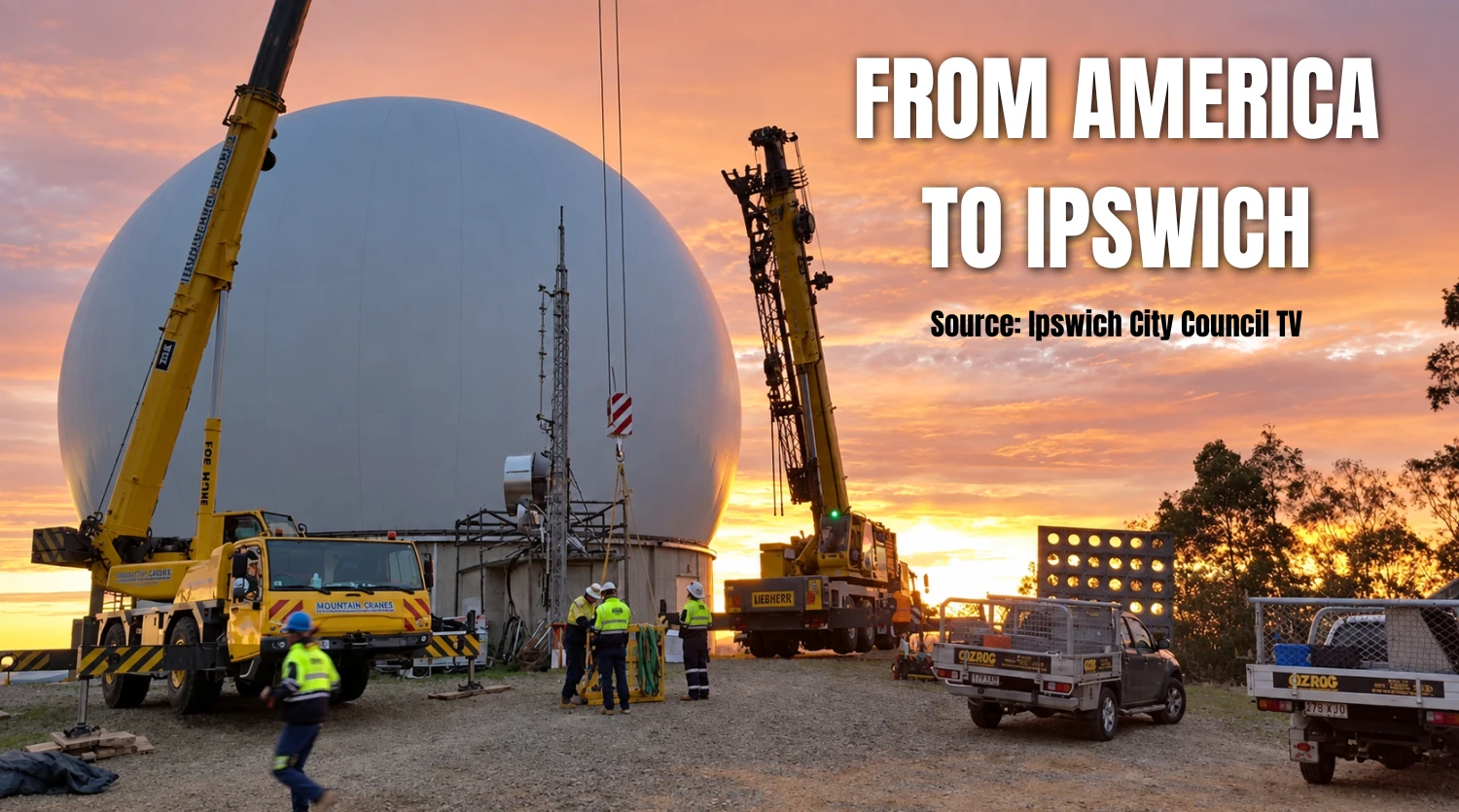
Cranes and workers beside the CP2 radar dome at sunset. Source: Ipswich City Council TV
The instruments had a working life before reaching Ipswich. CP2 was built in America in the 1970s, then refurbished and shipped to Australia.
- Origins: It was developed for hail and precipitation research during America’s National Hail Research Experiment. The US National Center for Atmospheric Research, or NCAR, supplied it for the Australian project.
- Upgrade: Engineers overhauled its electronics, signal processing and antenna controls. The refurbished radar could make sophisticated measurements despite the age of the original equipment.
- Arrival: Installation at Redbank Plains took place in December 2006. The first observations described in the technical report followed in June 2007.
3. Why Hardrock Quarry?
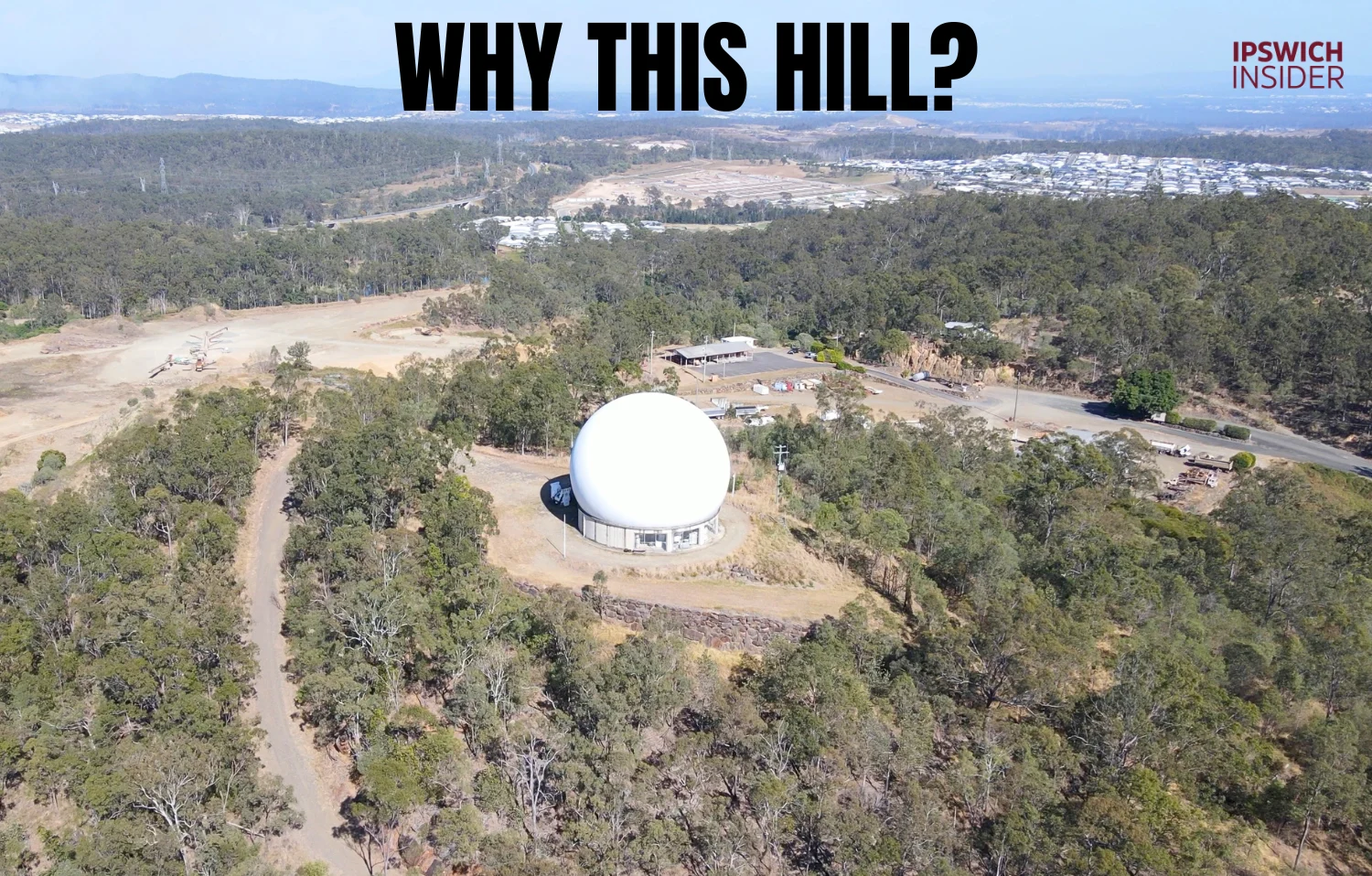
The CP2 dome on the Hardrock Quarry property, with surrounding bushland and suburbs. Drone photo: Ipswich Insider.
The hill is Mount Juillerat, part of the privately owned Hardrock Quarry property.
- Land: The quarry property is held through the Vic Cumner Trust. BoM’s role was operating the research radar on that privately owned land.
- Storms: At the time, BoM scientist Dr Tom Keenan explained that severe thunderstorms passed through the area. The centre would help researchers study how they formed and moved.
- Hazards: Hail, flash flooding and strong winds were particular interests. The aim was to use those observations to improve forecasting technology.
4. The cloud-seeding experiment
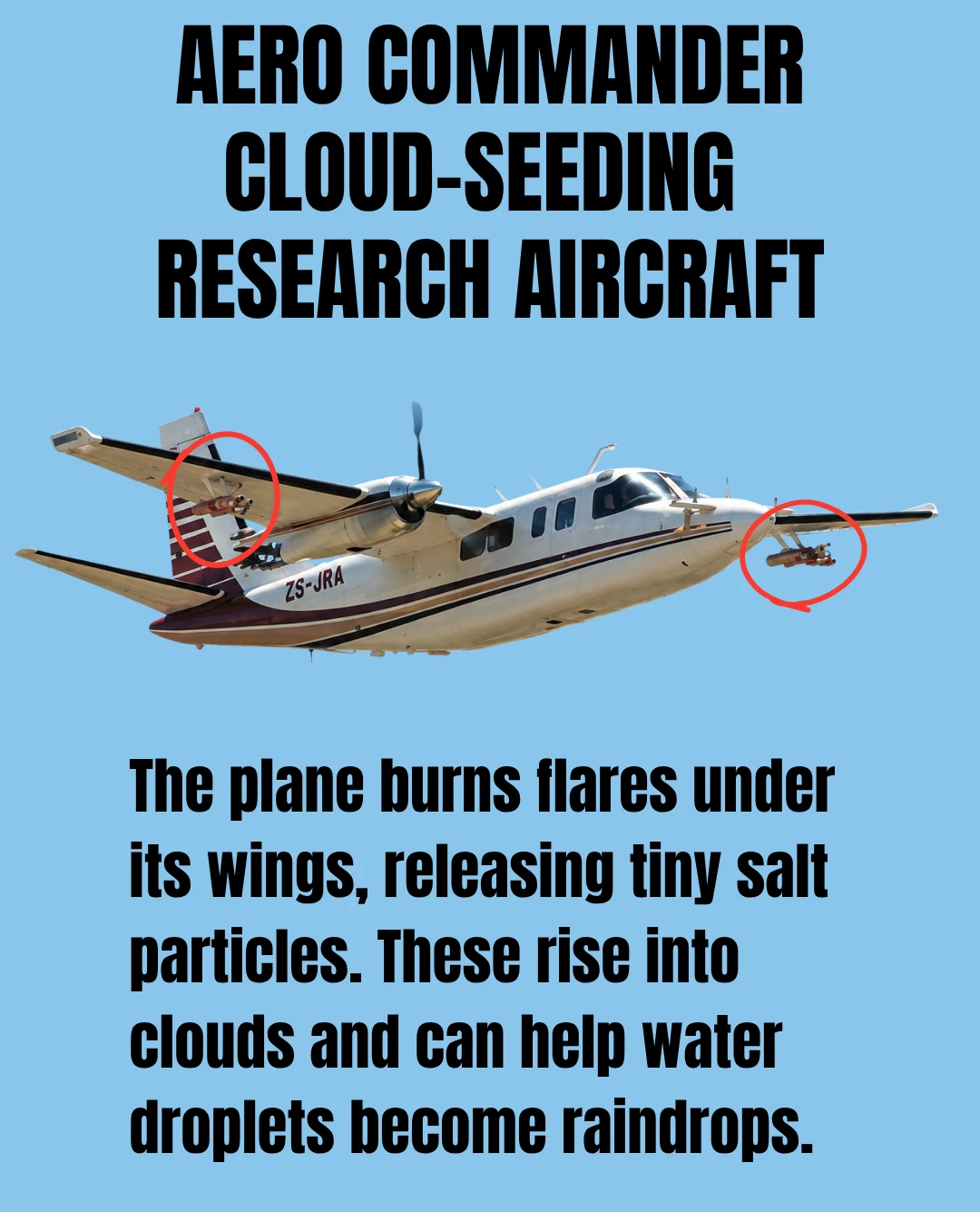
The Aero Commander was used for research and cloud seeding during the Queensland trials. Photo: Scott Collis / CAWCR.
During drought and water shortages, Queensland funded research into whether cloud seeding could boost rainfall. CP2 helped scientists assess what happened to the clouds.
- Timing: The fieldwork ran across the 2007–08 and 2008–09 wet seasons.
- Aircraft: In the randomised trials, planes burned special flares near cloud bases. These released moisture-attracting particles into rising air, aiming to help droplets grow and combine.
- Radar: CP2 tracked the clouds’ development and measured what was happening inside them. The aircraft carried out the seeding.
- Comparison: The initial statistical analysis included 39 suitable cases: 19 seeded and 20 unseeded.
- Results: The trials didn’t establish a clear increase in rainfall. The small sample and natural differences between clouds made the findings difficult to interpret.
5. A giant dome held up by air
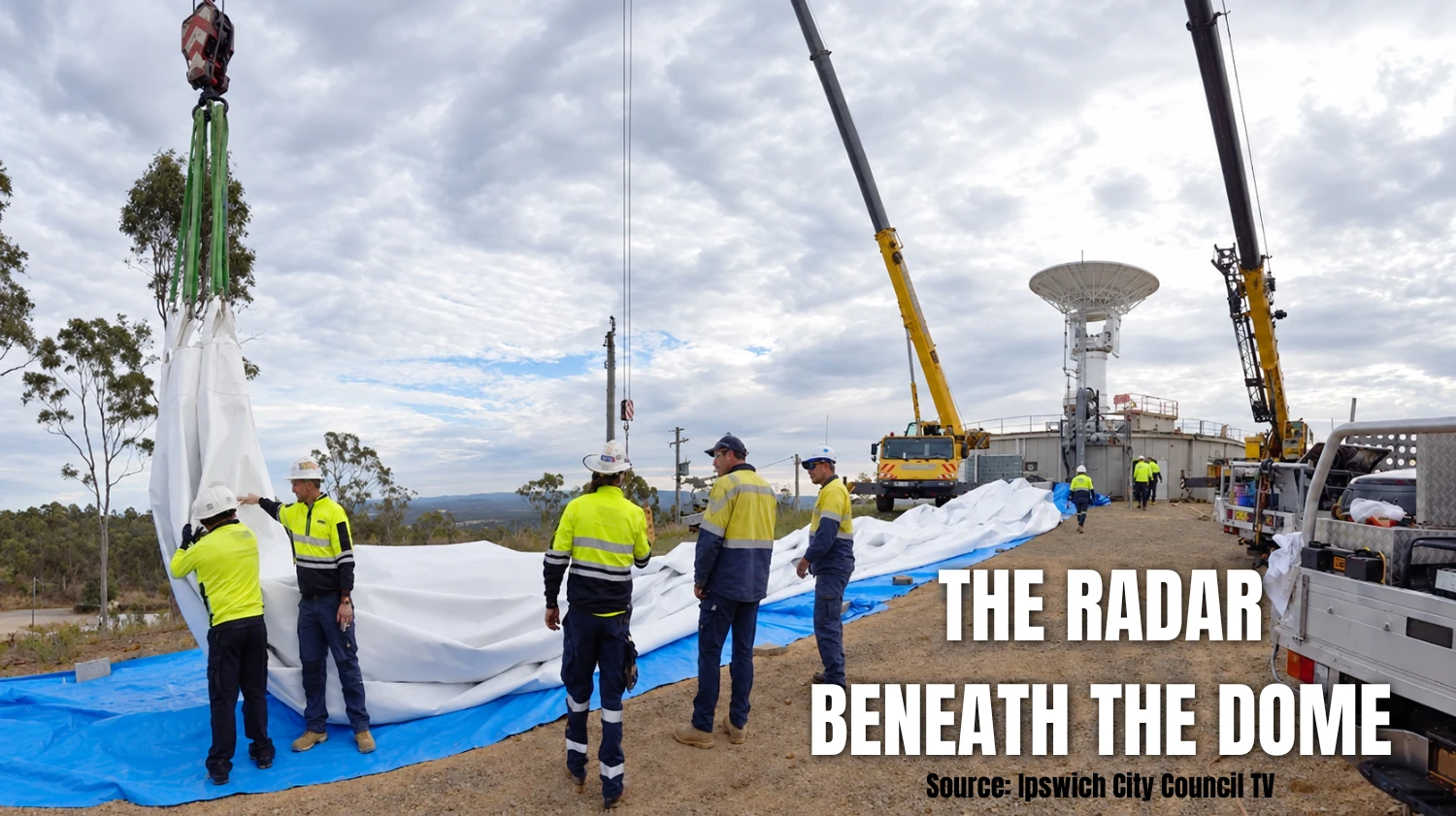
The radar is visible while workers handle the dome’s fabric cover. Source: Ipswich City Council TV
The original research-centre project was reported to cost $2.5 million. Most of that went into site works and infrastructure, with the radar supplied through the BoM–NCAR partnership.
- Equipment: Acquiring and revamping the radar technology accounted for about $750,000, according to the report.
- Size: The white cover is approximately 21 metres in diameter.
- Fabric: The sphere is an inflatable fabric enclosure protecting the radar equipment. It gets its shape from air pressure.
- Blowers: The design uses a primary air blower, with a second, more powerful blower fitted to increase pressure during strong winds.
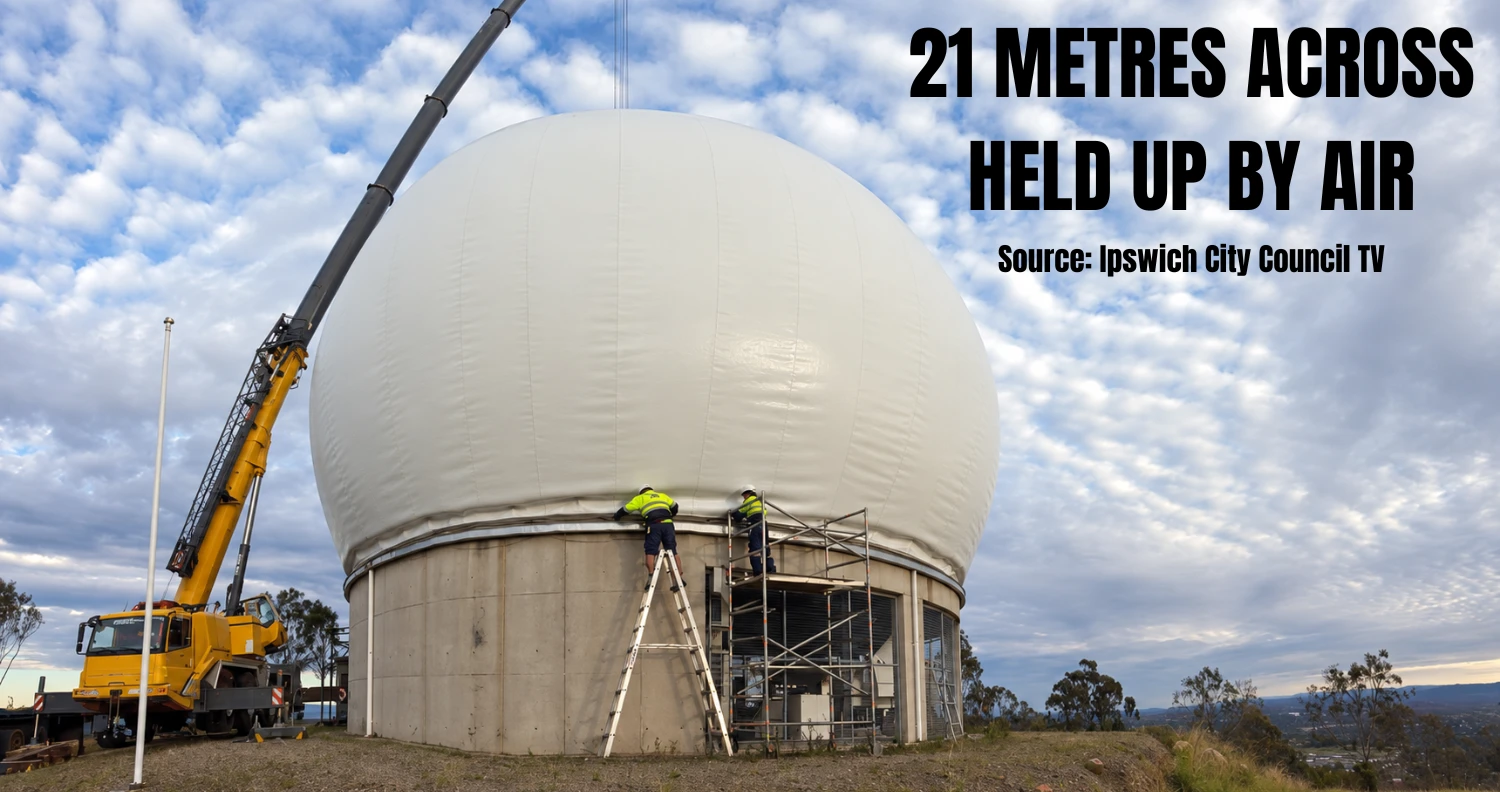
The inflated fabric cover above the radar building. Source: Ipswich City Council TV
6. What was inside the white ball?
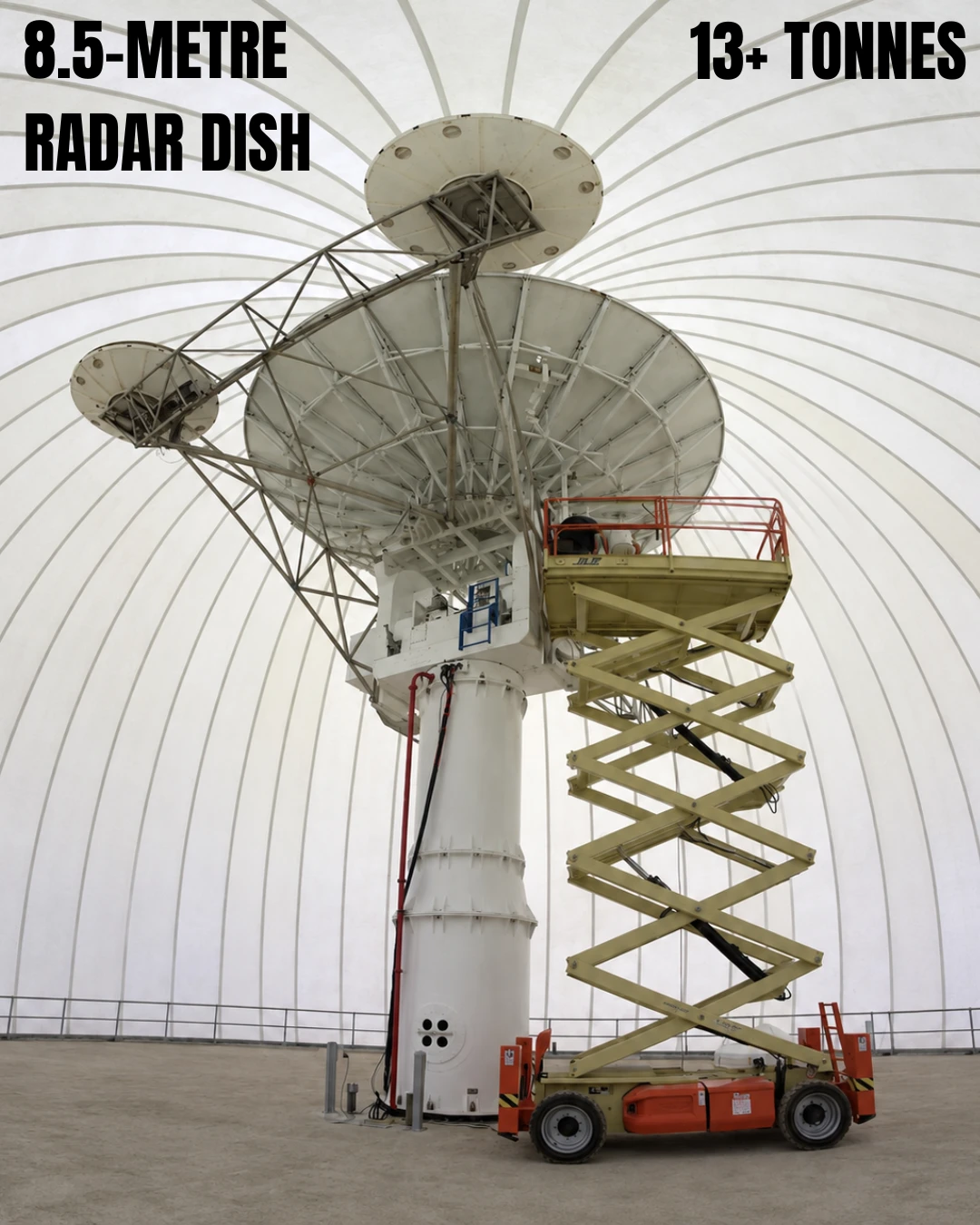
The main dish and two smaller antennas inside the dome during installation. Source: 2007 CP2 technical paper.
Inside was a large antenna system, with more equipment and working space below. The historical photo gives us a look at the installation during its research years.
- Dish: The main antenna measured 8.5 metres across, with two smaller 2.4-metre antennas mounted above it.
- Measurements: It sent out radio waves and analysed the returning signals. By using horizontal and vertical polarisation, it helped scientists distinguish between different kinds of precipitation, including rain and hail.
- Workspace: There was office space beneath the antenna pedestal, along with the transmitter and receiver equipment. So yes, people could work underneath that enormous dish.
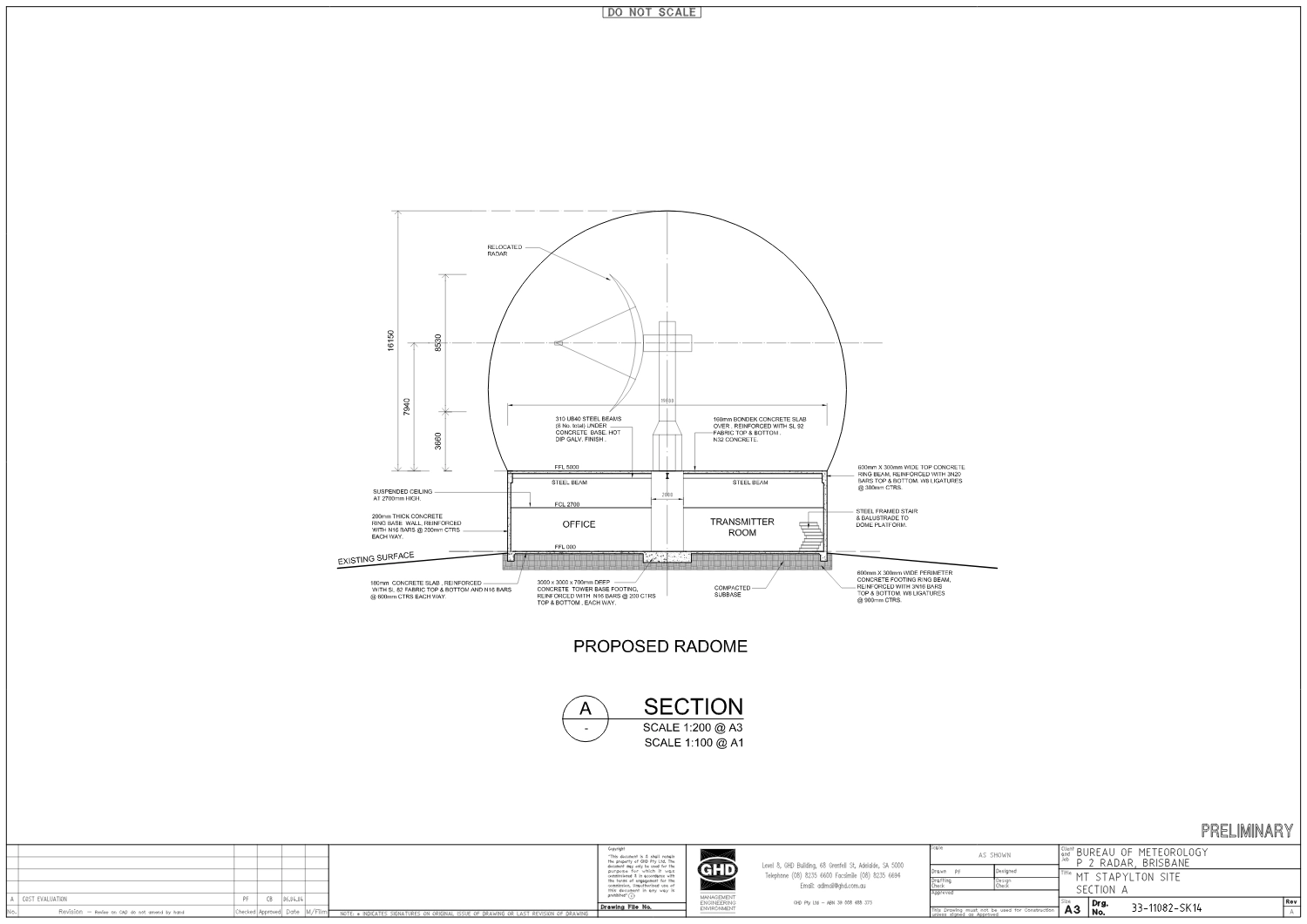
GHD’s preliminary CP2 design shows an office and transmitter room beneath the radar. Drawing 33-11082-SK14. Click the drawing to enlarge.
7. What happens there now?

The white dome remains at Redbank Plains in 2026. Radar operations ended in late 2016. Drone photo: Ipswich Insider.
BoM stopped operating the radar in late 2016, saying it had completed its research mission. The white dome remains a familiar landmark on the hill.
You’ve surely seen it from some vantage around Ipswich?
- Parts: In 2017, BoM said reusable components were being packed for return to NCAR as spare parts.
- Today: We haven’t confirmed exactly what equipment remains inside or whether the compound has another use.
- Access: The dome stands on private land. A visit would need to be arranged with the site’s owner or authorised operator. We haven’t confirmed any public tours.
Sources
- Sunday Creek—The CCOPE Operations Center. journals.ametsoc.org
- What on earth is that thing on the Centenary Highway? ipswichfirst.com.au
- Rationale and Use of the CP2 Testbed in Brisbane, Australia. ams.confex.com
- Aboriginal artifacts found on development site. ipswichtribunetoday.com.au
- An eye on our storms. qt.com.au
- Overview of the Queensland Cloud Seeding Research Program. journalofweathermodification.scholasticahq.com
- Antenna Pattern Analysis and Measurements for Multiparameter Radars. journals.ametsoc.org