

Ipswich Urban Legends at a Glance
- Top 9: Sharks swimming in flooded streets. Goodna Cemetery haunted angel. Castle reappears as steam. Amberley UFO sightings. Secret CBD tunnels. Pine Mountain panthers. Redbank Plains yowies. Storms dodge Ipswich bubble. Ghost at Old Flour Mill.
- Truth meter: 5-point Fact→Folklore scale. 1 = fact. 5 = folklore.
- What makes these legend stick? SUCCES method: A framework explaining why some stories spread. We use it to rate each legend’s stickiness from 0 to 6. Simple clear core. Unexpected surprise. Concrete vivid details. Credible believable cues. Emotional feelings that drive sharing. Story retellable narrative.
🌍 World‑Famous Urban Legends
- 🛁 Kidney Heist: Wake up in a bathtub of ice with your kidney missing
- 👻 Vanishing Hitchhiker: Ghost passenger disappears mid‑ride
- 🪞 Bloody Mary: Say her name in the mirror to summon her spirit.
- 🐊 Sewer Alligators: Gators thriving under big cities
- 🔪 Killer in the Backseat: Flashed lights warn of hidden attacker in your car.
🧪 Truth Meter Key

- 1 Fact: Solid evidence
- 2 Likely: Strong support
- 3 Plausible: Unverified
- 4 Unlikely: Folklore‑leaning
- 5 Folklore: No evidence
📍 Ipswich Urban Legend Locations
- Sharks: Goodna streets in flood zones
- Haunted Angel: Goodna Cemetery
- Steam Castle: Castle Hill, Blackstone
- UFOs: Around RAAF Amberley (public vantage)
- CBD Tunnels: Nicholas St precinct, Ipswich CBD
- Panthers: Pine Mountain & Chuwar bushland
- Yowies: Redbank Plains & Tivoli corridors
- Storm Bubble: Across Ipswich LGA (radar lore)
- Ghost Hubert: Old Flour Mill, 231 Brisbane St
Jump To:
Ever heard the kidney heist story?
You wake in a hotel bathtub full of ice. A note says call 000. There’s a fresh cut on your side.
Someone’s taken your kidney…
…or have they?
It’s famous because it feels real—but there are no verified cases. That’s an urban legend.
Did you know Ipswich has its own urban legends?
- Sharks in flooded streets
- A haunted angel in Goodna Cemetery
- Storms that split and dodge the city
- UFOs over Amberley
- Secret CBD tunnels
- Panthers and yowies in the bush.
Are they true?
Sometimes. Mostly folklore. Always fun.
They spread because they’re vivid, surprising, and close to home.
This report brings together the top 9 Ipswich urban legends. We tell the story, trace where it started, and call it: fact or folklore.
Jump in. Argue with your mates. Then tell us the version you heard first.
Before diving in
Each urban legend has been selected based on consistent local popularity. Each legend’s detailed breakdown explains its origin, credibility, and why it sticks around using the SUCCES model:
Why the SUCCES model?
- What it is: Simple, Unexpected, Concrete, Credible, Emotional, Story.
- Why we use it: These six levers explain why some ideas “stick” in memory and culture. Below, each legend’s stickiness is shown by how strongly it hits each lever, so readers can see exactly why the tale persists.
Haunted angel statue moves at Goodna Cemetery (Goodna’s Ghost Angel)

Urban Legend Summary
Visitors claim a cemetery angel statue moves, stalls cars, and leaves ghostly flour handprints.
Historical Origin
Popularised by Ghost Tours Australia starting in 1998, closely tied to the nearby Woogaroo/Wolston Park asylum’s tragic history.
Credibility Analysis:
- Causes: Likely psychological (fear, suggestion) or environmental (electrical interference).
- Evidence: No verified photographic or physical evidence found.
Why Top Legend?
- Local Tourism: Repeatedly highlighted by ghost tours (Ghost Tours Australia, National Trust Qld).
- Community Chatter: Regular discussions on local history pages and social groups keep it alive.
Stickiness Analysis (SUCCES Score: 5/6):
- Simple: Haunted cemetery tale (easy hook)
- Unexpected: Statue moves itself! (attention-grabbing)
- Concrete: Angel statue, flour handprints (clear imagery)
- Credible: Impossible to disprove (intriguing ambiguity)
- Emotional: Asylum history, spooky vibe (strong resonance)
- Story: Retold on guided tours (regular reinforcement)
Sources:
- Ghost Tours Australia – tour page (Open): establishes the actual set-pieces (“Headless Angel,” “Car Won’t Start,” etc.), showing this lore is canon on formal tours.
- National Trust Qld – event listing (Open): shows mainstream heritage backing; the cemetery’s ghost narrative is promoted by a reputable cultural body.
- ABC News – Wolston Park background (Open): documents anonymous asylum markers now in Goodna Cemetery, explaining the graveyard’s powerful emotional context that fuels the legend.
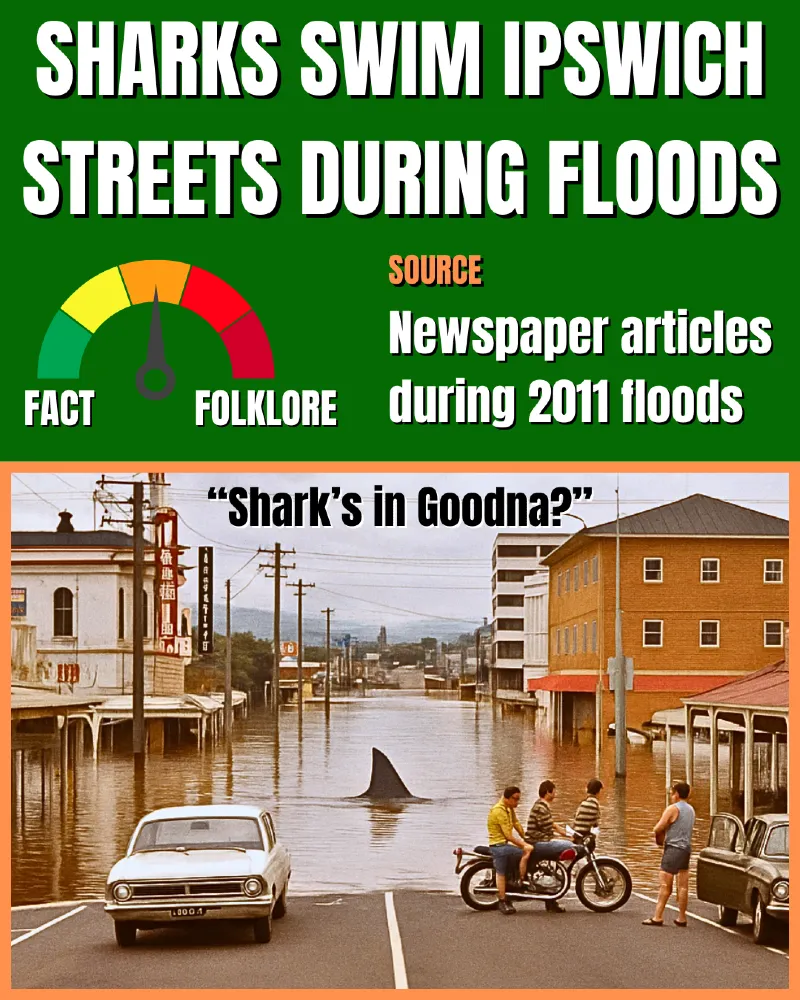
Bull sharks spotted in Goodna streets during 2011 floods (Sharks in Goodna?)
Urban Legend Summary
During the severe 2011 floods, bull sharks were reportedly swimming through Goodna’s suburban streets.
Historical Origin
Originated from contemporary flood reporting; the idea spread quickly via media and social posts.
Credibility Analysis:
- Possibility: Bull sharks inhabit the Brisbane/Bremer system; floodwaters could move them into unusual places.
- Evidence: No verified, geolocated street photos from Goodna; remains anecdotal.
Why Top Legend?
- News Archive: Reappears in flood retrospectives; became part of Goodna’s flood folklore.
- Social Media Popularity: Resurfaces each wet season on Facebook/Reddit.
Stickiness Analysis (SUCCES Score: 5.5/6):
- Simple: Sharks on streets! (immediately clear)
- Unexpected: Sharks near the shops?! (surprising)
- Concrete: Named suburb, flood context (vivid)
- Credible: Ecologically plausible (bull sharks locally)
- Emotional: Disaster fear (strong hook)
- Story: Retold with personal anecdotes (e.g., missing pets)
Sources:
- ABC News – flood coverage (Open): contemporaneous piece that mentions a bull shark in flooded Goodna; shows how the claim entered public discourse.
- Brisbane Times – butcher interview (Metered): local eyewitness story that anchored the meme in a specific street-level image.
- Ipswich Connect (Council) – shark signage (Open): council response (warning signs at Joseph Brady Park) confirms bull sharks in local waters, the kernel that makes the street-shark tale sticky.
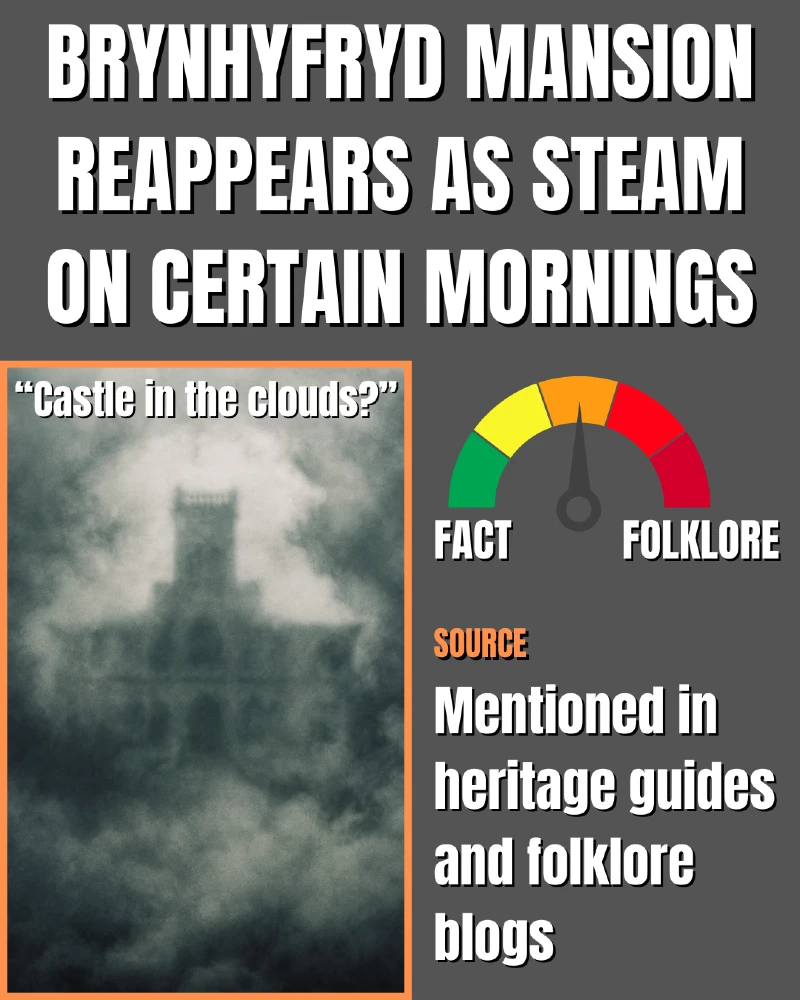
Brynhyfryd mansion reappears as steam on Castle Hill (Castle in the Clouds)
Legend Summary
Steam from underground mine fires supposedly outlines the demolished Brynhyfryd mansion on certain mornings.
Historical Origin
Noted in council/visitor materials; reinforced by exhibitions and local history guides.
Credibility Analysis:
- Science: Underground coal fires and heat vents are documented; recognisable “castle” shape is subjective.
Why Top Legend?
- Local Heritage: Repeated in council and tourism outlets; a favourite on guided walks.
- Tourist Attraction: Sits at the intersection of geology and nostalgia.
Stickiness Analysis (SUCCES Score: 5.5/6):
- Simple: Lost mansion returns (clear)
- Unexpected: Steam forms architecture (novel)
- Concrete: Real steam/heat on trails (tangible)
- Credible: Plausible in cold conditions (reasonable)
- Emotional: Pride/longing for heritage (strong)
- Story: Guides retell seasonally (enduring)
Sources:
- Discover Ipswich – legend page (Open): formalises the “castle returns” lore as part of the city’s tourism narrative.
- Ipswich City Council – Castle Hill Reserve (Open): confirms ex-mining land with heat/gases—mechanism for the steam that fuels the legend.
- Castle Hill Walking Trails Guide (Open): mentions ground cracks/heat along trails; shows this isn’t just hearsay.
- Ipswich Art Gallery – Brynhyfryd exhibition (Open): demonstrates sustained institutional interest in the mansion’s story.
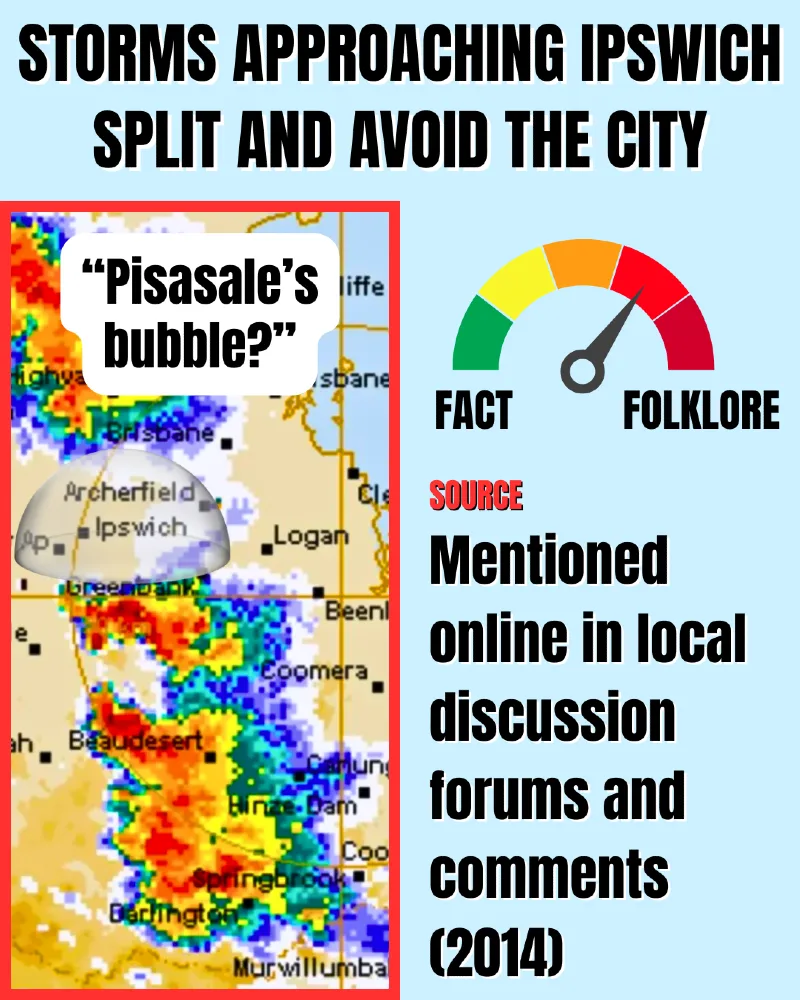
Storms approaching Ipswich split and avoid the city (Pisasale Bubble)
Legend Summary
Thunderstorms consistently split around Ipswich, humorously attributed to a “bubble” around the city.
Historical Origin
Nickname popularised via local Reddit threads around 2014 and repeated in storm seasons.
Credibility Analysis:
- Science: Storm-splitting is a real meteorological phenomenon; a city-specific “forcefield” is lore.
Why Top Legend?
- Social Media: Radar screenshots and jokes make it endlessly shareable.
- Local Identity: A fun, self-referential meme about Ipswich weather.
Stickiness Analysis (SUCCES Score: 5.5/6):
- Simple: Storms miss us! (pithy)
- Unexpected: Everyone gets rain but us (ironic)
- Concrete: Radar images (visual)
- Credible: Explained by wind shear (qualified)
- Emotional: Relief/frustration cycles (relatable)
- Story: Resurfaces every summer (habitual)
Sources:
- Reddit r/Ipswich – “Pisasale Bubble” thread (Open): shows the phrase and belief in situ—grassroots origin of the legend.
- BoM blog – severe thunderstorms Q&A (Open): authoritative explanation of storm behaviour, including splitting—grounds the lore in real physics.
- BoM – Thunderstorms education PDF (Open): technical background that explains why splitting happens without endorsing a “bubble.”
Secret Freemason tunnels beneath Ipswich CBD buildings (Secret CBD Tunnels?)

Legend Summary
Rumoured tunnels connect the Freemason lodge with Ipswich shops and government buildings.
Historical Origin
Boosted by mid-2000s press interest; often rehashed when the lodge does open days.
Credibility Analysis:
- Investigations: Open days and local reporting have found no tunnel network; rumours persist anyway.
Why Top Legend?
- Media Interest: Recurs in features; irresistible “secret passage” trope.
- Community Rumours: A classic “heard it from a mate” tale.
Stickiness Analysis (SUCCES Score: 5/6):
- Simple: Hidden tunnels (compelling)
- Unexpected: Under everyday shops (surprising)
- Concrete: Named lodge and street (specific)
- Credible: No proof despite checks (weak)
- Emotional: Conspiracy thrill (fun)
- Story: Pub-talk perennial (durable)
Sources:
- Picture Ipswich – Masonic Centre, 82A Nicholas St (Open): anchors the rumour to a real, named place people recognise.
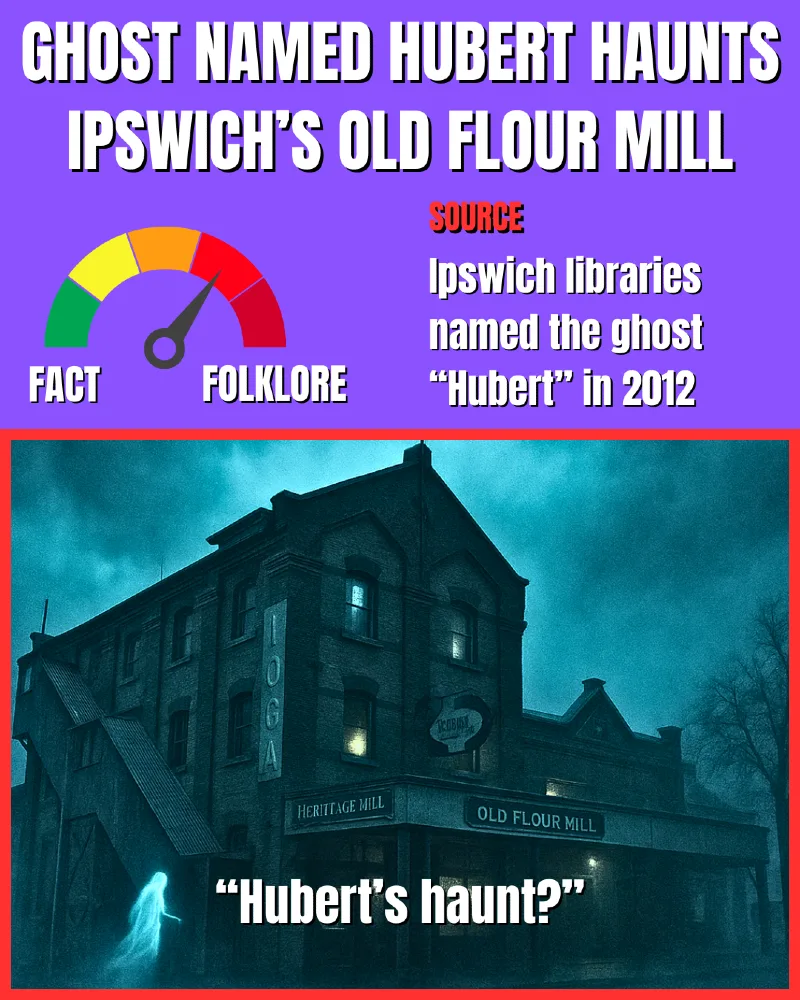
Ghost named Hubert haunts Ipswich’s Old Flour Mill (Hubert’s Haunt?)
Legend Summary
A flour-covered ghost named Hubert haunts the historic Old Flour Mill (231 Brisbane St).
Historical Origin
Popularised by Ipswich Libraries tours and posts from about 2012 onward.
Credibility Analysis:
- Evidence: No archival record for “Hubert” at the Mill; testimony-based legend.
Why Top Legend?
- Tourism Promotion: Libraries/tourism keep the story active.
- Community Retelling: Frequently mentioned in local features and posts.
Stickiness Analysis (SUCCES Score: 5/6):
- Simple: Ghost haunts mill (clear)
- Unexpected: Flour-covered worker (distinctive)
- Concrete: Named ghost, specific building (vivid)
- Credible: Anecdotal but persistent (soft)
- Emotional: Tragic worker vibe (affective)
- Story: Repeated on tours (sustained)
Sources:
- Ipswich Libraries – “Old Flour Mill ghost” (Open): the house-source that names “Hubert,” establishing the core story.
- Ipswich Libraries – “Past and Present” (Open): adds historical context for the building and repeats the ghost narrative.
- Discover Ipswich – ghost tales (Open): shows the legend used in tourism storytelling, demonstrating ongoing popularity.
UFOs frequently spotted at Amberley RAAF base since 1970s (UFOs at Amberley?)

Legend Summary
Amberley RAAF base has long been a hotspot for UFO/UAP sightings.
Historical Origin
Appears in declassified RAAF paperwork from the 1970s; retold by the base museum and enthusiasts.
Credibility Analysis:
- Documentation: Official records log “unusual aerial sightings”; explanations remain inconclusive.
Why Top Legend?
- Official Records: Paper trail adds credibility; keeps researchers returning.
- Community Buzz: Shared by museum posts and UFO forums.
Stickiness Analysis (SUCCES Score: 5.5/6):
- Simple: Lights over base (clear)
- Unexpected: Unknowns at runway (intriguing)
- Concrete: File numbers and dates (tangible)
- Credible: Government logs (stronger)
- Emotional: Awe/curiosity (compelling)
- Story: Decades of retelling (enduring)
Sources:
- The Black Vault – RAAF A703 file (Open): primary document showing Amberley-area sightings—your strongest provenance.
- National Archives of Australia – blog (Open): explains how/why the RAAF maintained UFO files, giving institutional context.
- Amberley Aviation Heritage Centre – video post (Open): local institution retelling a 1970s runway sighting—shows the story’s life in the community.
Large black panthers roam bushland near Pine Mountain (Pine Mountain Panther?)

Legend Summary
Big black cat sightings in Pine Mountain/Chuwar/Scenic Rim appear regularly.
Historical Origin
Popularised by press coverage in the late 2000s; recycled repeatedly since.
Credibility Analysis:
- Evidence: No carcasses/DNA; likely large ferals or misidentifications.
Why Top Legend?
- Media Attention: Recurring features keep it top of mind.
- Local Folklore: BBQ and campfire staple; resurfaces in threads.
Stickiness Analysis (SUCCES Score: 5/6):
- Simple: Panther in bush (sticky)
- Unexpected: Big cat near suburbs (jolting)
- Concrete: Named localities (specific)
- Credible: No proof despite claims (weak)
- Emotional: Fear/thrill (visceral)
- Story: Passed around for years (durable)
Sources:
- Courier-Mail – Pine Mountain panther (Paywalled): the piece that collated local sightings, giving the myth a media “home base.”
- MysteryCats blog – open excerpt (Open): aggregates and quotes paywalled pieces so readers can see what’s being claimed.
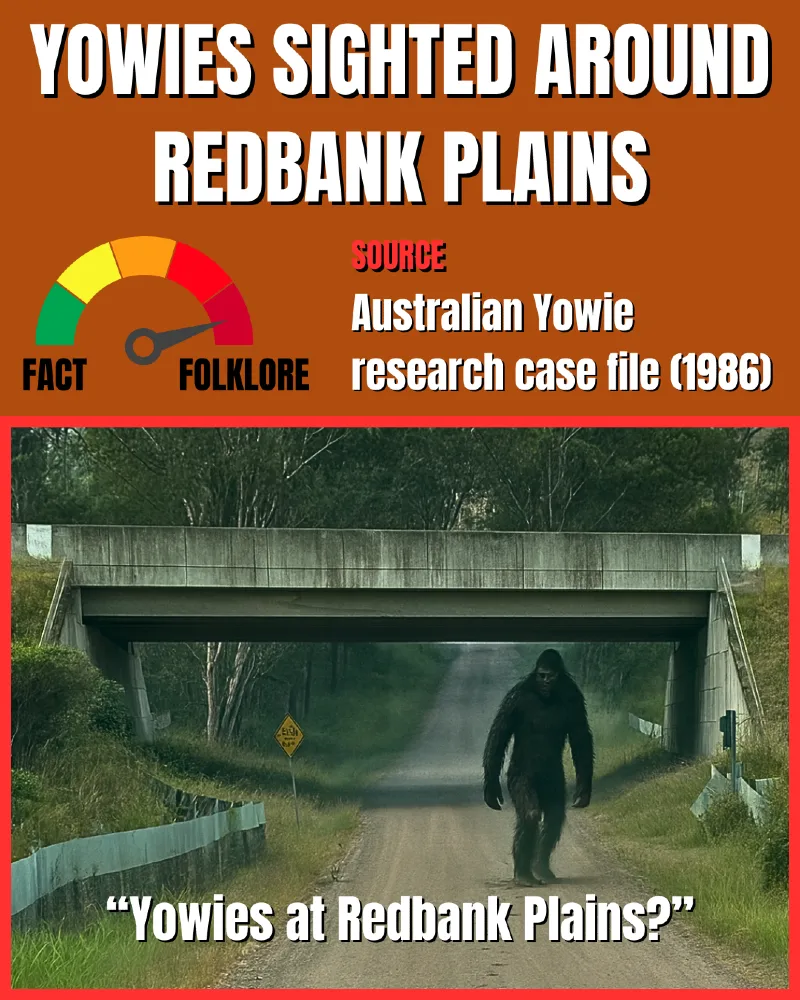
Yowies (Aussie Bigfoot) sighted around Redbank Plains (Yowies at Redbank?)
Legend Summary
Yowie encounters reported around Redbank Plains/Tivoli since the 1980s.
Historical Origin
Cemented by a 1986 Australian Yowie Research case; sporadic media mentions since.
Credibility Analysis:
- Evidence Status: Testimonial only; no physical proof to date.
Why Top Legend?
- Cryptid Community: AYR documents and maps local sightings.
- Media Interest: Occasional features keep it circulating.
Stickiness Analysis (SUCCES Score: 5/6):
- Simple: Aussie Bigfoot (clear)
- Unexpected: Near suburbs (intriguing)
- Concrete: Redbank Plains case (specific)
- Credible: Many witnesses, no proof (mixed)
- Emotional: Frontier mystery (compelling)
- Story: “My uncle saw one…” (retellable)
Sources:
- Australian Yowie Research – Redbank Plains 1986 (Open): the keystone local case file; establishes the “hotspot” claim.
- AYR – Queensland index (Open): shows Redbank Plains appears multiple times in the regional record.
Final “Why These Nine” Clarification Recap
- Strong Local Recognition: Legends that show up across tours, council/tourism pages, news items, and community threads.
- Clear Historical Origins: Each has at least one traceable seed (official file, heritage guide, first big article, or forum coinage).
- Persistent Popularity: These stories resurface predictably—during floods, storm seasons, heritage events, or cryptid/UFO cycles.
The SUCCES analysis clarifies the psychology: each legend has the right mix of a simple core, an unexpected twist, concrete props/places, just enough credibility, emotional stakes, and a story structure that’s easy to repeat—making them durable parts of Ipswich’s living folklore.