
Check out our in-depth deep dive on Ipswich’s most seen billboard: Bishopp’s Goodna billboard
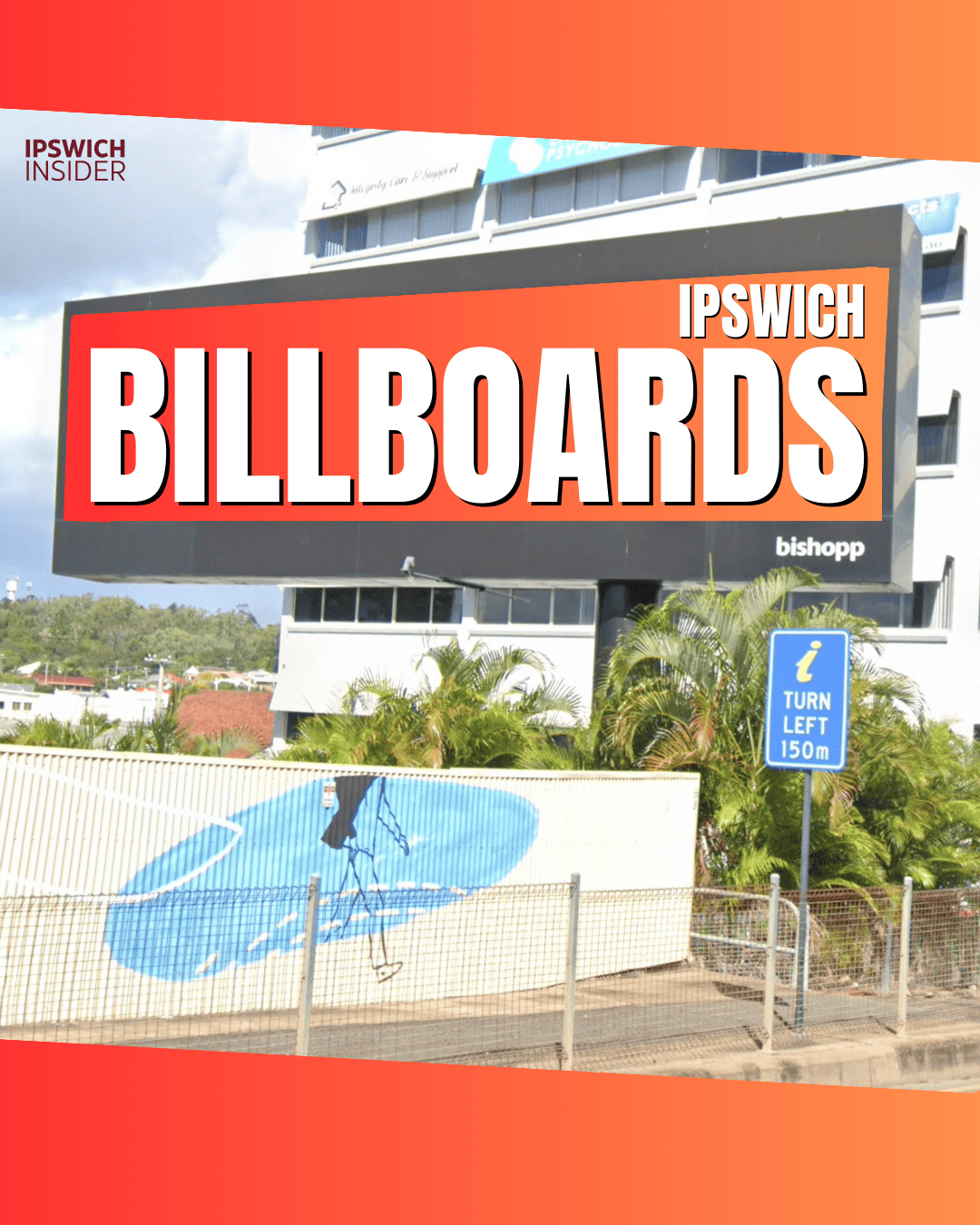
Ipswich Billboards at a Glance
- Opaque pricing: Billboard rates aren’t public. Operators quote based on site, season, and negotiating. Expect huge spreads, from a $400–$800 private paddock sign to $8,000–$13,000 per slot, per 28 days, on Goodna’s digital supersite.
- Dwell time matters: Raw traffic helps, but stopped traffic can outperform fast-flow exposure. Bundamba’s digital at the lights can hold attention for ~90 seconds, while motorway-speed placements might get only a few seconds of eye contact.
- Hidden costs and SOV: Static faces add print and install fees every time you change creative. Digital avoids vinyl, but you’re buying a slice of a loop. Always ask slot length, advertisers per loop, and proof of play.
🔢 By The Numbers
- 137,000 cars per day passing the Ipswich Motorway supersite at Goodna
- 12.48m × 3.26m the Bishopp digital supersite face size at Goodna and the Trumpy Bridge
- 25 seconds per slot on the Goodna screen (with roughly 6 advertisers in rotation)
- $330 per week ground lease paid to the homeowner at 12 Barram Street, Goodna
- $8,000 to $13,000 per 28 days estimated advertiser cost per slot on the Goodna supersite
- 44,000 cars per day passing the East Street (David Trumpy Bridge) digital supersite
- 10 seconds per slot at the Trumpy Bridge screen (more advertisers sharing the loop)
- 11pm to 5am the Trumpy Bridge screen’s sleep mode window
- 41,000 cars per day passing Sinnathamby Blvd, Springfield Central
- 4300-0004 / 4300-0005 the GOA Springfield site IDs (two faces, inbound + outbound)
- 118,000 vehicles per day on a long Cunningham Highway stretch with 0 billboards
- 28 days the standard “lunar month” booking period for static billboards
If you drive the Ipswich Motorway through Goodna, you pass the most expensive billboard in Ipswich every single day.
It costs an estimated $8,000 to $13,000 per 28 days for one slot.
Your message gets 25 seconds before the face rotates among five other advertisers—150 seconds total.
It’s a 12.5-metre-wide LED screen run by Bishopp Outdoor Advertising. Although the billboard is prominent from the motorway, if you look behind the sound barrier, you see this $1 million per year asset is installed in someone’s backyard.
Bishopp is paying them just $330 per week for the pleasure.
Years ago, before the installation, they subdivided the block into 12 and 12A Barram Street for electricity metering. Now, 12A pays more in electricity per year than Bishopp pays to lease the land.
Welcome to the billboard business in Ipswich.
More Ipswich Gold
What’s in this guide?
- Billboard Formats — The 6 types of outdoor advertising in Ipswich
- Billboard Spotlights — Real sites with traffic data and pricing
- Case Study — Inside the Goodna billboard deal
- How It Works — Static vs digital, share of voice, booking periods
- Hidden Costs — Print, install, and what they don’t tell you
- Can a Small Business Afford This? — Realistic budgets
- What to Ask — Questions for your quote request
- MOVE vs AADT — Understanding traffic data
- The Gap — 118,000 cars and zero billboards
- Who Runs the Billboards — Bishopp, GOA, oOh!media, and private operators
Billboard Formats in Ipswich
Six types of outdoor advertising are available in the Ipswich region. Up to $17,000 per 28 days digital supersites to DIY corflute signs that cost $15.
1. Digital Supersite

A large LED screen on a major road that rotates multiple advertisers in a timed loop. Your ad plays for a set number of seconds. Then the next advertiser’s plays. And so on.
Key details:
- Size: Approximately 12.5m × 3.2m
- Cost: $5,000 to $17,000 per slot, per face, per 28 days
- Share of Voice: Typically 1/6 to 1/10. You share the screen with other advertisers.
- Best for: Grand openings, time-sensitive offers, brand awareness across a whole corridor.
- Operators: Bishopp, GOA
2. Static Supersite

A large printed billboard where one advertiser owns the entire face. 24 hours a day. For the full booking period. Nobody else shares it.
Key details:
- Size: Approximately 12m × 3m
- Cost: $2,000 to $14,000 per face, per 28 days
- Production: Artwork can cost $1,200 per side and $400 per change.
- Best for: Simple brand messages that benefit from repetition. Real estate, car dealers, established local brands.
- Operators: Bishopp, GOA
3. Classic 6×3 Static

The standard roadside billboard. One printed face per side. One advertiser. On arterial roads and secondary corridors.
Key details:
- Size: 6m × 3m
- Cost: $1,500 to $4,000 per face, per 28 days
- Production: Artwork can cost $500 per side and $400 per change.
- Best for: Local services wanting steady visibility. Dentists, tradies, schools, directional signage.
- Locations: The majority of Ipswich billboards are this format. You’ll see 50+ of these on the Warrego, Cunningham, Warwick Road, Brisbane Road, and elsewhere.
4. Bus Shelter / Small Format
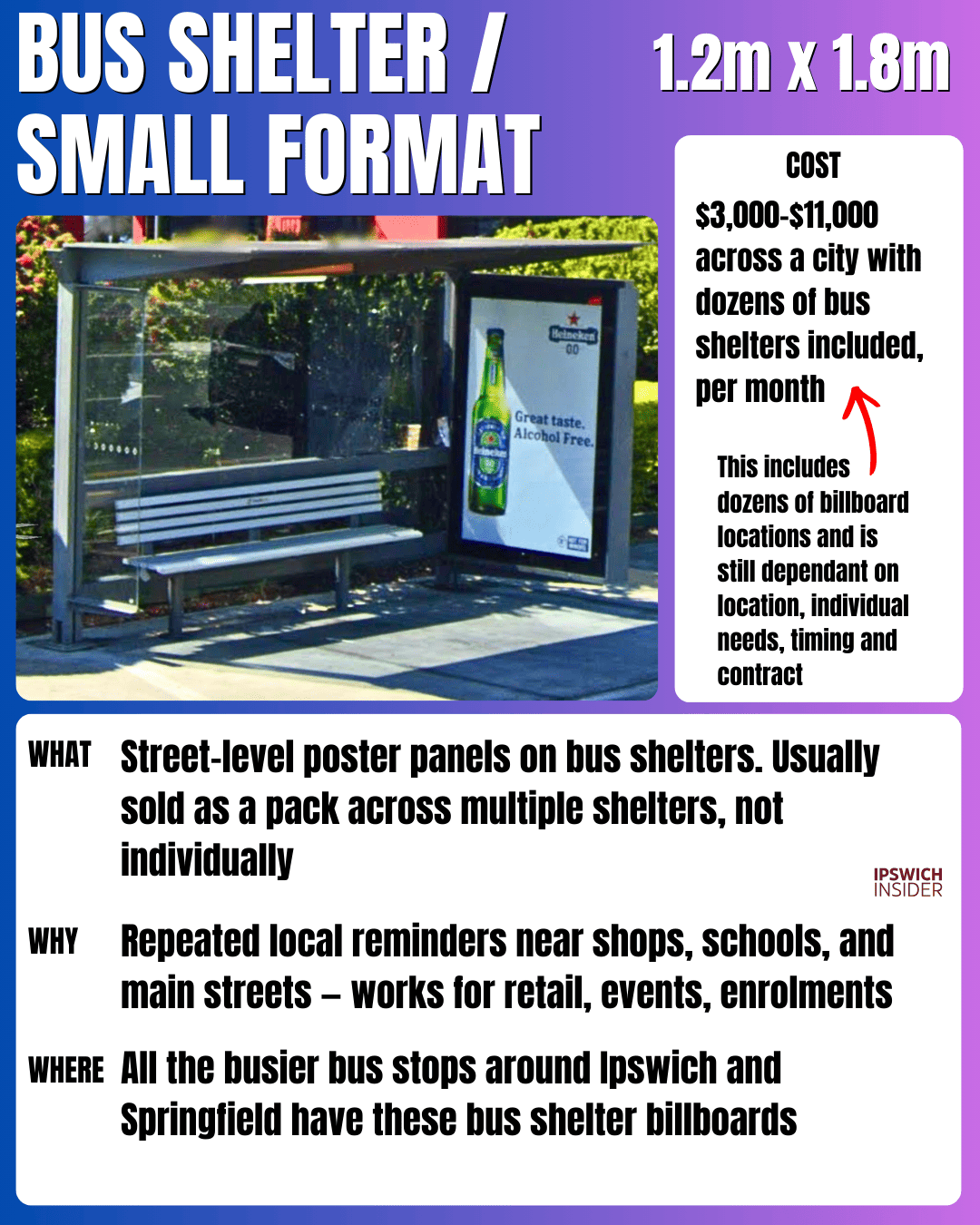
Street-level poster panels on bus shelters. Usually sold as a pack across multiple shelters. Not individually.
Key details:
- Size: 1.2m × 1.8m
- Cost: $3,000 to $11,000 across a city with dozens of bus shelters included, per 28 days
- Best for: Repeated local reminders near shops, schools, and main streets. Works for retail, events, enrolments.
- Operator: oOh!media
5. Vehicle Wrap / Trailer Sign
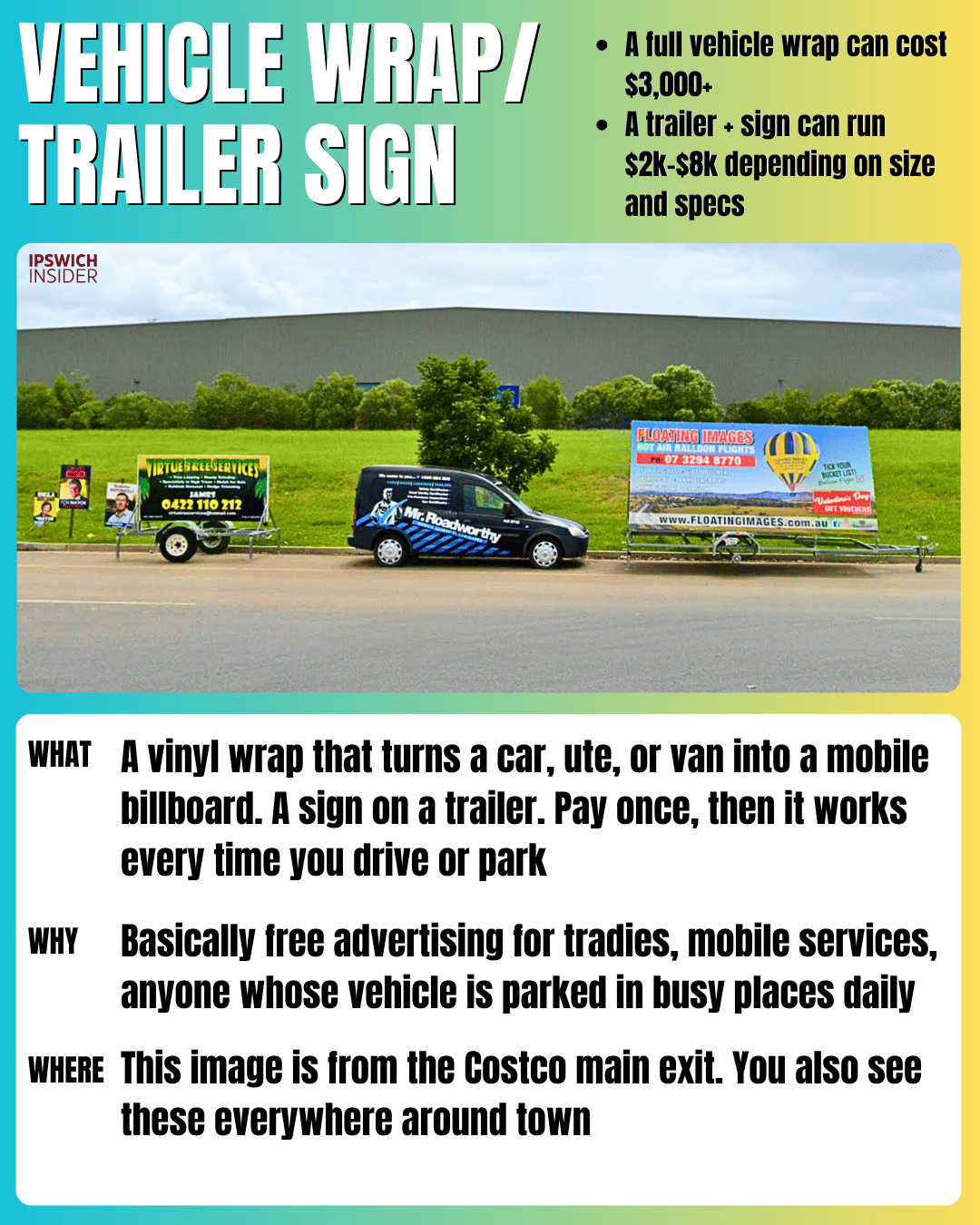
A vinyl wrap that turns a car, ute, or trailer into a mobile billboard. A sign on a trailer. Pay once. Then it works every time you drive or park.
Key details:
- Cost: A full vehicle wrap can cost $3,000. A trailer sign can run $2k-$5k depending on size and specs.
- Best for: Basically free advertising for tradies, mobile services, anyone whose vehicle is parked in busy places daily.
- Locations: You see these everywhere around town. The Costco main exit is a popular spot for trailer signs.
6. Corflute / Bandit Signs
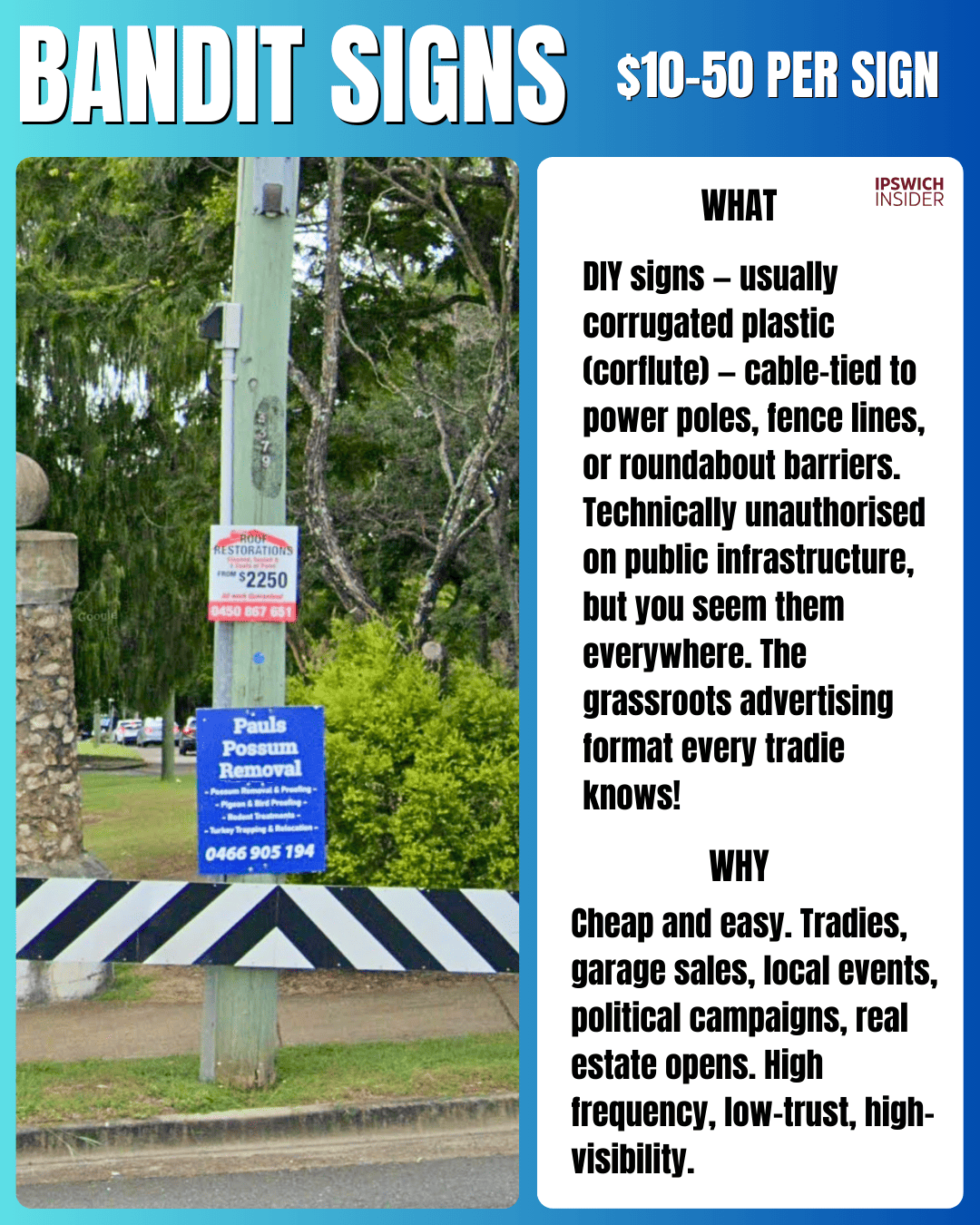
DIY signs. Usually corrugated plastic (corflute). Cable-tied to power poles, fence lines, or roundabout barriers. Technically unauthorised on public infrastructure. But ubiquitous. The grassroots advertising format every tradie knows.
Key details:
- Size: Typically 900mm × 600mm or 600mm × 450mm
- Cost: $10 to $50 per sign from Officeworks, Vistaprint, or local print shops. No media buy. You’re the installer.
- What’s included: Nothing. You buy the sign. You put it up. You hope council doesn’t pull it down.
- Best for: Tradies, garage sales, local events, political campaigns, real estate opens. High frequency. Low trust. High visibility.
Billboard Spotlights: Real Sites Across Ipswich
These are specific billboards across the Ipswich region. Each one shows verified traffic data. The operator and site ID where known. Our estimated cost range. And the story behind the sign.
Ipswich Motorway, Goodna (Bishopp)
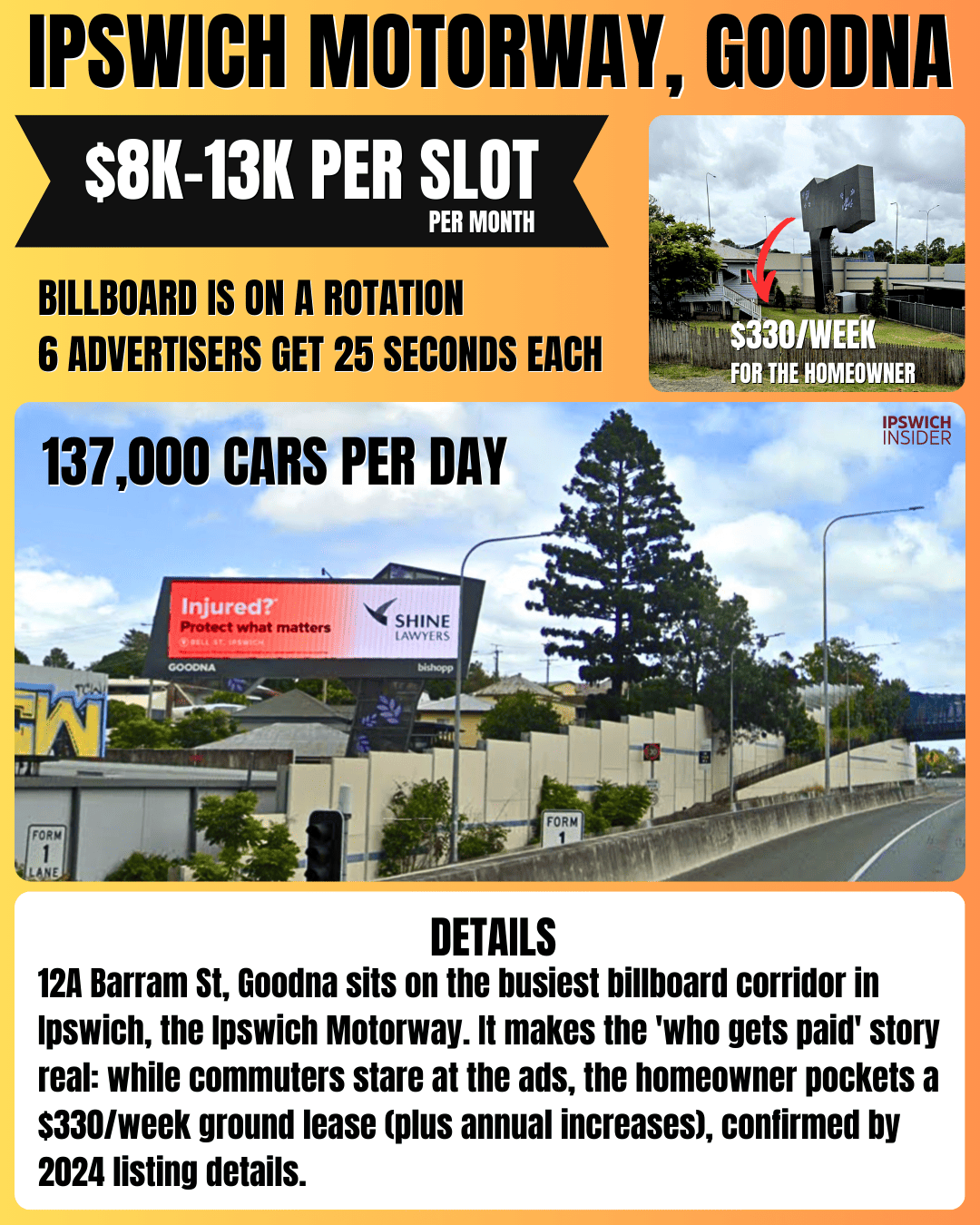
The anchor of Ipswich’s billboard landscape. At 137,000 vehicles a day, the Ipswich Motorway at this point carries more traffic than any other road in the region.
Key details:
- Operator: Bishopp Outdoor Advertising
- Site ID: 430002AD
- Format: Digital supersite, 12.48m × 3.26m
- Rotation: 25 seconds per slot, approximately 6 advertisers per loop (1/6 SOV)
- Traffic: 137,000 cars per day
- Estimated cost: $8,000 to $13,000 per face, per 28 days
The backstory:
The billboard sits on a suburban block at 12A Barram Street. When the property was listed for sale, the real estate ad highlighted $330 a week in income from the Bishopp advertising sign. On top of $375 in house rental. That’s $705 a week from a block that happens to sit beside a motorway.
We have the full case study on this billboard below. Including the approved development plans.
East Street, David Trumpy Bridge (Bishopp)
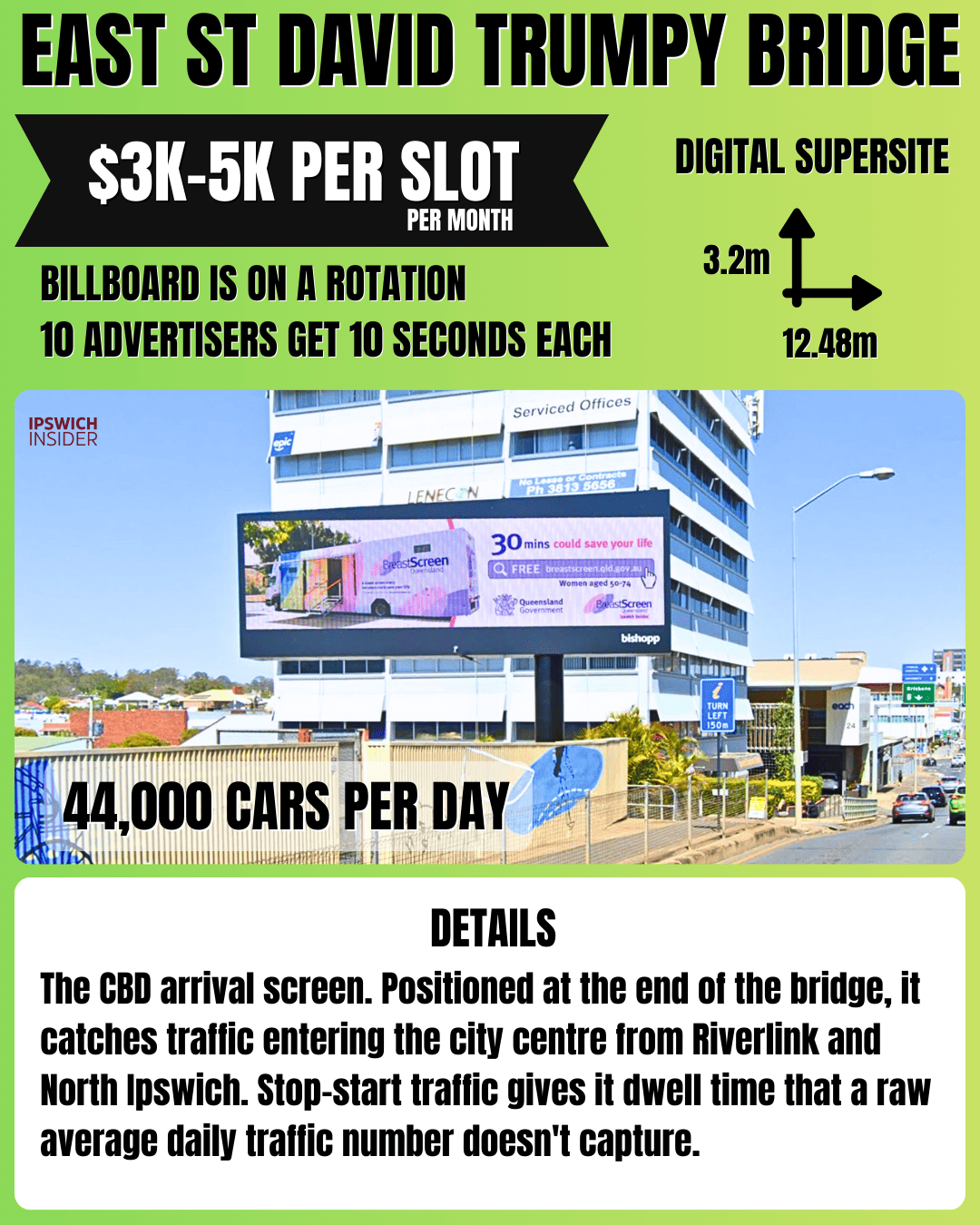
The same physical size as Goodna. A full 12.48-metre supersite. But it runs 10-second slots instead of 25. That means more advertisers sharing the loop.
Key details:
- Operator: Bishopp Outdoor Advertising
- Format: Digital supersite, 12.48m × 3.26m
- Rotation: 10 seconds per slot, approximately 10 advertisers per loop
- Traffic: 44,000 cars per day
- Estimated cost: $3,000 to $5,000 per slot, per 28 days
Why it matters:
Its real strength is position. It catches traffic entering the CBD from the bridge. Stop-start congestion gives it dwell time that a raw traffic number doesn’t capture. It has three lighting sensors that adjust brightness through the day. And goes into sleep mode from 11pm to 5am.
Sinnathamby Blvd, Springfield Central (GOA)
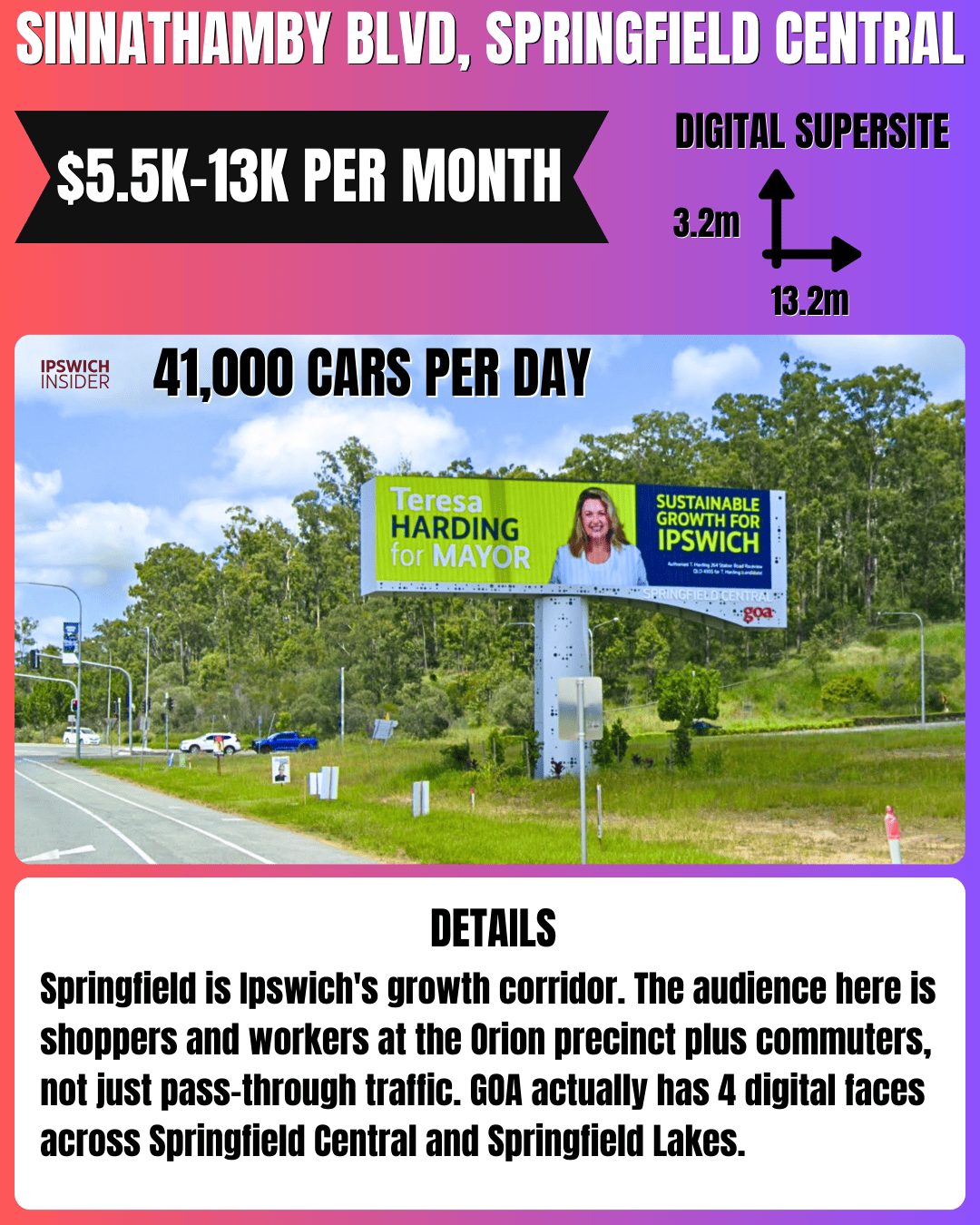
Springfield is where Ipswich meets the future. GOA actually has four digital faces across Springfield Central and Springfield Lakes. More than anywhere else in the Ipswich LGA.
Key details:
- Operator: GOA Billboards
- Site ID: 4300-0004 / 4300-0005 (two faces, inbound + outbound)
- Format: Digital large format, approximately 13.2m × 3.2m
- Traffic: 41,000 cars per day
- Estimated cost: $5,500 to $13,000 per 28 days
Why it matters:
The audience here isn’t just commuters passing through. It’s shoppers at Orion. Workers in the health hub. Students. When the Springfield billboard launched, GOA offered businesses in the 4300 postcode four weeks of free advertising to fill the loop.
Brisbane Road, Bundamba (Bishopp)
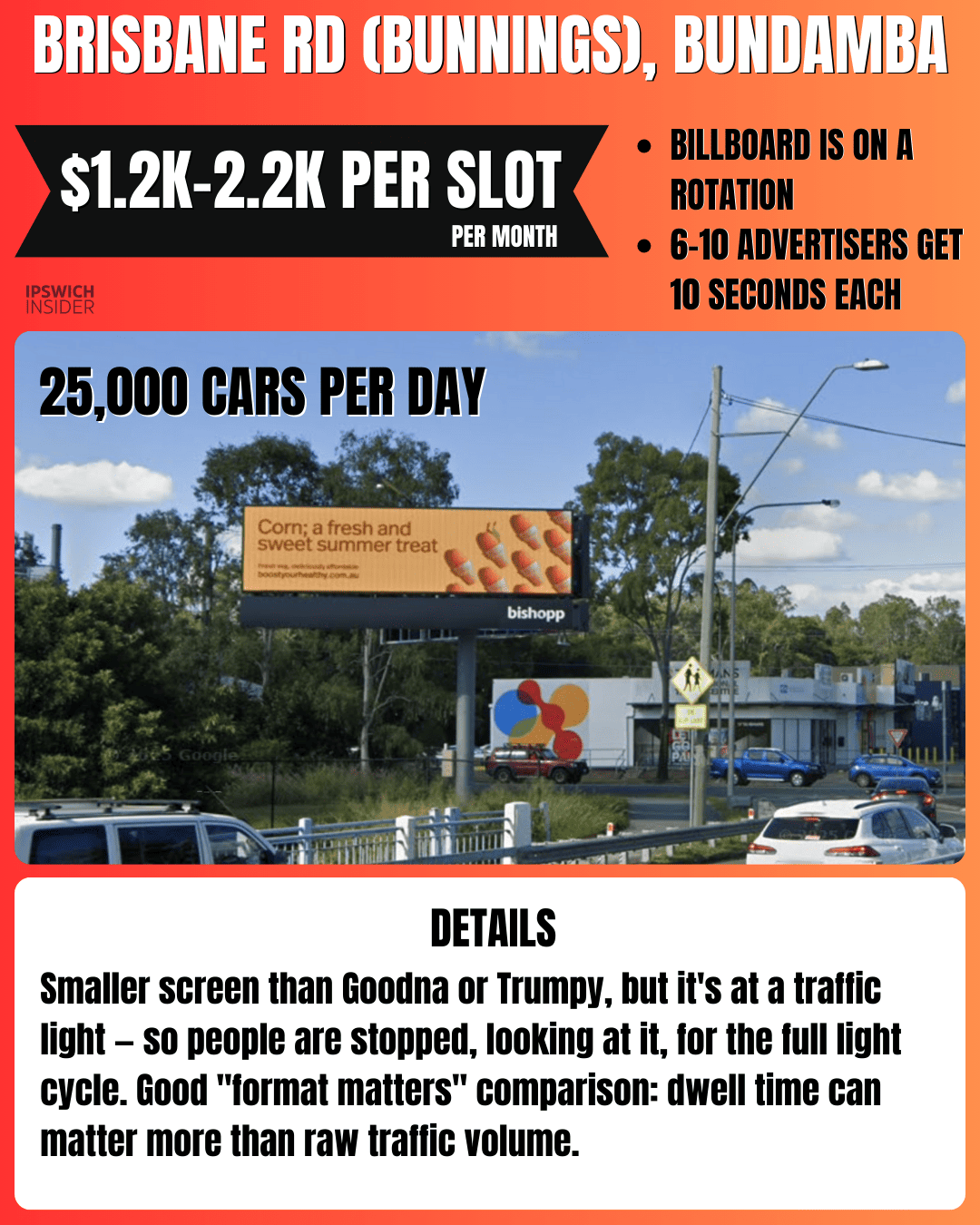
Smaller than Goodna and Trumpy. About 8 metres wide instead of 12.5. But it’s at a traffic light intersection near Bunnings. That matters.
Key details:
- Operator: Bishopp Outdoor Advertising
- Format: Digital, approximately 8m wide
- Traffic: 25,000 cars per day
- Estimated cost: $1,200 to $2,200 per slot, per 28 days
Why it matters:
When you’re stopped at a red light for 90 seconds, you’re looking at that screen for the full cycle. Not glancing at it for three seconds at 100km/h. Dwell time can matter more than traffic volume.
Cunningham Highway, Willowbank (Private)
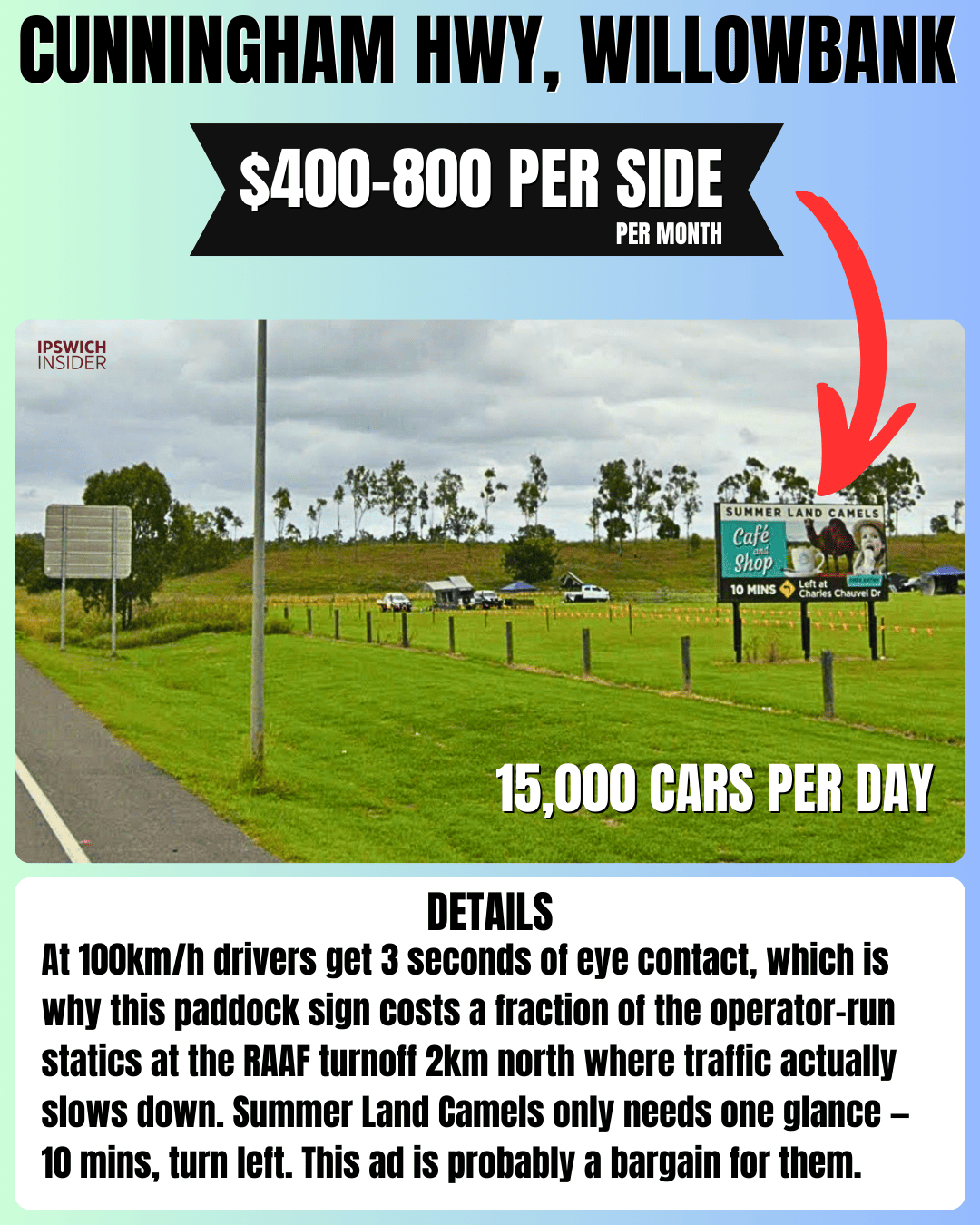
The outlier that makes the whole guide interesting. A farmer on the Cunningham Highway rents space to Summer Land Camels for roughly $400 a month. A fraction of what an operator-run billboard on the same road would cost.
Key details:
- Operator: Private landowner
- Format: Static paddock sign
- Traffic: 15,000 cars per day
- Estimated cost: $400 to $800 per side, per 28 days
Why it matters:
The creative says “10 mins, turn left at Charles Chauvel Dr.” Classic directional signage. No media buyer. No sitecard. No MOVE data. Just a farmer, a sign, and a deal. At 100km/h, drivers get about 3 seconds of eye contact. Which is why this paddock sign costs a fraction of the operator-run statics at the RAAF turnoff 2km north where traffic actually slows down.
The Fiveways Intersection (Private)
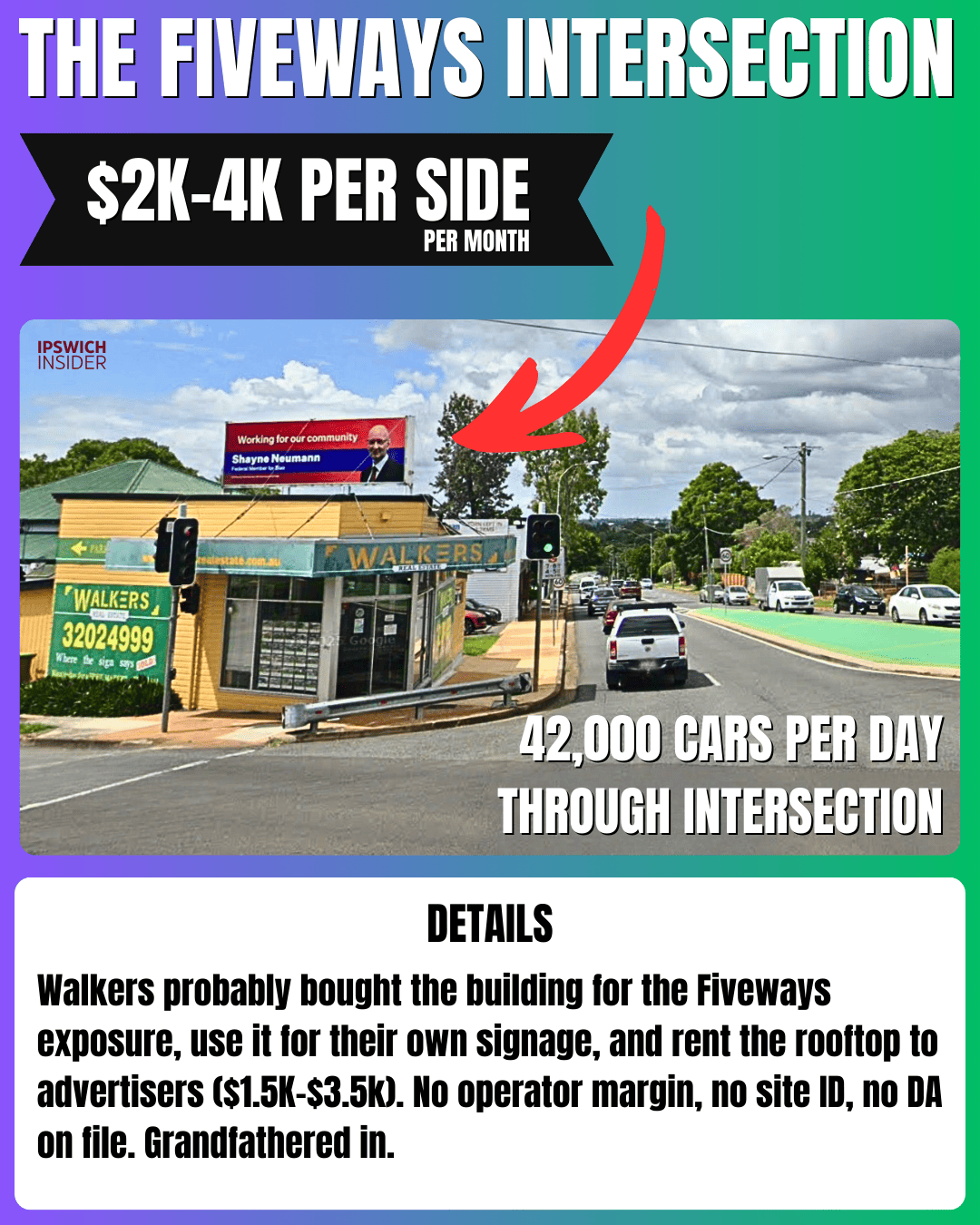
This one isn’t technically a billboard at all. Walkers Real Estate bought the building at the Fiveways intersection and put a sign on the roof.
Key details:
- Operator: Private (Walkers Real Estate owns the building)
- Format: Rooftop sign
- Traffic: 42,000 cars per day through intersection
- Estimated cost: $2,000 to $4,000 per 28 days (but no operator margin)
Why it matters:
It’s visible in Google Street View back to at least November 2007. But there’s no development approval on file with Ipswich City Council. It appears to be grandfathered. Walkers use it for their own branding and rent the rooftop space to advertisers. Zarraffa’s, local Politicians etc. have all been featured.
Potentially 3 revenue streams from one building: the property itself, the advertising on the walls outside, and the rental income from the roof sign. At a busy 5-road intersection with notoriously long light cycles, the dwell time could make this one of the most effective advertising positions in Ipswich per dollar spent.
Costco Exit Billboard Row (Various)
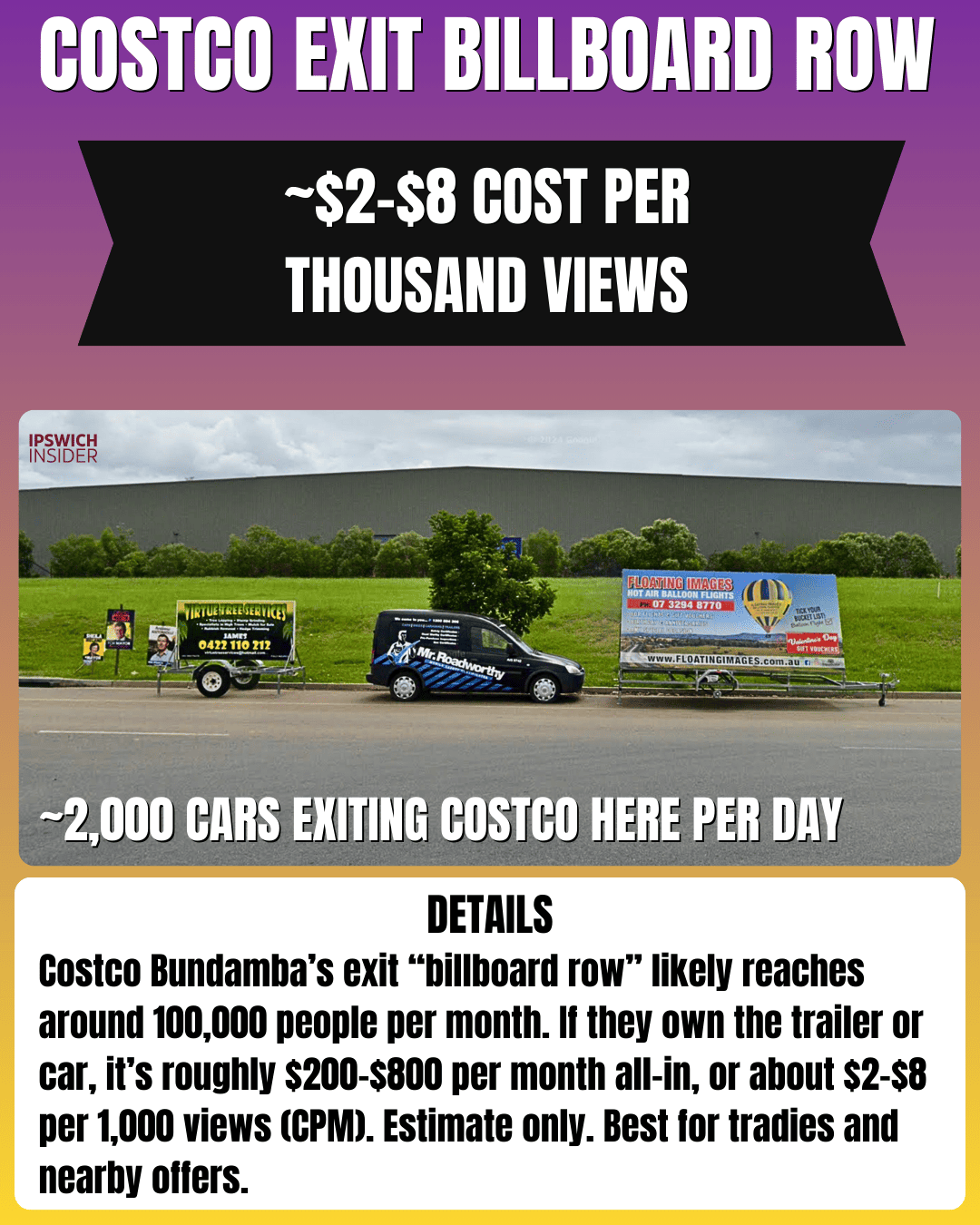
Costco Bundamba’s exit “billboard row” likely reaches around 100,000 people per month. If they own the trailer or car, it’s roughly $200-$800 per month all-in. Or about $2-$8 per 1,000 views (CPM). Estimate only. Best for tradies and nearby offers.
Key details:
- Operators: DIY / private
- Format: Trailer signs, vehicle wraps
- Traffic: Approximately 2,000 cars exiting Costco per day
- Estimated cost: $200 to $800 per 28 days if you own the trailer
Why it matters:
This is guerrilla advertising at its finest. No operator. No booking fee. Just park your trailer with a sign on it where everyone leaving Costco will see it. The location has high moderate dwell time because you have to drop and look first. Smart operators rotate their message seasonally.
Case Study: Inside the Goodna Billboard Deal

The Goodna digital supersite is the anchor of Ipswich’s billboard landscape. But how did a suburban house block become the most valuable advertising real estate in the region?
We pulled the development approval files from Ipswich City Council. Here’s what we found.
The Property
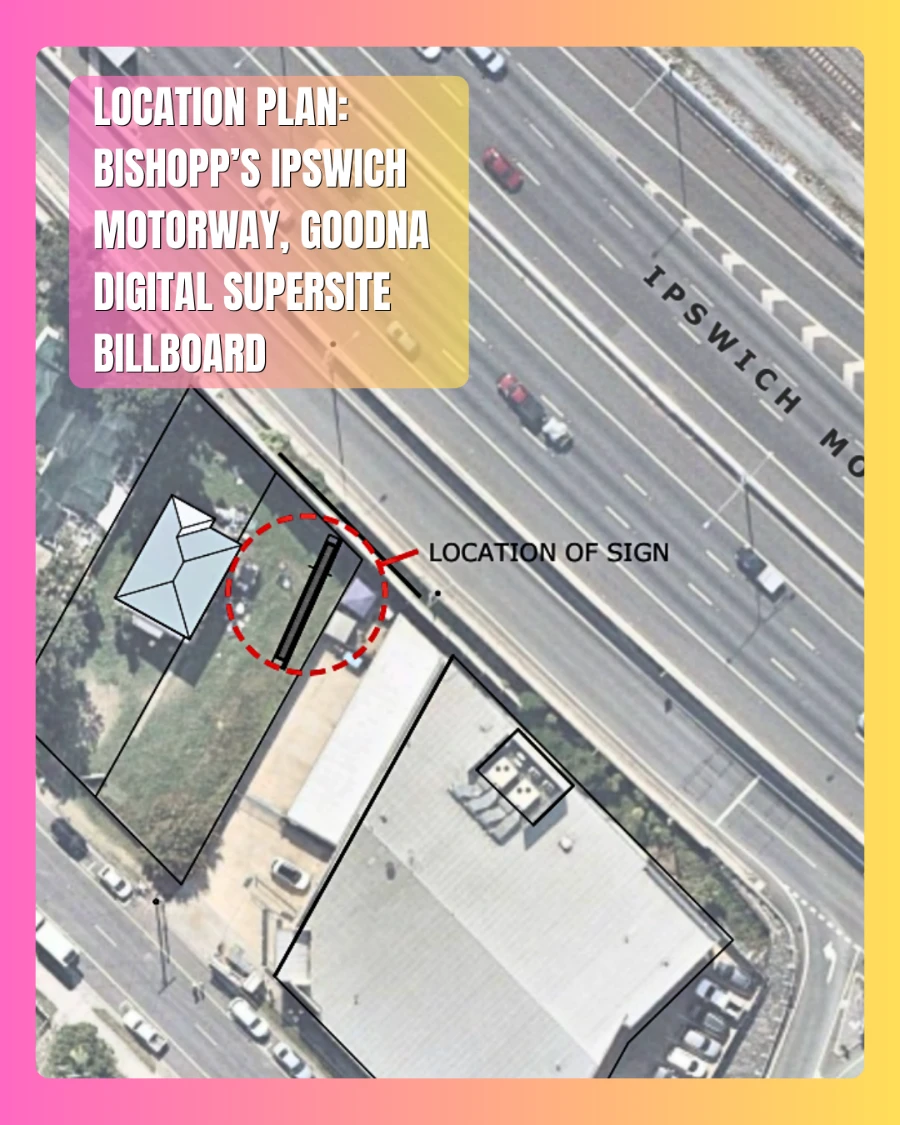
- Address: 12 Barram Street, Goodna
- Legal description: Lot 24-25 on RP22558
- Site area: 886m² (a regular suburban block)
- Existing use: Lowset dwelling house
- Landowners: Zabin Nisha Khan and Ayub Ayub
The Billboard
- Screen size: 12.45m wide × 3.2m high (40m² face area)
- Total height: 13.2m above ground level
- Orientation: Single face, westbound traffic only
- Classification: “Major Entry Community Signage” under Council’s Implementation Guideline No. 34
The Approval
- Approval number: 8429/2019/OD
- Date approved: 28 May 2019
- Applicant: Bishopp Outdoor Advertising Pty Ltd
- Planning consultant: DTS Group Qld
- Architect: Nikolaou Associates
Why This Location?
The development application explains it clearly. The Ipswich Motorway is a “key state-controlled arterial route into the local government area.” The site was chosen to provide “a dynamic entrance statement to the region.”
The sign had to be 13.2m tall. Not because bigger is better. But because it needed to clear the acoustic fence behind the property and the rooftop plant equipment on the neighbouring Centrelink building. Otherwise westbound drivers wouldn’t see it.
The Design Details
Bishopp didn’t just slap a screen on a pole. The approval documents show a proper architectural design by Nikolaou Associates.
What the plans include:
- Perforated metal screening on the back of the sign. So it doesn’t look overtly ugly from Barram Street.
- Ipswich leaf motif cut into the metalwork. A nod to Council’s branding.
- “GOODNA” suburb signage below the screen. A placemaking element.
- LED accent lighting on the support structure.
- Vitracore G2 cladding in Colorbond ‘Monument’ colour.
- Native landscaping at the base. Elaeocarpus reticulatus and Elaeocarpus eumundi.
Emergency Messaging
This is the part most people don’t know about. Bishopp has a partnership with Queensland Police Service. In the event of an Amber Alert, the billboard switches to emergency messaging automatically.
The development application states: “Similar use is envisaged in the event of a natural disaster or other events where communication with the community is essential.”
The Money
Here’s what we know about the economics:
- Ground lease to property owner: $330 per week ($17,160 per year)
- House rental income: $375 per week (per real estate listing when property was for sale)
- Total income from the block: $705 per week ($36,660 per year)
- Estimated advertising revenue: $8,000 to $13,000 per slot × 6 slots = $48,000 to $78,000 per 28 days. If you look at the high end this is a nearly $1 million asset for Bishopp. Yearly.
The homeowner gets a fixed ground lease. Bishopp takes the advertising risk. And the advertisers pay for access to 137,000 cars a day.
What It Takes to Get Approved
The planning application ran to 29 pages. It addressed:
- Flood overlay compliance (the site is in a regulated flood area)
- Traffic safety assessment referencing DTMR and Brisbane City Council guidelines
- Visual impact assessment by Arcadia Landscape Architecture
- Building setback variations (the sign is closer to the motorway than normally allowed)
- Height variations (taller than the 10m limit for billboards)
Every variation required a “performance solution” showing why it still met the intent of the planning scheme. This isn’t a simple DA. This is a full planning exercise.
The Bottom Line
If you want to put a billboard on your property in Ipswich, it’s possible. But you need:
- The right location (high traffic, commercial zoning, no heritage overlays)
- An operator willing to invest (Bishopp spent serious money on design and approvals)
- A planning consultant who knows the Advertising Devices Code
- Patience (this approval took from October 2018 to May 2019)
How Billboard Advertising Works
If you’ve never bought a billboard ad, here’s how it works.
You contact an operator. Or a media broker who shops across operators. You tell them your budget and target area. They send you sitecards. That’s a one-page info sheet per billboard showing the location, size, direction of travel, and audience numbers.
You pick a site. Sign a booking. Supply your artwork to their specs. They put it up.
Static vs Digital
- Static billboards are printed on vinyl skins and posted onto the frame. You own the whole face, 24/7, for the booking period.
- Digital billboards run your ad in a loop with other advertisers. Your share of screen time is called your Share of Voice (SOV).
Share of Voice Explained
If there are six advertisers sharing a screen with 25-second slots, your SOV is 1/6. Your ad plays about 60 times per hour.
Quick formula: 3,600 ÷ loop length in seconds = plays per hour. A 60-second loop gives you 60 plays per hour. An 80-second loop (8 advertisers × 10 seconds) gives you 45.
Always ask the operator how many advertisers share the loop. That’s your real SOV.
Booking Periods
- Static: Standard booking is 28 days. The industry calls it a “lunar month.”
- Digital: Can often be booked weekly.
Pricing is always per face, per period. And it’s always negotiable.
The Hidden Costs
The price you’re quoted for a billboard is usually just the media space. For static signs, printing the vinyl skin and installing it are extra. And you pay again every time you change the message.
Production costs (static billboards):
- Supersite skin print: Approximately $1,195
- Supersite installation: $800 to $900
- 6×3 skin print: Approximately $500
- 6×3 installation: From $395
Digital avoids print costs entirely. But you still need artwork built to the operator’s exact file specs and deadlines.
Always ask for the all-in figure before you commit.
Can a Small Business Afford a Billboard?
If your total marketing budget is around $2,000 a month, a billboard is a stretch. A standard 6×3 site can run $1,600 to $3,500 just for the space. Then you’re adding roughly $900 for print and install on top.
That pushes most options past the $2,000 mark before you’ve even paid for design.
If you do it:
- Pick one strong month. Your busiest season. A launch. A grand opening.
- Keep the creative dead simple. One message. Big text. Phone number or suburb name only.
- A quarterly burst will outperform a whisper nobody notices.
What to Ask When You Request a Quote
If this guide has you thinking about billboard advertising, here’s what to ask for when you contact an operator:
- Sitecards for every site in the Ipswich LGA that fits your budget
- A net quote per 28 days broken into media space, production, and installation
- For digital: Slot length, number of advertisers in the loop, and your real SOV
- Direction of travel — which way does the face point?
- MOVE audience numbers if available (contacts, reach, frequency)
- Artwork specs and deadlines
- Proof of posting (static) or proof of play (digital) after go-live
- Cancellation terms and any change fees
MOVE Data vs AADT
Throughout this guide, we’ve used AADT (Annual Average Daily Traffic) figures from the Department of Transport and Main Roads. AADT is a road engineering count. How many vehicles pass a point, averaged over a year. It’s publicly available and verifiable.
Billboard operators use a different system called MOVE. Run by the Outdoor Media Association. MOVE estimates how many people (not vehicles) are likely to see a sign. Broken down by hour and season.
The key differences:
- AADT: Public data. Vehicle counts. Verifiable.
- MOVE: Operator data. People counts. Not public. More sophisticated.
If they give you AADT, ask for the MOVE report. A new version of MOVE is scheduled to launch in March 2026.
The Gap: 118,000 Cars and Zero Buyable Billboards
The Cunningham Highway between Yamanto and the Ipswich motorway junction carries 118,000 vehicles a day. The second-highest traffic volume in the Ipswich LGA.
And there are zero Goa/Bishopp owned billboards. Not one. You see dualing Bishopp statics at the RAAF turnoff but then nothing until Redbank on the Ipswich Motorway if you’re travelling east.
I wonder why?
You do see a couple private signs for a landscape company and housing estate. But that’s it. That usually points to planning restrictions or a lack of suitable private land with the right geometry and setbacks. Not a lack of advertiser demand.
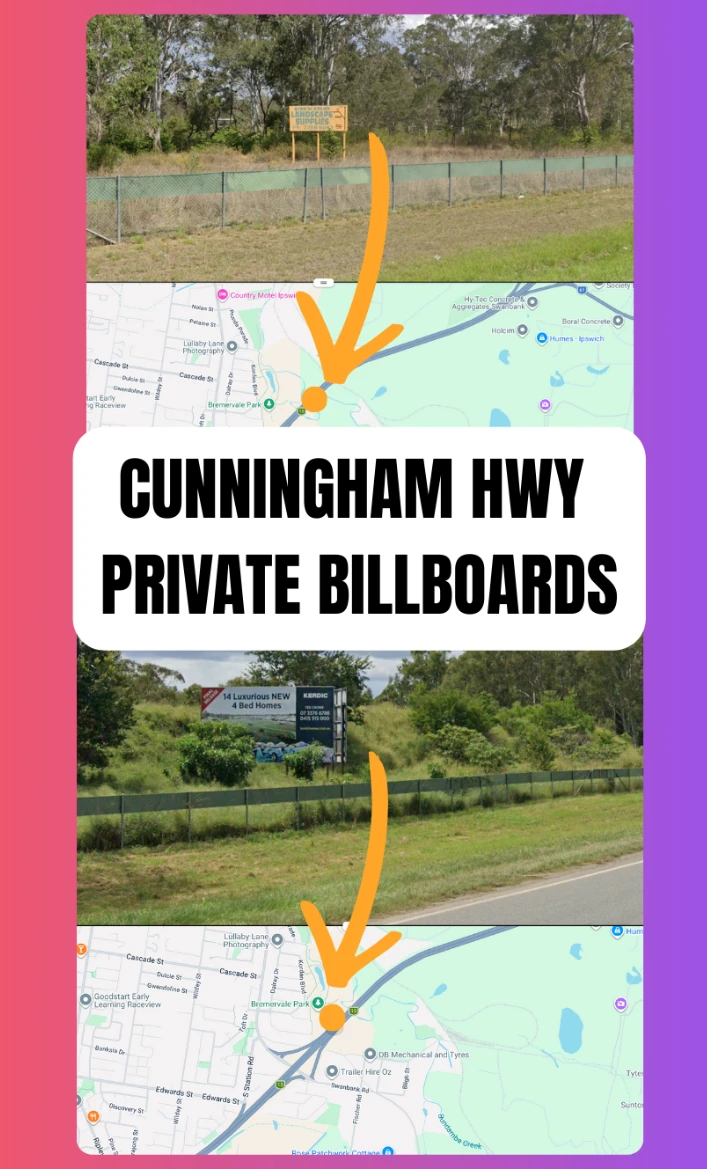
If someone ever gets approval for a billboard here, they’ll be sitting on one of the most valuable unused outdoor advertising sites in Southeast Queensland.
Who Runs the Billboards in Ipswich?
Three companies operate billboards in the Ipswich LGA. Between them, they cover every major corridor from the motorway to the Cunningham Highway.
Bishopp Outdoor Advertising
Queensland’s biggest regional outdoor advertising company. Founded in 1993 on a farm outside Maryborough. Bishopp claims over 49 roadside billboard faces in the Ipswich region.
Their key sites include:
- Digital supersites on the Ipswich Motorway at Goodna, East Street at the Trumpy Bridge, and Brisbane Road in Bundamba.
- Static supersites and 6×3 panels along Brisbane Road, the Warrego Highway, and the Cunningham Highway.
- Ground lease relationships with over 500 property owners nationally.
GOA Billboards
Southeast Queensland’s largest independent billboard provider. Family-owned since 1983. GOA operates 12 confirmed faces across the Ipswich LGA.
Their key sites include:
- Digital screens in Springfield Central and Springfield Lakes.
- Static supersites near the Ipswich Racecourse in Bundamba and on Warwick Road.
- 6×3 panels in Dinmore, Goodna, and Yamanto.
oOh!media
A national outdoor media company that operates bus shelter advertising in Ipswich. If you’ve seen a poster panel on an Ipswich bus shelter, that’s oOh!media. They run what was formerly the Adshel network.
Private Operators and Building Owners
Not every billboard in Ipswich belongs to a media company. Some are on farmers’ paddocks. Rented directly to businesses with a handshake. Others are fixed to buildings where the owner uses the signage for their own brand. These signs often have no site ID. No audience data. And sometimes no development approval on file.
What’s Next
Billboards are the most visible advertising option in Ipswich. But they’re not the only one. And for most small businesses, they’re not the most affordable.
Next in this series: We look at what radio advertising actually costs in Ipswich. What does a 30-second spot cost? Who’s listening? And is anyone under 40 still tuning in?
How We Researched This
- Traffic data: TMR Annual Average Daily Traffic counts (publicly available)
- Operator inventory: Bishopp and GOA public sitecard databases
- Field verification: Drive-by of every major billboard corridor in the Ipswich LGA, February 2026
- Planning records: ICC PD Online development approval search
- Pricing: Estimated from published industry ranges, operator benchmarking, and one confirmed private deal
All prices are indicative, per 28 days, excluding GST. Confirm directly with the operator before making any advertising decisions.
Know someone who gets paid for a billboard on their property? Or a creative way a local business advertises that we should cover? Reply to this email.
Sources
- Ipswich Billboards. bishopp.com.au.
- Brisbane and regional QLD advertising. oohmedia.com.au.
- Site Locator Map. goa.com.au.