
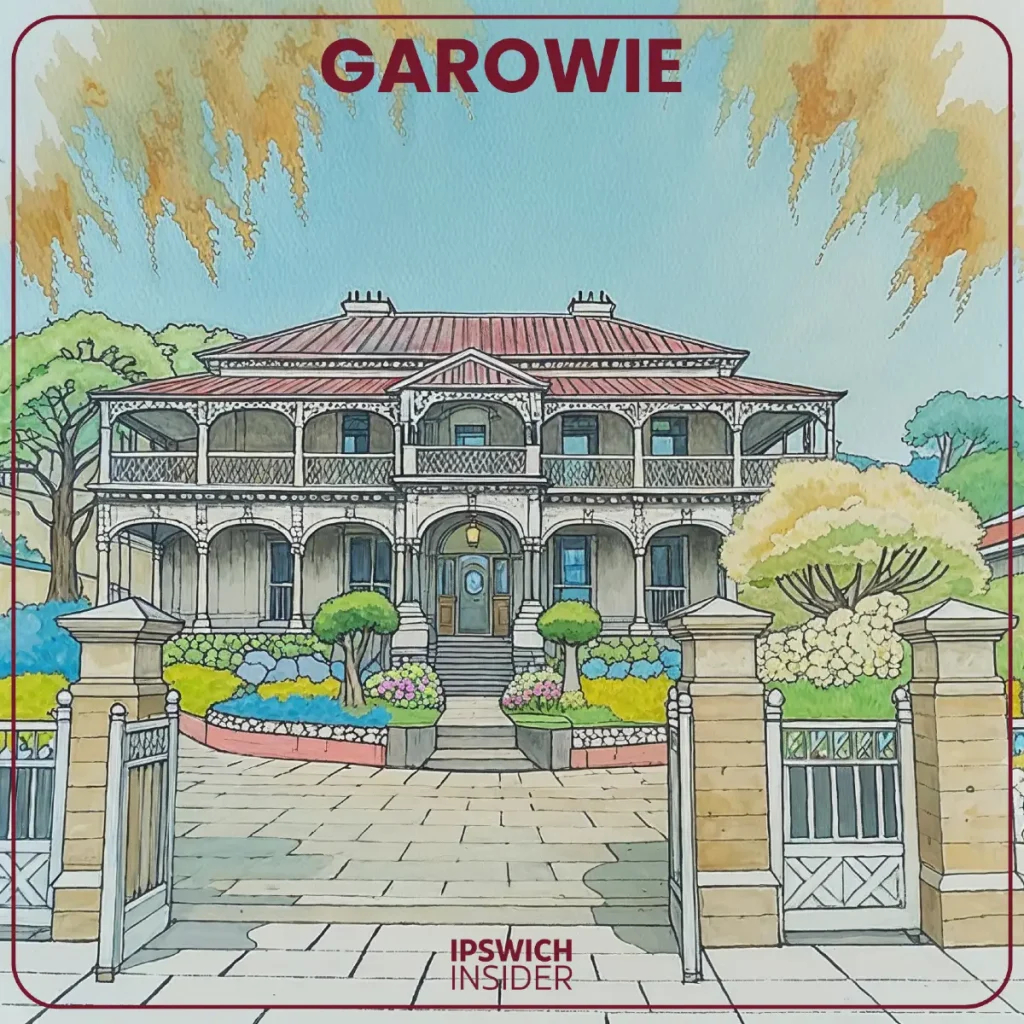
Garowie at a Glance:
- Classic. 1888 Victorian mansion.
- Top of the town location. Perched high in Eastern Heights, it’s second-story verandahs offer arguably the best views in all of Ipswich.
- Still shining. Lovingly restored and lived in today by June Frank and family (2004 – present).
- Heritage-listed. Officially protected — and featured in historic architecture tours.
🔢 Garowie — By the Numbers
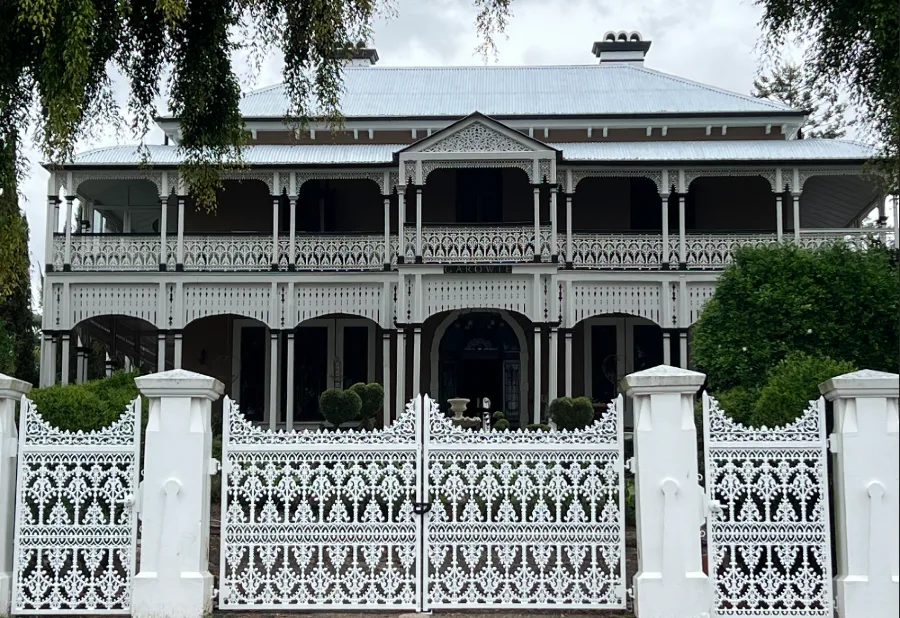
- Address: 59 Whitehill Road, Eastern Heights, Ipswich QLD
- Year built: 1888 (Victorian two-storey mansion)
- Living space: Over 1,000 m² of under roof floor area
- Land size: Approximately 1.25 acres (≈ 5,060 m²)
- Elevation: About 79 m above sea level
- Storeys: Two levels with wrap-around verandahs
If Garowie hit the market… Would it break the
$4 million mark?
Everyday I walk past Garowie — usually heading to Limestone Park — and wonder:
“If I won the lotto… how much would I have to offer June Frank to get my hands on this ultimate heritage treasure?”
So I started digging.
I ran the numbers.
Asked around.
Even hit up a few local real estate mates — just for fun.
The verdict?
$4+ million.
Yep, that’s the ballpark.
Sounds wild, right?
But when you break it down… it actually makes a lot of sense.
Let’s take a look:
📍 Location:
Prime Eastern Heights spot, perched on the highest point in Ipswich’s inner suburbs — 79 m elevation (even the Denmark Hill and Karragaroo Hill water tanks site just below). On Whitehill Road with 360° views — including the Brisbane skyline.
🏠 House:
Built in 1888. Two-storey Victorian mansion with imported Italian fireplaces, Helidon sandstone, and a ballroom. Painstakingly renovated and in pristine condition.
📐 Size:
Around 1.25 acres of grounds. Over 1,000 m2 of living space, including those sweeping verandahs.
🏛 Heritage:
Designed by Ipswich’s first mayor. Built for the Cribb family. Lovingly restored by June Frank and family — chandeliers, gardens, cedar and all.
And that’s just scratching the surface…
…Let’s dig deeper:
🧱 Construction and Early Days (c. 1888)
Imported Italian fireplaces, paired with locally quarried sandstone from Helidon, Queensland (out past Gatton) — because even back then, Garowie was built to impress.
- Owner: James Clarke Cribb — son of department store pioneer Benjamin Cribb — set out to build a home that rivalled anything in Queensland.
- Architect: Samuel Shenton, Ipswich’s first mayor and most respected architect, brought that vision to life.
- Builder: Robert Wilson & Co, the same team behind Gooloowan (Benjamin Cribb’s mansion), handled the construction.
- Inspiration: Garowie was a spiritual sequel to Gooloowan — but with more elevation, more refinement, and more show-stopping features.
- Name: “Garowie” is believed to mean “Fig Tree Camp” in the local Aboriginal language — a nod to the Moreton Bay figs that still guard the front.
- Materials: Think imported Italian marble fireplaces, locally sourced sandstone (Helidon), and extensive cedar joinery. Nothing cheap. Nothing standard.
📍 Part of Ipswich’s Prestigious Ridgeline
The view from Garowie was so good, you could read the SGIO clock in Brisbane.
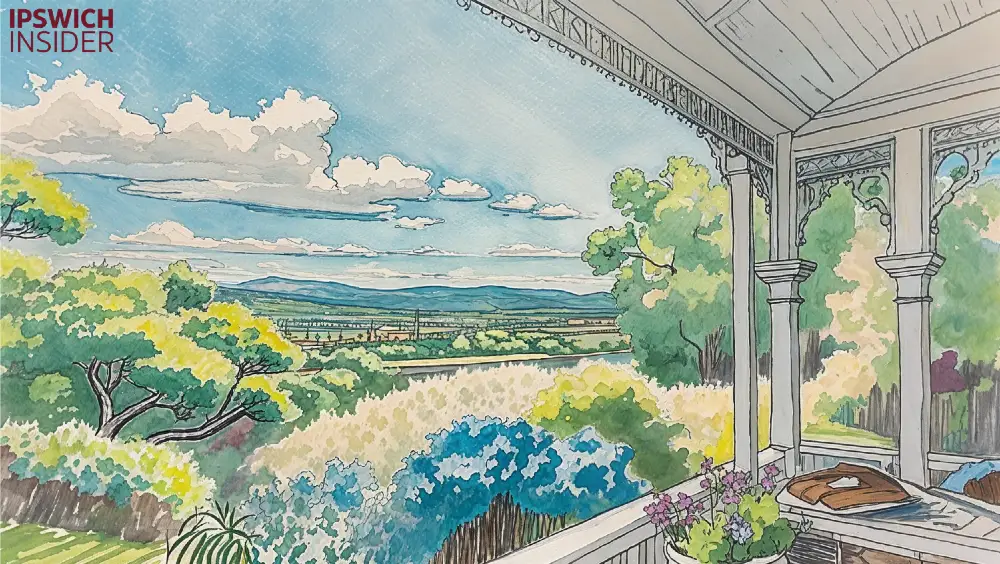
The once pristine Garowie verandah views.
- Elite Lineage: Garowie stands shoulder to shoulder with Fairy Knoll and Karragaroo House, forming a row of Ipswich’s most iconic heritage mansions — all built on the same elevated ridgeline through Eastern Heights.
- The So-Called “Golden Triangle”: While not a triangle in shape, these homes represented the triangle of wealth, influence, and architecture in Ipswich’s golden era.
- Elevation Advantage: This ridgeline is one of the highest residential stretches in Ipswich, offering uninterrupted views, cool breezes, and commanding street presence.
- Clear View: From Garowie’s verandahs, you can see Brisbane to the east, and on a clear day, all the way to the D’Aguilar Range to the north, the Great Dividing Range to the west, and the Scenic Rim to the south — a full sweep of Southeast Queensland’s natural skyline.
- Legacy Address: Whitehill Road has always been a mark of success — where Ipswich’s most prominent families built homes that still make jaws drop today.
🧬 The Cribb Family Influence
From Garowie’s verandah, James Cribb watched the 1893 floods swallow Ipswich below.
- Founding Father: The Cribb legacy began with Benjamin Cribb, who arrived in Ipswich in the 1840s and built Cribb & Foote into one of Queensland’s most successful department stores — a business empire that bankrolled multiple family mansions.
- Power: His son, James Clarke Cribb, continued that influence as a community leader and served 19 years in Queensland Parliament, representing Rosewood, Bundamba, and Bremer.
- Civic Legacy: James also sat on the boards of the Ipswich Hospital, Queensland Woollen Mills, and the Gas & Coke Company, and championed both education and Sunday schools.
- Flood Witness: In 1893, as floodwaters engulfed Moore’s Pocket, James stood on Garowie’s verandah and watched the flood unfold — a dramatic reminder of the home’s elevated power.
- Local Hero: After one election victory, locals unhitched his horses and pulled his carriage home by hand — the 19th-century version of crowd-surfing.
- Family Dynasty: The Cribbs also built Gooloowan (1864), with cedar, marble, and a hand-cranked lift. Garowie was its elevated successor — built to be seen, and remembered.
🏛 Architectural Highlights & Features
This wasn’t just a house — it was a hand-built statement of status.
- Structure: A two-storey Victorian villa — built with solid brick and later finished in smooth cement render post-1919.
- Verandahs: Wide wraparound verandahs on both levels. Lower: paired columns and scalloped timber battens. Upper: delicate cast iron lace balustrades still intact.
- Roofline: Classic hipped corrugated iron roof, stepped and slightly convex — a soft curve that frames the upper verandah elegantly.
- Entry: A gabled portico with fretwork detailing, inspired by nearby Lakemba, giving a grand welcome on arrival.
- Stairs: Two grand cedar staircases — one formal for guests, the other private for the family.
- Fireplaces: Imported Italian marble mantels, matched with handcrafted cedar surrounds — serious luxury for 1888.
- Ballroom: Features that now-iconic cigar mantel carving — a cheeky glimpse into Cribb’s character.
- Dining Room: Skylit, oversized, and anchored by a massive cedar dining table — designed to impress.
- Music Spaces: Originally fitted to hold two pianos and a harp — entertainment was built into the bones.
- Grounds: Once featured a tennis court, carriage house, horse yards, orchard, and formal rose garden.
- Gates & Fencing: The entire property was bordered by stone masonry fences and towering red cedar gates — announcing wealth from the street. Recently, the gates have been replaced with cast iron heritage-style balustrade gates, in keeping with the home’s character.
🎾 Harry Cribb’s Era (1926–1944)
He bred horses, judged dogs, played polo — and founded the Queensland Hunt Club.
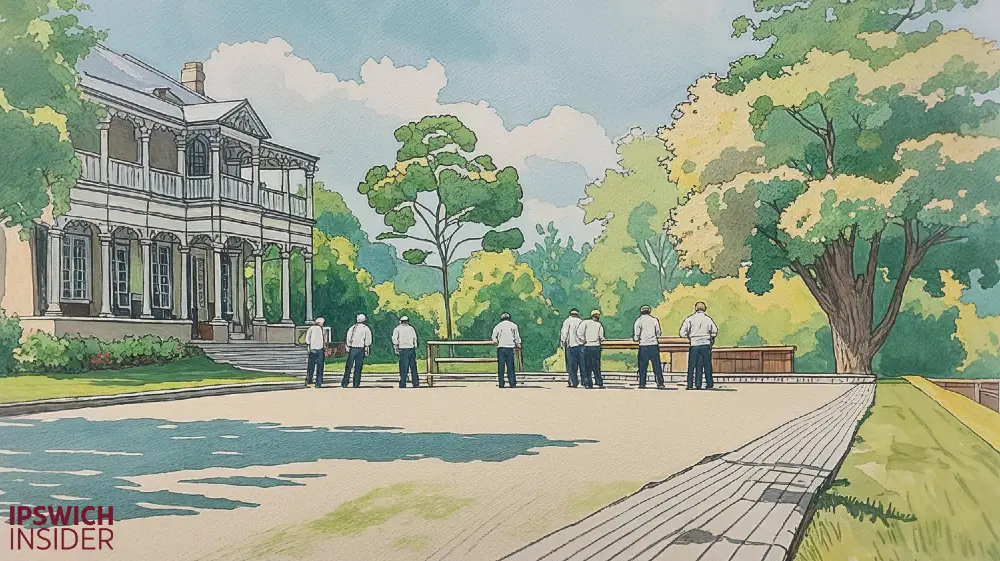
Harry turned the tennis court into a bowling green.
- Inheritance: When James Cribb passed in 1926, Garowie was passed down to his brother Harry Cribb — an aristocrat in lifestyle, if not in title.
- Sporting Life: A state tennis champion and avid polo rider, Harry brought an air of athletic prestige to the estate.
- Lifestyle Upgrade: Harry transformed the original tennis court into a private bowling green, reflecting his evolving tastes.
- Breeding & Judging: He bred trotters (harness horses) on the grounds and judged fox terriers at national competitions.
- Social Scene: Harry founded the Queensland Hunt Club, establishing Garowie as a hub for Ipswich’s equestrian and hunting set.
- Recreation Wing: He even built a separate billiard room — a gentleman’s retreat tucked into the estate.
- Legacy: By the time of his death in 1944, Garowie had become a private country club in miniature — reflecting wealth, freedom, and elite hobbies of the interwar years.
⛓ Challenges and Changes (1944–1970)
At one point, Garowie was carved into seven flats — with fire escapes bolted onto the outside and cedar walls painted shut.
- Post-Harry: After Harry Cribb passed in 1944, the estate was sold to Duncan Robson, who converted it into seven self-contained flats — a common wartime housing solution.
- Subdivision: In 1951, K.V. McDonnell took things further, carving up the once 3.5-acre estate into nine suburban blocks.
- Loss: Gone were the tennis court, carriage house, rose garden, orchard, and horse yards — sold off, bit by bit.
- Modifications: The grand ballroom was shrunk, fire escapes were added, and original cedar joinery was painted over to meet rental codes.
- Survival: Yet despite the wear and tear, some tenants kept the gardens blooming, and the house — though scarred — never lost its bones.
- Bottom Line: This was Garowie’s darkest chapter, but it makes her restoration story even more remarkable — and valuable.
🛠 Restoration and Recognition (1970–Today)
June Frank trims heart-shaped hedges at 3:30 AM — by hand.
- Rescue Mission: In 1970, Dr. John & Robyn Thomas bought Garowie and returned it to a single-family home — beginning the long road back from disrepair.
- Authentic Details: They tracked down original-style fretwork from Lakemba, one of Garowie’s Ipswich mates, to restore the front facade.
- Official Recognition: In 1992, Garowie was added to the Queensland Heritage Register (Place ID 600599) — cementing its cultural and architectural significance.
- A New Era: In 2003, June Frank, local real estate agent and heritage warrior, stepped in as Garowie’s next caretaker.
- The Condition: What she bought was bare bones — no carpets, no curtains, no chandeliers, and signs of serious neglect.
- Purchase Price: Official figures say the sale price was $1.4 million (June 2003), but some argue the price was likely lower $700K–$800K — a bargain by today’s standards, but a massive fixer-upper.
- Restoration Works: June rebuilt entire verandahs, replaced white ant-damaged walls, restored every inch of cedar woodwork, and brought the mansion back to life.
- Lighting: She sourced and installed chandeliers from the 1800s to match the home’s original grandeur.
- Gardens: Over the years, June has planted 700+ pink flowers and shaped heart-shaped hedges, which she personally trims — usually before sunrise.
- Community: Garowie is no longer just a house. Thanks to June, it’s a place where charity events, garden tours, and heritage conversations happen.
- Bottom Line: You can’t put a price on love — but if you could, June added millions in value through sweat, soul, and scissors.
🌟 Why Garowie Still Matters Today
It’s survived floods, fire escapes, termites — and still looks good on a postcard.
- Timeless Design: Garowie remains one of Queensland’s finest examples of late-Victorian architecture, complete with iron lace, Italian marble, Helidon stone, and rich cedar details.
- Foundational Family: Built by the Cribbs, who didn’t just shape Ipswich — they built it: in politics, business, education, and civic life.
- Built to Endure: The house has lived through natural disasters, war-era flat conversions, subdivision, and neglect — and still stands proud.
- Elevated Beauty: Its hilltop views stretch to Brisbane, a reminder that its position — physically and historically — is unmatched.
- Living Landmark: Today, it’s more than a heritage listing. Thanks to June Frank’s care, Garowie is alive, loved, and still hosting life — from garden tours to charity nights.
- True Value: In a city where history is often knocked down and rebuilt, Garowie is the rare survivor that’s been restored, not replaced — and that alone makes it priceless.
💰 So… Is Garowie Worth $4 Million?
Stroll past 59 Whitehill Rd and you’re not just looking at a house — you’re looking at:
- A Victorian mansion built in 1888 with Italian marble, Helidon stone, and cedar throughout.
- Designed by Ipswich’s first mayor, built for the Cribb family dynasty.
- Perched on a high ridge with views to Brisbane and beyond.
- Sitting on 1.25 acres, framed by Moreton Bay figs and manicured gardens.
- Restored by hand — chandeliers, verandahs, cedar, and all.
- Heritage-listed, community-loved, and still lived in today.
$4 million?
For all this?
Start to finish — it makes sense.