
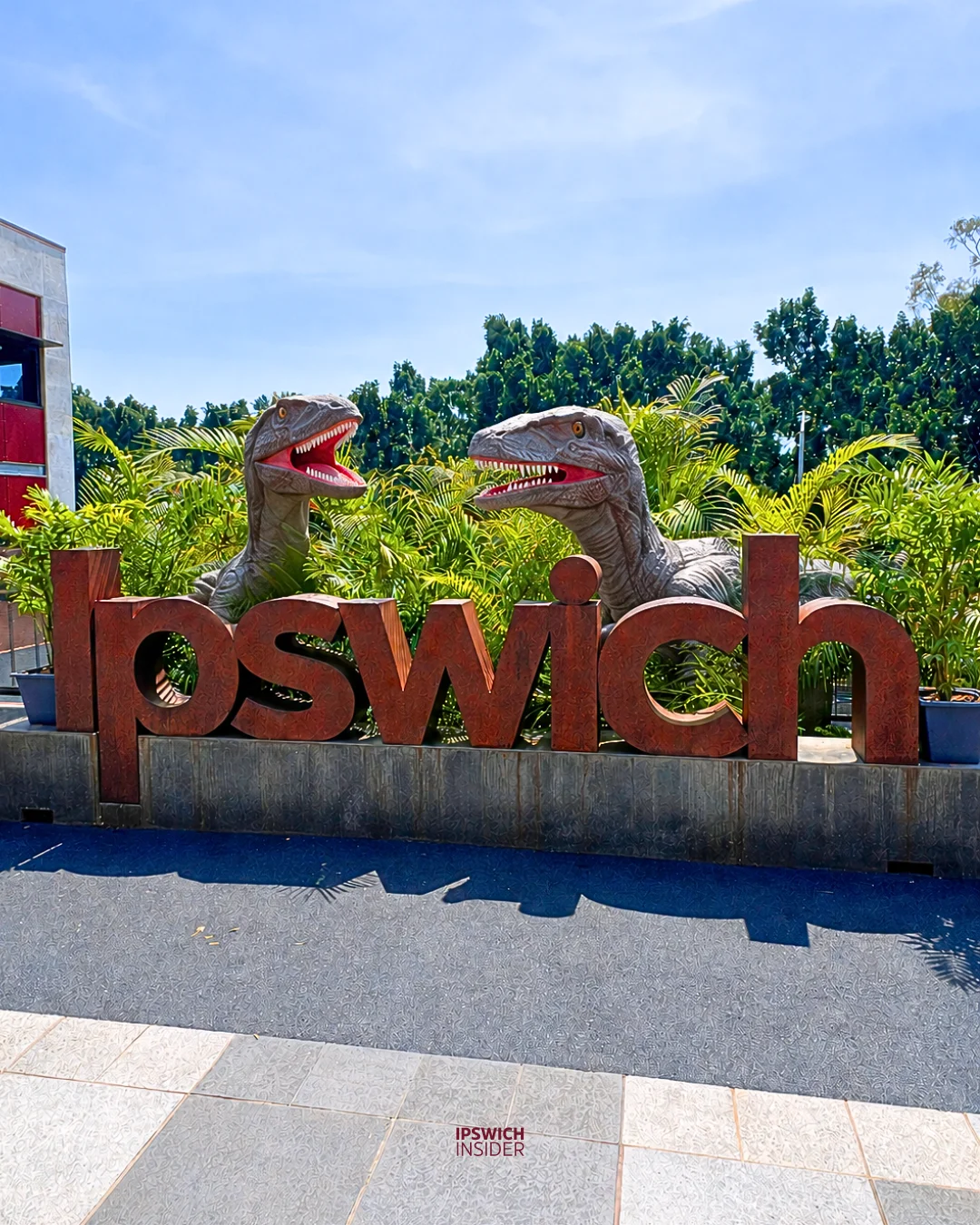
Ipswich Dinosaur Fossils at a Glance
- Australia’s Oldest Dinosaur Fossils Until 2026 – Ipswich coal miners found 3 dinosaur footprints 213m underground at Rhondda Colliery in New Chum in 1964. They were considered the oldest ones in Australia. In Feb 2026, scientists confirmed a footprint found at Albion in Brisbane in 1958 was 10 million years older.
- More Than Just New Chum – Ipswich’s dinosaur tracks were found at 10 coal mines near Rosewood and at Rylance No. 5 in Ebbw Vale.
- Tracks From Two Dinosaur Periods – New Chum and Ebbw Vale date to the Late Triassic about 220 million years ago. Jeebropilly and the other Rosewood tracks come from the Jurassic, about 170–151 million years ago.

The main scientifically reviewed dinosaur footprint groups connected to Ipswich. The separate Jeebropilly footprint is covered below. (Source: Ipswich Insider)
🔢 By The Numbers
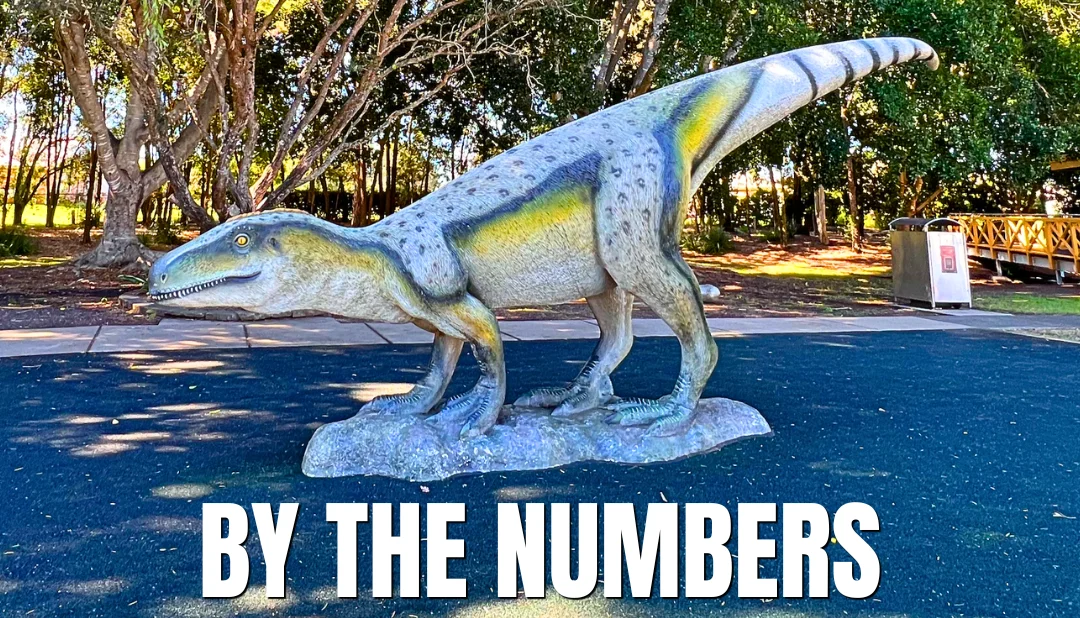
Dinosaur display at Johnston Park, Rosewood
- 12 – Ipswich mine sites with recorded dinosaur footprints
- 220 million years – Age of the New Chum and Ebbw Vale footprints
- 170 million years – Age given for the Jeebropilly plant-eater footprint
- 165–151 million years – Age of Rosewood’s large meat-eater footprints
- 62 years – Time Ipswich held Australia’s oldest-known dinosaur fossil record
- 3 – Footprints found in the roof of Rhondda Colliery at New Chum
- 6 – Tiny footprints recorded on the missing Ebbw Vale slab
- About 7cm – Length of each Ebbw Vale footprint
- Nearly 80cm – Length of the largest reviewed Rosewood meat-eater dinosaur footprint
Ever wondered why there’s a dinosaur park in Rosewood?
Or why dinosaurs keep taking over Nicholas Street Precinct during the school holidays?
It’s not just random dinosaur fun.
Ipswich is famous for dinosaur footprint fossils found in its old coal mines.
For 62 years (since 1964), footprints found 213m underground at New Chum were considered Australia’s oldest-known dinosaur fossils.
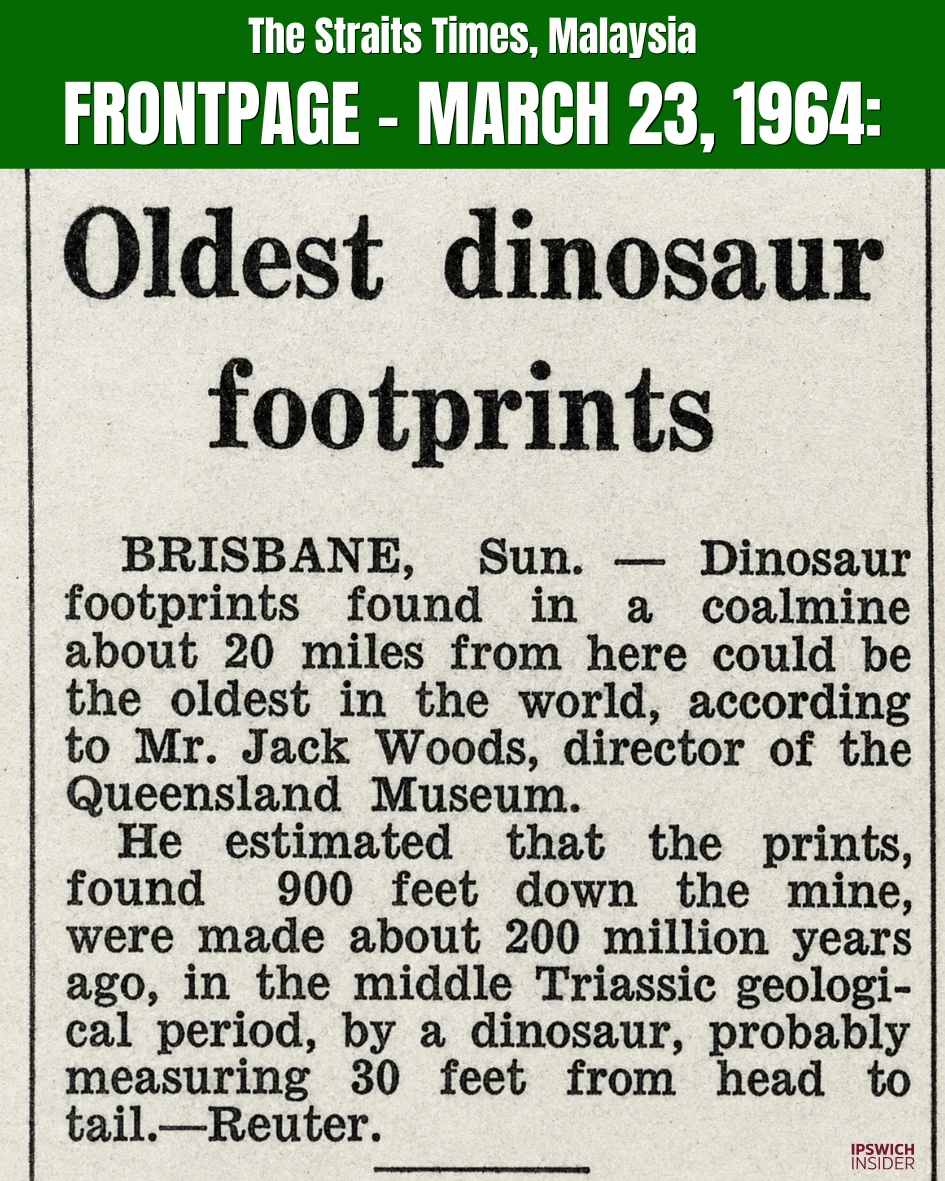
Ipswich’s 1964 dinosaur discovery made worldwide news.
And New Chum was only 1 of 12 Ipswich mine sites where dinosaur footprints were found.
So, now you know why dinosaurs keep turning up around Ipswich.
Let’s look at what was found, where it was found and which dinosaurs left the footprints.
Jump to:
New Chum’s Record-Setting Footprints
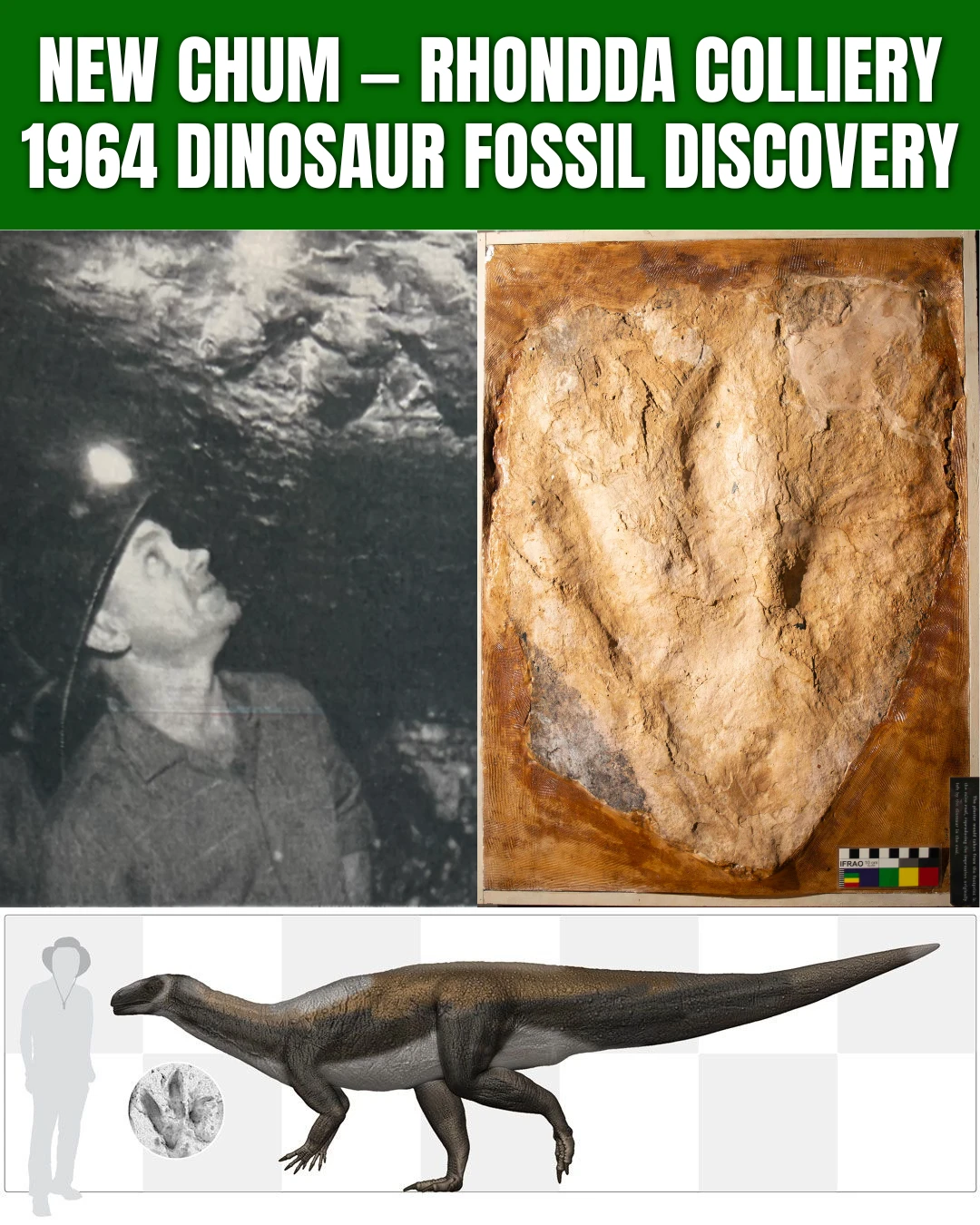
Discovered at Rhondda Colliery in 1964, this 32–34cm footprint was likely made by an early plant-eating sauropodomorph. The mine tracks are inaccessible, but Queensland Museum holds the plaster cast (Source: Queensland Museum)
In 1964, miners working 213m below New Chum found 3 large footprints crossing the roof of Rhondda Colliery.
For the next 62 years (until Feb 2026), they were considered the oldest-known dinosaur fossils in Australia.
Funny thing too:
The surprise did not end there…
Modern scanning later showed that scientists had also been picturing the wrong dinosaur.
- 3 tracks in the roof – The prints hung down from the stone above the coal seam, as if the dinosaur had just walked over the miners’ heads.
- 213m underground – That is roughly the height of a 60-storey building.
- About 220 million years old – The dinosaur crossed a wet Ipswich landscape during the Late Triassic.
- First measured too large – Old drawings made the best print look 40–46cm long. A 2021 3D study found the true footprint was closer to 32–34cm.
- Not a giant hunter – Marks beside the toes had been mistaken for part of the foot. Once removed, the shape no longer matched a giant meat-eater.
- An early plant-eater – The likely trackmaker was an early relative of the long-necked dinosaurs that appeared later. It was the first fossil sign of this broad dinosaur group recognised in Australia.
- One cast survives – Researchers could recheck the find because old photographs and a plaster cast made in 1964 were kept at Queensland Museum.
The updated study changed the dinosaur, but not the age or importance of the find.
New Chum still held the national record until scientists finally studied an older footprint that had been sitting in teaching collections for decades.
The Albion Footprint That Took the Record
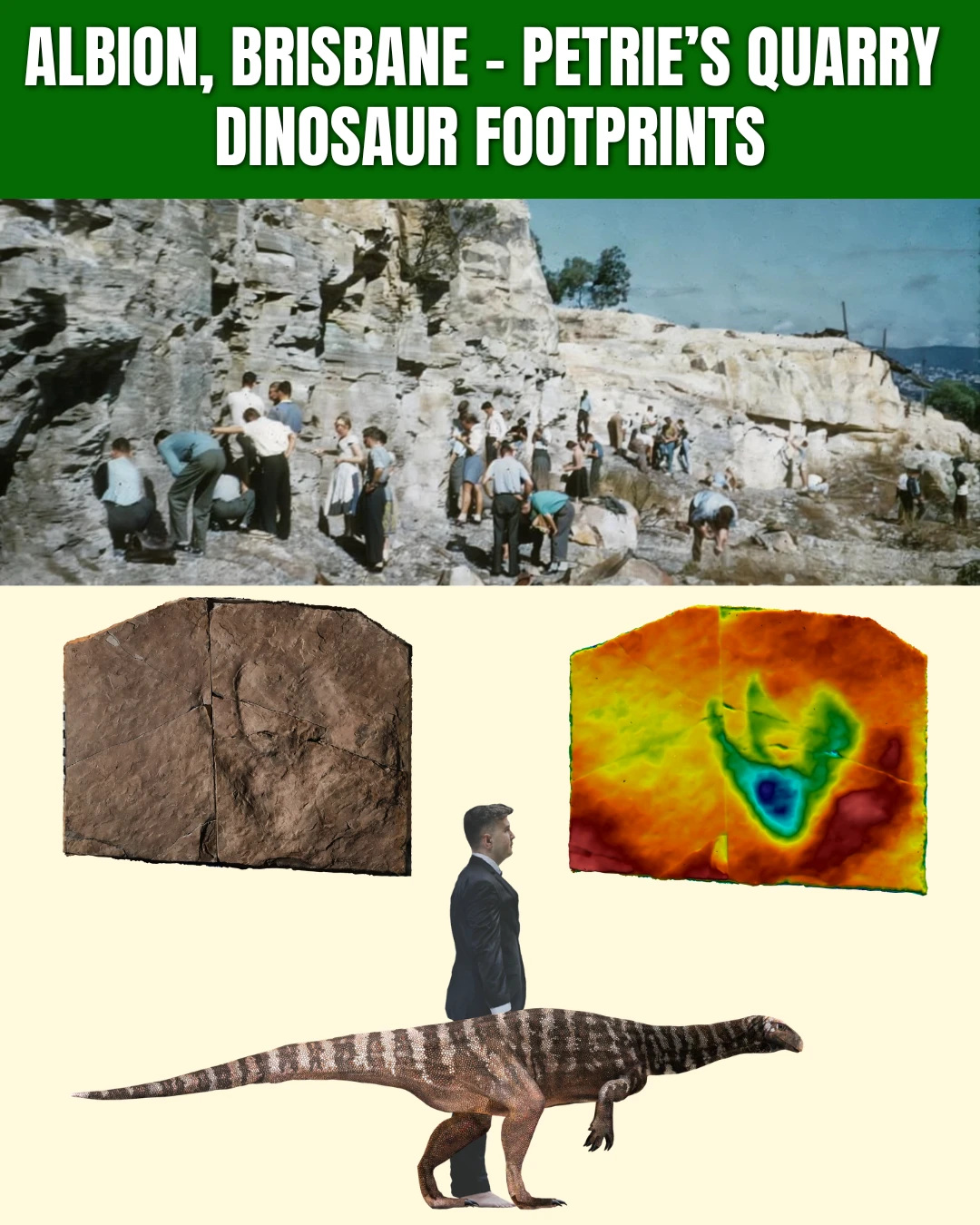
Discovered at Petrie’s Quarry, Albion, in 1958, this 18.5cm footprint was likely made by a plant-eating sauropodomorph. The original slab survives at Queensland Museum but is not always publicly displayed (Source: Queensland Museum)
Ipswich did not lose its record to a fossil dug up in 2026.
The older footprint had been found at Petrie’s Quarry in Albion, Brisbane, back in 1958. 6 years before the original New Chum tracks.
What changed in February 2026 was the science.
The old Albion slab was finally studied and confirmed as Australia’s oldest-known dinosaur fossil.
- Found by a schoolboy – Bruce Runnegar collected the footprint during a 1958 quarry visit with Brisbane Grammar schoolmates.
- About 230 million years old – It is roughly 10 million years older than the New Chum and Ebbw Vale tracks.
- Only 18.5cm long – The likely trackmaker stood about 75–80cm high at the hips and weighed around 140kg.
- Another early plant-eater – Like the New Chum animal, it was probably an early 2-legged relative of the much later long-necked dinosaurs.
- A possible tail mark – A second piece of stone may preserve a narrow mark made by the dinosaur’s tail.
- A capital-city first – It is the first dinosaur fossil confirmed from an Australian capital city.
- Hidden in plain sight – The slabs travelled through teaching collections at UQ, the University of New England and UCLA before returning to Queensland in 2025.
- Confirmed in February 2026 – The study did not announce a new find. It finally explained the true age and importance of a fossil collected 68 years earlier.
Albion now holds the record, but it does not replace the Ipswich story.
Ipswich still has a much larger spread of finds across 12 mines, from the Late Triassic to the Jurassic, and several very different dinosaurs.
Where Ipswich’s Dinosaur Footprints Were Found
Ipswich’s dinosaur footprints came from 3 main coal mining areas:
- Rosewood-Walloon Coalfield
- Rylance No. 5 at Ebbw Vale
- Rhondda Colliery at New Chum.
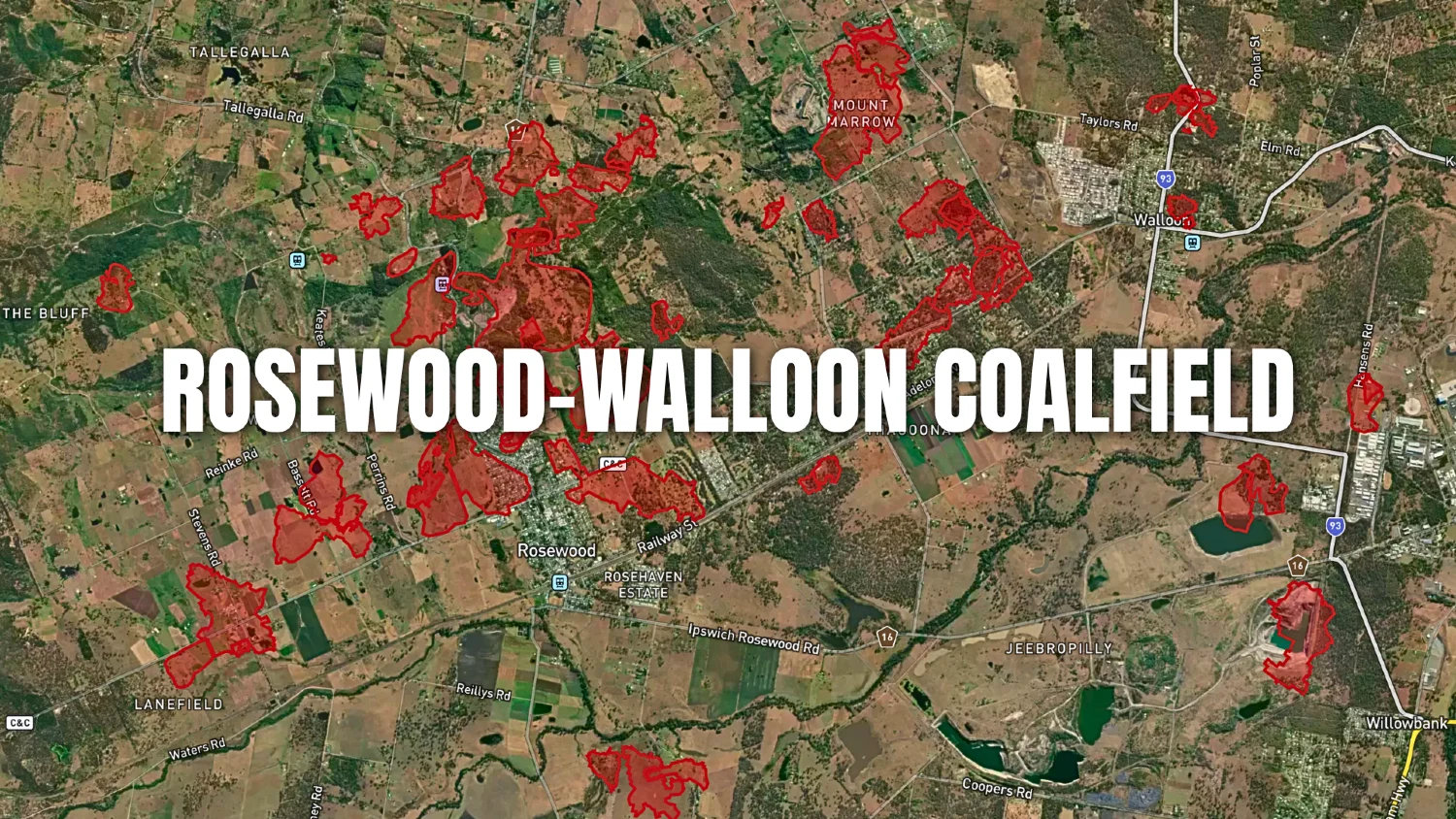
Where the large theropod meat-eater footprints were found dating 165-151 million years ago.
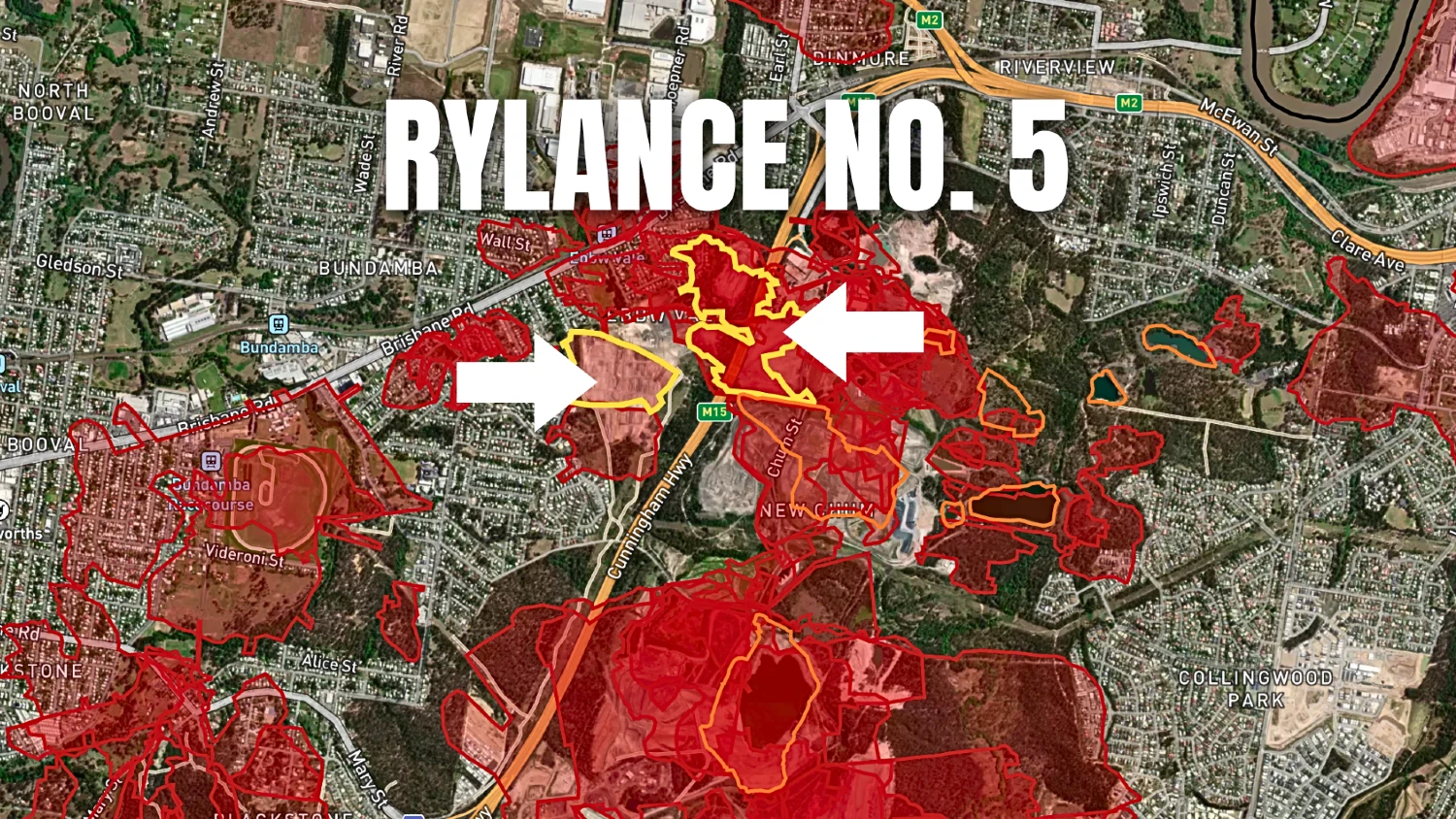
Where the small theropod meat-eater footprints were found dating 220 million years ago.
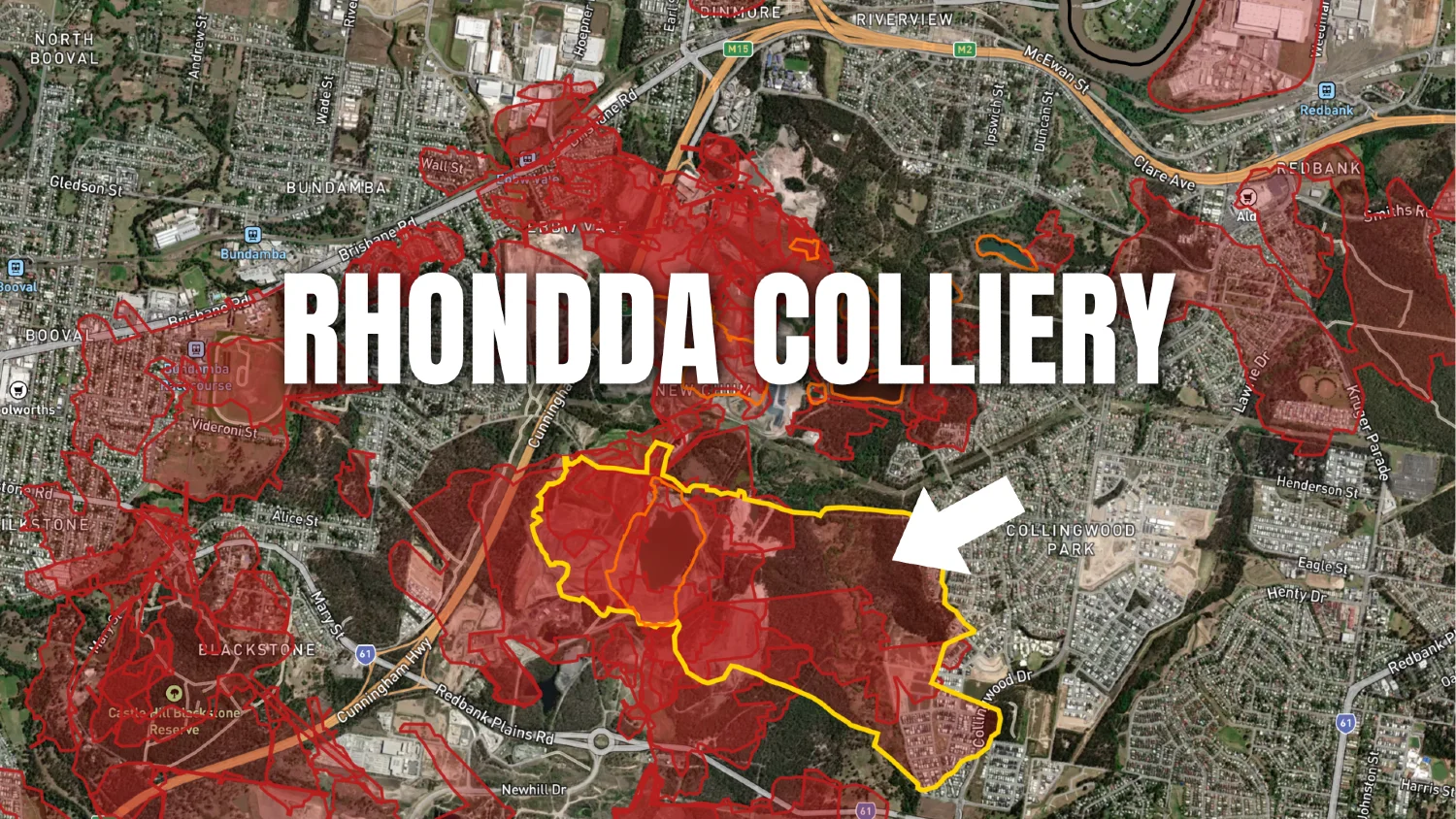
Where the early sauropodomorph plant-eater footprints were found dating 220 million years ago.
Dinosaur fossils have been found here:
- 12 Ipswich mine sites – 10 mines around Rosewood (including Jeebropilly), plus Rylance No. 5 at Ebbw Vale and Rhondda Colliery at New Chum.
- 10 Rosewood mines – Caledonian No. 5, Lanefield No. 2, Lanefield Extended No. 2, New Hope Open Cut at Jeebropilly, Oakleigh No. 3, Roughrigg No. 5, United No. 8 and Westvale Nos. 3, 5 and 6.
- One site not counted – The 2020 scientific review also covered a mine at Oakey, near Toowoomba. It is part of the same wider study, but it is not one of the 12 Ipswich sites.
- Some local lists differ – Old Rosewood records also name places such as Lowfield No. 2 and Glencoe.

The Ipswich Coal Measures and the rock layer where Grallator- and Eubrontes-type dinosaur tracks were historically recorded
View Ipswich Underground Mines
Ipswich Insider’s Mine Mapper shows the known extent of old mines. It does not show the exact spot underground where each footprint was found.
Why the Footprints Were Above the Miners
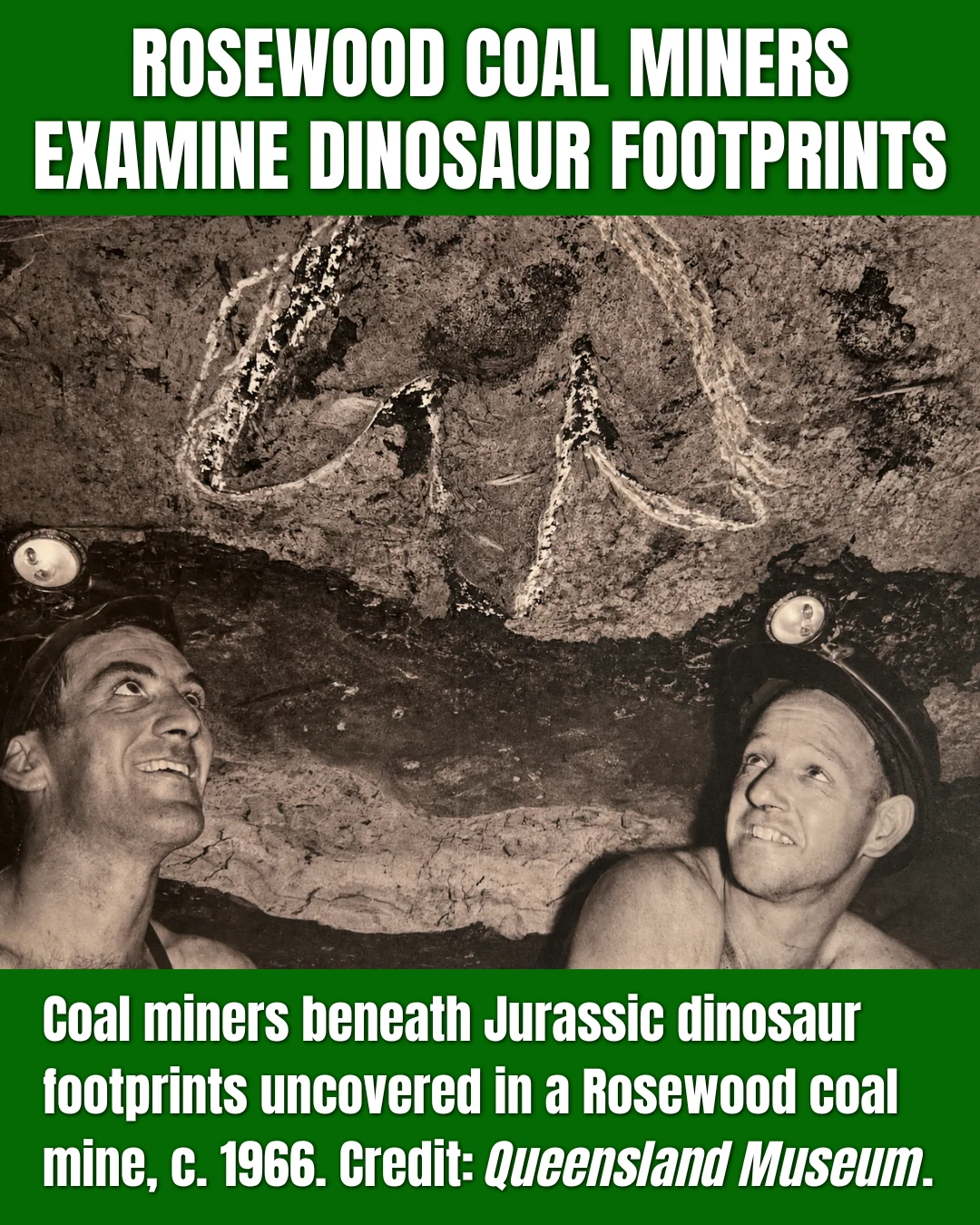
The miners were seeing stone casts of footprints.
The process:
Ground was muddy. Dinosaur stepped in mud. Mud dried and was filled with loose plant matter. Footprint cast in mud hardened and was preserved for millions of years in the Ipswich basin.
- Foot pressed into mud – A dinosaur walked across wet ground and left a hollow in the surface.
- Mud filled the hollow – New layers washed over the print and copied its shape.
- The layers became rock – The filled footprint hardened, while plant matter below it became coal.
- Miners removed the coal – Once the softer coal layer came out, the hard stone copy was left pointing down from the roof.
Rylance No. 5 was the exception.
Its tiny footprints were recorded on a loose slab in October 1983 among mine waste rather than in a ceiling.
The coal mines gave people a view into rock that would otherwise have stayed hidden. That is why nearly every part of Ipswich’s dinosaur story begins with a miner looking up.
The Tiny Tracks at Ebbw Vale
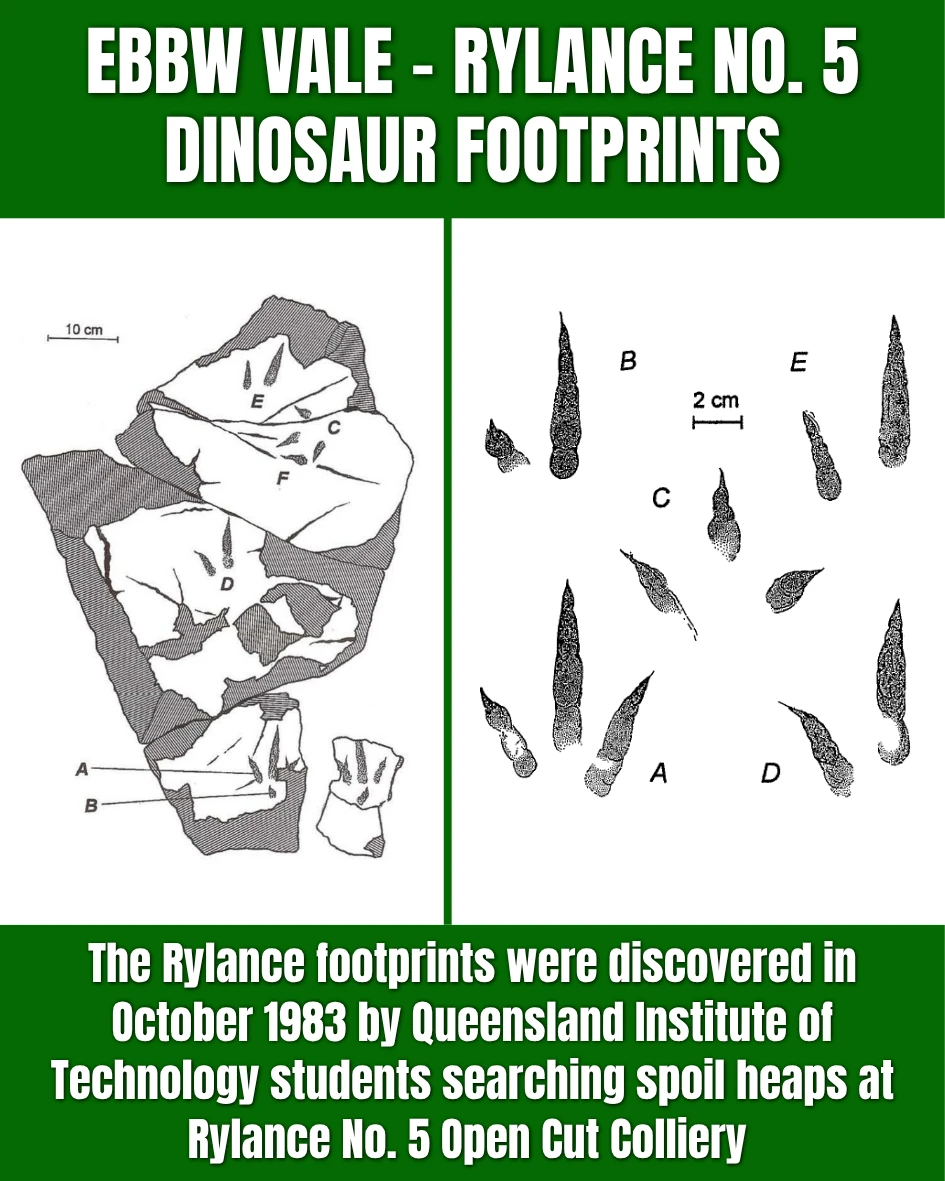
A 7cm three-toed footprint from Rylance No. 5 Colliery at Ebbw Vale, made by a small meat-eating dinosaur about 220 million years ago (Source: Academia.edu)
The Rylance No. 5 find at Ebbw Vale is easy to overlook because everything about it is small. The recorded track area was roughly the size of a 40cm square. But they are about 55 million years older.
- 6 tiny footprints (Marked A → F) – The slab held 6 small 3-toed prints close together.
- Only about 7cm long – Each print was shorter than most adult palms.
- 4 small meat-eaters – Researchers read the pattern as tracks left by 4 small dinosaurs, each standing about 30cm high at the hips.
- About 220 million years old – They came from the Late Triassic and are about the same age as the New Chum tracks.
- Discovery date not recorded – The find entered scientific writing around 2000, but no reliable record has been found for the year miners first picked up the slab.
- The slab is missing – It does not appear to have entered a museum collection, and its location today is unknown. The story now depends on the records made before it disappeared.
Ebbw Vale shows that more than one kind of dinosaur was walking around Ipswich 220 million years ago.
Rosewood’s Giant Meat-Eaters
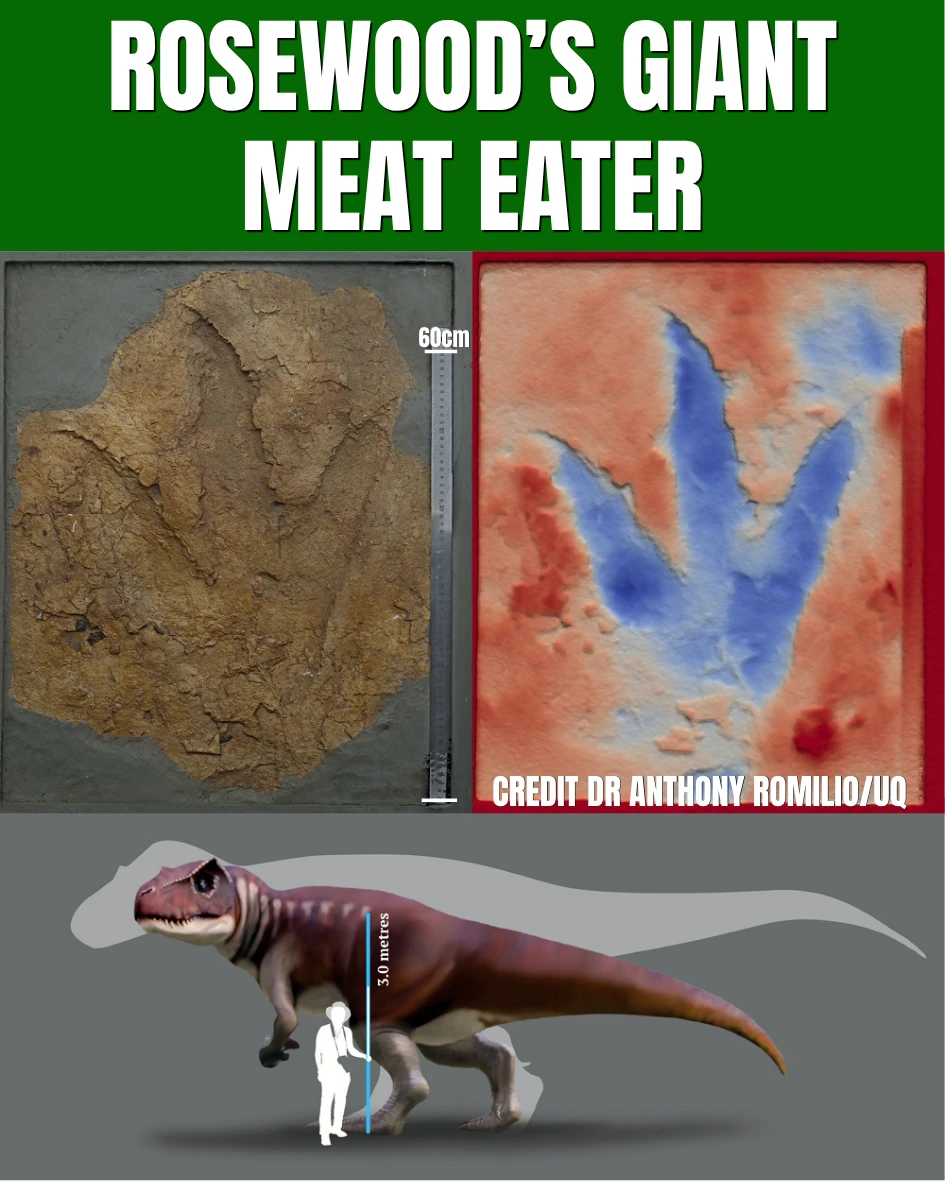
A large meat-eating dinosaur footprint found in the roof of a Rosewood coal mine, dating back 165–151 million years (Credit: Anthony Romilio/UQ)
Rosewood has the biggest group of dinosaur finds in Ipswich.
Tracks were reported across 10 mines.
They also came from the largest dinosaurs in the Ipswich story: meat-eaters that were almost as tall at the hips as a T. rex, although they lived about 90 million years earlier.
- First reports in 1933 – Reports from Lanefield appeared in 1933 and 1934, decades before the famous New Chum discovery.
- 165–151 million years old – The tracks came from the Jurassic period and are at least 55 million years younger than the New Chum and Ebbw Vale prints.
- Mostly 50–60cm long – Many of the reviewed footprints were roughly half a metre long.
- Some nearly 80cm long – The largest tracks are among the biggest meat-eating dinosaur footprints known in Australia.
- Up to 10m long – Scientists estimate the biggest trackmakers stood about 3m high at the hips and may have reached about 10m from nose to tail.
- Not a T. rex – The size comparison is useful, but these were much earlier meat-eaters, probably from the broad group that includes Allosaurus. Footprints cannot give us an exact species.
- 5 tracks made news – An old Young Telegraph story described 5 Westvale tracks, each about 64cm long, with almost 1.8m between steps. Those figures come from the newspaper because the full trackway can no longer be checked.
- Rechecked in 2020 – The tracks had been known for decades, but a modern review pulled together old photographs, casts and museum pieces to show how important the Rosewood finds were.
- Most evidence is gone – The mines were working industrial sites, not protected fossil digs. The workings closed and much of the rock was cut away, leaving photographs, casts and a small number of saved pieces.
Rosewood’s dinosaur story was not only about giant meat-eaters. In 1996, workers at Jeebropilly found a separate footprint identified as a large plant-eater.
The Jeebropilly Footprint You Can Still See
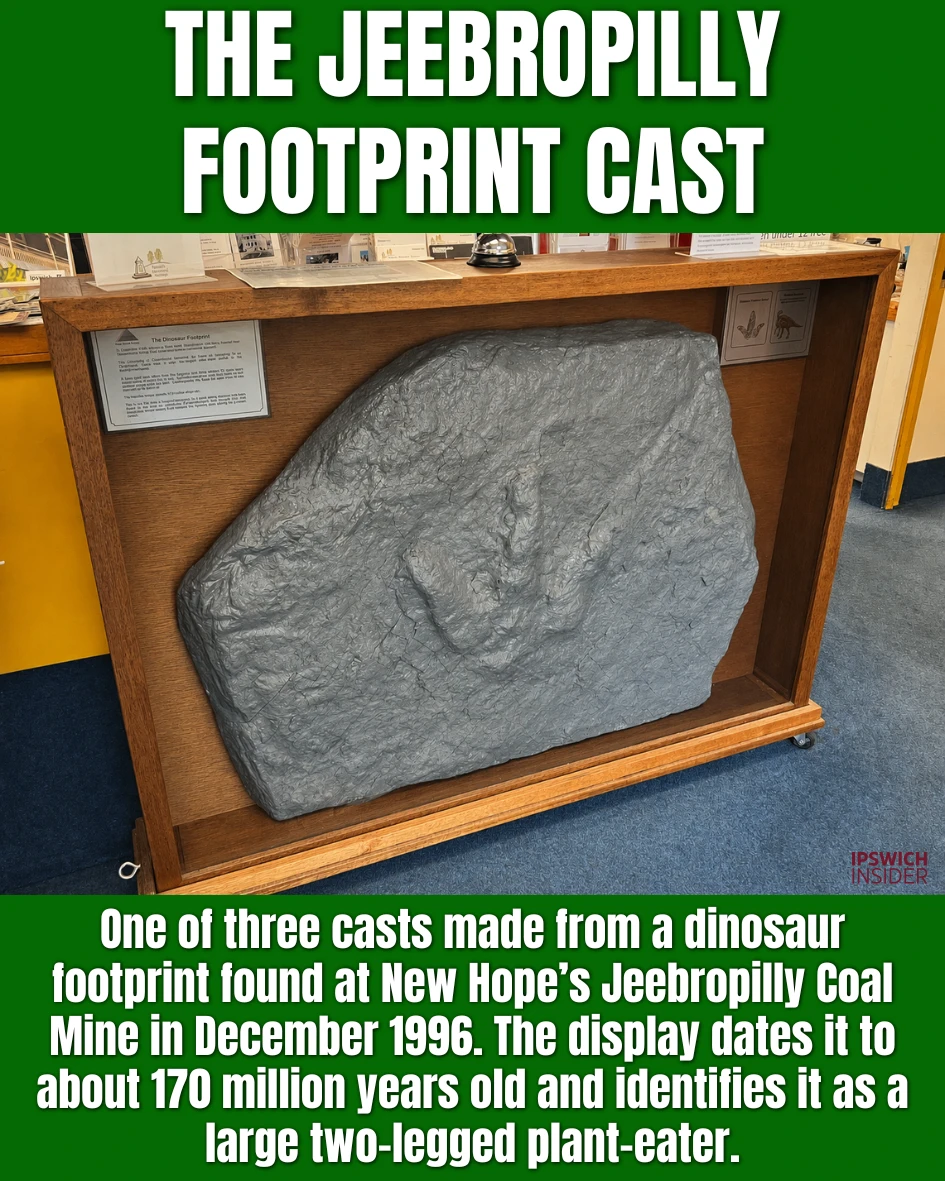
The large footprint cast at Cooneana Heritage Centre is not the famous 220-million-year-old Rhondda footprint from New Chum.
It comes from a separate dinosaur footprint found at New Hope’s Jeebropilly Coal Mine near Rosewood in December 1996.
- Found in December 1996 – Workers found the footprint at New Hope’s Jeebropilly Coal Mine.
- About 170 million years old – That is the age given on the Cooneana display, placing the footprint in the Jurassic Period.
- A large plant-eater – The display says UQ identified it at the time as the track of a large two-legged plant-eater from the ornithopod group.
- Not Muttaburrasaurus – The display uses Muttaburrasaurus as a comparison. That dinosaur lived much later and could not have made this footprint.
- One of three casts – A latex copy was taken from the footprint and used to make three full-size casts. Cooneana displays one of them.
- The original was lost – The fossil fell apart after being brought into the open air, leaving the casts as the best record of the find.
The Jeebropilly discovery adds a large plant-eater to a Rosewood dinosaur story otherwise dominated by giant meat-eaters. Its cast is also the clearest part of Ipswich’s dinosaur fossil history that you can still visit today.
What You Can See Around Ipswich Today
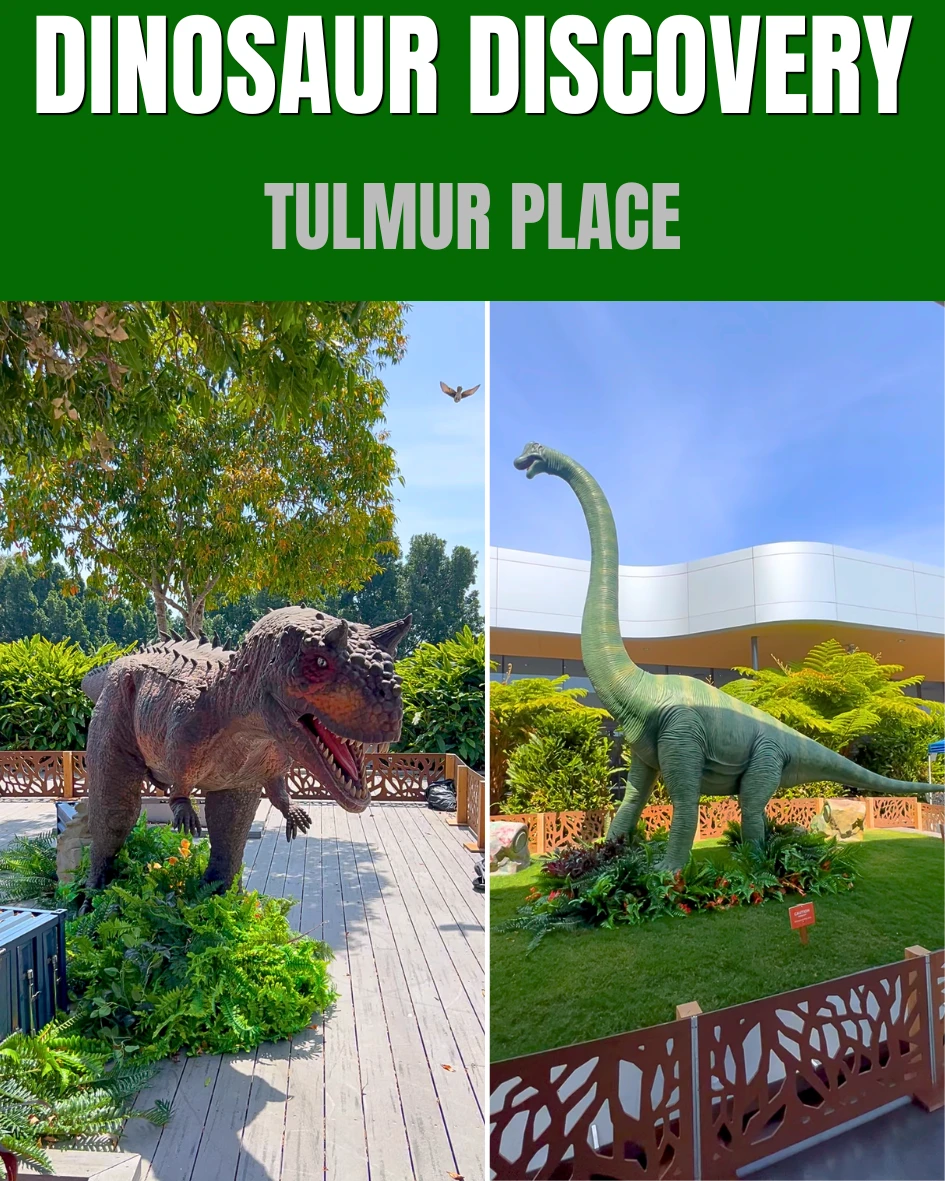
September school holiday event in Ipswich
You cannot visit the original mine roofs.
The workings are closed, gone or on private land.
You can still see part of the story around Ipswich:
- Cooneana Heritage Centre – This is the best local stop. The centre displays a large cast linked by its label to a December 1996 New Hope mine find near Rosewood. Cooneana is at 1041 Redbank Plains Road, New Chum. Current listed hours are Thursday to Saturday, 10am–2pm, with $5 adult entry. Check before making a special trip.
- Queensland Museum – The museum holds the New Chum cast used in the 2021 study and the original Albion slabs. A museum holding an object does not mean it is always on public display, so check first.
- Johnston Park, Rosewood – The park has large dinosaur models, eggs and replica footprints inspired by the local finds. It is a fun local marker and a kids’ playground, not the place where the real tracks were found.
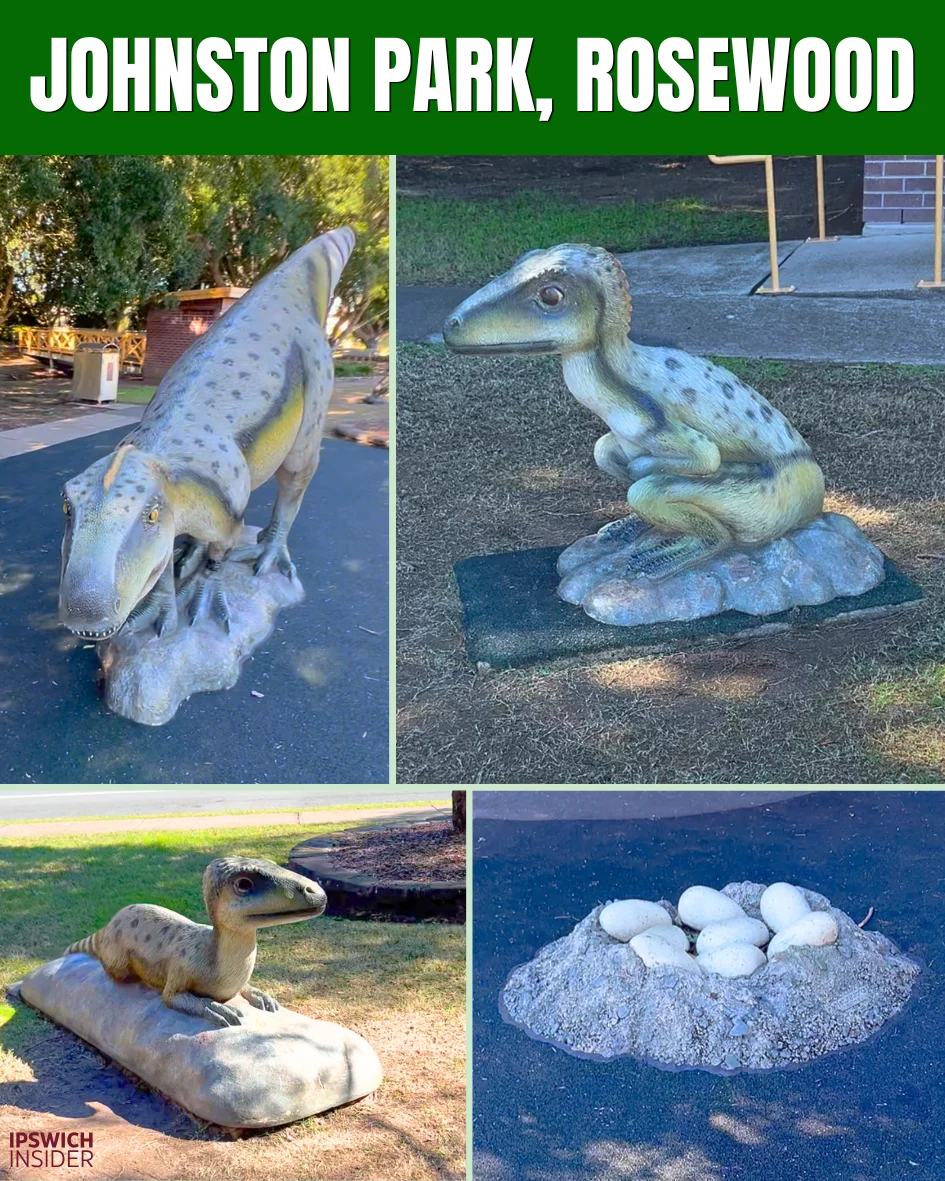
Free and open daily
- Nicholas Street Precinct – Dinosaur Discovery has brought large moving dinosaur displays and family activities into the CBD during past school holidays. It is an occasional event rather than a permanent fossil display, so check the current calendar.
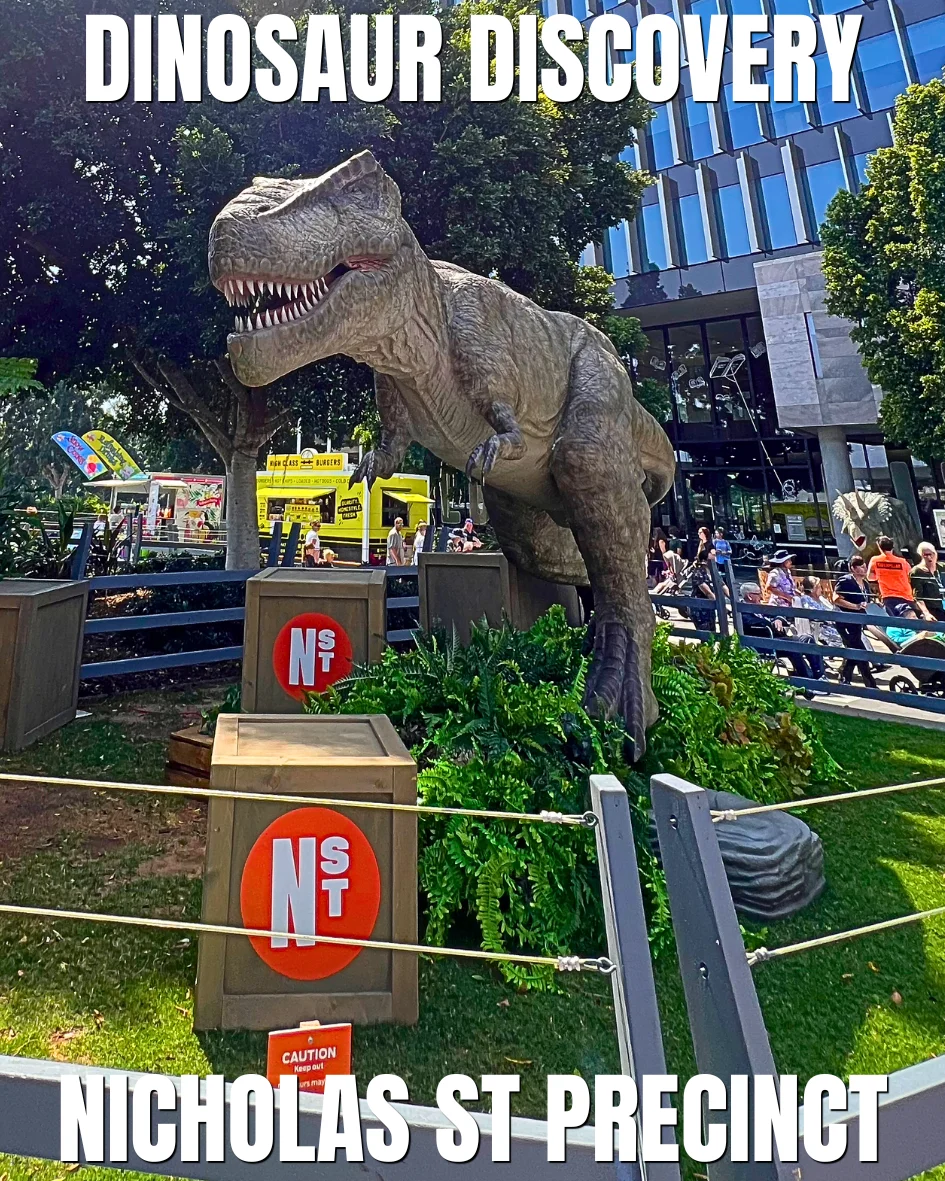
Annual Ipswich event held during September school holidays at Tulmur Place
- Ipswich Insider Mine Mapper – Use the Mine Mapper to understand the scale of the old Rosewood and New Chum coalfields around Ipswich. The mapped mine areas are historical information, not public access routes to fossil sites.
If you want to see one physical piece of Ipswich’s dinosaur story, start at Cooneana. Johnston Park and the city events are useful local nods to the story, but the real discoveries came from mine roofs that can no longer be visited.
Enjoy!
Sources
- Scientific review of the Rosewood and Walloon Coal Measures tracks, Historical Biology, 2020.
- Modern study of the New Chum and Ebbw Vale tracks, Historical Biology, 2021.
- The study confirming the Albion footprint as Australia’s oldest, Alcheringa, 2026.
- A New Start to the Age of Dinosaurs in Australia, University of Queensland Dinosaur Lab.
- Brisbane Dinosaur Fossil Is Australia’s Oldest, University of Queensland, 2 February 2026.
- Dinosaurs as Big as T. Rex Stomped Around Ipswich, Ipswich First, 7 July 2020.
- Lanefield footprint photographs from July 1934, Queensland Government Mining Journal.
- Lanefield footprint photographs from September 1934, Queensland Government Mining Journal.
- Cooneana Heritage Centre visitor information, IpswichHistoricalSociety.com.